15% off all plans & roadmaps Use code
See plans
Editorial
Core insight
Asteroid Collision · Stack Patterns
Core Insight for Asteroid Collision
The key intuition is that we can process the asteroids from left to right and maintain a "stable" state of survivors in a stack.
The stack represents the asteroids that have survived all collisions so far and are currently moving safely.
- Safety Condition: A collision only happens when a Left-Moving (-) asteroid encounters a Right-Moving (+) asteroid that is already in the stack.
- No Collision:
- If the stack is empty.
- If the current asteroid is moving Right (+).
- If the stack top is moving Left (-). (Two left-moving asteroids never collide; they just follow each other).
When we encounter a Left-Moving asteroid, we check it against the top of the stack (the rightmost survivor). We repeatedly "pop" from the stack as long as the incoming left-asteroid destroys the stack top. If the stack top destroys the incoming asteroid, we stop.
Visual Description: Imagine the stack as the "safe zone" to the left of our current position.
- We push
5(Right). Stack:[5]. - We push
10(Right). Stack:[5, 10]. - We encounter
-5(Left). It clashes with10. Since10 > |-5|, the-5explodes. The stack remains[5, 10]. - If we encountered
-15instead: It clashes with10.10explodes (pop). Then it clashes with5.5explodes (pop). The stack becomes empty, and-15survives (push).
Deep dive
Full breakdown
Full reasoning, pitfalls, and implementation flow
LeetCode 735: Asteroid Collision Solution & Explanation
Problem Overview
TL;DR: Use a stack to maintain the state of asteroids moving right, resolving collisions immediately when a left-moving asteroid is encountered by popping smaller right-moving asteroids.
The Asteroid Collision problem asks us to simulate the aftermath of a series of asteroid collisions in a single row. We are given an array where the absolute value represents size and the sign represents direction (positive for right, negative for left). When two asteroids collide, the smaller one explodes. If they are the same size, both explode. We need to return the state of the asteroids after all collisions are resolved.
This is a popular interview question, and the optimal LeetCode 735 Solution requires handling sequential dependencies efficiently.
Brute Force Approach for Asteroid Collision
The naive approach attempts to simulate the collisions by repeatedly scanning the array for adjacent collision pairs. A collision pair is defined as a positive number immediately followed by a negative number (e.g., [..., 10, -5, ...]).
- Iterate through the array to find the first index
iwhereasteroids[i] > 0andasteroids[i+1] < 0. - Resolve the collision based on their sizes.
- Remove the destroyed asteroid(s) from the array.
- Repeat the scan from the beginning (or slightly before the collision index) until no such pairs exist.
Pseudo-Code:
while collision_exists:
    find index i where asteroids[i] is right(+) and asteroids[i+1] is left(-)
    if abs(asteroids[i]) > abs(asteroids[i+1]):
        remove asteroids[i+1]
    else if abs(asteroids[i]) < abs(asteroids[i+1]):
        remove asteroids[i]
    else:
        remove both
Why this fails:
The time complexity of this approach is O(N²). Removing elements from an array (shifting subsequent elements) takes O(N) time. In the worst-case scenario (e.g., many right-moving asteroids followed by many left-moving asteroids), we might perform O(N) removals. Given the constraint N <= 10^4, an O(N²) solution performs roughly operations, which may lead to a Time Limit Exceeded (TLE) error or perform poorly in an interview setting.
Algorithm Strategy: Stack Patterns
- Initialize an empty Stack to store the surviving asteroids.
- Iterate through the
asteroidsarray one by one. - For each
asteroid:- Check if it interacts with the top of the stack. An interaction occurs only if the current asteroid is negative (
< 0) and the stack top is positive (> 0). - While there is an interaction:
- Compare the size of the current asteroid (
abs(current)) with the stack top (top). - Case A (Top < Current): The stack top explodes. Pop the stack. Continue the loop to compare the current asteroid with the new top.
- Case B (Top == Current): Both explode. Pop the stack. Mark the current asteroid as destroyed and break the loop (do not push it).
- Case C (Top > Current): The current asteroid explodes. Mark it as destroyed and break the loop.
- Compare the size of the current asteroid (
- If the current asteroid survived the collision checks (or never collided), push it onto the stack.
- Check if it interacts with the top of the stack. An interaction occurs only if the current asteroid is negative (
- Convert the stack content to an array and return it.
Execution Flow
Consider Input: [10, 2, -5]
- Initialize: Stack =
[] - Process
10:- Positive. No collision check needed.
- Push
10. - Stack:
[10]
- Process
2:- Positive. No collision check needed.
- Push
2. - Stack:
[10, 2]
- Process
-5:- Negative. Stack top (
2) is Positive. Collision! - Compare
|-5|vs2.5 > 2. - Stack top
2explodes (Pop). - Stack:
[10]. Current-5is still alive. - Loop continues.
- Stack top (
10) is Positive. Collision! - Compare
|-5|vs10.5 < 10. - Current
-5explodes. - Stop processing
-5. - Stack:
[10]
- Negative. Stack top (
- Result:
[10]
Proof of Correctness
The algorithm maintains an invariant: the stack always contains a sequence of asteroids that will never collide with each other. This is guaranteed because:
- We only push positive asteroids freely.
- We only push negative asteroids if the stack is empty or the top is also negative (safe state).
- If a negative asteroid encounters positive ones, we simulate the physics exactly as described until stability is reached. Since we process every asteroid exactly once and resolve all its potential collisions before moving to the next, the final stack state represents the correct simulation outcome.
Pattern Reuse Notes
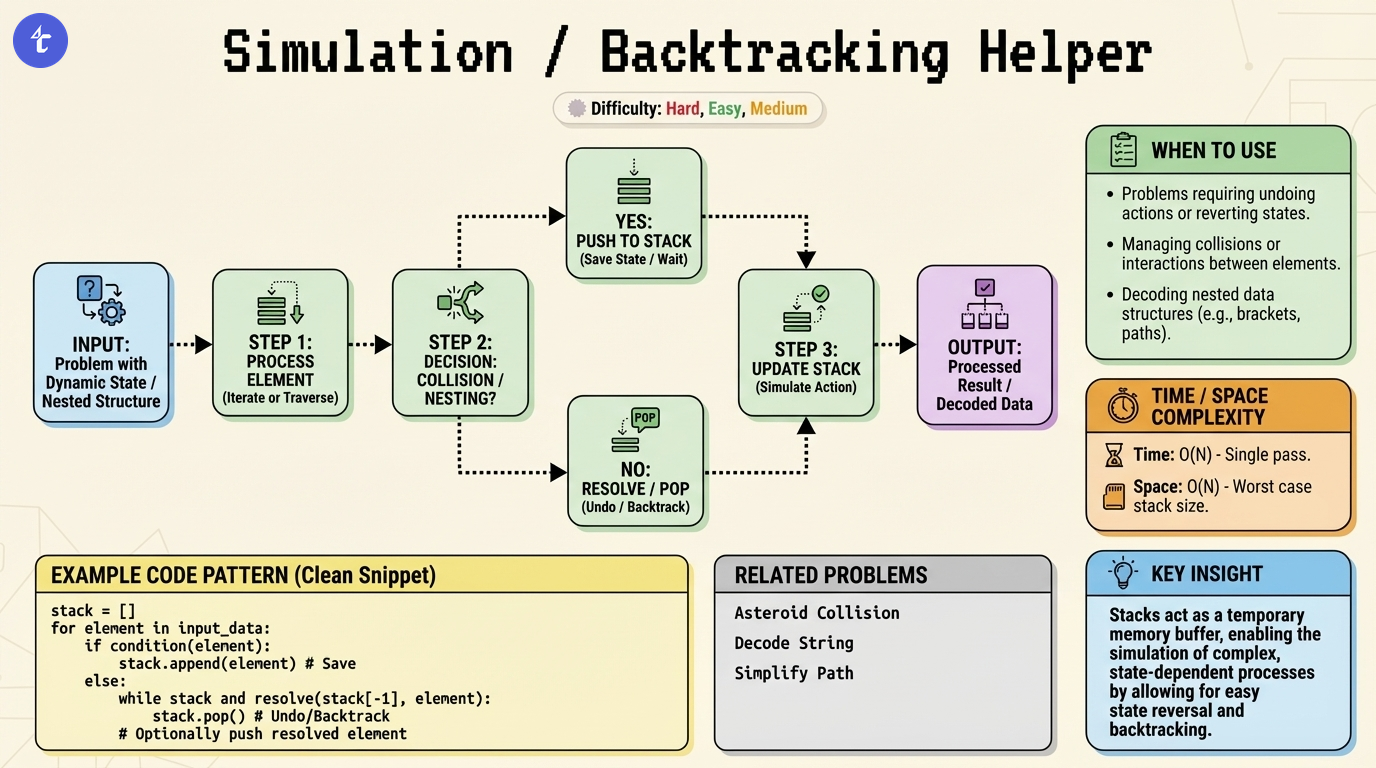
The Stack - Simulation / Backtracking Helper pattern is versatile. It applies when element interactions depend on immediate history.
- LeetCode 71: Simplify Path: Uses a stack to resolve directory path components (e.g.,
..pops the previous directory). - LeetCode 394: Decode String: Uses a stack to handle nested encoding brackets, simulating the expansion process from inside out.
Feynman coach · Before you peek at the code
Can you explain the core insight in your own words?
If you can explain it before reading code, you’re far more likely to recall it under interview pressure.
Loading your attempt…
Reference Implementation
C++ Solution for LeetCode 735
1class Solution {
2public:
3    vector<int> asteroidCollision(vector<int>& asteroids) {
4        vector<int> st; // Using vector as a stack for easy result return
5
6        for (int asteroid : asteroids) {
7            bool exploded = false;
8
9            // Collision loop: while current is moving left (-) and top is moving right (+)
10            while (!st.empty() && asteroid < 0 && st.back() > 0) {
11                if (abs(asteroid) > st.back()) {
12                    st.pop_back(); // Top explodes, current continues
13                    continue;
14                } else if (abs(asteroid) == st.back()) {
15                    st.pop_back(); // Both explode
16                    exploded = true;
17                    break;
18                } else {
19                    exploded = true; // Current explodes
20                    break;
21                }
22            }
23
24            if (!exploded) {
25                st.push_back(asteroid);
26            }
27        }
28
29        return st;
30    }
31};
Java Solution for LeetCode 735
1class Solution {
2    public int[] asteroidCollision(int[] asteroids) {
3        Stack<Integer> stack = new Stack<>();
4
5        for (int asteroid : asteroids) {
6            boolean exploded = false;
7
8            // Handle collision
9            while (!stack.isEmpty() && asteroid < 0 && stack.peek() > 0) {
10                if (Math.abs(asteroid) > stack.peek()) {
11                    stack.pop(); // Top explodes
12                    continue;
13                } else if (Math.abs(asteroid) == stack.peek()) {
14                    stack.pop(); // Both explode
15                    exploded = true;
16                    break;
17                } else {
18                    exploded = true; // Current explodes
19                    break;
20                }
21            }
22
23            if (!exploded) {
24                stack.push(asteroid);
25            }
26        }
27
28        // Convert stack to array
29        int[] result = new int[stack.size()];
30        for (int i = result.length - 1; i >= 0; i--) {
31            result[i] = stack.pop();
32        }
33        return result;
34    }
35}
Python Solution for LeetCode 735
1class Solution:
2    def asteroidCollision(self, asteroids: List[int]) -> List[int]:
3        stack = []
4
5        for asteroid in asteroids:
6            # Flag to track if the current asteroid survives
7            exploded = False
8
9            # Collision happens if stack has right-moving (+) and current is left-moving (-)
10            while stack and asteroid < 0 and stack[-1] > 0:
11                if abs(asteroid) > stack[-1]:
12                    stack.pop() # Top explodes, check next
13                    continue
14                elif abs(asteroid) == stack[-1]:
15                    stack.pop() # Both explode
16                    exploded = True
17                    break
18                else:
19                    exploded = True # Current explodes
20                    break
21
22            if not exploded:
23                stack.append(asteroid)
24
25        return stack