
Editorial
Core insight
Basic Calculator II · Stack Patterns
Core Insight for Basic Calculator II
The primary challenge in LeetCode 227 is handling operator precedence without parentheses. We cannot simply process the expression from left to right because a + operation cannot be executed until we ensure the right-hand operand isn't part of a subsequent * or / operation (e.g., in 3 + 2 * 5, we cannot add 3 and 2 immediately).
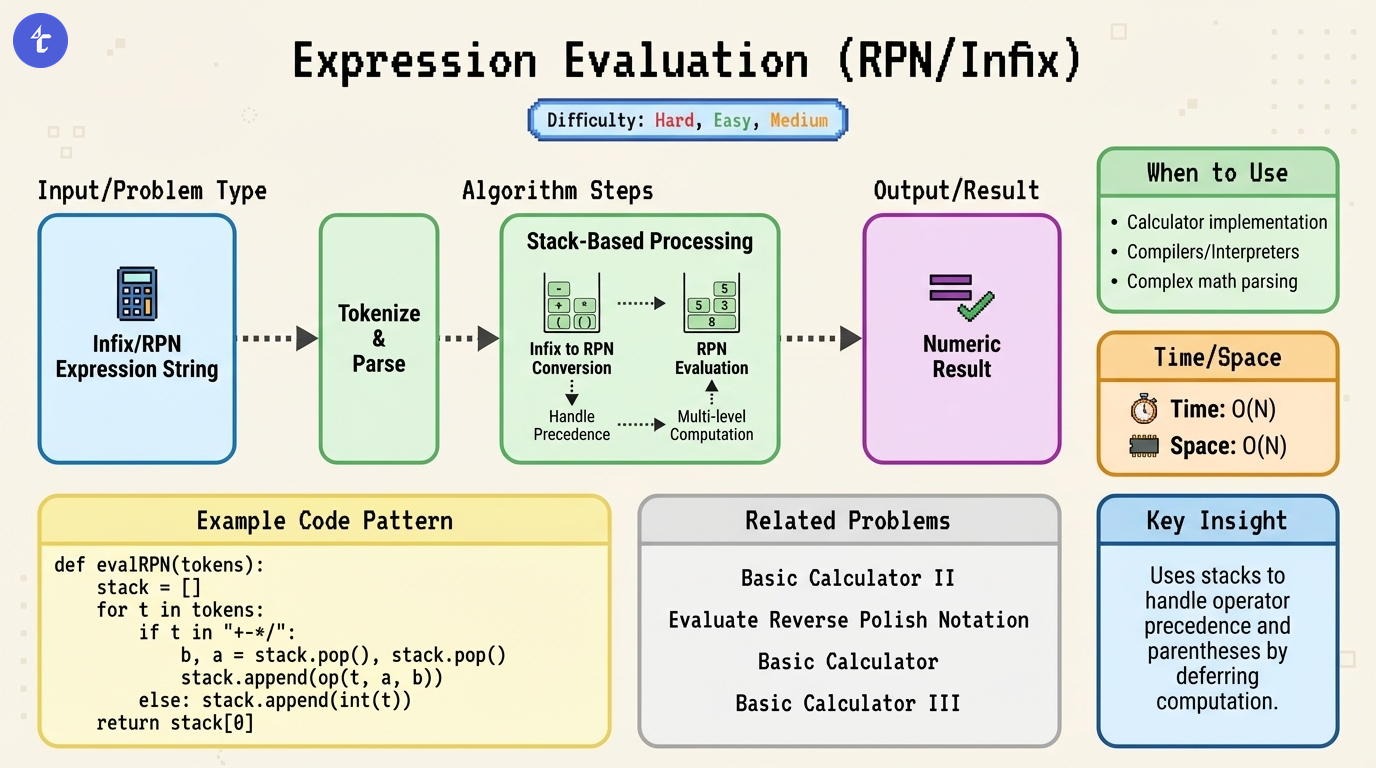
The core insight is to treat the expression as a sum of terms. We can use a stack to store these terms.
- Addition/Subtraction: These have the lowest precedence. When we encounter these, we push the number (or its negative for subtraction) onto the stack. We effectively say, "I will add this later."
- Multiplication/Division: These have high precedence. When we encounter these, we must evaluate them immediately with the last number processed. We pop the top of the stack (the left operand), perform the operation with the current number (the right operand), and push the result back.
Visual Description:
Imagine the stack as a list of numbers waiting to be summed. As we iterate through 3 + 2 * 5:
- We see
3, push3. Stack:[3]. - We see
+, note it. - We see
2. Previous op was+, so push2. Stack:[3, 2]. - We see
*, note it. - We see
5. Previous op was*. We don't push5. Instead, we pop2, calculate2 * 5 = 10, and push10. Stack:[3, 10]. - At the end, we sum the stack:
3 + 10 = 13.
Deep dive
Full breakdown
Full reasoning, pitfalls, and implementation flow
LeetCode 227: Basic Calculator II Solution & Explanation
Problem Overview
TL;DR: By utilizing a stack to store additive terms and resolving multiplicative operations immediately upon discovery, we can evaluate the expression in a single linear pass.
The LeetCode 227 problem, known as Basic Calculator II, asks us to evaluate a string expression containing non-negative integers and the operators +, -, *, and /. The evaluation must respect the standard order of operations (operator precedence), meaning multiplication and division must be performed before addition and subtraction. We are not allowed to use built-in evaluation functions like eval().
Brute Force Approach for Basic Calculator II
A naive or brute force approach to solving Basic Calculator II often involves recursively searching for the operator with the lowest precedence to split the expression.
- Scan the entire string to find the last occurrence of
+or-. - Split the string into a left and right part and recursively evaluate both.
- If no
+or-exists, scan for*or/and split similarly. - If no operators exist, parse the number.
Pseudo-code
function solve(expression):
    if expression is just a number: return parsed number

    // Find split point (lowest precedence, rightmost)
    idx = find_last_plus_or_minus(expression)
    if idx != -1:
        return solve(left_part) + solve(right_part) (or -)

    idx = find_last_mul_or_div(expression)
    return solve(left_part) * solve(right_part) (or /)
Time Complexity: . In the worst case (e.g., 1+2+3+...), the algorithm scans the string linearly to find the split point, performs the split, and recurses. This repeated scanning leads to quadratic time complexity.
Why it fails: While semantically correct, this approach effectively constructs an Abstract Syntax Tree (AST) implicitly through recursion. For constraints where string length s is up to , an solution will result in a Time Limit Exceeded (TLE) error.
Algorithm Strategy: Stack Patterns
- State Maintenance: We maintain a
stackto hold integers. We also need acurrentNumbervariable to build multi-digit numbers from characters, and alastOperatorvariable to store the operator immediately preceding the current number. - Initialization: Initialize
lastOperatorto+. This is a trick to treat the first number as a positive term (e.g.,3...becomes0 + 3...). - Iteration: Traverse the string character by character.
- If the character is a digit, update
currentNumber(handlecurrentNumber * 10 + digit). - If the character is an operator or we have reached the end of the string:
- Check
lastOperator(the operator before the current number). - If
+: PushcurrentNumberto stack. - If
-: Push-currentNumberto stack. - If
*: Pop the top element, multiply bycurrentNumber, push result. - If
/: Pop the top element, divide bycurrentNumber(truncating towards zero), push result. - Update
lastOperatorto the current character. - Reset
currentNumberto 0.
- Check
- If the character is a digit, update
- Final Aggregation: The stack now contains all additive terms. Sum the elements in the stack to get the final result.
Execution Flow
Consider the input s = "3+2*2".
- Init:
stack = [],lastOp = '+',currNum = 0. - Process '3': It's a digit.
currNumbecomes 3. - Process '+': It's an operator.
- Check
lastOp(+). Push3to stack.stack = [3]. - Update
lastOpto+. ResetcurrNumto 0.
- Check
- Process '2': It's a digit.
currNumbecomes 2. - Process '*': It's an operator.
- Check
lastOp(+). Push2to stack.stack = [3, 2]. - Update
lastOpto*. ResetcurrNumto 0.
- Check
- Process '2': It's a digit.
currNumbecomes 2. - End of String: Treat as if we hit a delimiter.
- Check
lastOp(*). - Pop top (
2). Calculate2 * 2 = 4. - Push
4.stack = [3, 4].
- Check
- Result: Sum stack
3 + 4 = 7.
Proof of Correctness
The algorithm correctly implements operator precedence by ensuring that multiplication and division bind tighter than addition and subtraction.
- Invariant: At any point, the stack contains terms that are meant to be added together.
- When we encounter
*or/, we effectively "merge" the current number with the last term on the stack. This prevents the previous term from being added to the overall sum until the higher-precedence operation is complete. - When we encounter
+or-, we "seal" the previous number as a complete term and push it, making it available for future addition. - Since standard math is associative for addition
(a + b) + c = a + (b + c), deferring the sum until the end produces the correct result.
Pattern Reuse Notes
The Stack - Expression Evaluation pattern is highly versatile and appears in several popular interview questions.
- LeetCode 150: Evaluate Reverse Polish Notation - Uses a stack to evaluate Postfix expressions directly. Simpler than 227 as precedence is already handled by the notation.
- LeetCode 224: Basic Calculator - Handles parentheses
()and+/-. Requires handling nested contexts, often by pushing the current local sum onto the stack when(is found. - LeetCode 772: Basic Calculator III - The ultimate variation combining precedence (
*,/) and parentheses(). This requires a robust application of the stack pattern or conversion to RPN.
Feynman coach · Before you peek at the code
Can you explain the core insight in your own words?
If you can explain it before reading code, you’re far more likely to recall it under interview pressure.
Loading your attempt…
Reference Implementation
C++ Solution for LeetCode 227
1class Solution {
2public:
3    int calculate(string s) {
4        stack<int> myStack;
5        char lastOp = '+';
6        int currentNumber = 0;
7        int n = s.length();
8
9        for (int i = 0; i < n; ++i) {
10            char c = s[i];
11
12            if (isdigit(c)) {
13                currentNumber = currentNumber * 10 + (c - '0');
14            }
15
16            // Trigger processing if current char is an operator or it's the last character.
17            // Note: We skip spaces unless it's the last character.
18            if ((!isdigit(c) && !isspace(c)) || i == n - 1) {
19                if (lastOp == '+') {
20                    myStack.push(currentNumber);
21                } else if (lastOp == '-') {
22                    myStack.push(-currentNumber);
23                } else if (lastOp == '*') {
24                    int top = myStack.top();
25                    myStack.pop();
26                    myStack.push(top * currentNumber);
27                } else if (lastOp == '/') {
28                    int top = myStack.top();
29                    myStack.pop();
30                    myStack.push(top / currentNumber);
31                }
32                lastOp = c;
33                currentNumber = 0;
34            }
35        }
36
37        int result = 0;
38        while (!myStack.empty()) {
39            result += myStack.top();
40            myStack.pop();
41        }
42        return result;
43    }
44};
Java Solution for LeetCode 227
1class Solution {
2    public int calculate(String s) {
3        if (s == null || s.length() == 0) return 0;
4
5        Deque<Integer> stack = new ArrayDeque<>();
6        int currentNumber = 0;
7        char lastOp = '+';
8        int n = s.length();
9
10        for (int i = 0; i < n; i++) {
11            char c = s.charAt(i);
12
13            if (Character.isDigit(c)) {
14                currentNumber = currentNumber * 10 + (c - '0');
15            }
16
17            if ((!Character.isDigit(c) && c != ' ') || i == n - 1) {
18                if (lastOp == '+') {
19                    stack.push(currentNumber);
20                } else if (lastOp == '-') {
21                    stack.push(-currentNumber);
22                } else if (lastOp == '*') {
23                    stack.push(stack.pop() * currentNumber);
24                } else if (lastOp == '/') {
25                    stack.push(stack.pop() / currentNumber);
26                }
27                lastOp = c;
28                currentNumber = 0;
29            }
30        }
31
32        int result = 0;
33        for (int num : stack) {
34            result += num;
35        }
36        return result;
37    }
38}
Python Solution for LeetCode 227
1class Solution:
2    def calculate(self, s: str) -> int:
3        stack = []
4        current_number = 0
5        last_op = '+'
6        n = len(s)
7
8        for i, char in enumerate(s):
9            if char.isdigit():
10                current_number = current_number * 10 + int(char)
11
12            # If current char is operator or last char in string
13            if (not char.isdigit() and char != ' ') or i == n - 1:
14                if last_op == '+':
15                    stack.append(current_number)
16                elif last_op == '-':
17                    stack.append(-current_number)
18                elif last_op == '*':
19                    top = stack.pop()
20                    stack.append(top * current_number)
21                elif last_op == '/':
22                    top = stack.pop()
23                    # Python // floors, but problem requires truncation toward zero
24                    # e.g., -3 // 2 = -2, but we want -1
25                    stack.append(int(top / current_number))
26
27                last_op = char
28                current_number = 0
29
30        return sum(stack)