
Editorial
Core insight
Binary Tree Zigzag Level Order Traversal · Tree Traversal Patterns (DFS & BFS)
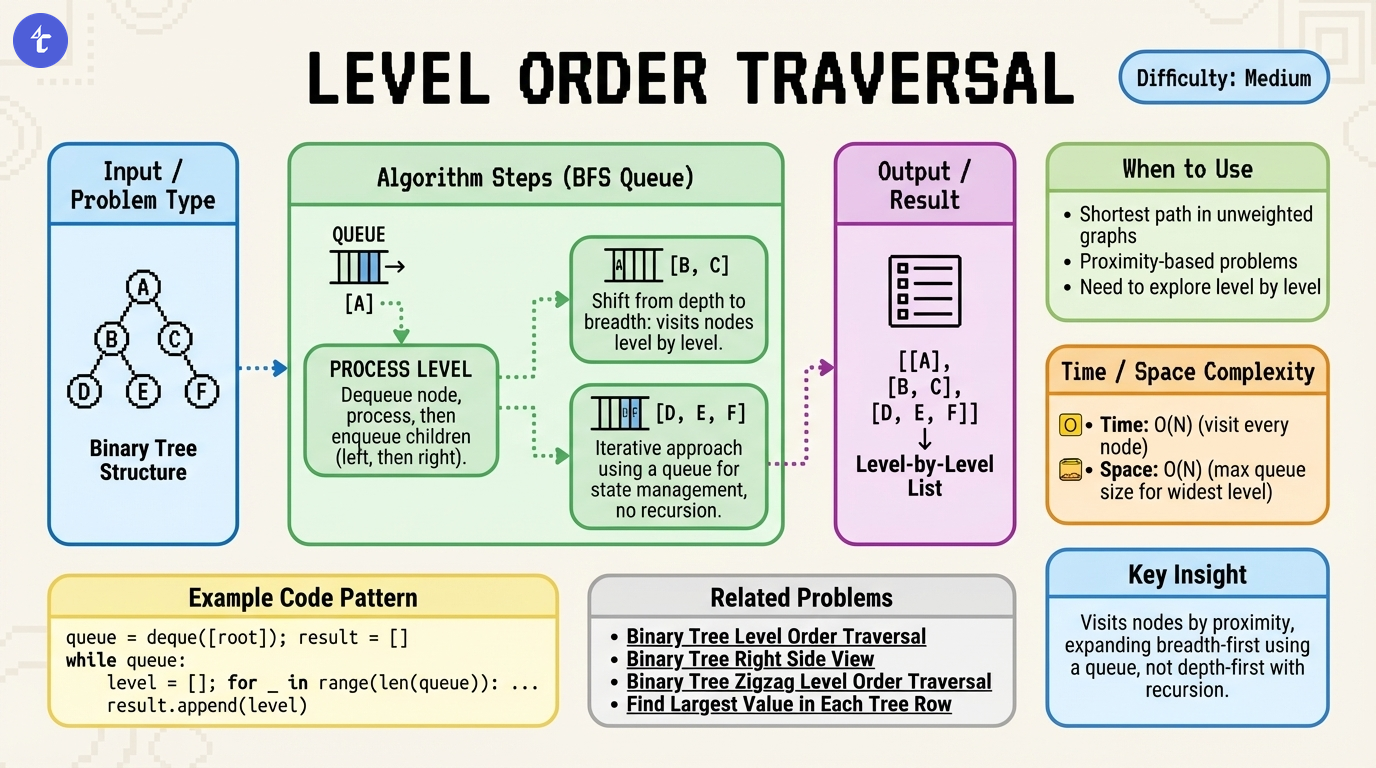
Core Insight for Binary Tree Zigzag Level Order Traversal
The key insight for the optimal LeetCode 103 Solution is to separate the traversal order from the output order.
In a standard BFS, we use a Queue (FIFO) to visit nodes. To generate the next level correctly, we must always process the current level's nodes from left to right and add their children from left to right. If we tried to change the order in which we visit nodes or add children to the queue to satisfy the "right-to-left" requirement, we would scramble the order for the subsequent level.
Therefore, the invariant is: The Queue always operates strictly Left-to-Right.
The "Zigzag" is handled strictly at the collection phase:
- Dequeue nodes for the current level.
- Store their values in a temporary list.
- If the current level requires Right-to-Left order, reverse the temporary list (or insert values at the front).
- Add the list to the final result.
- Flip the direction flag for the next level.
Visual Description: Imagine the recursion tree or BFS process. At depth 0 (root), we extract the value. At depth 1, the queue contains the left child then the right child. We extract them in that order. However, before finalizing the list for depth 1, we visually "flip" the list of values. Crucially, the children of these nodes are still added to the queue in the standard Left-Child then Right-Child order. This ensures that when we reach depth 2, the queue contains all grandchildren sorted strictly by their position from left to right in the tree.
Deep dive
Full breakdown
Full reasoning, pitfalls, and implementation flow
LeetCode 103: Binary Tree Zigzag Level Order Traversal Solution & Explanation
Problem Overview
TL;DR: Use a Breadth-First Search (BFS) to traverse the tree level by level, reversing the collected node values for every alternate level to achieve the zigzag effect.
The Binary Tree Zigzag Level Order Traversal problem asks us to traverse a binary tree and return its values grouped by level. However, unlike a standard level-order traversal, the direction of traversal alternates. The first level is traversed left-to-right, the second right-to-left, the third left-to-right, and so on. This creates a "zigzag" or serpentine pattern across the tree's depth.
This is a popular interview question because it tests your ability to modify a standard algorithm (BFS) to handle specific state changes (direction) without corrupting the underlying traversal logic.
Brute Force Approach for Binary Tree Zigzag Level Order Traversal
A naive or brute force approach to solve LeetCode 103 might involve repeated traversals or an unstructured Depth-First Search (DFS).
One inefficient method is Iterative Deepening. In this approach, we determine the height of the tree first. Then, for every level from 0 to Height, we perform a fresh traversal from the root to find all nodes specifically at level . Depending on whether is even or odd, we would collect these nodes in the specific order required.
Pseudo-code
function bruteForceZigzag(root):
    height = getTreeHeight(root)
    result = []
    for level from 0 to height:
        current_level_nodes = []
        dfs_collect(root, level, current_level_nodes)
        if level is odd:
            reverse(current_level_nodes)
        result.add(current_level_nodes)
    return result
Complexity Analysis
- Time Complexity: in the worst case (skewed tree). For a balanced tree, visiting nodes repeatedly for each level results in strictly worse performance than a single-pass scan.
- Space Complexity: for the recursion stack and output storage.
Why it fails
While this logic produces the correct output, it performs redundant work by traversing the upper nodes repeatedly to reach lower levels. In a large tree (up to 2000 nodes), this is inefficient compared to a single-pass solution.
Algorithm Strategy: Tree BFS - Level Order Traversal
- Initialization: Handle the edge case where
rootisnullby returning an empty list. Initialize aQueuewith therootnode. Initialize a boolean flagleftToRighttotrue. - Level Loop: While the queue is not empty, start a new level.
- Determine the number of nodes in the current level (
size = queue.size()). - Create a data structure (list or deque) to hold the values for this level.
- Determine the number of nodes in the current level (
- Node Processing: Iterate
sizetimes:- Dequeue a node.
- If
leftToRightis true, add the node's value to the end of the current level's list. - If
leftToRightis false, add the node's value to the beginning of the current level's list (or append and reverse later). - Crucial Step: Always enqueue the current node's left child, then its right child. This maintains the BFS invariant.
- State Update: After processing all nodes in the current level, add the level's list to the main result list. Toggle the
leftToRightboolean. - Termination: Return the result list when the queue is empty.
Execution Flow
Consider Input: root = [3, 9, 20, null, null, 15, 7]
- Start: Queue =
[3],leftToRight=true, Result =[]. - Level 0:
- Size is 1. Pop
3. leftToRightis true. Level list:[3].- Add children
9,20to Queue. Queue =[9, 20]. - Add
[3]to Result. ToggleleftToRight->false.
- Size is 1. Pop
- Level 1:
- Size is 2.
- Pop
9.leftToRightis false. Level list:[9]. Add children (none). - Pop
20.leftToRightis false. Prepend20. Level list:[20, 9]. Add children15,7. Queue =[15, 7]. - Add
[20, 9]to Result. ToggleleftToRight->true.
- Level 2:
- Size is 2.
- Pop
15.leftToRightis true. Level list:[15]. Add children (none). - Pop
7.leftToRightis true. Append7. Level list:[15, 7]. Add children (none). - Add
[15, 7]to Result. ToggleleftToRight->false.
- End: Queue empty. Return
[[3], [20, 9], [15, 7]].
Proof of Correctness
The algorithm is correct because it maintains the structural integrity of the BFS traversal. By always enqueuing children Left-to-Right, we guarantee that the queue contains nodes for level in their correct geometric order (Left-to-Right) after processing level . The zigzag effect is purely a presentation transformation applied to the values of the current level, which does not affect the order in which future nodes are visited. Thus, every node is visited exactly once, and levels are grouped correctly.
Pattern Reuse Notes
The Tree BFS - Level Order Traversal pattern used in this LeetCode 103 Solution is fundamental for many tree problems.
- LeetCode 102: Binary Tree Level Order Traversal: The base case of this pattern without the zigzag reversal.
- LeetCode 199: Binary Tree Right Side View: Uses the same BFS traversal but only captures the last element of each level.
- LeetCode 515: Find Largest Value in Each Tree Row: Instead of collecting all nodes, we track the maximum value seen in the current level loop.
- LeetCode 1161: Maximum Level Sum of a Binary Tree: Computes the sum of values at each level during the BFS pass to find the maximal level.
Feynman coach · Before you peek at the code
Can you explain the core insight in your own words?
If you can explain it before reading code, you’re far more likely to recall it under interview pressure.
Loading your attempt…
Reference Implementation
C++ Solution for LeetCode 103
1#include <vector>
2#include <queue>
3#include <algorithm>
4
5using namespace std;
6
7struct TreeNode {
8    int val;
9    TreeNode *left;
10    TreeNode *right;
11    TreeNode() : val(0), left(nullptr), right(nullptr) {}
12    TreeNode(int x) : val(x), left(nullptr), right(nullptr) {}
13    TreeNode(int x, TreeNode *left, TreeNode *right) : val(x), left(left), right(right) {}
14};
15
16class Solution {
17public:
18    vector<vector<int>> zigzagLevelOrder(TreeNode* root) {
19        vector<vector<int>> result;
20        if (!root) return result;
21
22        queue<TreeNode*> q;
23        q.push(root);
24        bool leftToRight = true;
25
26        while (!q.empty()) {
27            int levelSize = q.size();
28            vector<int> currentLevel(levelSize);
29
30            for (int i = 0; i < levelSize; ++i) {
31                TreeNode* node = q.front();
32                q.pop();
33
34                // Determine position based on direction
35                int index = leftToRight ? i : (levelSize - 1 - i);
36                currentLevel[index] = node->val;
37
38                if (node->left) q.push(node->left);
39                if (node->right) q.push(node->right);
40            }
41
42            result.push_back(currentLevel);
43            leftToRight = !leftToRight;
44        }
45
46        return result;
47    }
48};
Java Solution for LeetCode 103
1import java.util.*;
2
3/**
4 * Definition for a binary tree node.
5 * public class TreeNode {
6 *     int val;
7 *     TreeNode left;
8 *     TreeNode right;
9 *     TreeNode() {}
10 *     TreeNode(int val) { this.val = val; }
11 *     TreeNode(int val, TreeNode left, TreeNode right) {
12 *         this.val = val;
13 *         this.left = left;
14 *         this.right = right;
15 *     }
16 * }
17 */
18class Solution {
19    public List<List<Integer>> zigzagLevelOrder(TreeNode root) {
20        List<List<Integer>> result = new ArrayList<>();
21        if (root == null) return result;
22
23        Queue<TreeNode> queue = new LinkedList<>();
24        queue.offer(root);
25        boolean leftToRight = true;
26
27        while (!queue.isEmpty()) {
28            int levelSize = queue.size();
29            // Use LinkedList for efficient addFirst/addLast if desired,
30            // or ArrayList and reverse.
31            List<Integer> currentLevel = new ArrayList<>(levelSize);
32
33            for (int i = 0; i < levelSize; i++) {
34                TreeNode node = queue.poll();
35
36                // Always add children left to right to maintain BFS order
37                if (node.left != null) queue.offer(node.left);
38                if (node.right != null) queue.offer(node.right);
39
40                if (leftToRight) {
41                    currentLevel.add(node.val);
42                } else {
43                    currentLevel.add(0, node.val); // Or collect and reverse later
44                }
45            }
46
47            result.add(currentLevel);
48            leftToRight = !leftToRight;
49        }
50
51        return result;
52    }
53}
Python Solution for LeetCode 103
1from collections import deque
2from typing import List, Optional
3
4# Definition for a binary tree node.
5# class TreeNode:
6#     def __init__(self, val=0, left=None, right=None):
7#         self.val = val
8#         self.left = left
9#         self.right = right
10
11class Solution:
12    def zigzagLevelOrder(self, root: Optional[TreeNode]) -> List[List[int]]:
13        if not root:
14            return []
15
16        result = []
17        queue = deque([root])
18        left_to_right = True
19
20        while queue:
21            level_size = len(queue)
22            current_level = deque() # Using deque for efficient append/appendleft
23
24            for _ in range(level_size):
25                node = queue.popleft()
26
27                if left_to_right:
28                    current_level.append(node.val)
29                else:
30                    current_level.appendleft(node.val)
31
32                if node.left:
33                    queue.append(node.left)
34                if node.right:
35                    queue.append(node.right)
36
37            result.append(list(current_level))
38            left_to_right = not left_to_right
39
40        return result