15% off all plans & roadmaps Use code
See plans
Editorial
Core insight
Contains Duplicate · Array/Matrix Manipulation Patterns
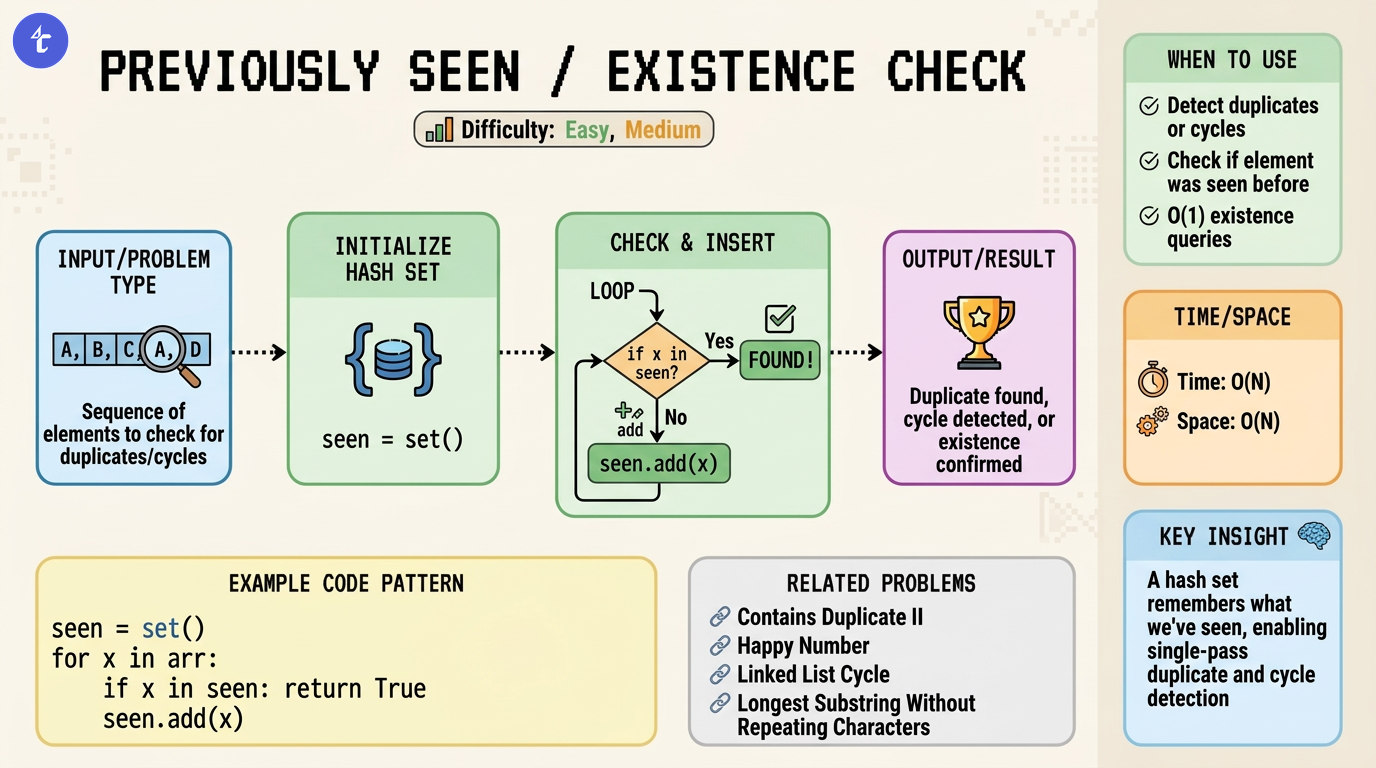
Core Insight for Contains Duplicate
The key observation is that duplicate detection can be performed incrementally. When processing a value, only one question matters:
Has this value already appeared earlier in the scan?
A hash set answers that question in constant average time:
- If the value is already in
seen, a duplicate has been found. - If it is not in
seen, insert it so future elements can detect it.
The pattern maintains the invariant:
Before processing the next array element,
seencontains exactly the distinct values from all previously processed elements.
This invariant eliminates the need to compare the current value against every earlier position individually.
Visual Description
For nums = [8, 3, 5, 8], the set changes as follows:
Start:          seen = {}

Process 8:      8 is absent → insert 8
                seen = {8}

Process 3:      3 is absent → insert 3
                seen = {8, 3}

Process 5:      5 is absent → insert 5
                seen = {8, 3, 5}

Process 8:      8 is present → return true
The data structure records only existence, not positions or frequencies. The first repeated membership check terminates the scan immediately.
Deep dive
Full breakdown
Full reasoning, pitfalls, and implementation flow
LeetCode 217: Contains Duplicate Solution & Explanation
Problem Overview
TL;DR: Scan the array once while storing previously seen values in a hash set; if a value is already present, return true, otherwise return false after the scan.
This LeetCode 217 Solution determines whether any integer appears at least twice in nums. The order of elements does not matter, and duplicate occurrences may be at any positions. For the Contains Duplicate problem, the optimal interview solution uses a hash set to perform constant-average-time existence checks.
Because nums.length can be as large as 10^5, checking every pair of elements is inefficient. A previously seen-value set provides a direct way to detect repetition during a single array traversal.
Brute Force Approach for Contains Duplicate
The naive approach compares every element with every element that appears after it:
- Select an element at index
i. - Compare it with each element at index
j > i. - Return
trueif any pair has the same value. - Return
falseif all pairs are different.
Naive Pseudocode
for i from 0 to n - 1:
    for j from i + 1 to n - 1:
        if nums[i] == nums[j]:
            return true

return false
Complexity
- Time:
O(n²), because the algorithm may compare every pair of elements. - Space:
O(1)auxiliary space.
Why the Brute Force Method Fails
With up to 10^5 elements, O(n²) requires up to roughly 10^10 pair comparisons. That is far beyond a practical execution limit and can result in Time Limit Exceeded.
The problem only requires determining whether a value has appeared before. Comparing all pairs performs much more work than necessary because it repeatedly searches for the same information.
Algorithm Strategy: Array/Matrix Manipulation Patterns
- Create an empty hash set named
seen. - Traverse each value in
numsfrom left to right. - Check whether the current value exists in
seen. - If it exists, return
trueimmediately. - Otherwise, insert the value into
seen. - If the traversal finishes without finding an existing value, return
false.
The hash set enforces uniqueness among the values already processed. A repeated value violates that condition and proves that the array contains a duplicate.
Execution Flow
For nums = [8, 3, 5, 8]:
- Initialize
seenas an empty set. - Read
8.8is not inseen.- Insert
8.
- Read
3.3is not inseen.- Insert
3.
- Read
5.5is not inseen.- Insert
5.
- Read
8.8is already inseen.- Return
trueimmediately.
- The remaining elements, if any, do not need to be processed.
For nums = [-4, 12, 0, 7], every membership check fails before insertion, so the scan ends and returns false.
Proof of Correctness
We prove that the algorithm returns the correct result.
Invariant
Before processing each array element, seen contains exactly the distinct values that occurred earlier in nums.
Preservation
- If the current value is already in
seen, it appeared earlier. Therefore, the array contains a duplicate, and returningtrueis correct. - If the current value is not in
seen, it has not appeared earlier. Inserting it ensures thatseenremains the set of all distinct processed values.
Thus, the invariant is preserved after every iteration.
Termination
If the algorithm completes the entire array without returning true, no value was found in seen before its first insertion. Therefore, every value appeared exactly once, so returning false is correct.
Hence, the algorithm always produces the correct result.
Pattern Reuse Notes
The following problems share the same pattern/subpattern:
- LeetCode 202: Happy Number
- LeetCode 349: Intersection of Two Arrays
- LeetCode 219: Contains Duplicate II
- LeetCode 3: Longest Substring Without Repeating Characters
Each problem maintains hash-based state to check whether a value, transformed value, or relevant character has already been encountered. The stored information differs, but the core operation remains a previously seen or existence check.
Feynman coach · Before you peek at the code
Can you explain the core insight in your own words?
If you can explain it before reading code, you’re far more likely to recall it under interview pressure.
Loading your attempt…
Reference Implementation
C++ Solution for LeetCode 217
1class Solution {
2public:
3    bool containsDuplicate(vector<int>& nums) {
4        unordered_set<int> seen;
5        for (int value : nums) {
6            if (seen.count(value)) {
7                return true;
8            }
9            seen.insert(value);
10        }
11        return false;
12    }
13};
The unordered_set stores values that have already appeared. count(value) checks whether the current value exists before insertion.
Java Solution for LeetCode 217
1class Solution {
2    public boolean containsDuplicate(int[] nums) {
3        java.util.Set<Integer> seen = new java.util.HashSet<>();
4        for (int num : nums) {
5            if (seen.contains(num)) {
6                return true;
7            }
8            seen.add(num);
9        }
10        return false;
11    }
12}
Java’s HashSet provides the previously seen-value storage and supports average constant-time contains and add operations.
Python Solution for LeetCode 217
1class Solution:
2    def containsDuplicate(self, nums: List[int]) -> bool:
3        seen = set()
4        for num in nums:
5            if num in seen:
6                return True
7            seen.add(num)
8        return False
The Python set performs the same existence-check pattern: test membership first, then add unseen values.