
Editorial
Core insight
Find Largest Value in Each Tree Row · Tree Traversal Patterns (DFS & BFS)
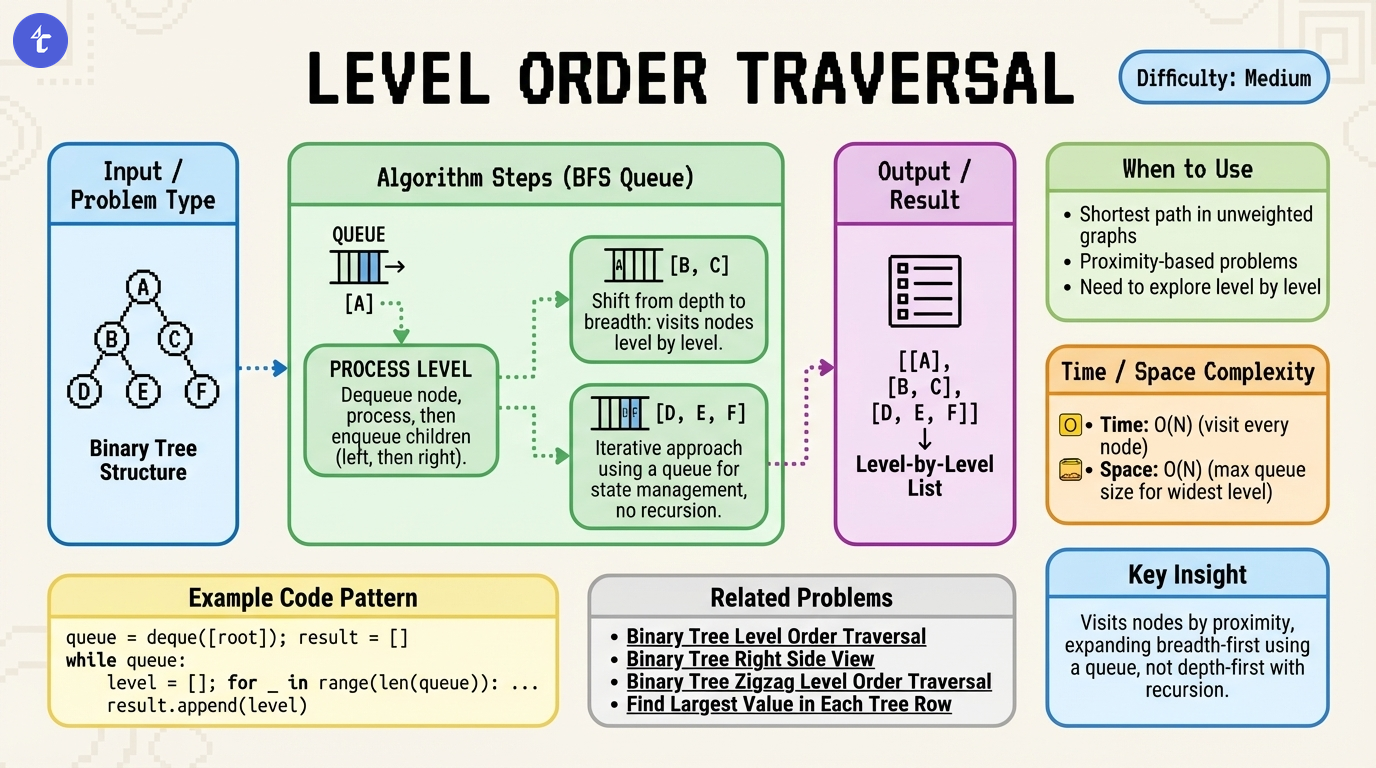
Core Insight for Find Largest Value in Each Tree Row
The key intuition for the LeetCode 515 Solution is that a standard Queue-based BFS allows us to process nodes in "batches."
When using a Queue for BFS, there is a specific moment at the beginning of the while loop where the Queue contains all nodes for the current level and only nodes for the current level.
By capturing the size of the Queue at this exact moment, we can iterate exactly that many times to process the current row. During this inner iteration, we perform two tasks:
- Compare the node's value to a running maximum for the current level.
- Enqueue the node's children (which will form the next level's batch).
Visual Description: Imagine the algorithm state when processing the second row of a tree (nodes 3 and 2).
- The Queue contains
[3, 2]. - We record
size = 2. - We initialize
current_max = -Infinity. - Iteration 1: Dequeue
3. Updatecurrent_maxto 3. Enqueue children of 3 (e.g.,5, 3). Queue is now[2, 5, 3]. - Iteration 2: Dequeue
2. Compare 2 vs 3;current_maxremains 3. Enqueue children of 2 (e.g.,9). Queue is now[5, 3, 9]. - The inner loop finishes because we ran it 2 times. We push
3to our result list. The Queue now contains only the nodes for the third row.
This logic guarantees that we never mix nodes from different levels when calculating the maximum.
Deep dive
Full breakdown
Full reasoning, pitfalls, and implementation flow
LeetCode 515: Find Largest Value in Each Tree Row Solution & Explanation
Problem Overview
TL;DR: The optimal solution uses Breadth-First Search (BFS) to traverse the tree level by level, tracking the maximum value encountered within the current batch of nodes representing a specific row.
The Find Largest Value in Each Tree Row problem requires us to process a binary tree and identify the single highest numerical value present at every depth level. If a tree has a height of , the output will be an array of size , where the -th element corresponds to the maximum value found among all nodes at depth .
This is a classic tree traversal challenge that tests the ability to aggregate data horizontally across a tree structure. It is a popular interview question for companies like Facebook, often used to verify a candidate's grasp of standard traversal algorithms.
Brute Force Approach for Find Largest Value in Each Tree Row
A naive approach to solving Find Largest Value in Each Tree Row might involve traversing the tree repeatedly or using an inefficient storage mechanism.
One specific brute-force strategy is to perform a separate traversal for every possible depth level. For a tree of height :
- Start at depth .
- Traverse the entire tree from the root.
- Check every node's depth. If it matches , consider it for the maximum.
- Increment and repeat until .
Pseudo-code
function findLargestValues(root):
    height = getHeight(root)
    result = []

    for d from 0 to height - 1:
        max_val = -infinity
        // Traverse entire tree to find nodes at depth d
        nodes = getAllNodesAtDepth(root, d)
        for node in nodes:
            max_val = max(max_val, node.val)
        result.add(max_val)

    return result
Complexity Analysis
The time complexity of this approach is , where is the number of nodes and is the height of the tree.
- In the worst case (a skewed tree), , resulting in complexity.
- In a balanced tree, , resulting in .
Why it fails
This approach is inefficient because it revisits nodes unnecessarily. To find nodes at depth 3, we must traverse through depth 0, 1, and 2 again. While this might pass for small constraints, it demonstrates a lack of understanding regarding state maintenance during traversal. A single-pass solution is expected in interviews.
Algorithm Strategy: Tree BFS - Level Order Traversal
- Initialization: Create a result list and a Queue. If the root is null, return the empty list immediately.
- Bootstrap: Add the root node to the Queue.
- Outer Loop: Continue while the Queue is not empty.
- Snapshot Size: Store
n = queue.size(). Thisnrepresents the number of nodes in the current row. - Level Max: Initialize a variable
max_valto the smallest possible integer (e.g.,Integer.MIN_VALUE). - Inner Loop: Iterate
ntimes:- Dequeue a node.
- Update
max_valwith the maximum of itself and the node's value. - Enqueue the node's left and right children (if they exist).
- Store Result: After the inner loop finishes, append
max_valto the result list.
- Snapshot Size: Store
- Completion: Return the result list.
Execution Flow
Let's trace the algorithm with Input: root = [1, 3, 2].
- Start: Queue =
[1], Result =[]. - Level 0:
- Queue size is 1.
max_valinitialized toMIN_INT.- Process Node 1:
- Pop
1. max_valbecomes1.- Push children
3and2. Queue =[3, 2].
- Pop
- End of level. Result =
[1].
- Level 1:
- Queue size is 2.
max_valinitialized toMIN_INT.- Process Node 3:
- Pop
3. max_valbecomes3.- No children. Queue =
[2].
- Pop
- Process Node 2:
- Pop
2. max_valremains3(since 3 > 2).- No children. Queue =
[].
- Pop
- End of level. Result =
[1, 3].
- End: Queue is empty. Return
[1, 3].
Proof of Correctness
The correctness relies on the FIFO (First-In-First-Out) property of the Queue.
- Invariant: At the start of the outer loop iteration, the Queue contains all nodes at depth and no nodes from any other depth.
- Induction:
- Base Case: Initially, the Queue contains only the root (Depth 0).
- Step: Assuming the Queue contains only nodes at Depth , the inner loop processes exactly those nodes. As we remove nodes at Depth , we add their children, which are strictly at Depth . By the time the inner loop finishes, all Depth nodes are removed, and all Depth nodes are added.
- Conclusion: The variable
max_valis computed strictly over the set of values at Depth , ensuring the correct maximum is found for each row.
Pattern Reuse Notes
The Tree BFS - Level Order Traversal pattern is highly reusable. The logic of "snapshotting" the queue size to process one level at a time is identical in the following problems:
- LeetCode 102: Binary Tree Level Order Traversal - Instead of finding the max, you simply collect all nodes into a sub-list.
- LeetCode 103: Binary Tree Zigzag Level Order Traversal - Same logic, but you reverse the order of addition for every other level.
- LeetCode 199: Binary Tree Right Side View - Instead of the max, you only capture the last node processed in the inner loop.
- LeetCode 1161: Maximum Level Sum of a Binary Tree - Instead of max node value, you calculate the sum of the level and track which level has the highest sum.
Feynman coach · Before you peek at the code
Can you explain the core insight in your own words?
If you can explain it before reading code, you’re far more likely to recall it under interview pressure.
Loading your attempt…
Reference Implementation
C++ Solution for LeetCode 515
1#include <vector>
2#include <queue>
3#include <algorithm>
4#include <climits>
5
6using namespace std;
7
8struct TreeNode {
9    int val;
10    TreeNode *left;
11    TreeNode *right;
12    TreeNode() : val(0), left(nullptr), right(nullptr) {}
13    TreeNode(int x) : val(x), left(nullptr), right(nullptr) {}
14    TreeNode(int x, TreeNode *left, TreeNode *right) : val(x), left(left), right(right) {}
15};
16
17class Solution {
18public:
19    vector<int> largestValues(TreeNode* root) {
20        vector<int> result;
21        if (!root) {
22            return result;
23        }
24
25        queue<TreeNode*> q;
26        q.push(root);
27
28        while (!q.empty()) {
29            int levelSize = q.size();
30            int maxVal = INT_MIN;
31
32            for (int i = 0; i < levelSize; ++i) {
33                TreeNode* currentNode = q.front();
34                q.pop();
35
36                maxVal = max(maxVal, currentNode->val);
37
38                if (currentNode->left) {
39                    q.push(currentNode->left);
40                }
41                if (currentNode->right) {
42                    q.push(currentNode->right);
43                }
44            }
45            result.push_back(maxVal);
46        }
47
48        return result;
49    }
50};
Java Solution for LeetCode 515
1import java.util.ArrayList;
2import java.util.LinkedList;
3import java.util.List;
4import java.util.Queue;
5
6/**
7 * Definition for a binary tree node.
8 * public class TreeNode {
9 *     int val;
10 *     TreeNode left;
11 *     TreeNode right;
12 *     TreeNode() {}
13 *     TreeNode(int val) { this.val = val; }
14 *     TreeNode(int val, TreeNode left, TreeNode right) {
15 *         this.val = val;
16 *         this.left = left;
17 *         this.right = right;
18 *     }
19 * }
20 */
21class Solution {
22    public List<Integer> largestValues(TreeNode root) {
23        List<Integer> result = new ArrayList<>();
24        if (root == null) {
25            return result;
26        }
27
28        Queue<TreeNode> queue = new LinkedList<>();
29        queue.offer(root);
30
31        while (!queue.isEmpty()) {
32            int levelSize = queue.size();
33            // Initialize with MIN_VALUE because node values can be negative
34            int maxVal = Integer.MIN_VALUE;
35
36            for (int i = 0; i < levelSize; i++) {
37                TreeNode currentNode = queue.poll();
38                maxVal = Math.max(maxVal, currentNode.val);
39
40                if (currentNode.left != null) {
41                    queue.offer(currentNode.left);
42                }
43                if (currentNode.right != null) {
44                    queue.offer(currentNode.right);
45                }
46            }
47            result.add(maxVal);
48        }
49
50        return result;
51    }
52}
Python Solution for LeetCode 515
1from collections import deque
2from typing import Optional, List
3
4# Definition for a binary tree node.
5# class TreeNode:
6#     def __init__(self, val=0, left=None, right=None):
7#         self.val = val
8#         self.left = left
9#         self.right = right
10
11class Solution:
12    def largestValues(self, root: Optional[TreeNode]) -> List[int]:
13        result = []
14        if not root:
15            return result
16
17        queue = deque([root])
18
19        while queue:
20            level_size = len(queue)
21            # Initialize with negative infinity
22            max_val = float('-inf')
23
24            for _ in range(level_size):
25                node = queue.popleft()
26                max_val = max(max_val, node.val)
27
28                if node.left:
29                    queue.append(node.left)
30                if node.right:
31                    queue.append(node.right)
32
33            result.append(max_val)
34
35        return result