
Editorial
Core insight
Game of Life · Array/Matrix Manipulation Patterns
Core Insight for Game of Life
The core insight that allows us to move from the brute force approach to the optimal pattern is the observation that the input data only utilizes the values 0 and 1. However, an integer (in C++, Java, or Python) can hold a much wider range of values.
We can invent new "composite" states that encode both the past (current generation) and the future (next generation). By defining unique integers for state transitions, we can update the board in a single pass without losing the information required for neighbors that haven't been processed yet.
Visual Description:
Imagine the grid as a state machine. Instead of flipping a 1 directly to a 0, we flip it to a temporary marker, let's say 2.
- If a cell holds
2, it tells us: "I am currently live (1) for calculation purposes, but I will be dead (0) in the next frame." - If a cell holds
3, it tells us: "I am currently dead (0) for calculation purposes, but I will be live (1) in the next frame."
By reading the "past" part of the code during neighbor counting and writing the "future" part of the code during the update, we simulate simultaneity in-place.
Deep dive
Full breakdown
Full reasoning, pitfalls, and implementation flow
LeetCode 289: Game of Life Solution & Explanation
Problem Overview
TL;DR: The optimal solution uses in-place marking with temporary state codes to simulate simultaneous updates without allocating extra memory for a board copy.
The Game of Life is a cellular automaton played on an m x n grid. Each cell is either live (1) or dead (0). The state of the board evolves in generations based on the number of live neighbors (horizontal, vertical, and diagonal) each cell possesses. The rules governing life and death are standard: under-population and over-population kill live cells, while reproduction brings dead cells to life.
The critical challenge in LeetCode 289 is the requirement for simultaneous updates. The state of a cell in the next generation depends on the current state of its neighbors. If we update a cell's value immediately, its neighbors will effectively "see" the future state when calculating their own transitions, violating the rules.
Brute Force Approach for Game of Life
The most intuitive way to handle the simultaneous update requirement is to create a complete copy of the board. We read the neighbor counts from the original board and write the resulting state into the new copy. Once all cells are processed, we copy the new values back into the original board.
Pseudo-code:
function gameOfLife(board):
    copyBoard = deep_copy(board)
    for r from 0 to rows:
        for c from 0 to cols:
            neighbors = countNeighbors(copyBoard, r, c)
            if rules say live:
                board[r][c] = 1
            else:
                board[r][c] = 0
Complexity Analysis:
- Time Complexity: , where is the number of rows and is the number of columns. We iterate through the grid once.
- Space Complexity: to store the
copyBoard.
Why it is suboptimal: While correct, this approach fails the "Follow up" constraint of solving the problem in-place. In a technical interview, allocating extra space is often considered a brute force solution when an space solution exists. For very large matrices, doubling the memory usage is inefficient.
Algorithm Strategy: Array/Matrix Manipulation
The algorithm utilizes a two-pass strategy on the board matrix.
-
State Definition: We define four states to handle transitions:
0: Dead Dead (No change)1: Live Live (No change)2: Live Dead (Under/Over-population)3: Dead Live (Reproduction)
-
First Pass (Determine Transitions):
- Iterate through every cell
(row, col)in the matrix. - For each cell, count its live neighbors. Crucially, when checking a neighbor's value, we must check if it was originally live. Based on our definitions, a cell was originally live if its value is
1or2. - Apply the Game of Life rules:
- If current is
1and neighbors < 2 or > 3: Change state to2. - If current is
0and neighbors == 3: Change state to3.
- If current is
- Leave
0and1unchanged if they don't transition.
- Iterate through every cell
-
Second Pass (Finalize):
- Iterate through the matrix again.
- Convert the composite states back to the standard binary representation:
2becomes0.3becomes1.
- This can be achieved mathematically using the modulo operator:
cell % 2correctly maps2 \to 0and3 \to 1, while preserving0and1.
Execution Flow
- Initialize: Determine board dimensions
mandn. Define the 8 directional deltas for neighbor traversal. - Transition Pass:
- Loop
rfrom0tom-1. - Loop
cfrom0ton-1. - Initialize
liveNeighbors = 0. - Check all 8 neighbors. For a neighbor at
(nr, nc), check ifboard[nr][nc]represents a live cell.- A cell is live if
board[nr][nc] == 1ORboard[nr][nc] == 2.
- A cell is live if
- Apply Rules:
- Rule 1 & 3 (Die): If
board[r][c] == 1and(liveNeighbors < 2 OR liveNeighbors > 3), setboard[r][c] = 2. - Rule 4 (Reproduction): If
board[r][c] == 0andliveNeighbors == 3, setboard[r][c] = 3.
- Rule 1 & 3 (Die): If
- Loop
- Finalization Pass:
- Loop
rfrom0tom-1. - Loop
cfrom0ton-1. - Update
board[r][c] = board[r][c] % 2. - This effectively resolves
2(was live, now dead) to0, and3(was dead, now live) to1.
- Loop
Proof of Correctness
The correctness relies on the invariant that for any cell (r, c), the decision to transition is based strictly on the initial state of its neighbors.
- By using state
2(Live Dead), we preserve the fact that the cell was live. When a neighbor at(r+1, c)calculates its count later, it sees2, recognizes it as "originally live," and increments its count correctly. - By using state
3(Dead Live), we preserve the fact that the cell was dead. A neighbor sees3, recognizes it as "originally dead," and does not increment its count. - The second pass resolves these temporary states to the final requirement, ensuring the output matches the simulation rules exactly.
Pattern Reuse Notes
The In-place Marking pattern used in this LeetCode 289 solution is versatile and appears in other popular interview questions:
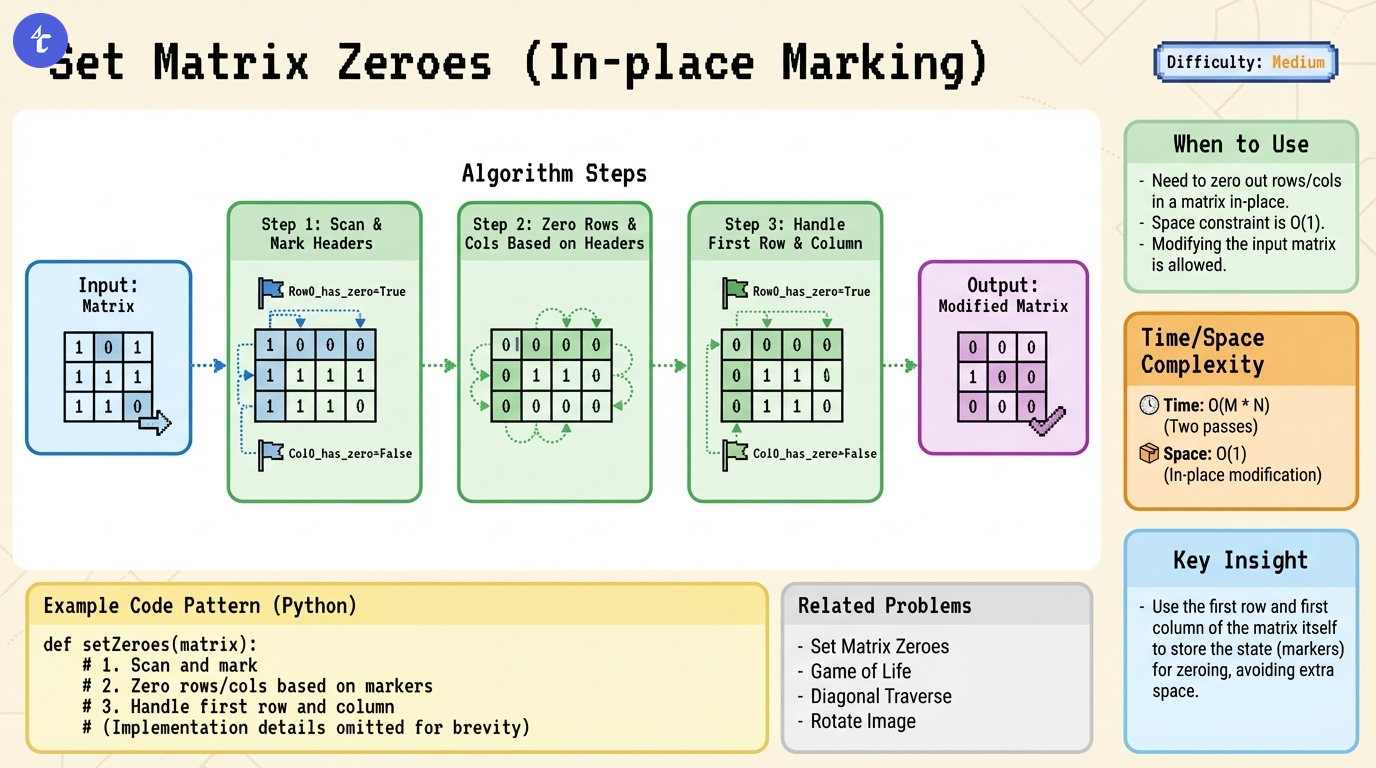
- LeetCode 73: Set Matrix Zeroes: Uses the first row and first column as markers to store which rows/cols should be zeroed out, avoiding space.
- LeetCode 498: Diagonal Traverse: While primarily about traversal, complex variants often require marking visited cells in-place to prevent cycles or redundant processing without extra memory.
Feynman coach · Before you peek at the code
Can you explain the core insight in your own words?
If you can explain it before reading code, you’re far more likely to recall it under interview pressure.
Loading your attempt…
Reference Implementation
C++ Solution for LeetCode 289
1class Solution {
2public:
3    void gameOfLife(vector<vector<int>>& board) {
4        int m = board.size();
5        int n = board[0].size();
6
7        // Directions for 8 neighbors
8        int dr[] = {-1, -1, -1, 0, 0, 1, 1, 1};
9        int dc[] = {-1, 0, 1, -1, 1, -1, 0, 1};
10
11        // Pass 1: Mark transitions
12        // 0: Dead -> Dead
13        // 1: Live -> Live
14        // 2: Live -> Dead
15        // 3: Dead -> Live
16        for (int r = 0; r < m; ++r) {
17            for (int c = 0; c < n; ++c) {
18                int liveNeighbors = 0;
19
20                for (int i = 0; i < 8; ++i) {
21                    int nr = r + dr[i];
22                    int nc = c + dc[i];
23
24                    if (nr >= 0 && nr < m && nc >= 0 && nc < n) {
25                        // Check if neighbor was originally live (1 or 2)
26                        if (board[nr][nc] == 1 || board[nr][nc] == 2) {
27                            liveNeighbors++;
28                        }
29                    }
30                }
31
32                // Apply rules
33                if (board[r][c] == 1) {
34                    if (liveNeighbors < 2 || liveNeighbors > 3) {
35                        board[r][c] = 2; // Live -> Dead
36                    }
37                } else { // board[r][c] == 0
38                    if (liveNeighbors == 3) {
39                        board[r][c] = 3; // Dead -> Live
40                    }
41                }
42            }
43        }
44
45        // Pass 2: Finalize states
46        for (int r = 0; r < m; ++r) {
47            for (int c = 0; c < n; ++c) {
48                board[r][c] %= 2;
49            }
50        }
51    }
52};
Java Solution for LeetCode 289
1class Solution {
2    public void gameOfLife(int[][] board) {
3        int m = board.length;
4        int n = board[0].length;
5
6        // Directions array for neighbor checking
7        int[] dr = {-1, -1, -1, 0, 0, 1, 1, 1};
8        int[] dc = {-1, 0, 1, -1, 1, -1, 0, 1};
9
10        // Pass 1: Encode next state
11        // 0: Dead -> Dead
12        // 1: Live -> Live
13        // 2: Live -> Dead
14        // 3: Dead -> Live
15        for (int r = 0; r < m; r++) {
16            for (int c = 0; c < n; c++) {
17                int liveNeighbors = 0;
18
19                for (int i = 0; i < 8; i++) {
20                    int nr = r + dr[i];
21                    int nc = c + dc[i];
22
23                    if (nr >= 0 && nr < m && nc >= 0 && nc < n) {
24                        // Was the neighbor originally live? (1 or 2)
25                        if (board[nr][nc] == 1 || board[nr][nc] == 2) {
26                            liveNeighbors++;
27                        }
28                    }
29                }
30
31                if (board[r][c] == 1) {
32                    // Rule 1 & 3: Live cell dies
33                    if (liveNeighbors < 2 || liveNeighbors > 3) {
34                        board[r][c] = 2;
35                    }
36                } else {
37                    // Rule 4: Dead cell becomes live
38                    if (liveNeighbors == 3) {
39                        board[r][c] = 3;
40                    }
41                }
42            }
43        }
44
45        // Pass 2: Decode final state
46        for (int r = 0; r < m; r++) {
47            for (int c = 0; c < n; c++) {
48                board[r][c] %= 2;
49            }
50        }
51    }
52}
Python Solution for LeetCode 289
1class Solution:
2    def gameOfLife(self, board: List[List[int]]) -> None:
3        """
4        Do not return anything, modify board in-place instead.
5        """
6        m = len(board)
7        n = len(board[0])
8
9        # Directions: (row_delta, col_delta)
10        directions = [(-1,-1), (-1,0), (-1,1), (0,-1), (0,1), (1,-1), (1,0), (1,1)]
11
12        # Pass 1: Calculate next states and mark transitions
13        # 0: Dead -> Dead
14        # 1: Live -> Live
15        # 2: Live -> Dead
16        # 3: Dead -> Live
17        for r in range(m):
18            for c in range(n):
19                live_neighbors = 0
20                for dr, dc in directions:
21                    nr, nc = r + dr, c + dc
22                    if 0 <= nr < m and 0 <= nc < n:
23                        # Check if neighbor was originally live
24                        if board[nr][nc] == 1 or board[nr][nc] == 2:
25                            live_neighbors += 1
26
27                # Apply rules
28                if board[r][c] == 1:
29                    if live_neighbors < 2 or live_neighbors > 3:
30                        board[r][c] = 2  # Live -> Dead
31                else:
32                    if live_neighbors == 3:
33                        board[r][c] = 3  # Dead -> Live
34
35        # Pass 2: Update to final state
36        for r in range(m):
37            for c in range(n):
38                board[r][c] %= 2