
Editorial
Core insight
Group Anagrams · String Manipulation Patterns
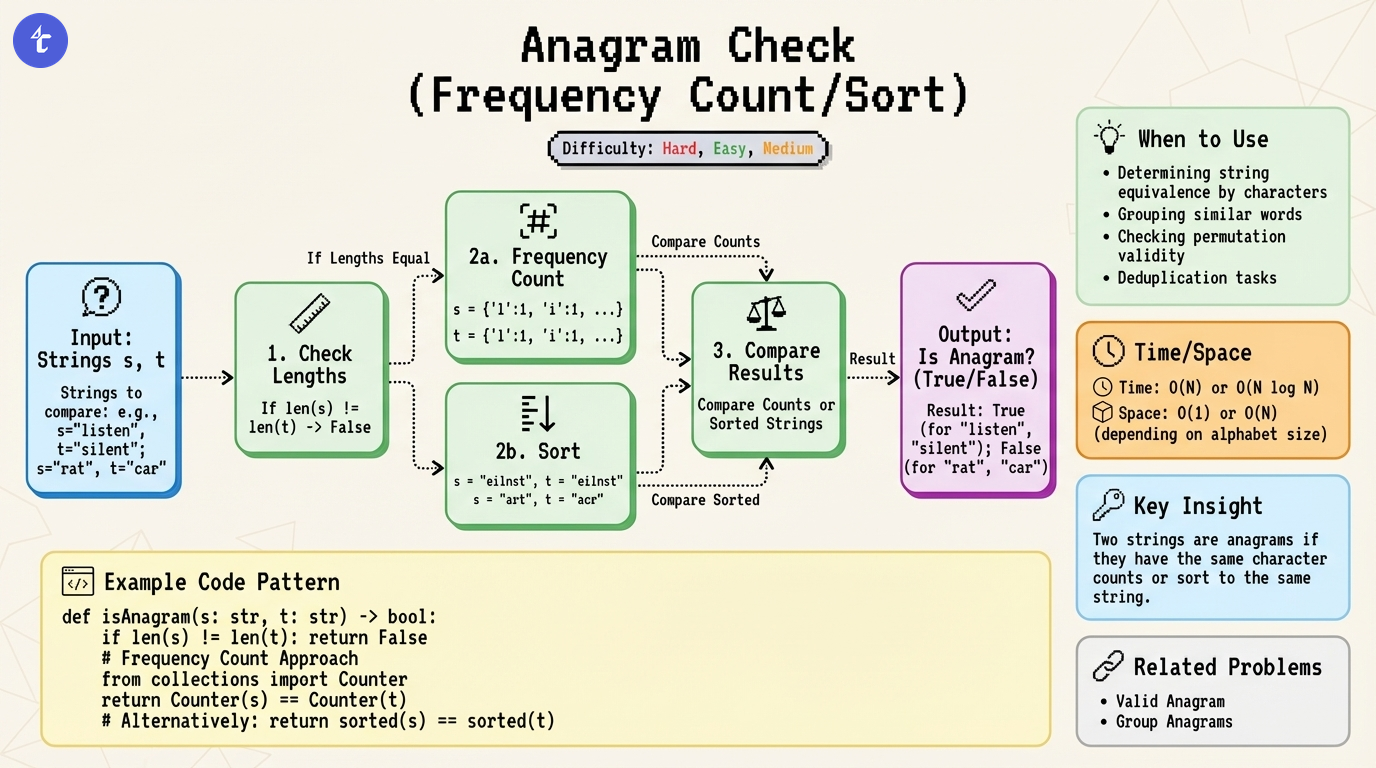
Core Insight for Group Anagrams
The key intuition for solving LeetCode 49 efficiently lies in finding a "Canonical Representation" for each group of anagrams.
We need a way to map multiple different strings (e.g., "eat", "tea", "ate") to a single, unique identifier. If two strings are anagrams, they must map to the exact same identifier. If they are not anagrams, they must map to different identifiers.
There are two primary ways to generate this identifier based on the subpattern:
- Sorting: If you sort the characters of "eat", "tea", and "ate" alphabetically, they all become "aet".
- Frequency Count: You can count the occurrences of each character (e.g., a:1, e:1, t:1) and use that count array as a key.
For this editorial, we focus on the Sorting strategy as it is the most intuitive implementation of the pattern and highly effective for the given constraints ().
Visual Description:
Imagine the data flow as a mapping process. The algorithm views the input array as a set of raw values. It applies a transformation function Sort(s) to each value.
- Input:
["eat", "tea", "tan", "ate", "nat", "bat"] - Transformation Layer:
- "eat" "aet"
- "tea" "aet"
- "tan" "ant"
- The Hash Map acts as a bucket collector. The keys are the transformed values ("aet", "ant"). The values are lists accumulating the original raw strings. All strings transforming to "aet" fall into the same bucket.
Deep dive
Full breakdown
Full reasoning, pitfalls, and implementation flow
LeetCode 49: Group Anagrams Solution & Explanation
Problem Overview
TL;DR: The optimal solution utilizes a Hash Map to group strings by using their sorted character sequence as a unique key (canonical form).
The LeetCode 49 problem, "Group Anagrams," asks us to process an array of strings and categorize them into groups where every string in a group is an anagram of the others. An anagram is defined as a word or phrase formed by rearranging the letters of a different word or phrase, typically using all the original letters exactly once. The order of the output groups does not matter.
This is a classic interview question that tests your ability to identify shared properties between data objects and efficient hashing strategies.
Brute Force Approach for Group Anagrams
The naive approach involves iterating through the array and, for each string, checking it against every other string to see if they are anagrams. If a match is found, they are grouped together. To prevent processing the same string twice, we would need to maintain a visited array.
Naive Algorithm Logic:
- Initialize a list of groups.
- Iterate through the input array with index
i. - If
strs[i]has been visited, skip it. - Create a new group containing
strs[i]. - Iterate through the rest of the array with index
j. - Check if
strs[j]is an anagram ofstrs[i](often by sorting both temp strings). - If yes, add
strs[j]to the group and markstrs[j]as visited.
Why this fails: The time complexity of this approach is roughly , where is the number of strings and is the maximum length of a string.
- The nested loops result in comparisons.
- The anagram check (usually via sorting) takes .
Given the constraint , results in operations before even considering the string length factor. This will almost certainly result in a Time Limit Exceeded (TLE) error on modern coding platforms.
Algorithm Strategy: String Manipulation Patterns
We will implement the solution using a Hash Map (or Dictionary) to group the data in a single pass ().
-
Data Structure Initialization: Create a Hash Map where:
- The Key is a String (the sorted version of the word).
- The Value is a List of Strings (the group of anagrams).
-
Iteration: Loop through every string in the input array
strs. -
Canonical Key Generation: For the current string, generate its key by sorting its characters. This enforces the constraint that order does not matter, only character composition.
-
Grouping:
- Check if this sorted key exists in the Hash Map.
- If not, initialize a new entry with this key and an empty list.
- Append the original (unsorted) string to the list associated with the sorted key.
-
Output: Extract all the lists (values) from the Hash Map and return them.
This strategy effectively reduces the comparison complexity from checking every pair () to checking against a hash table ( average), resulting in a linear dependency on .
Execution Flow
Let's trace the algorithm with the input: strs = ["eat", "tea", "tan", "ate", "nat", "bat"].
-
Initialize Map:
groups = {} -
Process "eat":
- Sort "eat" Key: "aet"
- "aet" not in map. Create entry.
groupsstate:{"aet": ["eat"]}
-
Process "tea":
- Sort "tea" Key: "aet"
- "aet" exists. Append "tea".
groupsstate:{"aet": ["eat", "tea"]}
-
Process "tan":
- Sort "tan" Key: "ant"
- "ant" not in map. Create entry.
groupsstate:{"aet": ["eat", "tea"], "ant": ["tan"]}
-
Process "ate":
- Sort "ate" Key: "aet"
- "aet" exists. Append "ate".
groupsstate:{"aet": ["eat", "tea", "ate"], "ant": ["tan"]}
-
Process "nat":
- Sort "nat" Key: "ant"
- "ant" exists. Append "nat".
groupsstate:{"aet": ["eat", "tea", "ate"], "ant": ["tan", "nat"]}
-
Process "bat":
- Sort "bat" Key: "abt"
- "abt" not in map. Create entry.
groupsstate:{"aet": [...], "ant": [...], "abt": ["bat"]}
-
Return: Collect values
[["eat", "tea", "ate"], ["tan", "nat"], ["bat"]].
Proof of Correctness
The correctness relies on the fundamental theorem of anagrams: Two strings are anagrams if and only if they contain the exact same characters with the exact same frequencies.
By sorting the characters of a string, we produce a standardized sequence. If string and string are anagrams, their sorted versions and must be identical because sorting is deterministic and depends solely on character composition. Conversely, if and are not anagrams, they differ in character composition, implying .
Therefore, the sorted string serves as a perfect hash key that collides strictly for anagrams and remains unique for non-anagrams.
Pattern Reuse Notes
The "Canonical Representation" pattern used here is highly versatile.
- LeetCode 242: Valid Anagram: This is the simplified version of Group Anagrams. Instead of grouping many strings, you simply compare two. The logic is identical: Sort both and compare, or use a frequency counter array.
- Isomorphic Strings: Similar to anagrams, this requires mapping characters to a canonical form (e.g., "paper" and "title" both map to a pattern like
0,1,0,2,3) to check for structural equality.
Feynman coach · Before you peek at the code
Can you explain the core insight in your own words?
If you can explain it before reading code, you’re far more likely to recall it under interview pressure.
Loading your attempt…
Reference Implementation
C++ Solution for LeetCode 49
1#include <vector>
2#include <string>
3#include <unordered_map>
4#include <algorithm>
5
6using namespace std;
7
8class Solution {
9public:
10    vector<vector<string>> groupAnagrams(vector<string>& strs) {
11        // Map to store sorted string -> list of original strings
12        unordered_map<string, vector<string>> groups;
13
14        for (const string& s : strs) {
15            string key = s;
16            // Sort the string to create the canonical key
17            sort(key.begin(), key.end());
18
19            // Add the original string to the corresponding group
20            groups[key].push_back(s);
21        }
22
23        // Extract the grouped anagrams from the map
24        vector<vector<string>> result;
25        for (auto& entry : groups) {
26            result.push_back(entry.second);
27        }
28
29        return result;
30    }
31};
Java Solution for LeetCode 49
1import java.util.*;
2
3class Solution {
4    public List<List<String>> groupAnagrams(String[] strs) {
5        if (strs == null || strs.length == 0) {
6            return new ArrayList<>();
7        }
8
9        // Map to store sorted string -> list of original strings
10        Map<String, List<String>> map = new HashMap<>();
11
12        for (String s : strs) {
13            // Convert to char array to sort
14            char[] characters = s.toCharArray();
15            Arrays.sort(characters);
16
17            // Create the canonical key
18            String key = new String(characters);
19
20            // Add to map, initializing list if key doesn't exist
21            if (!map.containsKey(key)) {
22                map.put(key, new ArrayList<>());
23            }
24            map.get(key).add(s);
25        }
26
27        // Return only the values (the lists of grouped anagrams)
28        return new ArrayList<>(map.values());
29    }
30}
Python Solution for LeetCode 49
1from collections import defaultdict
2
3class Solution:
4    def groupAnagrams(self, strs: List[str]) -> List[List[str]]:
5        # Defaultdict avoids checking if key exists explicitly
6        anagram_map = defaultdict(list)
7
8        for s in strs:
9            # Sort the string to create the canonical key
10            # sorted(s) returns a list, so we join it back to a string
11            # or use a tuple as the dict key
12            sorted_key = "".join(sorted(s))
13
14            # Append original string to the correct group
15            anagram_map[sorted_key].append(s)
16
17        return list(anagram_map.values())