
Editorial
Core insight
Largest Rectangle in Histogram · Stack Patterns
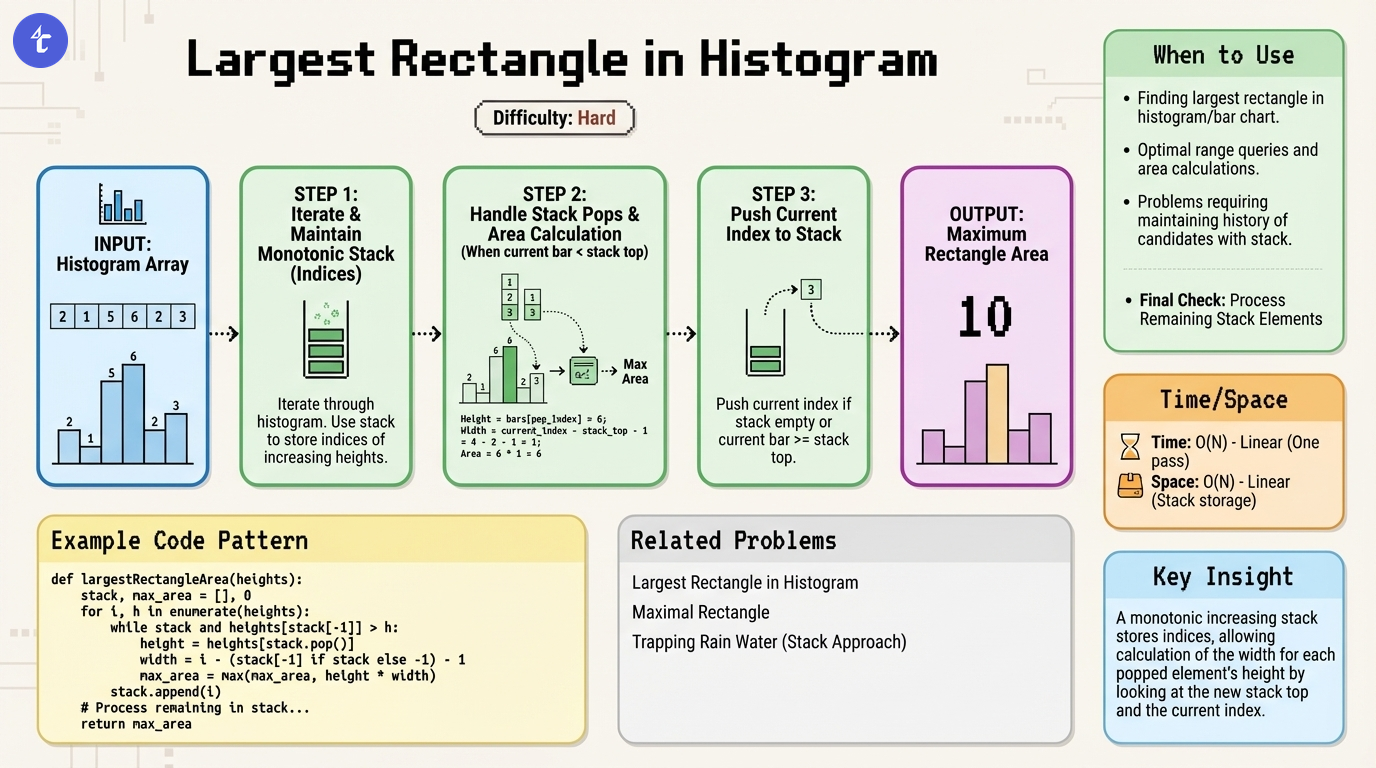
Core Insight for Largest Rectangle in Histogram
The inefficiency of the brute force method comes from repeatedly scanning the array to find how far a bar can extend. We need a way to determine the left and right boundaries for every bar in a single pass.
The core insight is that a bar at index i with height h can extend to the right until it encounters an index j where heights[j] < h. Similarly, it extends to the left until it hits an index k where heights[k] < h.
We can maintain a Monotonic Increasing Stack of indices. This stack maintains the invariant that the heights corresponding to the indices in the stack are always in strictly increasing order.
- Push Condition: If the current bar is taller than the bar at the stack's top, we push the current index. This indicates the current bar's left boundary might be the stack top.
- Pop Condition: If the current bar is shorter than the bar at the stack's top, we have found the Right Boundary for the bar at the stack top. The current index
iis the first index to the right that is smaller. - Left Boundary: When we pop an index (let's call it
popped_index) to process its area, the new top of the stack (after the pop) represents the first index to the left that is smaller. This is the Left Boundary.
By processing the area of a bar only when it is popped from the stack, we ensure that we know both its left limit (the element currently below it in the stack) and its right limit (the current element i that caused the pop).
Visual Description: Imagine iterating through the histogram. As long as bars are getting taller, we stack them up. The moment we see a drop in height (a smaller bar), we stop and look at the stack. The tall bars currently on the stack cannot extend past this new smaller bar. We pop the tallest bar. Its area is determined by its own height and the distance between the current "smaller" bar and the next bar remaining on the stack. We repeat this until the stack satisfies the increasing condition again.
Deep dive
Full breakdown
Full reasoning, pitfalls, and implementation flow
LeetCode 84: Largest Rectangle in Histogram Solution & Explanation
Problem Overview
TL;DR: The optimal solution uses a monotonic increasing stack to find the nearest smaller bars on the left and right for every element in time, calculating the maximum possible area where each bar acts as the height bottleneck.
The LeetCode 84 problem asks us to find the area of the largest rectangle that can be formed within a histogram. We are given an array of integers representing the heights of bars, assuming each bar has a width of 1. We must determine the contiguous sub-array of bars that forms the largest rectangular area, where the height of the rectangle is limited by the shortest bar in that sub-array.
This is a classic interview problem that tests the ability to optimize geometric array problems using stack-based data structures.
Brute Force Approach for Largest Rectangle in Histogram
The naive approach involves checking every possible pair of bars to define the start and end of a rectangle, or alternatively, expanding outwards from every bar to find its maximum width.
For each bar at index i, we can treat heights[i] as the height of a potential rectangle. We then expand to the left and right as long as the adjacent bars are greater than or equal to heights[i]. Once we hit a bar smaller than heights[i] (or the array boundaries), we stop. The width is the distance between these boundaries.
Pseudo-code:
max_area = 0
for i from 0 to n-1:
    height = heights[i]
    left = i
    right = i

    // Expand left
    while left >= 0 and heights[left] >= height:
        left--

    // Expand right
    while right < n and heights[right] >= height:
        right++

    width = (right - 1) - (left + 1) + 1
    max_area = max(max_area, height * width)

return max_area
Complexity Analysis:
The time complexity is . In the worst case (e.g., a sorted array like [1, 2, 3, 4, 5]), for every bar, the inner loops traverse a significant portion of the array. Given the constraint , an solution performs approximately operations, which results in a Time Limit Exceeded (TLE) error.
Algorithm Strategy: Stack Patterns
- Initialize an empty stack to store indices.
- Initialize
maxAreato 0. - Iterate through the
heightsarray using an indexi. - While the stack is not empty AND the current bar
heights[i]is less than the bar at the index at the top of the stack:- This means the bar at
stack.top()cannot extend further right. - Pop the top index; let this be
h_index. - The height of the rectangle is
heights[h_index]. - The right boundary is the current index
i. - The left boundary is the new
stack.top()(if the stack is empty, the width extends to the very beginning). - Calculate width:
i - stack.top() - 1(oriif stack is empty). - Update
maxArea.
- This means the bar at
- Push the current index
ionto the stack. - Cleanup: After the loop finishes, the stack may still contain elements. These are bars that never found a smaller bar to the right. Their right boundary is the end of the array (index
n).- Process the remaining elements in the stack using the same logic, treating the current index as
n.
- Process the remaining elements in the stack using the same logic, treating the current index as
Execution Flow
Let's trace heights = [2, 1, 5, 6, 2, 3].
- i = 0, height = 2: Stack empty. Push 0. Stack:
[0](vals:[2]). - i = 1, height = 1:
1 < 2. Pop 0.- Height:
heights[0] = 2. - Right Boundary: 1.
- Stack empty Left Boundary: -1.
- Width:
1 - (-1) - 1 = 1. Area:2 * 1 = 2. Max: 2. - Push 1. Stack:
[1](vals:[1]).
- Height:
- i = 2, height = 5:
5 > 1. Push 2. Stack:[1, 2](vals:[1, 5]). - i = 3, height = 6:
6 > 5. Push 3. Stack:[1, 2, 3](vals:[1, 5, 6]). - i = 4, height = 2:
2 < 6. Pop 3.- Height:
heights[3] = 6. - Right: 4. Left: 2 (stack top).
- Width:
4 - 2 - 1 = 1. Area:6 * 1 = 6. Max: 6. - Stack:
[1, 2](vals:[1, 5]). 2 < 5. Pop 2.- Height:
heights[2] = 5. - Right: 4. Left: 1 (stack top).
- Width:
4 - 1 - 1 = 2. Area:5 * 2 = 10. Max: 10. - Stack:
[1](vals:[1]). 2 > 1. Push 4. Stack:[1, 4](vals:[1, 2]).
- Height:
- i = 5, height = 3:
3 > 2. Push 5. Stack:[1, 4, 5](vals:[1, 2, 3]). - End of array: Process remaining stack with
i = 6.- Pop 5 (height 3): Width
6 - 4 - 1 = 1. Area 3. - Pop 4 (height 2): Width
6 - 1 - 1 = 4. Area 8. - Pop 1 (height 1): Width
6 - (-1) - 1 = 6. Area 6.
- Pop 5 (height 3): Width
- Result: 10.
Proof of Correctness
The algorithm ensures correctness by systematically considering every bar as the shortest bar in a potential rectangle. For any specific bar x, the widest possible rectangle with height heights[x] extends from the first element smaller than x on the left to the first element smaller than x on the right.
The monotonic stack invariant guarantees that when we pop an index, we have correctly identified these exact boundaries. Since the maximum area rectangle must have some bar that serves as its minimum height bottleneck, and we calculate the max area for every bar serving as that bottleneck, the global maximum area is guaranteed to be found.
Pattern Reuse Notes
The logic used in LeetCode 84: Largest Rectangle in Histogram is directly applicable to:
- LeetCode 85: Maximal Rectangle: This problem involves a 2D binary matrix. By treating each row as the base of a histogram (accumulating heights from rows above), you can solve LeetCode 85 by running the LeetCode 84 algorithm on each row.
Feynman coach · Before you peek at the code
Can you explain the core insight in your own words?
If you can explain it before reading code, you’re far more likely to recall it under interview pressure.
Loading your attempt…
Reference Implementation
C++ Solution for LeetCode 84
1#include <vector>
2#include <stack>
3#include <algorithm>
4
5using namespace std;
6
7class Solution {
8public:
9    int largestRectangleArea(vector<int>& heights) {
10        stack<int> s;
11        int maxArea = 0;
12        int n = heights.size();
13
14        for (int i = 0; i <= n; i++) {
15            // Use current height or 0 if we reached the end to flush stack
16            int currentHeight = (i == n) ? 0 : heights[i];
17
18            // Maintain monotonic increasing stack
19            while (!s.empty() && currentHeight < heights[s.top()]) {
20                int h = heights[s.top()];
21                s.pop();
22
23                // Determine width
24                // Right boundary is i
25                // Left boundary is s.top() (exclusive)
26                // If stack is empty, width extends from 0 to i
27                int w = s.empty() ? i : i - s.top() - 1;
28
29                maxArea = max(maxArea, h * w);
30            }
31            s.push(i);
32        }
33
34        return maxArea;
35    }
36};
Java Solution for LeetCode 84
1import java.util.ArrayDeque;
2import java.util.Deque;
3
4class Solution {
5    public int largestRectangleArea(int[] heights) {
6        Deque<Integer> stack = new ArrayDeque<>();
7        int maxArea = 0;
8        int n = heights.length;
9
10        // Iterate through all bars plus one extra iteration (i=n) to clear stack
11        for (int i = 0; i <= n; i++) {
12            int currentHeight = (i == n) ? 0 : heights[i];
13
14            while (!stack.isEmpty() && currentHeight < heights[stack.peek()]) {
15                int h = heights[stack.pop()];
16
17                // Calculate width
18                // Right boundary is i
19                // Left boundary is stack.peek() (exclusive)
20                int w = stack.isEmpty() ? i : i - stack.peek() - 1;
21
22                maxArea = Math.max(maxArea, h * w);
23            }
24            stack.push(i);
25        }
26
27        return maxArea;
28    }
29}
Python Solution for LeetCode 84
1class Solution:
2    def largestRectangleArea(self, heights: list[int]) -> int:
3        stack = [] # Stores indices
4        max_area = 0
5        n = len(heights)
6
7        # Iterate through array.
8        # We go up to n to handle the cleanup of remaining items in stack.
9        for i in range(n + 1):
10            # Use 0 height for index n to force pops
11            current_height = heights[i] if i < n else 0
12
13            while stack and current_height < heights[stack[-1]]:
14                h = heights[stack.pop()]
15
16                # Determine width
17                # If stack is empty, width is the entire distance to i
18                # Else, width is distance between current i and new top
19                w = i if not stack else i - stack[-1] - 1
20
21                max_area = max(max_area, h * w)
22
23            stack.append(i)
24
25        return max_area