15% off all plans & roadmaps Use code
See plans
Editorial
Core insight
Longest Consecutive Sequence · Array/Matrix Manipulation Patterns
Core Insight for Longest Consecutive Sequence
The key improvement is to remove repeated full-array searches by placing every distinct number into a hash set.
For any value x:
- If
x - 1exists, thenxis not the beginning of a sequence. - If
x - 1does not exist, thenxis a sequence start. - Starting from such a value, repeatedly check whether
x + 1,x + 2, and later values exist.
This start-value condition is the main invariant:
A value is expanded only when its immediate predecessor is absent.
As a result, every consecutive sequence is scanned from its smallest value exactly once. Values in the middle of a sequence are not expanded independently, because their predecessors exist.
Duplicates are automatically removed when the input is inserted into the set. Therefore, duplicate entries cannot inflate the sequence length.
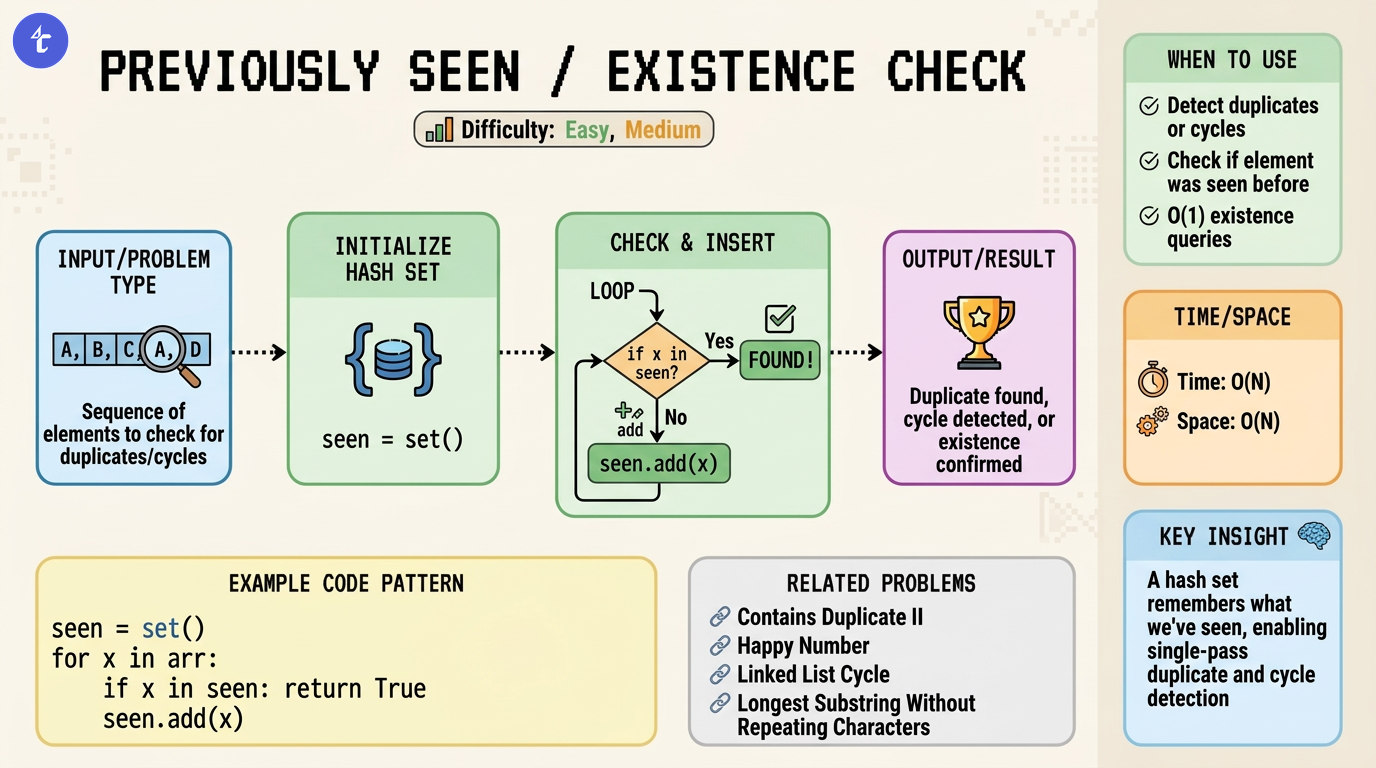
Visual Description
The algorithm represents the input as a set of distinct numeric positions. During iteration, a value with an existing predecessor is marked as an internal position and receives no forward scan. A value without a predecessor is marked as a sequence boundary, and the algorithm checks positions to its right one at a time until the first missing value. The tracked state consists of the current boundary, the current sequence length, and the global maximum length.
Deep dive
Full breakdown
Full reasoning, pitfalls, and implementation flow
LeetCode 128: Longest Consecutive Sequence Solution & Explanation
Problem Overview
TL;DR: Store all values in a hash set, begin counting only from values with no predecessor, and extend each sequence by checking whether successive values exist.
For LeetCode 128: Longest Consecutive Sequence, return the length of the longest sequence of distinct integers that increase by exactly 1. The values do not need to be adjacent in the input array, and duplicate values should be counted only once.
The required LeetCode 128 Solution must run in expected O(n) time, where n is the number of elements in nums. This makes direct sorting unsuitable because sorting requires O(n log n) time.
This is a popular interview question because it tests hash-set membership checks, duplicate handling, and the ability to avoid repeated work. The optimal solution for interviews identifies the beginning of each sequence before scanning forward.
Brute Force Approach for Longest Consecutive Sequence
A direct approach is to examine every value as a possible starting point:
- Select a value from
nums. - Check whether
value + 1exists anywhere in the array. - Continue searching for
value + 2,value + 3, and so on. - Stop when the next value does not exist.
- Track the longest sequence found.
Because the array is unsorted, each existence check may scan the entire array.
Naive Pseudocode
longest = 0

for each value in nums:
    length = 1
    nextValue = value + 1

    while nextValue exists in nums:
        length += 1
        nextValue += 1

    longest = max(longest, length)

return longest
If the array contains a long consecutive range, the algorithm repeatedly scans nums for many successive values. For example, a range of n consecutive values can cause approximately n searches, each taking O(n) time.
Therefore:
- Time complexity:
O(n^2)in the worst case - Space complexity:
O(1)additional space, excluding the input
With n up to 100,000, this approach can require billions of comparisons and will likely result in Time Limit Exceeded.
Algorithm Strategy: Array/Matrix Manipulation Patterns
- Insert every element of
numsinto a hash set namedvalues. - Initialize
longestto0. - Iterate through each distinct value in the set.
- Check whether
value - 1exists:- If it exists, skip this value because it is not a sequence start.
- If it does not exist, begin a new sequence from
value.
- Starting with a length of
1, check whethervalue + lengthexists in the set. - Increase the length while consecutive values are present.
- Update
longestwith the largest sequence length found. - Return
longest.
The hash set enforces constant-time expected existence checks, while the predecessor condition prevents the same sequence from being expanded repeatedly.
Execution Flow
Consider the values:
[14, 9, 11, 10, 13, 15, 15, 2]After hashing, the distinct values are:
{2, 9, 10, 11, 13, 14, 15}The execution proceeds as follows:
-
For
2:1is absent, so2is a sequence start.3is absent, so the sequence length is1.longestbecomes1.
-
For
9:8is absent, so9is a sequence start.10and11exist.12is absent.- The sequence length is
3, solongestbecomes3.
-
For
10:9exists.- Skip
10; it is already covered by the sequence beginning at9.
-
For
11:10exists.- Skip
11.
-
For
13:12is absent, so13is a sequence start.14and15exist.16is absent.- The sequence length is
3.
-
For
14and15:- Their predecessors exist.
- Both values are skipped.
-
Return
3.
The iteration order of a hash set is unspecified, but the result is independent of that order because every sequence is expanded only from its smallest value.
Proof of Correctness
We prove that the algorithm returns the length of the longest consecutive sequence.
Claim 1: Every sequence is expanded from its smallest value
Let a consecutive sequence have smallest value s. By definition, s - 1 is not part of that sequence. If s - 1 existed anywhere in the set, then s would not be the smallest value of its maximal consecutive sequence. Therefore, the algorithm identifies s as a valid sequence start.
Claim 2: Starting from a valid sequence start counts the entire sequence
When the algorithm starts at s, it checks:
s + 1, s + 2, s + 3, ...It increments the length for every value found in the set. Since the sequence contains exactly consecutive values, the loop stops at the first missing value. Thus, the computed length is exactly the length of the sequence beginning at s.
Claim 3: No sequence is counted multiple times
Any value after the smallest value of a sequence has an immediate predecessor in the set. The algorithm skips such values because they fail the condition:
value - 1 not in valuesTherefore, each maximal consecutive sequence is expanded exactly once.
Conclusion
Every maximal consecutive sequence is counted exactly once, and its exact length is compared with longest. Therefore, the algorithm returns the length of the longest consecutive sequence.
Pattern Reuse Notes
The following problems share the same pattern/subpattern:
- LeetCode 202: Happy Number
- LeetCode 349: Intersection of Two Arrays
- LeetCode 219: Contains Duplicate II
- LeetCode 3: Longest Substring Without Repeating Characters
Each problem uses hashing to record values or states and perform efficient existence checks. Happy Number detects previously seen transformations, Intersection of Two Arrays checks whether values occur in another collection, Contains Duplicate II tracks recent positions, and Longest Substring Without Repeating Characters tracks characters currently represented in a window. For Longest Consecutive Sequence, the same subpattern is applied to integer existence checks and sequence-boundary detection.
Feynman coach · Before you peek at the code
Can you explain the core insight in your own words?
If you can explain it before reading code, you’re far more likely to recall it under interview pressure.
Loading your attempt…
Reference Implementation
C++ Solution for LeetCode 128
1class Solution {
2public:
3    int longestConsecutive(vector<int>& nums) {
4        unordered_set<int> values(nums.begin(), nums.end());
5        int longest = 0;
6
7        for (int value : values) {
8            if (values.find(value - 1) != values.end()) {
9                continue;
10            }
11
12            int length = 1;
13            while (values.find(value + length) != values.end()) {
14                ++length;
15            }
16            longest = max(longest, length);
17        }
18
19        return longest;
20    }
21};
The unordered_set removes duplicates and supports expected O(1) membership checks. The continue statement ensures that only sequence starts perform forward expansion.
Java Solution for LeetCode 128
1class Solution {
2    public int longestConsecutive(int[] nums) {
3        java.util.Set<Integer> values = new java.util.HashSet<>();
4        for (int num : nums) {
5            values.add(num);
6        }
7
8        int longest = 0;
9
10        for (int value : values) {
11            if (!values.contains(value - 1)) {
12                int length = 1;
13                while (values.contains(value + length)) {
14                    length++;
15                }
16                longest = Math.max(longest, length);
17            }
18        }
19
20        return longest;
21    }
22}
The Java implementation follows the same boundary-detection invariant. A value is expanded only when its predecessor is absent from the HashSet.
Python Solution for LeetCode 128
1from typing import List, Optional
2
3
4class Solution:
5    def longestConsecutive(self, nums: List[int]) -> int:
6        values = set(nums)
7        longest = 0
8
9        for value in values:
10            if value - 1 not in values:
11                length = 1
12                while value + length in values:
13                    length += 1
14                longest = max(longest, length)
15
16        return longest
Python's set automatically removes duplicates and provides expected constant-time membership checks. The empty input case works naturally because the set is empty and longest remains 0.