15% off all plans & roadmaps Use code
See plans
Editorial
Core insight
Pow(x, n) · Bit Manipulation Patterns
Core Insight for Pow(x, n)
The exponent can be represented as a sum of powers of two. For example:
13 = 8 + 4 + 1Therefore:
x^13 = x^8 * x^4 * x^1Instead of computing every intermediate power separately, repeatedly square the current base:
x
x^2
x^4
x^8
x^16
...
At each step:
- If the current exponent is odd, its lowest bit is
1, so the current power must be included inresult. - Square the current base to move from
x^(2^k)tox^(2^(k+1)). - Shift the exponent right by one bit to discard the bit that was just processed.
Negative exponents are normalized before this loop:
x^(-n) = (1 / x)^nThis allows the main loop to process only a non-negative exponent.
The key invariant is:
After each iteration,
resultcontains the product of all power-of-two components already selected from the original exponent, whilexrepresents the next power of the base andexponentcontains only the unprocessed higher bits.
The C++ and Java implementations first store n in a long long or long. This is necessary because the minimum 32-bit signed integer, -2^31, cannot be safely negated while still represented as an int.
Visual description: The algorithm maintains three changing values in one linear state sequence: result, the current squared base, and the remaining exponent bits. At each node of this sequence, the least significant bit determines whether the current base is multiplied into result; then the base is squared and the exponent shifts right. The sequence ends when all exponent bits have been removed.
Deep dive
Full breakdown
Full reasoning, pitfalls, and implementation flow
LeetCode 50: Pow(x, n) Solution & Explanation
Problem Overview
TL;DR: Convert negative exponents using a reciprocal, then use exponentiation by squaring while reading the exponent bit by bit to compute the result in O(log |n|) time.
LeetCode 50, Pow(x, n), asks you to compute x^n for a floating-point base x and a 32-bit signed integer exponent n. The exponent may be positive, zero, or negative, and the result must be returned as a floating-point value within the accepted numerical error.
This LeetCode 50 Solution uses the binary representation of the exponent. Each set bit identifies a power of x that belongs in the final product, while repeated squaring generates those powers efficiently. This is a popular interview question because it tests exponent manipulation, bitwise operations, numerical edge cases, and the optimal solution for interviews.
Brute Force Approach for Pow(x, n)
The direct approach multiplies the base by itself once for every unit in the absolute value of the exponent.
For a non-negative exponent:
result = 1

repeat n times:
    result = result * x

return result
For a negative exponent, compute the positive power first and then take its reciprocal:
if n < 0:
    result = 1
    repeat -n times:
        result = result * x
    return 1 / result

return result
The time complexity is:
O(|n|)The exponent can be as large as 2^31 - 1, so this method may require billions of multiplications. That causes a Time Limit Exceeded error and does not meet the expected efficiency for LeetCode 50. The solution must reduce the number of multiplication steps from linear in |n| to logarithmic in |n|.
Algorithm Strategy: Bit Manipulation Patterns
- Store the exponent in a sufficiently wide integer type where necessary.
- If the exponent is negative:
- Replace
xwith1 / x. - Negate the exponent.
- Replace
- Initialize
resultto1.0. - While the exponent is greater than zero:
- Inspect its least significant bit.
- If that bit is
1, multiplyresultby the current base. - Square the current base.
- Shift the exponent right by one bit.
- Return
result.
The exponent bits determine which squared powers are included. The right shift guarantees that every bit is processed exactly once, and repeated squaring guarantees that the current base always corresponds to the next power of two.
Execution Flow
For x = 2 and n = 13:
- The exponent is positive, so the base remains
2. - Initialize:
result = 1 x = 2 exponent = 13 // binary 1101 - The least significant bit of
13is1:- Multiply
resultby2. - Square the base to
4. - Shift
13right to6.
- Multiply
- The least significant bit of
6is0:- Do not change
result. - Square the base to
16. - Shift
6right to3.
- Do not change
- The least significant bit of
3is1:- Multiply
resultby16. - Square the base to
256. - Shift
3right to1.
- Multiply
- The least significant bit of
1is1:- Multiply
resultby256. - Shift the exponent to
0.
- Multiply
- Stop and return:
2 * 16 * 256 = 8192 = 2^13
For a negative exponent such as n = -3:
- Replace
xwith1 / x. - Convert the exponent to
3. - Run the same bitwise loop.
- Return
(1 / x)^3, which equalsx^-3.
When n is zero, the loop executes zero times and the initial value result = 1.0 is returned.
Proof of Correctness
Let the original normalized exponent be N, where N >= 0.
At the beginning of each iteration:
resultcontains the product of the powers corresponding to all previously processed set bits.xequals the original normalized base raised to2^k, wherekis the number of processed bits.exponentcontains the remaining bits ofNafter removing the lowestkbits.
If the current least significant bit is 1, the current power x is part of the binary decomposition of N, so multiplying it into result preserves the correct product. If the bit is 0, no multiplication is needed.
Afterward:
- Squaring
xchanges it from the powerbase^(2^k)tobase^(2^(k+1)). - Right-shifting
exponentremoves the processed bit and exposes the next bit.
Thus, the invariant remains true after every iteration. When exponent becomes zero, all bits of N have been processed, so result equals the normalized base raised to N.
For an original negative exponent, the algorithm first uses:
x^n = (1 / x)^(-n)Therefore, the same proof applies after normalization. If n is zero, no bits are processed and the initialized result 1.0 is mathematically correct.
Pattern Reuse Notes
The following problems share the same pattern/subpattern:
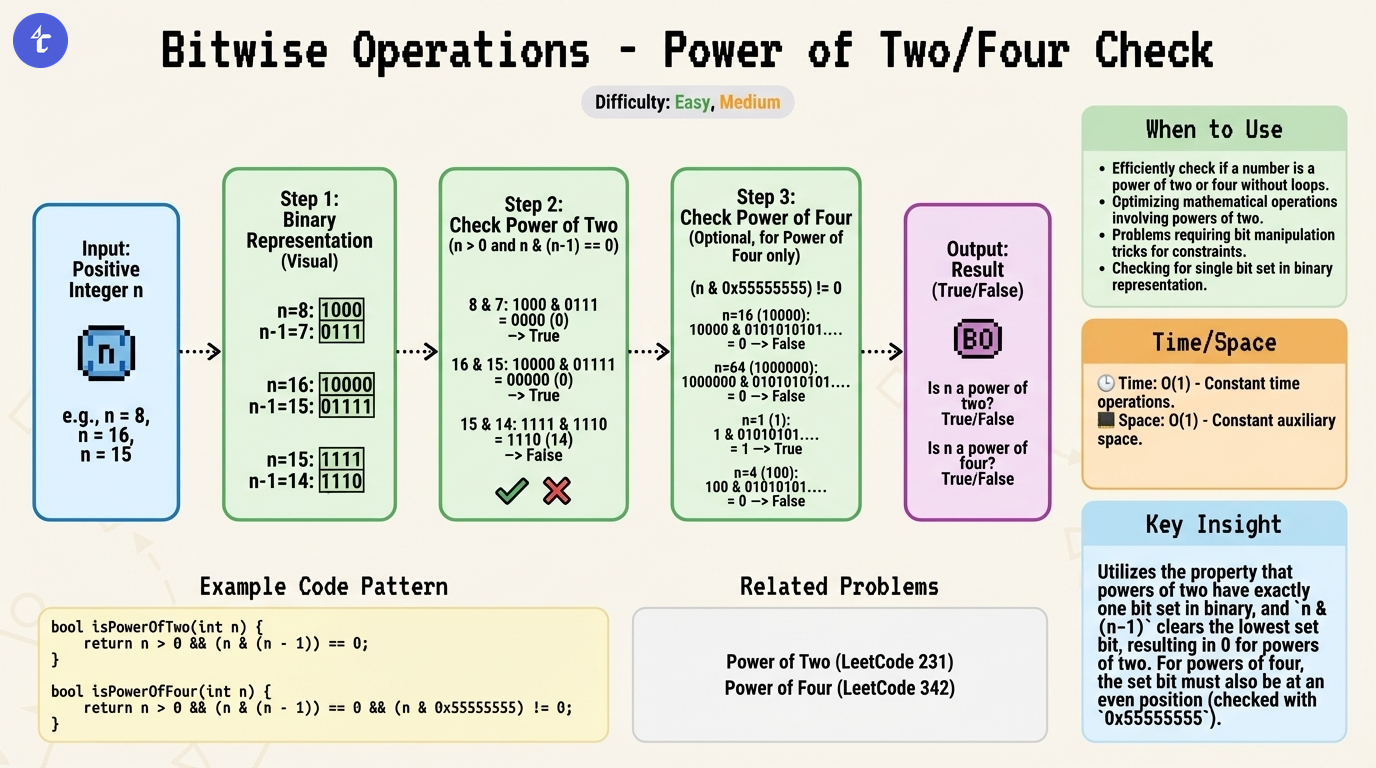
Both problems inspect binary structure using bitwise operations. Power of Two checks whether exactly one bit is set, while Power of Four adds a positional constraint on that set bit. Pow(x, n) uses the same binary representation principles differently: it processes every exponent bit and uses repeated squaring to construct the corresponding powers.
The Pow(x, n) technique is therefore exponentiation by squaring guided by bitwise exponent processing, making it a direct example of the Bit Manipulation Patterns curriculum.
Feynman coach · Before you peek at the code
Can you explain the core insight in your own words?
If you can explain it before reading code, you’re far more likely to recall it under interview pressure.
Loading your attempt…
Reference Implementation
C++ Solution for LeetCode 50
1class Solution {
2public:
3    double myPow(double x, int n) {
4        long long exponent = n;
5        if (exponent < 0) {
6            x = 1.0 / x;
7            exponent = -exponent;
8        }
9
10        double result = 1.0;
11        while (exponent > 0) {
12            if (exponent & 1LL) {
13                result *= x;
14            }
15            x *= x;
16            exponent >>= 1;
17        }
18        return result;
19    }
20};
The long long exponent safely handles n = -2^31. The expression exponent & 1LL checks whether the current exponent bit is set, and exponent >>= 1 removes that bit after processing.
Java Solution for LeetCode 50
1class Solution {
2    public double myPow(double x, int n) {
3        long exponent = n;
4        if (exponent < 0) {
5            x = 1.0 / x;
6            exponent = -exponent;
7        }
8
9        double result = 1.0;
10        while (exponent > 0) {
11            if ((exponent & 1) != 0) {
12                result *= x;
13            }
14            x *= x;
15            exponent >>= 1;
16        }
17
18        return result;
19    }
20}
Java promotes n to long before negation, preventing overflow for the minimum integer value. The loop uses the same bit inspection, squaring, and right-shift transitions as the C++ version.
Python Solution for LeetCode 50
1class Solution:
2    def myPow(self, x: float, n: int) -> float:
3        if n < 0:
4            x = 1.0 / x
5            n = -n
6
7        result = 1.0
8        while n > 0:
9            if n & 1:
10                result *= x
11            x *= x
12            n >>= 1
13
14        return result
Python integers automatically support values beyond the 32-bit range, so negating the minimum exponent does not overflow. The bitwise loop directly mirrors the C++ and Java implementations.