15% off all plans & roadmaps Use code
See plans
Editorial
Core insight
Regular Expression Matching · Dynamic Programming (DP) Patterns
Core Insight for Regular Expression Matching
The recursive state is determined entirely by two positions:
- A position in the input string.
- A position in the pattern.
Therefore, the result for the same pair of positions is always identical. The DP table stores that result once instead of recomputing it.
The important transition is caused by *. If a pattern element is followed by *, the pair can be interpreted in two ways:
- Zero occurrences: skip both the element and
*. - At least one occurrence: if the element matches the current string character, consume one string character while keeping the same pattern element available.
For ordinary pattern characters and ., a match consumes one character from both sides.
The table must also enforce complete matching. The final state is true only when both the string and pattern have been fully consumed.
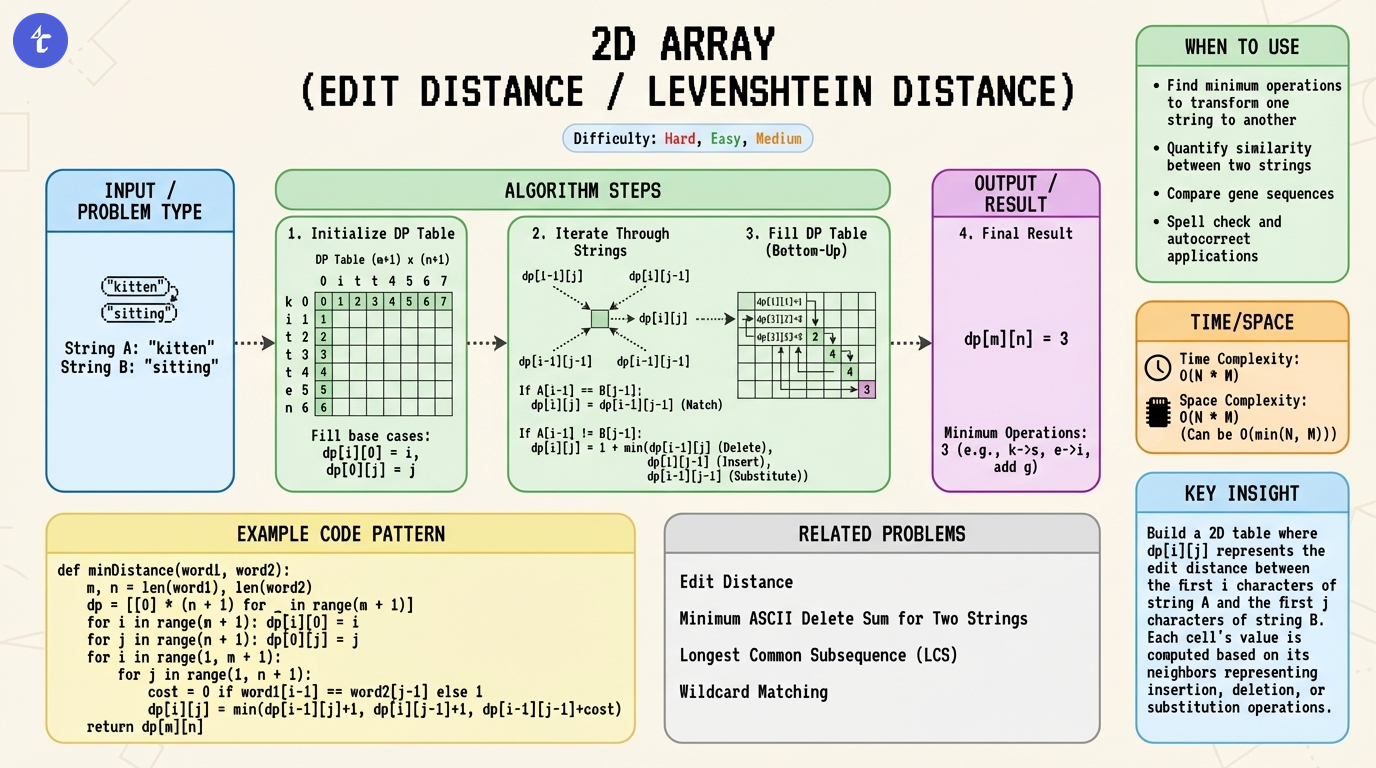
Visual Description: The DP table has one axis for positions in s and one axis for positions in p. Each cell records whether those two positions can complete a valid match. A normal character moves diagonally to the next string and pattern position. A * state can move two pattern positions forward for zero occurrences or move one string position forward while staying on the same pattern state for another occurrence. In the suffix-oriented implementations, these transitions move toward larger indices, and the final matching state is dp[0][0].
Deep dive
Full breakdown
Full reasoning, pitfalls, and implementation flow
LeetCode 10: Regular Expression Matching Solution & Explanation
Problem Overview
TL;DR: Use a two-dimensional dynamic programming table to determine whether every prefix of s can be matched by every prefix of p, handling * through its zero-occurrence and one-or-more-occurrence transitions.
The LeetCode 10 Solution determines whether the entire string s matches the entire pattern p. A lowercase letter matches itself, . matches any single character, and * allows the preceding element to appear zero or more times.
This is a popular interview question because it tests state design, boundary handling, and dynamic programming over two strings. The result must describe a complete match: matching only a prefix of s is not sufficient.
Brute Force Approach for Regular Expression Matching
A direct recursive solution explores every valid interpretation of *.
At a state (i, j):
irepresents the current position ins.jrepresents the current position inp.- If the current pattern element is followed by
*, there are two choices:- Skip the element and
*, treating it as occurring zero times. - If the current characters match, consume one character from
swhile keeping the pattern position unchanged.
- Skip the element and
- Otherwise, consume one character from both strings when they match.
Naive Pseudocode
match(i, j):
    if j == length(p):
        return i == length(s)

    firstMatch =
        i < length(s) and
        (p[j] == '.' or p[j] == s[i])

    if j + 1 < length(p) and p[j + 1] == '*':
        return match(i, j + 2) or
               (firstMatch and match(i + 1, j))

    return firstMatch and match(i + 1, j + 1)
The recursive calls can repeatedly evaluate the same (i, j) state. For example, patterns containing several * symbols can produce many different recursion paths that converge on identical string and pattern positions.
Complexity of the Brute Force Method
In the worst case, the recursion tree has exponential size. Its time complexity can reach:
O(2^(n + m))where n = s.length() and m = p.length().
Although the constraints are small, this repeated work makes the naive approach inefficient and vulnerable to Time Limit Exceeded on adversarial inputs. The repeated (i, j) states are the reason to use a two-dimensional DP table.
Algorithm Strategy: Dynamic Programming (DP) Patterns
Maintain a two-dimensional boolean table whose dimensions correspond to positions in the string and pattern.
The verified implementations use two equivalent orientations:
- The C++ implementation builds answers for prefixes:
dp[i][j]means the firsticharacters ofsmatch the firstjcharacters ofp.
- The Java and Python implementations build answers for suffixes:
dp[i][j]means the suffix beginning at pattern positionimatches the suffix beginning at string positionj.
For a * transition:
- The zero-occurrence option skips the preceding pattern element and
*. - The repeated-occurrence option consumes one string character if the preceding element matches, while keeping the
*state active.
For a regular character or ., the current elements must match, and the state advances diagonally.
The table initialization must account for empty strings. A pattern such as q* can match an empty string because the * group may be skipped.
Execution Flow
- Represent the current matching problem using two indices: one for
sand one forp. - Initialize the base case where both sides are empty:
- An empty string matches an empty pattern.
- Handle patterns that can match an empty string:
- A character followed by
*can be skipped. - This behavior may repeat across multiple
*groups.
- A character followed by
- For each state, determine whether the current pattern element matches the current string character:
- A literal matches the same literal.
.matches any available lowercase character.
- If the next pattern symbol is
*:- Transition past the pair for zero occurrences.
- If the current element matches, consume one string character and remain at the same pattern element.
- If the current pattern element is not part of a
*group:- Require a current-character match.
- Advance both positions.
- Return the state representing the complete string and complete pattern:
- In the C++ prefix table, this is
dp[n][m]. - In the Java and Python suffix tables, this is
dp[0][0].
- In the C++ prefix table, this is
Proof of Correctness
We prove that the DP result is true exactly when the corresponding string and pattern portions match completely.
Base Case
When both the string portion and pattern portion are empty, the match is valid. The table records this state as true.
If the string portion is empty and the remaining pattern consists of groups such as x*, each group can represent zero occurrences. The initialization or transitions therefore correctly mark such states as matchable.
Ordinary Character or .
If the current pattern element is not followed by *, it must consume exactly one string character.
- A literal is valid only when it equals the current string character.
.is valid for any current string character.
When the characters match, the algorithm relies on the state for the remaining portions. By the induction hypothesis, that remaining state is true exactly when the rest of the strings match.
* Transition
For a group consisting of an element followed by *, every valid match must use one of two possibilities:
- The element occurs zero times. The algorithm skips both the element and
*. - The element occurs at least once. The current element must match the current string character, and the algorithm consumes that character while keeping the same
*group available for additional occurrences.
These two transitions cover all valid interpretations of *. Since both transitions use smaller remaining portions or a shorter remaining string, their stored results are correct by induction.
Complete Match
The returned state represents the entire string and entire pattern, not merely a prefix. Therefore, the algorithm returns true exactly when all characters of s are consumed by all valid pattern elements of p.
Pattern Reuse Notes
The following problems share the same pattern/subpattern:
- LeetCode 583: Delete Operation for Two Strings
- LeetCode 72: Edit Distance
- LeetCode 712: Minimum ASCII Delete Sum for Two Strings
Each problem uses a two-dimensional DP table whose state is defined by positions in two strings. The transition meaning changes:
- Delete Operation for Two Strings minimizes deletions.
- Edit Distance combines insertion, deletion, and replacement costs.
- Minimum ASCII Delete Sum minimizes the total deletion value.
Regular Expression Matching stores boolean feasibility instead of a minimum cost, but the two-dimensional state organization is the same.
Feynman coach · Before you peek at the code
Can you explain the core insight in your own words?
If you can explain it before reading code, you’re far more likely to recall it under interview pressure.
Loading your attempt…
Reference Implementation
C++ Solution for LeetCode 10
1class Solution {
2public:
3    bool isMatch(string s, string p) {
4        int n = s.size();
5        int m = p.size();
6        vector<vector<bool>> dp(n + 1, vector<bool>(m + 1, false));
7        dp[0][0] = true;
8
9        for (int j = 2; j <= m; ++j) {
10            if (p[j - 1] == '*') {
11                dp[0][j] = dp[0][j - 2];
12            }
13        }
14
15        for (int i = 1; i <= n; ++i) {
16            for (int j = 1; j <= m; ++j) {
17                if (p[j - 1] == '*') {
18                    dp[i][j] = dp[i][j - 2];
19
20                    char preceding = p[j - 2];
21                    if (preceding == '.' || preceding == s[i - 1]) {
22                        dp[i][j] = dp[i][j] || dp[i - 1][j];
23                    }
24                } else if (p[j - 1] == '.' || p[j - 1] == s[i - 1]) {
25                    dp[i][j] = dp[i - 1][j - 1];
26                }
27            }
28        }
29
30        return dp[n][m];
31    }
32};
The C++ table uses prefix lengths. When p[j - 1] is *, dp[i][j - 2] represents zero occurrences, while dp[i - 1][j] represents consuming one matching string character and keeping the * group active.
Java Solution for LeetCode 10
1class Solution {
2    public boolean isMatch(String s, String p) {
3        int sLen = s.length();
4        int pLen = p.length();
5        boolean[][] dp = new boolean[pLen + 1][sLen + 1];
6        dp[pLen][sLen] = true;
7
8        for (int i = pLen - 1; i >= 0; i--) {
9            for (int j = sLen; j >= 0; j--) {
10                boolean firstMatch = j < sLen && (p.charAt(i) == '.' || p.charAt(i) == s.charAt(j));
11
12                if (i + 1 < pLen && p.charAt(i + 1) == '*') {
13                    dp[i][j] = dp[i + 2][j] || (firstMatch && dp[i][j + 1]);
14                } else {
15                    dp[i][j] = firstMatch && dp[i + 1][j + 1];
16                }
17            }
18        }
19
20        return dp[0][0];
21    }
22}
The Java implementation uses suffix states. dp[i][j] describes whether the remaining pattern beginning at i matches the remaining string beginning at j.
For a * group:
dp[i + 2][j]skips the group.dp[i][j + 1]consumes one matching string character and keeps the group available.
Python Solution for LeetCode 10
1class Solution:
2    def isMatch(self, s: str, p: str) -> bool:
3        s_len = len(s)
4        p_len = len(p)
5        dp = [[False] * (s_len + 1) for _ in range(p_len + 1)]
6        dp[p_len][s_len] = True
7
8        for i in range(p_len - 1, -1, -1):
9            for j in range(s_len, -1, -1):
10                first_match = j < s_len and (p[i] == '.' or p[i] == s[j])
11
12                if i + 1 < p_len and p[i + 1] == '*':
13                    dp[i][j] = dp[i + 2][j] or (first_match and dp[i][j + 1])
14                else:
15                    dp[i][j] = first_match and dp[i + 1][j + 1]
16
17        return dp[0][0]
The Python implementation follows the same suffix-based state definition as the Java version. The reverse iteration ensures that every state referenced by the current cell has already been computed.