
AI
Can AI Replace Traditional Interview Preparation Platforms?
Most engineers preparing for technical interviews today are using some blend of LeetCode-style platforms, books, and peer mock interviews. At the same time, ...
Most engineers preparing for technical interviews today are using some blend of LeetCode-style platforms, books, and peer mock interviews. At the same time, a new category is emerging: AI interview prep platforms that promise personalized coaching, instant feedback, and adaptive learning.
The natural question is: can AI actually replace traditional interview preparation platforms, or is it just another tool in the stack?
This post takes a technical, systems-level view of that question. We’ll break down how traditional and AI-driven tools work, what each is good at, where each fails, and what a realistic “future of interview prep” looks like for serious candidates.
How Traditional Interview Prep Platforms Work
Before comparing AI vs traditional learning, it’s useful to understand the mechanics of the traditional side.
The core components of traditional prep
Most established platforms and resources share a few building blocks:
-
Static problem banks
- Hundreds or thousands of problems categorized by topic (arrays, graphs, DP, etc.)
- Difficulty levels (easy/medium/hard) and tags
- Solutions are usually written once and rarely updated.
-
Editorial-style explanations
- One or a handful of “official” solutions per problem
- Sometimes community solutions and discussions
- Emphasis on canonical approaches and patterns.
-
Practice mode and contests
- You select a problem, write code, submit, and get pass/fail feedback
- Weekly/biweekly contests to simulate time pressure.
-
Non-interactive learning
- Books like Cracking the Coding Interview
- Course videos and lectures
- Blog posts and tutorials.
These tools are essentially content distribution systems: they give you problems and explanations, but they don’t deeply adapt to you.
Strengths of traditional platforms
- Breadth of content: Large, curated repositories of problems and solutions.
- Community and benchmarking: Discussions, solution sharing, contest rankings.
- Stability and trust: Problems and editorials are vetted and relatively consistent.
- Interview-reality alignment: Many problems closely mirror what big companies ask.
Limitations that show up in real prep
Engineers who rely solely on traditional tools often hit similar bottlenecks:
-
Lack of personalization
The platform doesn’t know:- Which patterns you’ve mastered
- Where you’re consistently making mistakes
- How your performance changes under time pressure.
-
Feedback is binary and shallow
- “Accepted” or “Wrong answer / TLE / MLE”
- Little insight into why you made a mistake
- No guidance on how to improve your reasoning process.
-
Interview simulation is weak
- Solving alone is not the same as explaining out loud to an interviewer
- No realistic back-and-forth, hints, or behavioral questions.
-
Static learning paths
- Problem lists are often linear or manually curated (e.g., “Top 100”)
- No dynamic adjustment based on your progress or weaknesses.
These gaps are precisely where AI education tools are starting to operate.
What Do AI Interview Prep Platforms Actually Do?
AI interview prep platforms try to move from content distribution to adaptive coaching. Under the hood, this typically involves several components.
1. Adaptive problem selection
Instead of you manually picking problems, an AI system can:
- Track your history (topics solved, success rates, time taken)
- Infer your strengths and weaknesses
- Select the next problem to:
- Reinforce a pattern you’re weak on
- Expose you to a new pattern at the right difficulty
- Mix in review problems to prevent forgetting.
This looks more like a recommendation system than a static list.
Conceptually:
TEXT
The exact models vary, but the goal is the same: optimize learning progress per unit time, not just problem count.
2. AI mock interviews and conversational feedback
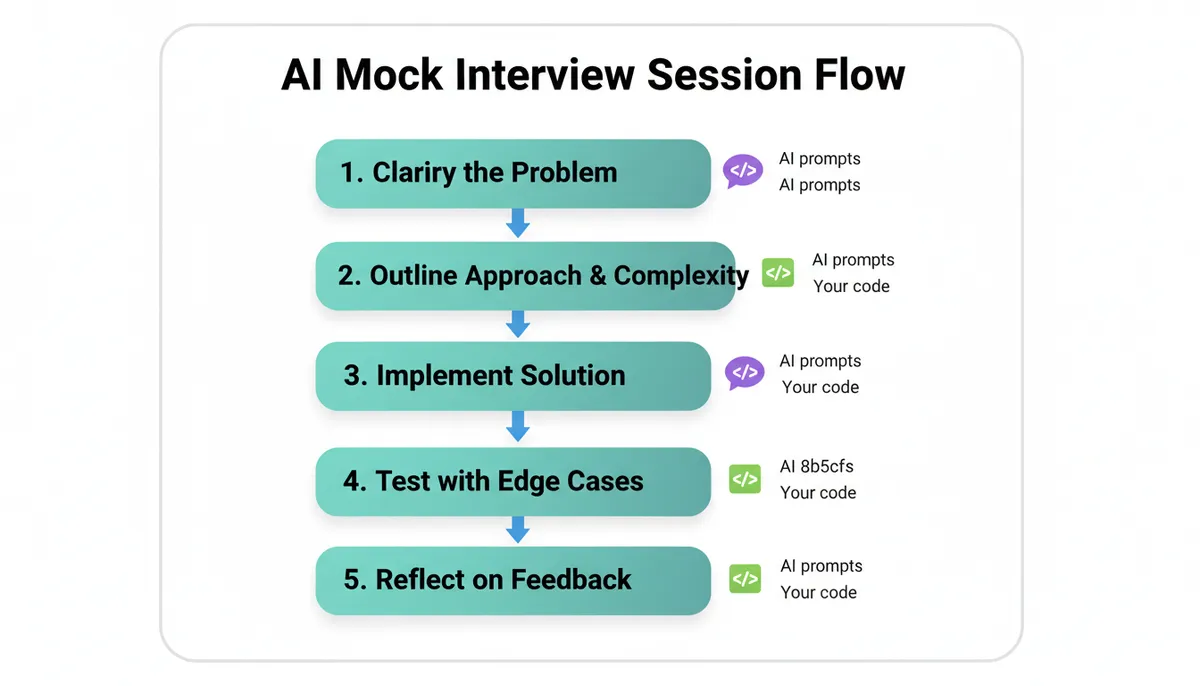
Instead of just submitting code, you interact with an AI interviewer:
- The AI presents a problem and clarifies requirements
- You explain your thought process in natural language (and code)
- The AI asks follow-up questions:
- “What’s the time complexity of your approach?”
- “How would this scale if inputs are 10x larger?”
- “Can you optimize space usage?”
This mimics the dialogue in a real interview rather than a one-way coding session.
Platforms like Thita’s AI Interview Practice: Free Mock Interview Simulator with Real-Time Feedback for Technical Interviews feature exemplify this: the AI doesn’t just judge correctness; it evaluates communication, structure, and tradeoff reasoning.
3. Pattern-based learning with AI coaching
Traditional platforms have tags (like “two pointers” or “sliding window”). AI platforms can go further:
- Detect which patterns your solution uses (or fails to use)
- Suggest alternative patterns or optimizations
- Generate targeted practice sets for specific patterns.
For example, if you consistently brute-force when a two-pointer solution exists, an AI coach might:
- Highlight the inefficiency
- Walk you through the two-pointer reasoning
- Assign 3–5 follow-up problems from the same pattern.
A system like Thita’s 94 DSA patterns across 15 categories is particularly amenable to this: the AI can map your performance to a structured pattern space rather than a flat list of problems. Using a DSA pattern sheet as your backbone can greatly enhance this process.
4. Real-time, granular feedback
AI education tools can analyze your process, not just your final answer:
-
Partial credit and hints
- “Your base case is correct, but the recurrence misses the overlapping subproblems.”
- “Your algorithm is correct but O(n²); try thinking about prefix sums.”
-
Code quality feedback
- Readability, naming, structure
- Edge case coverage
- Test case suggestions.
-
Behavioral and communication feedback
- How clearly you explain tradeoffs
- Whether you ask clarifying questions
- Whether you structure your answer logically.
This is closer to a human mentor than a judge that only says AC/WA.
AI vs Traditional Learning: Where Each Wins
Let’s compare AI interview prep platforms and traditional tools along a few key dimensions.
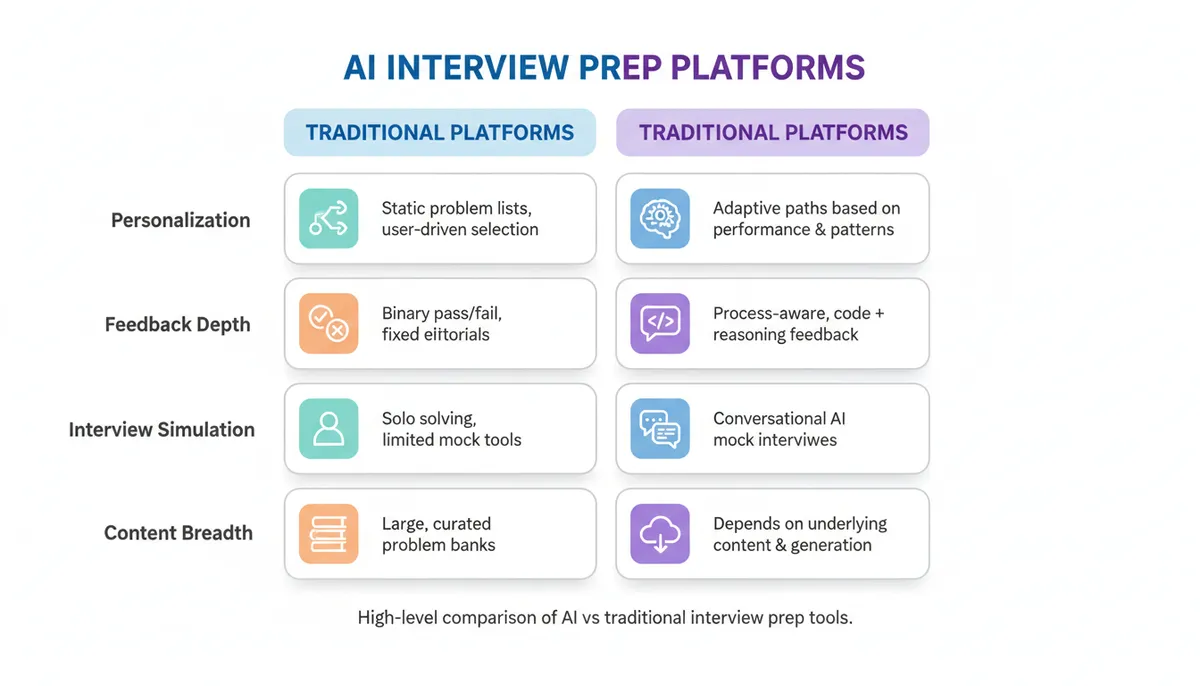
What “traditional” and “AI” actually mean, by product
| Dimension | LeetCode (traditional, solo) | Exponent, formerly Pramp (traditional, human-led) | Thita AI Mock Interview |
|---|---|---|---|
| Format | Solo, timed problem sets | Live peer-to-peer video, roles rotate | AI-led, voice interviewer, adaptive follow-ups |
| Code execution | Yes, LeetCode’s own judge | Yes, built-in collaborative editor | Yes, 6 languages |
| Feedback type | Automated pass/fail; Premium mock mode adds a timer, not an evaluator | Verbal from a peer, quality varies | Instant written report per question |
| Round types | DSA only | DSA, System Design, Behavioral, PM, Data Science, Frontend | DSA, System Design, LLD, Machine Coding, Behavioral, PM, Data Science/AI |
| Price | Free problems; Premium USD 35/mo or USD 159/yr | Free with monthly credits; paid membership for unlimited + AI transcripts | Free Starter forever; Pro USD 14.99/mo; Elite USD 29.99/mo |
| Free tier | Yes, problems only | Yes | Yes |
Sources, checked 2026-09-07: tryexponent.com/practice; LeetCode Premium pricing and mock-interview-mode description via codeswiftr.com's 2026 review (leetcode.com returns 403 to automated fetches). Thita figures from productFacts.ts and lib/geo.ts.
Personalization and adaptivity
-
Traditional:
- You choose what to practice, often guided by community lists (“Top 75”, “Blind 75”).
- Some platforms show topic-wise progress, but they rarely adapt the sequence.
-
AI:
- Can model your mastery at a fine-grained level (e.g., specific patterns, error types).
- Can adjust difficulty and topic mix in real time.
- More similar to how modern adaptive learning systems (like language learning apps) operate.
Verdict: AI has a clear edge for personalization, provided the underlying modeling is done well.
Feedback and explanation depth
-
Traditional:
- High-quality editorials for many problems.
- But explanations are one-size-fits-all and static.
- No awareness of the specific mistake you made.
-
AI:
- Can generate explanations tailored to your attempt:
- “You’re missing the case where the array is already sorted.”
- “Your recursion depth will exceed limits for n > 10⁵.”
- Can answer follow-up “why” questions interactively.
- Risk: hallucinations or subtly incorrect advice if the system isn’t carefully constrained.
- Can generate explanations tailored to your attempt:
Verdict: AI wins on personalization of feedback; traditional wins on guaranteed correctness and consistency of editorials.
Interview simulation and soft skills
-
Traditional:
- Mostly absent. You get this from peers or paid mock interview services.
- Some platforms offer human-led mock interviews, but they’re expensive and infrequent.
-
AI:
- Can provide unlimited, on-demand mock sessions.
- Can focus on:
- Problem understanding
- Communication clarity
- Time management
- Behavioral questions (“Tell me about a time…”).
- Not yet perfect at reading nonverbal cues or emotional states, but good at structure and content.
Verdict: AI is uniquely positioned to fill this gap at scale.
Content breadth and reliability
-
Traditional:
- Decade-plus of curated problems and discussions.
- Strong mapping to real interview questions.
- Community-vetted solutions.
-
AI:
- Often built on top of existing content (internal or external).
- Can generate new problems dynamically, but quality control is non-trivial.
- Risk of:
- Ambiguous problem statements
- Incorrect edge cases
- Misaligned difficulty.
Verdict: Traditional platforms currently have an advantage in stable, vetted content. AI platforms that combine generation with strong validation pipelines can close this gap, but it’s a hard engineering problem.
How AI Interview Prep Platforms Work Under the Hood
To evaluate whether AI can replace traditional tools, it helps to understand how these systems are engineered.
1. LLMs as reasoning and feedback engines
Large Language Models (LLMs) like GPT-4, Claude, etc., are used for:
- Parsing your solution and natural language explanation
- Identifying patterns, complexity, and correctness reasoning
- Generating feedback, hints, and follow-up questions.
Example pattern detection (conceptual prompt to an LLM):
TEXT
The output might be:
JSON
This can then drive further coaching logic.
2. State tracking and learning models
Beyond the LLM, platforms maintain structured state:
- Per-user mastery scores per pattern/topic
- Performance metrics (accuracy, time, hints used)
- Interview simulation scores (communication, structure, etc.).
This can be implemented with:
- Simple heuristics (e.g., exponential moving averages)
- Or more advanced models (e.g., Bayesian Knowledge Tracing, reinforcement learning for problem selection).
The AI then uses this state to decide:
- What to ask next
- When to review old topics
- When to increase difficulty.
3. Guardrails and validation
Because LLMs can be wrong, production systems add guardrails:
- Unit tests: Generated solutions are always run against tests.
- Static analyzers: Check for obvious errors (e.g., O(n³) where n ≤ 10⁵).
- Prompt constraints: Force the LLM to respond in structured formats (JSON) for downstream checks.
- Human-in-the-loop review: For new problem generation and explanations, especially in early stages.
Without these, AI education tools quickly become untrustworthy.
Common Pitfalls When Using AI Education Tools for Interview Prep
AI can accelerate learning, but it introduces new failure modes. Here are patterns that show up repeatedly.
1. Over-reliance on AI-generated solutions
Pitfall:
- Asking the AI to “just show me the optimal solution” too early and too often.
- Copying patterns without understanding the invariants or tradeoffs.
Why it’s harmful:
- Interviews test reasoning under constraints, not recall.
- You risk learning surface patterns (“use sliding window here”) without deep understanding (why the window invariants hold).
Mitigation:
- Always attempt the problem for a fixed time (e.g., 20–30 minutes) before asking for help.
- When you see a solution, re-derive it:
- Explain it back in your own words
- Implement it from scratch without looking
- Modify it for a variant problem.
2. Accepting AI feedback uncritically
Pitfall:
- Treating AI feedback as infallible.
- Not testing alternative approaches or edge cases yourself.
Why it’s harmful:
- LLMs can be subtly wrong, especially on:
- Worst-case complexity
- Edge-case behavior
- Numerical stability or overflow.
Mitigation:
- Use AI feedback as a first pass, not the final arbiter.
- Always:
- Run additional test cases
- Manually reason about big-O complexity
- Cross-check with known patterns or editorials when possible.
3. Ignoring behavioral and communication practice
Pitfall:
- Using AI only as a “LeetCode with explanations” replacement.
- Neglecting mock interviews and behavioral questions.
Why it’s harmful:
- Many candidates fail not on coding, but on:
- Poor problem clarification
- Weak communication
- Inability to discuss past projects clearly.
Mitigation:
- Schedule regular AI mock interviews where you:
- Verbally explain your approach
- Practice asking clarifying questions
- Rehearse behavioral answers.
4. Fragmented learning without structure
Pitfall:
- Jumping between random AI-generated problems.
- No structured progression through core patterns (graphs, DP, trees, etc.).
Why it’s harmful:
- You may cover many problems but miss foundational patterns.
- Harder to build a mental map of “what problem belongs where”.
Mitigation:
- Use structured resources like a DSA pattern sheet (e.g., Thita’s What Are DSA Patterns? A Complete Guide for Beginners) as your backbone.
- Let AI adapt within that structure, not replace it entirely.
Best Practices: Combining AI and Traditional Tools Effectively
Instead of asking “Can AI replace traditional interview prep platforms?”, a more productive question is: “How can I orchestrate both to maximize my learning?”
Here’s a practical workflow.
Step 1: Establish a pattern-based roadmap
-
Start from a curated list of patterns:
- Arrays & two pointers
- Sliding window
- Binary search
- Trees & graphs (BFS/DFS)
- Backtracking
- Dynamic programming (1D, 2D, on trees, etc.)
- Greedy, heap, union-find, etc.
-
For each pattern:
- Solve a few canonical problems on a traditional platform
- Read high-quality editorials to anchor your understanding.
Step 2: Use AI for targeted practice and gap detection
-
Switch to an AI interview prep platform to:
- Detect which patterns you’re weak on
- Generate or select focused problems in those areas
- Get feedback on your reasoning, not just correctness.
-
Example loop:
- Attempt a problem for 25 minutes.
- Ask the AI for hints only, not full solutions.
- After solving or timing out, review AI feedback on:
- Complexity
- Edge cases
- Code clarity.
Step 3: Schedule regular AI mock interviews
-
Once or twice a week:
- Run a full 45–60 minute AI mock interview.
- Include:
- 1–2 coding questions
- Follow-up optimization questions
- 1–2 behavioral questions.
-
Focus on:
- Speaking your thought process aloud
- Structuring answers (clarify → brainstorm → choose → implement → test → optimize)
- Handling pushback from the interviewer.
Step 4: Validate with traditional problems and contests
-
Periodically:
- Solve problems on a traditional platform without AI assistance.
- Participate in timed contests to:
- Validate that your skills transfer
- Benchmark against other candidates.
-
After contests:
- Use AI to analyze your performance:
- “Where did I spend too much time?”
- “Which patterns did I fail to recognize?”
- “How could I have structured my time better?”
- Use AI to analyze your performance:
Step 5: Use AI for resume and behavioral prep, but keep a human loop
-
AI can help you:
- Refine bullet points on your resume
- Generate behavioral question variants
- Practice STAR-format answers.
-
But also:
- Get feedback from at least one human mentor or peer
- Ensure your stories are authentic and technically accurate.
What AI Still Can’t Replace (Yet)
Even the best AI interview prep platforms have structural limitations.
1. Real-world project depth
AI can help you present your projects better, but it can’t:
- Replace building real systems
- Give you the intuition that comes from:
- Debugging prod issues at 3 AM
- Migrating a legacy system
- Designing APIs used by other teams.
Interviewers often probe this depth in system design and behavioral rounds.
2. Human judgment and culture fit
AI can simulate interviewer questions, but not:
- The specific preferences of a given team or manager
- The interpersonal dynamics of a real conversation
- The subtle signals around culture and collaboration.
You still need real human interactions—mock interviews with peers, networking, and actual interviews—to calibrate here.
3. Long-term career context
AI can optimize for “pass this interview,” but:
- It doesn’t (yet) reliably optimize for:
- Long-term career satisfaction
- Alignment with your interests and values
- Non-obvious tradeoffs (e.g., startup vs FAANG vs research lab).
You need mentors, managers, and your own reflection for that.
The Future of Interview Prep: Replacement or Integration?
So, can AI replace traditional interview preparation platforms?
In the near term, the answer is “no—but it will reshape the stack.”
What’s likely to happen
-
Traditional platforms will embed AI features
- Adaptive problem recommendation
- AI explanations and hints
- Basic mock interview capabilities.
-
Dedicated AI interview prep platforms will specialize
- Deeper conversational interviewing
- Rich pattern-based modeling and coaching
- Cross-round preparation (coding, system design, behavioral, resume).
-
The candidate’s workflow will be hybrid by default
- Static problem banks for breadth and benchmarking
- AI tools for personalization, feedback, and simulation.
What this means for serious candidates
If you’re aiming for top roles:
- Don’t treat AI as a shortcut to avoid hard work.
- Use it as a force multiplier:
- Faster feedback loops
- More realistic practice
- Better visibility into your blind spots.
And remember: the goal isn’t to beat the platform; it’s to become the kind of engineer who can reason clearly under constraints, communicate well, and build robust systems. AI can help you get there faster, but it can’t walk into the interview for you.
Key Takeaways
- AI interview prep platforms excel at personalization, interactive feedback, and mock interviews—but rely on careful engineering to avoid hallucinations and low-quality content.
- Traditional platforms still lead on stable, vetted problem banks, community discussions, and contest ecosystems.
- The most effective strategy today is hybrid:
- Use pattern-based roadmaps and traditional problems for breadth and grounding.
- Use AI tools for adaptive practice, deep feedback, and realistic interview simulation.
- Be aware of common pitfalls:
- Over-reliance on AI-generated solutions
- Uncritical acceptance of feedback
- Neglecting behavioral and communication practice.
- Over the next few years, we’re likely to see integration rather than replacement: AI will become a standard layer on top of traditional content, not a complete substitute.
If you structure your prep around patterns, use AI to close feedback loops, and regularly validate your skills in realistic settings, you’ll be aligned with where the future of interview prep is heading—not just consuming the latest tool, but using it intelligently.