
Data Science
CodeSignal AI/ML Assessments in 2026: RAG, ML Frameworks & the AI Interviewer Explained
The CodeSignal AI assessment in 2026 covers RAG, ML frameworks & the AI Interviewer.
If you are interviewing for an applied-AI, ML, or backend role this year, you have probably noticed that the CodeSignal AI assessment in 2026 looks nothing like the algorithm-heavy coding tests of a few years ago. CodeSignal has rebuilt its platform around how engineers actually work today — with AI copilots in the loop, retrieval pipelines in production, and ML systems that need to be built, not just memorized. The result is a family of newer assessment surfaces: an AI-assisted RAG-style assessment, machine-learning and ML-framework evaluations, and an AI Interviewer that holds a live, scored conversation with you.
This guide breaks down each of these surfaces, explains what they actually test, and gives you a concrete, role-based prep plan. Everything here is grounded in CodeSignal's official product pages and announcements, with features clearly flagged where the public docs are still light on detail.
Want to practice before the real thing? Run a realistic AI mock interview to rehearse the AI Interviewer format, or build the underlying skills on the AI/ML Learning Path.
The new AI-Assisted RAG assessment
The biggest shift in the CodeSignal AI assessment for 2026 is that AI is now inside the test, not banned from it. CodeSignal introduced AI-Assisted Coding Assessments and Interviews built around Cosmo, its embedded AI assistant, so companies can evaluate how candidates solve real problems with AI rather than pretending the tool does not exist.
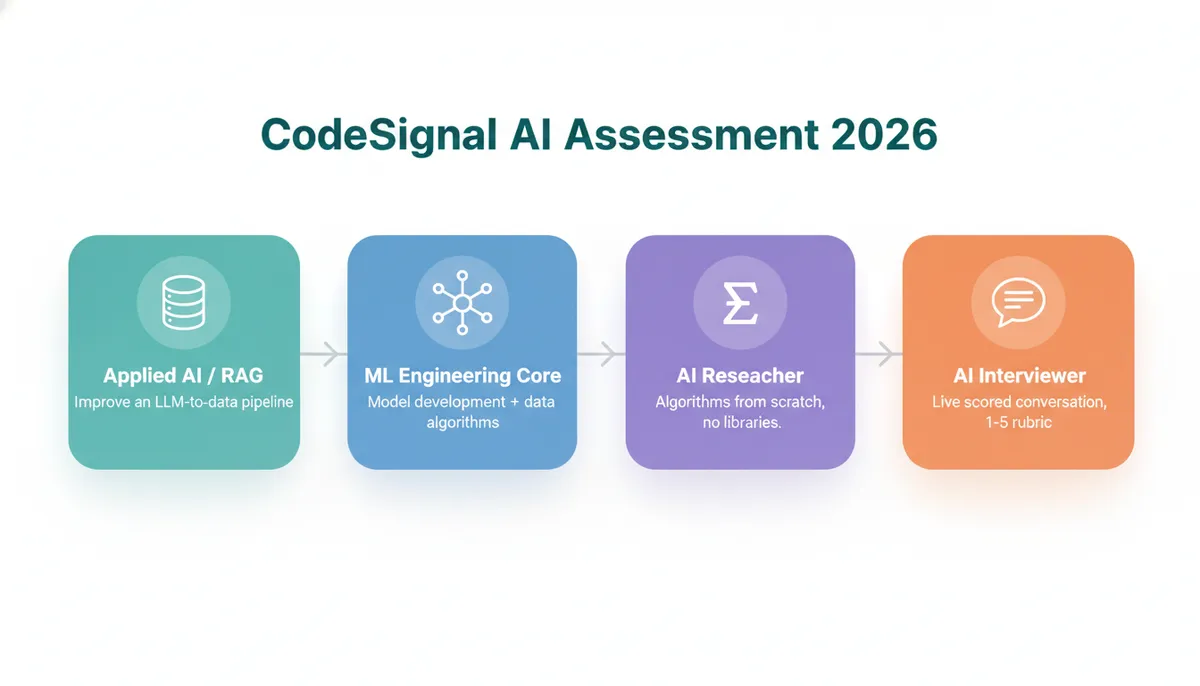
For applied-AI candidates, the most relevant surface is the Applied AI Assessment, which CodeSignal describes as evaluating your ability to "improve an LLM-driven natural-language-to-data workflow through prompt iteration." In practice, this is the closest thing to a CodeSignal RAG assessment: you are handed a working but imperfect retrieval-and-generation pipeline and asked to make it better — tightening prompts, improving retrieval relevance, and handling edge cases — rather than building a model from scratch.
Across its AI skills assessments, CodeSignal says it measures the "full spectrum" from AI literacy and prompt engineering through to RAG implementation, vector database integration, and multi-agent systems coordination. So while the RAG work shows up under the Applied AI and prompt-engineering surfaces today, retrieval competence is explicitly part of the rubric.
The AI-assisted coding format runs in two configurable modes you should expect to see:
- Full AI Co-Pilot Mode — Cosmo actively collaborates with you to solve advanced challenges, exactly like pairing with a copilot at work.
- Guided Support Mode — Cosmo offers light-touch help: navigating the IDE, fixing syntax, or referencing docs.
💡 Pro Tip: In co-pilot mode, your prompting is being graded as much as your code. Hiring managers get transcripts and session replays of every AI interaction. Vague prompts that produce slop, blindly pasted output, and no verification all read as weak signals — even if the tests pass.
⚠️ Important: "AI-assisted" does not mean "AI-does-it-for-you." The challenges are designed so the model alone cannot finish them. You still need to decompose the problem, evaluate what the assistant returns, and catch its mistakes. Treat Cosmo like a fast but unreliable junior engineer.
ML-framework evaluation: what the machine learning test really checks
The second surface is the CodeSignal ML assessment track, and here the platform pulls in two different directions depending on the role.
On one end is the Machine Learning Engineering Core Assessment, which CodeSignal positions around coding, data algorithms, and machine learning model development. Candidate reports from early 2026 (for example, a Senior AI/ML Engineer screen run through CodeSignal in January 2026) describe a CodeSignal machine learning test that blends theoretical ML knowledge, numerical reasoning, and implementing core algorithms under time pressure. Note: that is a third-party candidate account, not an official spec — treat the exact structure as indicative rather than guaranteed.
On the other end is the AI Researcher Assessment, which CodeSignal explicitly describes as measuring "the ability to implement complex AI algorithms without relying on standard machine learning libraries." This is the inverse of an ML-framework evaluation: no scikit-learn, no pandas crutches — you write gradient descent, backprop, or a clustering routine by hand.
So when people ask "is the CodeSignal AI engineer assessment a framework test or a from-scratch test?", the honest answer is: it depends which surface the company picks.
| Surface | Framework allowed? | What it really tests |
|---|---|---|
| ML Engineering Core | Yes (applied) | Model development, data handling, numerical reasoning |
| AI Researcher | No — from scratch | Implementing ML/AI algorithms without standard libraries |
| Applied AI (RAG-style) | Yes (LLM + tooling) | Improving an LLM-to-data pipeline via prompt iteration |
| AI-Assisted Coding | Yes (Cosmo copilot) | Solving real problems effectively with an AI assistant |
✅ Do: Ask your recruiter which specific assessment you will sit. "ML Engineering Core" and "AI Researcher" demand almost opposite preparation, and recruiters will usually tell you the assessment name.
❌ Don't: Assume you can lean on a framework. If you land the AI Researcher surface and you have only ever called model.fit(), you will struggle to implement the math by hand in the time given.
The AI Interviewer and what it changes
The third surface is the most behaviorally different: the CodeSignal AI Interviewer. Instead of a static prompt and a code editor, you have a live conversation with a specialized AI Interview Agent.
According to CodeSignal's AI Interviewer page, the agent runs a short interview — typically around 15 minutes, configurable per role — and crucially, "if answers are thin, it probes and asks follow-up questions based on your criteria." It is not a one-take video recording; it adapts to what you say, staying bounded by the competencies the company defined.
Here is what changes for you as a candidate:
- You cannot pre-script your way through it. Because the agent asks dynamic follow-ups, a memorized monologue falls apart the moment it digs into "how did you implement that?"
- Specificity is the whole game. The system maps your answers to a 1-5 scale per competency. Vague, high-level answers score low; concrete, technical detail scores high.
- Everything is transparent. Hiring teams receive "an in-depth report with an overall score, skill evaluation, and key insights" plus a full transcript — described by CodeSignal as "no AI black box." Humans make the final call, but your transcript is the evidence.
💡 Pro Tip: Because the AI Interviewer probes thin answers, treat every initial response as the headline and assume a follow-up is coming. Lead with your decision or result, then be ready to go three layers deep: what you did, why you chose it, and what the tradeoff was. This is exactly the loop you can rehearse with Thita's AI Interview Coach.
⚠️ Important: The AI Interviewer scores substance and structure, not your accent or appearance. Rambling to fill silence hurts you. A tight, specific 90-second answer beats a meandering three-minute one every time.
What applied-AI, backend, and ML candidates should prep
Different roles map to different surfaces. Here is how to focus your effort instead of trying to prepare for everything at once.
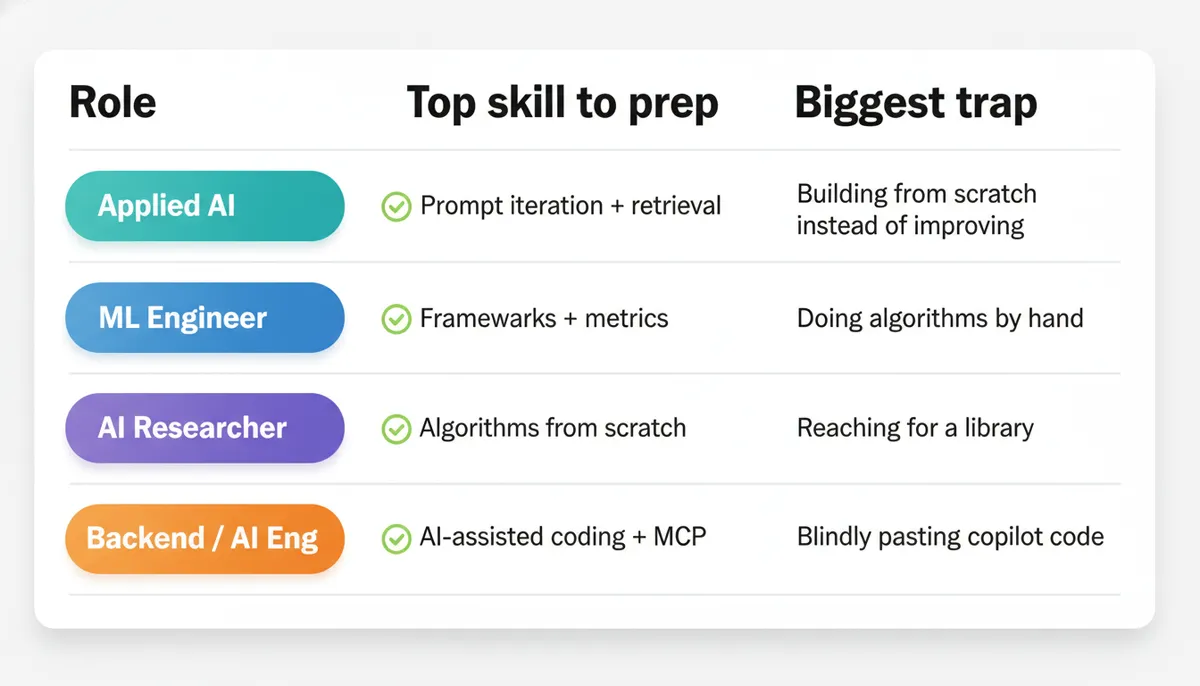
For applied-AI / GenAI candidates (most likely to hit the Applied AI / RAG-style surface):
- Be fluent in the RAG loop: chunking, embeddings, vector search, reranking, and prompt assembly.
- Practice improving a pipeline, not building one — given a weak retrieval result, what do you change first?
- Sharpen prompt-engineering discipline: structured prompts, evals, and iteration. This is a graded skill, not a soft one.
For ML engineers (ML Engineering Core or AI Researcher):
- Core surface: be comfortable with feature engineering, model selection, evaluation metrics, and reasoning about data under time pressure.
- Researcher surface: be able to implement key algorithms (linear/logistic regression, k-means, a small neural net, backprop) from scratch in plain Python/NumPy.
- Refresh the math: gradients, loss functions, and the numerical-reasoning questions candidates report.
For backend / AI engineers (AI-Assisted Coding + MCP/Agentic):
- Practice with an AI copilot deliberately. Learn to prompt precisely, read generated diffs critically, and verify before you trust.
- Understand tool integration and action execution — CodeSignal's MCP and Agentic Systems Assessment tests exactly this.
- Keep your fundamentals sharp; the assistant accelerates you, it does not replace your judgment.
Across all three, the AI/ML Learning Path covers the retrieval, modeling, and systems fundamentals these surfaces lean on, and the broader Data Science Learning Path fills in the statistics and ML theory the from-scratch and Core assessments reward.
Sample prep plan by role
Use whichever track matches the assessment your recruiter names. Each is a four-step plan you can run over two to three weeks.
Applied-AI / RAG track:
- Week 1 — Build a small RAG app end to end (loader → chunker → embeddings → vector DB → prompt). You learn the failure modes fastest by shipping one.
- Week 1-2 — Practice diagnosing bad outputs: is it retrieval, ranking, or the prompt? Write down a checklist.
- Week 2 — Drill prompt iteration against a fixed eval set so improvement is measurable, not vibes.
- Week 3 — Do a timed AI mock interview and narrate your pipeline-improvement reasoning out loud.
ML Engineer (Core / Researcher) track:
- Week 1 — Re-implement linear regression, logistic regression, and k-means from scratch in NumPy. No libraries.
- Week 1-2 — Refresh evaluation metrics (precision/recall, ROC-AUC, RMSE) and when each applies.
- Week 2 — Do timed numerical-reasoning and "implement this algorithm" drills (45-60 min each).
- Week 3 — Practice explaining your model choices aloud — the AI Interview Coach will probe your tradeoffs the way the AI Interviewer does.
Backend / AI Engineer (AI-assisted) track:
- Week 1 — Solve real tasks using a copilot, deliberately practicing precise prompts and critical review of output.
- Week 1-2 — Read every generated diff before accepting it. Build the habit of verifying, not trusting.
- Week 2 — Learn tool/agent integration basics (function calling, MCP-style tool use, action execution).
- Week 3 — Run a timed assessment-style task with an assistant and review your own transcript for sloppy prompts.
Frequently Asked Questions
What is the CodeSignal AI assessment in 2026?
It is a family of AI-focused assessment surfaces rather than a single test. CodeSignal now offers AI-assisted coding assessments (powered by its Cosmo assistant), an Applied AI / RAG-style assessment, ML Engineering Core and AI Researcher assessments, an MCP/Agentic Systems assessment, and a conversational AI Interviewer. The exact one you sit depends on the role and the company.
Does CodeSignal have a dedicated RAG assessment?
Not under that exact name in the public docs. The closest surface is the Applied AI Assessment, which CodeSignal describes as improving an LLM-driven natural-language-to-data workflow through prompt iteration. RAG implementation and vector database integration are explicitly listed among the skills CodeSignal's AI assessments measure, so retrieval competence is graded — just framed as part of the applied-AI track.
Can I use AI tools during a CodeSignal assessment?
On the AI-assisted surfaces, yes — that is the point. Cosmo is built into the IDE in either a full co-pilot mode or a lighter guided-support mode. But hiring teams see transcripts and session replays of how you used it, so effective, well-verified prompting is the skill being measured. On non-AI-assisted surfaces, normal assessment rules apply.
How does the CodeSignal AI Interviewer score me?
It maps your answers to competencies on a 1-5 scale that the company defines, asks dynamic follow-up questions when answers are thin, and produces a report with an overall score, per-skill evaluation, key insights, and a full transcript. CodeSignal emphasizes there is "no AI black box" and that humans make the final hiring decision.
Is the CodeSignal machine learning test from scratch or framework-based?
Both exist. The ML Engineering Core assessment is more applied and allows standard tooling, while the AI Researcher assessment explicitly requires implementing algorithms without standard machine learning libraries. Ask your recruiter which one you will take — they prepare very differently.
How long is the CodeSignal AI Interviewer?
CodeSignal describes it as a short interview, typically around 15 minutes, though it is configurable per role. Because it asks adaptive follow-ups, the exact length varies with how deep the agent needs to probe your answers.
How should I prepare for a CodeSignal AI engineer assessment?
Confirm the assessment name first, then prep the matching surface: RAG/prompt iteration for Applied AI, algorithms-from-scratch for AI Researcher, applied modeling for ML Core, or copilot-driven problem solving for AI-assisted coding. Rehearse explaining your reasoning out loud with a realistic AI mock interview, since both the AI Interviewer and the assisted assessments reward clear, specific reasoning.
Is the AI Interviewer fair, or is it a black box?
CodeSignal positions it as transparent: every interview produces a full transcript and a per-competency report, and the company's I-O psychology team calibrates and locks the rubric before it is used. The agent shortlists, but a human makes the final call. Your best defense against any scoring noise is specificity — concrete, technical answers leave little room for ambiguity.
Final thoughts
The CodeSignal AI assessment in 2026 rewards engineers who can build with AI, reason about ML systems, and explain their thinking under questioning — not just those who can grind LeetCode. The candidates who do best are the ones who (1) find out exactly which surface they are facing, (2) prep that surface specifically, and (3) practice narrating their reasoning out loud, because every newer surface — from co-pilot transcripts to the AI Interviewer's follow-ups — is ultimately scoring how you think.
Start now:
- Rehearse the conversational format with an AI mock interview and the AI Interview Coach.
- Build the underlying skills on the AI/ML Learning Path and Data Science Learning Path.
Put in the focused reps now, and the assessment becomes a formality instead of a filter.