
DSA
Beginner to Advanced DSA Roadmap for Software Engineers in 2026
Most engineers don’t fail coding interviews because they’re “bad at algorithms.” They fail because their learning is unstructured: they jump from random Leet...
Most engineers don’t fail coding interviews because they’re “bad at algorithms.” They fail because their learning is unstructured: they jump from random LeetCode problems to YouTube videos without a coherent DSA roadmap.
If you’re preparing for software engineering roles in 2026, you need a deliberate, pattern-based DSA roadmap 2026 that starts from fundamentals and scales all the way to advanced system-level thinking. This guide lays out that path, step by step, from beginner to advanced, with concrete milestones, examples, and common pitfalls.
1. How to Use This DSA Roadmap (2026 Edition)
This data structures roadmap is organized in four stages:
- Foundations (0–1): Basic syntax, complexity, and core data structures
- Core DSA (1–2): Patterns that cover 80% of interview questions
- Advanced DSA (2–3): Graphs, advanced trees, DP, and optimization
- Systems-Aware DSA (3–4): Scaling your reasoning to real-world constraints
Each stage has:
- What you should learn
- Why it matters in interviews and real work
- Example problems or code
- Typical time/space complexity expectations
You don’t have to follow this linearly, but you should avoid skipping entire stages.
2. Stage 0–1: Foundations of Algorithms and Complexity
2.1. Learn to Think in Big-O
Before you dive into lists and trees, you need a mental model for cost.
Key concepts:
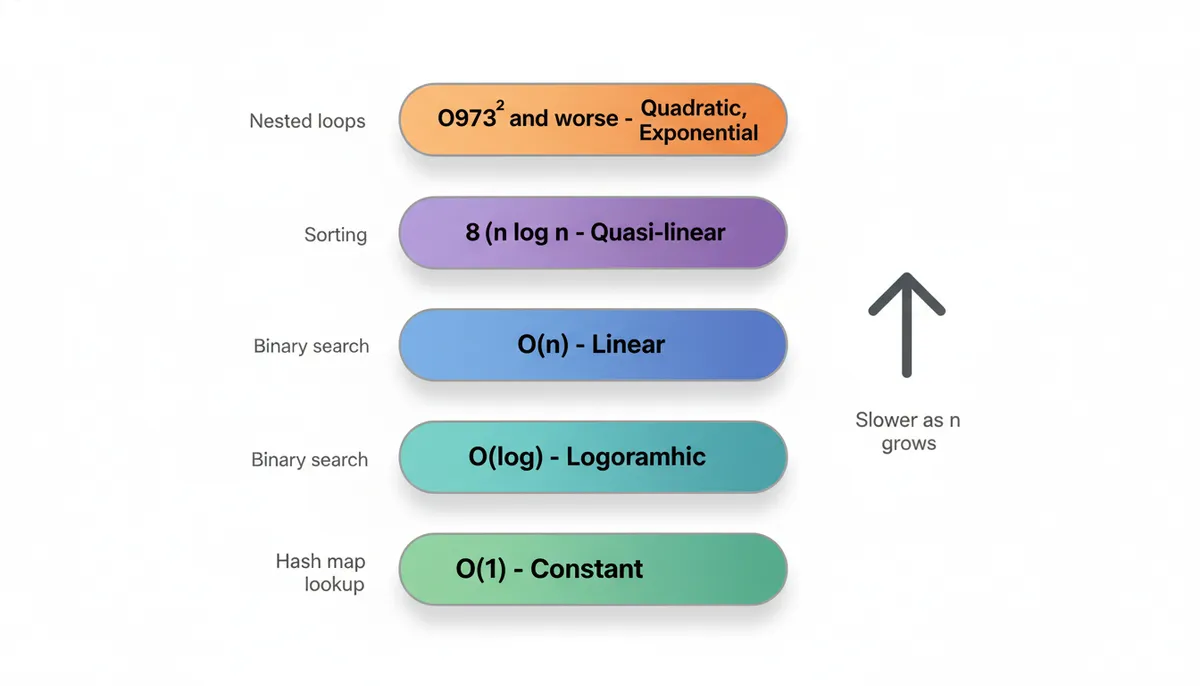
- Time complexity: O(1), O(log n), O(n), O(n log n), O(n²)
- Space complexity: auxiliary space vs input size
- Worst, average, best case
Simple exercise:
- What’s the complexity?
PYTHON
Be able to:
- Explain why this is O(n) time, O(n) space
- Compare it to a naive O(n²) double loop
2.2. Master the Primitive Building Blocks
These are language-level tools you must be fluent with:
- Arrays / lists
- Strings and basic string operations
- Hash tables / dictionaries / maps
- Sets
- Basic loops, conditionals, and functions
Practice:
- Reverse a string
- Find max/min in an array
- Count frequency of elements using a hash map
- Remove duplicates from a list
For each, articulate:
- Time complexity (e.g., O(n))
- Space complexity (does it allocate extra structures?)
3. Stage 1–2: Core Data Structures Roadmap
This is the heart of a coding interview roadmap. These data structures and patterns appear repeatedly across companies and levels.
3.1. Arrays and Two-Pointer Patterns
Arrays are the canvas for many interview questions.
Key operations:
- Indexing: O(1)
- Scanning: O(n)
- Slicing: language-dependent cost
Essential patterns
- Two pointers (opposite ends):
- Example: Given a sorted array, find two numbers that sum to target.
PYTHON
-
Fast/slow pointers:
- Detect cycle in linked list
- Find middle of list
-
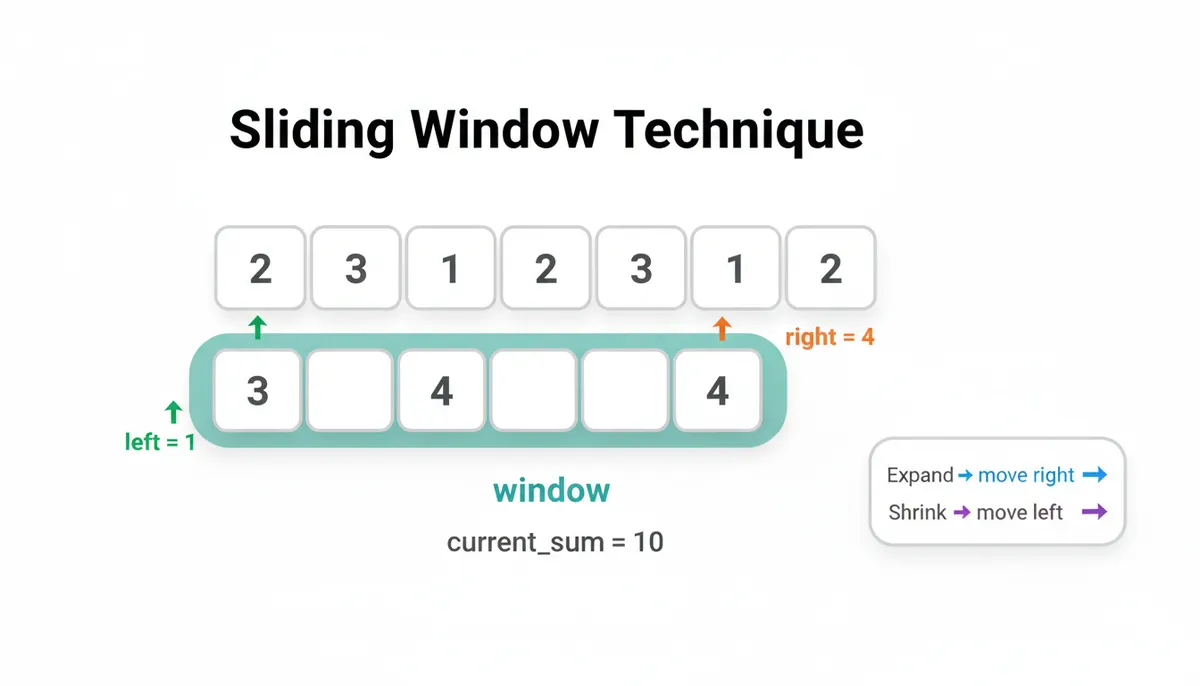
Sliding window:
- Longest substring without repeating characters
- Smallest subarray with sum ≥ S
3.2. Linked Lists
Understand:
- Singly vs doubly linked lists
- Basic operations: insert, delete, reverse, find middle
- When to use them vs arrays
Example: Reverse a singly linked list iteratively.
PYTHON
3.3. Stacks and Queues
Core ideas:
- Stack: LIFO (function calls, undo operations, expression evaluation)
- Queue: FIFO (task scheduling, BFS)
Implementations:
- Using arrays/lists
- Using linked lists
- Using two stacks to build a queue (common interview variant)
Typical problems:
- Valid parentheses
- Min stack
- Implement queue using stacks and vice versa
- Level-order traversal of trees (using queue)
3.4. Hash Maps and Sets
These are your go-to for O(1) average-time lookups.
Use cases:
- Frequency counting
- De-duplication
- Caching results
- Two-sum (unsorted arrays)
Be able to reason about:
- Average vs worst-case O(1) vs O(n)
- Why hash collisions matter conceptually
- Trade-offs vs sorted structures (like trees)
4. Stage 2–3: Core Algorithms and Patterns (Intermediate)
At this stage, you move from “I know the data structures” to “I can recognize and apply patterns quickly.” This is where pattern-based learning shines.
4.1. Sorting and Searching
Sorting
Know:
- Time complexities:
- Quick sort: average O(n log n), worst O(n²)
- Merge sort: O(n log n) time, O(n) space
- Heap sort: O(n log n) time, O(1) space
- Stability and in-place vs out-of-place
You don’t need to hand-write quicksort in interviews often, but you must:
- Recognize when sorting unlocks other patterns (two pointers, binary search)
- Understand that O(n log n) is usually the lower bound for comparison-based sorts
Binary Search
Binary search is more than mid = (l + r) // 2.
Patterns:
- Search in sorted array
- Search insert position
- Search on answer space (e.g., minimum capacity, minimum days)
Example: Binary search on answer space (minimize largest subarray sum given k splits) is a typical mid-level interview question.
4.2. Trees: Binary Trees and Binary Search Trees
Core concepts:
- Tree traversal:
- Preorder, inorder, postorder (DFS)
- Level-order (BFS)
- Binary Search Tree (BST) properties:
- Left < root < right
- Operations: search, insert, delete
Example: Inorder traversal (iterative, using stack):
PYTHON
4.3. Recursion and Backtracking
Understand:
- Call stack behavior
- Base case and recursive case
- When recursion is natural (trees, divide-and-conquer, combinatorics)
Backtracking patterns:
- Subsets, permutations, combinations
- N-Queens
- Word search in a grid
Be able to:
- Translate a recursive solution to iterative (especially tree traversals)
- Analyze stack depth and worst-case space complexity
4.4. Sliding Window and Prefix Sums (Advanced Use)
You’ve seen basic sliding window; now apply it to:
- Dynamic-sized windows with constraints (e.g., at most K distinct characters)
- Fixed-size windows (e.g., max average subarray of size K)
Prefix sums:
- 1D prefix sums for range queries
- 2D prefix sums for matrix problems
- Difference arrays for range updates
5. Advanced DSA Roadmap (Stage 3–4)
This is the advanced DSA roadmap section: graphs, advanced trees, dynamic programming, and optimization techniques. These topics appear in senior-level and specialized interviews, and in competitive roles (e.g., quant, infra, ML systems).
5.1. Graphs: The Real World Model
Graphs model networks, dependencies, and relationships—core to modern systems (microservices, social graphs, routing).
You should understand:
- Representations:
- Adjacency list vs adjacency matrix
- Types:
- Directed vs undirected
- Weighted vs unweighted
- Cyclic vs acyclic
Fundamental algorithms
-
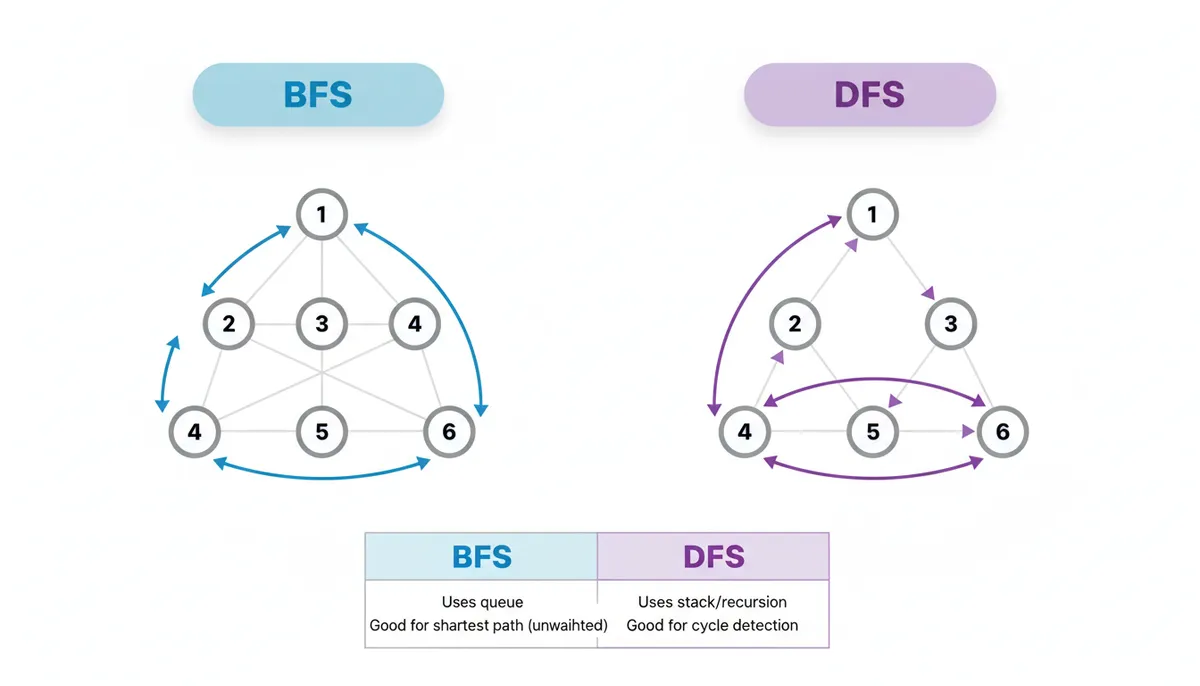
Traversal:
- BFS: shortest path in unweighted graphs
- DFS: cycle detection, connected components
-
Shortest paths:
- Dijkstra (non-negative weights)
- Bellman-Ford (handles negative weights)
- BFS as special case when all weights = 1
-
Topological sort:
- For DAGs (Directed Acyclic Graphs)
- Task scheduling, build systems, dependency resolution
-
Minimum Spanning Tree (MST):
- Kruskal’s and Prim’s algorithms
- Network design, clustering
Be able to:
- Choose BFS vs DFS depending on problem
- Explain why Dijkstra fails with negative weights
- Implement topological sort using Kahn’s algorithm (BFS with in-degree)
5.2. Advanced Trees: Heaps, Tries, Segment Trees
Heaps (Priority Queues)
Use cases:
- Top-K elements
- Scheduling (e.g., next task with earliest deadline)
- Dijkstra’s algorithm
Know:
- Binary heap operations: insert, extract-min/max = O(log n)
- Heapify: O(n)
Tries (Prefix Trees)
Use cases:
- Autocomplete
- Dictionary word lookup
- Prefix-based queries
Be able to:
- Insert/search words
- Discuss space trade-offs vs hash maps
Segment Trees / Fenwick Trees (Binary Indexed Trees)
Useful for:
- Range sum / min / max queries with updates
- Interval problems with frequent modifications
Expectations for interviews:
- Top-tier / algorithm-heavy roles may expect you to implement these
- For many roles, conceptual understanding and ability to reason about O(log n) updates/queries is enough
5.3. Dynamic Programming (DP) in 2026 Interviews
DP remains one of the most feared topics, but it’s pattern-driven.
Core ideas:
- Overlapping subproblems
- Optimal substructure
- Memoization (top-down) vs tabulation (bottom-up)
Common categories:
-
1D DP:
- Fibonacci, climbing stairs
- House robber
- Longest increasing subsequence (LIS) – O(n²) and O(n log n) versions
-
2D DP:
- Edit distance
- Longest common subsequence (LCS)
- Grid path problems (unique paths, minimum path sum)
-
Knapsack-style:
- 0/1 knapsack
- Subset sum
- Coin change
-
DP on trees / graphs:
- Tree DP for counting or maximizing values
- DAG shortest paths using DP
DP workflow:
- Define
dp[i]ordp[i][j]precisely (what does it represent?) - Derive recurrence relation
- Set base cases
- Choose iteration order
- Optimize space if needed
Example: Classic 1D DP – climbing stairs.
PYTHON
6. Systems-Aware DSA: Bridging to Real-World Engineering
By 2026, interviewers increasingly expect you to connect algorithmic reasoning with system constraints: memory, latency, concurrency, and distribution.
6.1. Practical Constraints to Consider
When solving problems, practice asking:
- What are the input size limits? (10³ vs 10⁵ vs 10⁷ changes everything)
- Is the data streaming or batch?
- Do we need online (real-time) answers or offline processing?
- Is memory constrained? (e.g., embedded devices, browsers)
- Are operations read-heavy or write-heavy?
Example reasoning:
- For 10⁷ integers, O(n²) is impossible; you must aim for O(n) or O(n log n)
- For streaming logs, you might use:
- Sliding windows
- Approximate structures (Bloom filters, HyperLogLog) – at least conceptually
6.2. Data Structures in Distributed Systems
You don’t need to implement Raft in a coding interview, but you should:
- Understand why hash maps don’t “just scale” across machines
- Recognize when consistent hashing is useful (sharding)
- Know that tree traversals across the network are latency-heavy
This is where pattern-based DSA connects to system design interviews: BFS/DFS, graphs, and hash-based partitioning reappear at larger scale.
If you want integrated practice that bridges coding and interview-style reasoning, an AI coach or mock interview system (e.g., Thita’s /ai-interview) can simulate these constraints: follow-ups, complexity trade-offs, and “what if n = 10⁸?” questions.
7. Pattern-Based Learning: Mapping Problems to Patterns
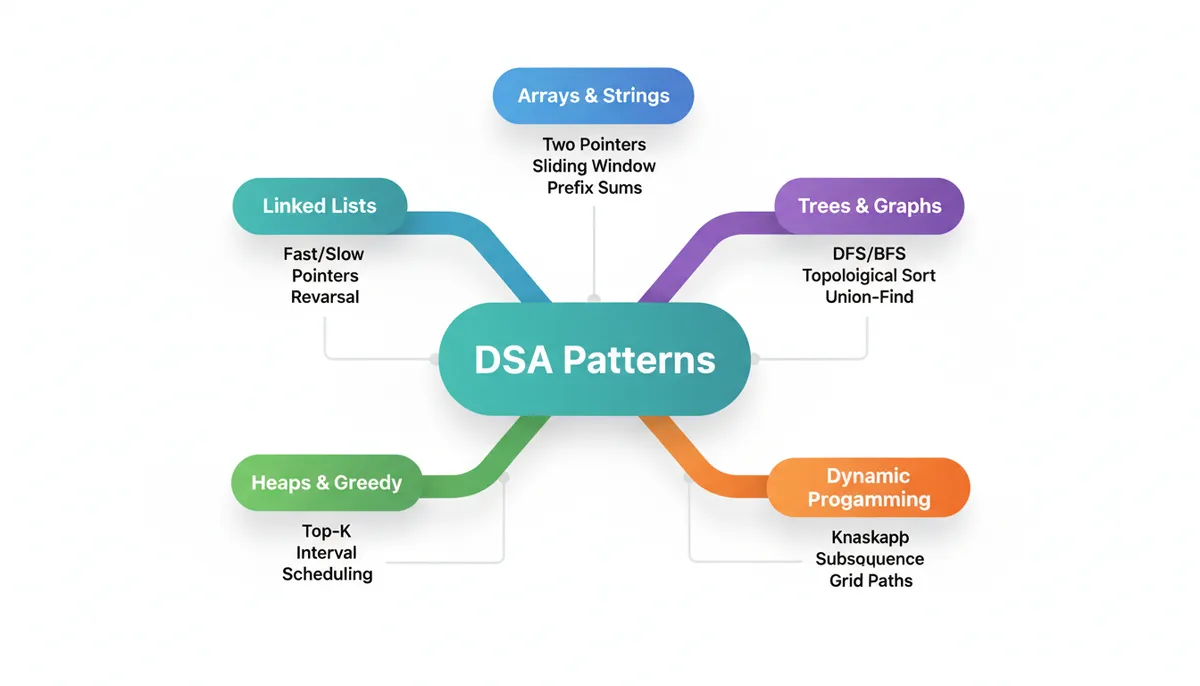
Random problem grinding is inefficient. Instead, organize your practice around patterns. A pattern sheet (like Thita’s /dsa-patterns-sheet) can be used as a checklist.
Core pattern families (non-exhaustive):
- Array / String Patterns
- Two pointers
- Sliding window
- Prefix sums
- Linked List Patterns
- Fast/slow pointers
- Reversal and merging
- Tree / Graph Patterns
- DFS/BFS
- Topological sort
- Union-Find (Disjoint Set Union)
- Heap / Priority Queue Patterns
- Top-K
- Merge K sorted lists
- DP Patterns
- Knapsack
- Subsequence / substring
- Palindromes
- Partitioning
8. Common Mistakes and Pitfalls (and How to Avoid Them)
8.1. Memorizing Solutions Instead of Patterns
Pitfall:
- You “know” how to solve LeetCode #123 but can’t solve a slightly modified version.
Fix:
- After solving a problem, write down:
- Which pattern it uses (e.g., “sliding window with hash map”)
- What changes if constraints or data types change
8.2. Ignoring Complexity Trade-offs
Pitfall:
- You produce a working solution but can’t justify its complexity or improve it.
Fix:
- For every solution, ask:
- Can I do better than O(n²)?
- Can I reduce space?
- What if n = 10⁵? 10⁶?
8.3. Not Practicing Under Interview Conditions
Pitfall:
- You solve problems with lots of trial-and-error, print debugging, and long thinking gaps.
Fix:
- Regularly simulate 45–60 minute interviews:
- Choose 1–2 problems
- Talk through your approach
- Write code in one pass if possible
- Analyze complexity out loud
8.4. Skipping Fundamentals
Pitfall:
- Jumping to DP and graphs while still shaky on arrays, hash maps, or pointers.
Fix:
- Ensure you’re fluent in:
- Basic operations on arrays, strings, hash maps, sets
- Iteration patterns (for loops, while loops)
- Simple recursion
9. Best Practices and Actionable Tips
9.1. Build a Weekly Plan Around This Roadmap
Example 8-week plan:
- Weeks 1–2: Foundations + Arrays/Strings + Hash Maps/Sets
- Weeks 3–4: Linked Lists, Stacks/Queues, Basic Trees, Binary Search
- Weeks 5–6: Graphs, Heaps, Advanced Trees, Sliding Window, Prefix Sums
- Weeks 7–8: Dynamic Programming, Mixed-topic mock interviews, review weak areas
Each week:
- 3–5 focused patterns
- 10–20 problems total (not hundreds)
- 1–2 timed mock interviews
9.2. Use a Deliberate Practice Loop
For each problem:
- Classify: Which pattern does this look like?
- Plan: Outline approach, complexity, edge cases.
- Implement: Write code cleanly, with function signatures and comments.
- Review: Compare with optimal solutions, note differences.
- Summarize: Update your pattern notes.
9.3. Maintain a Personal “Pattern Notebook”
Keep a living document where you:
- List patterns
- Add 1–2 canonical problems per pattern
- Write the key idea in 2–3 sentences
- Note common pitfalls (e.g., off-by-one, overflow, recursion depth)
This becomes your pre-interview review material.
10. Putting It All Together: From Beginner to Advanced in 2026
A strong DSA roadmap 2026 doesn’t just list topics; it sequences them so each layer builds on the last:
- Foundations: Complexity, arrays, strings, hash maps, sets
- Core Structures: Linked lists, stacks, queues
- Core Algorithms: Sorting, binary search, tree traversals, recursion
- Intermediate Patterns: Sliding window, prefix sums, basic DP
- Advanced Topics: Graph algorithms, heaps, tries, segment trees, advanced DP
- Systems-Aware Thinking: Scaling, memory, distributed constraints
- Pattern-Based Mastery: Mapping new problems to known patterns under time pressure
If you follow this advanced DSA roadmap systematically—focusing on understanding patterns, practicing under realistic conditions, and connecting algorithms to real-world constraints—you’ll be well-prepared for software engineering interviews in 2026 and beyond.
Key takeaways:
- Depth beats breadth: truly master core patterns before chasing exotic topics.
- Patterns beat memorization: aim to recognize structures, not specific problems.
- Systems thinking matters: always consider input size, memory, and latency.
- Consistency wins: a few focused hours every week over months beats last-minute cramming.
Use this roadmap as a scaffold, adapt it to your background and target roles, and treat each problem as an opportunity to refine your pattern recognition and reasoning skills.