
fde
FDE Mock Interview Practice (2026): A 2-Week Plan for Forward Deployed Engineer Loops
How to practise for forward deployed engineer interviews: run a decomposition mock, a customer role-play and a staged coding round, with a 14-day plan.
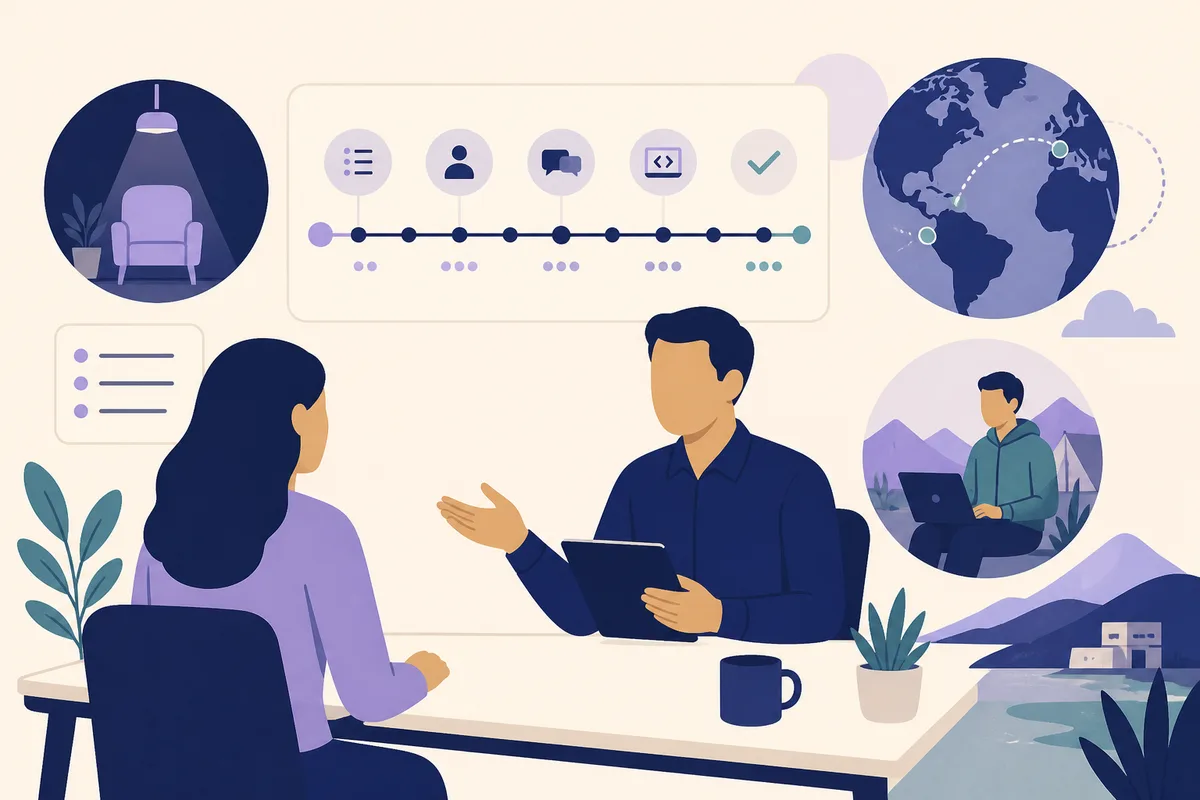
Prepare for the Forward Deployed Engineer loop
To practise for a forward deployed engineer (FDE) interview, run three kinds of mock: a decomposition round on a vague customer brief, a customer-scenario role play where you only ask questions, and a staged coding round where requirements change mid-problem. Do each at least twice, score yourself against a short rubric, and add behavioral stories and an applied-AI design session. The two-week plan below sequences all of it. Reading about the rounds helps, but these skills (thinking aloud, scoping under pressure, adapting code) only improve through repetitions you can review.
At a glance
| Question | Short answer |
|---|---|
| Which rounds should I mock? | Decomposition, customer discovery role play, practical staged coding, applied-AI design, behavioral. |
| How long is one decomposition mock? | 45 to 60 minutes. Palantir's reported round is 60 minutes (Aced). |
| Can I practise alone? | Partly. Timed solo runs work for decomposition and coding; role play needs another voice, human or AI. |
| How many mocks do I need? | No evidence-based number exists. This plan uses about 10 timed sessions in 14 days. |
| What should I record? | Audio of yourself. Count how long you talk before asking a question. |
| What about AI tools? | Policy differs by company and round. Ask your recruiter and practise under the same rules. |
| Where do I start? | The free lessons in the Thita FDE track. |
What FDE loops test
The public loops we have documented (full company-by-company table) share a few ingredients: practical coding, behavioral questions about customers and ownership, and at many companies either a decomposition round or a case built on an ambiguous brief. AI labs add applied-AI system design with an evaluation question. Our research covered eight companies and noted that most sources are prep sites summarizing candidate reports, so confirm your own loop with the recruiter early.
That list gives you the mock menu. Standard LeetCode drilling covers one of the five.
Mock 1: the decomposition round
What it is. A vague prompt, such as "a logistics client is losing money on deliveries," worked at a whiteboard with little code. The reported Palantir version asks you to identify the end user, the data, the APIs and an MVP buildable in one to two weeks while the interviewer adds constraints (Aced). More background is in the decomposition interview guide.
How to run it (45 minutes).
- Minutes 0 to 8: clarifying questions only. Who owns the problem? What do they control? What does success look like and how is it measured today?
- Minutes 8 to 20: data and hypotheses. What data exists, what would you check first, what would change your mind?
- Minutes 20 to 32: the narrow MVP. What ships in a week, who uses it, what is the metric?
- Minutes 32 to 45: your partner injects a constraint ("the system you need belongs to another team with a six-week queue"). Adapt out loud.
Prompts for practice. Use the free case studies on the Thita track (city traffic with sensor data, logistics client losing money) after you have tried them cold. Or write your own: a hospital with long discharge delays, a retailer with high return rates, a bank with slow onboarding.
Score yourself (0 to 2 each). Did you anchor on an end user? Did you reason from data before solutions? Is the MVP small enough to ship in two weeks? Did you name a metric and a baseline? Did you adapt when the constraint arrived?
Mock 2: the customer-scenario role play
What it is. One source describes an Anthropic-style stage in which the interviewer plays a fictional enterprise buyer, such as a VP of Engineering evaluating an LLM for an internal copilot, and you run a discovery call. That account says strong candidates ask about evaluation criteria, past failed AI deployments, fixed constraints like compliance and data residency, and the workflow being replaced, and that pitching or opening a code editor goes badly (getperspective). It is a single vendor post, and the Aced guide to the same loop does not list the stage, so treat it as likely, not certain. ElevenLabs' reported case is similar: a customer wants to automate a process and discovery comes first (Aced).
How to run it (30 minutes). Your partner plays a stakeholder with a one-line brief and a private sheet of facts: the real pain, a hidden constraint, a political blocker, a number they will only reveal if asked. You may only ask questions for the first 20 minutes. In the last 10, summarize what you heard, state the problem in their words and propose a first step.
Brief ideas for the stakeholder.
- "We want an AI assistant for our support team." (Hidden: agents mostly need access to one legacy system.)
- "Our data is a mess and leadership wants dashboards." (Hidden: two teams define revenue differently.)
- "We tried a chatbot last year and it failed." (Hidden: nobody measured what failed.)
Score yourself. Count questions asked versus statements made. Did you surface a constraint you did not know about? Did you restate the problem in their language? Did you avoid proposing a solution until asked? Record the call; most people hear themselves pitch at minute four.
Mock 3: the staged coding round
What it is. Reported FDE coding rounds are production-style problems with requirements added in stages: a credit system with expiry rules at OpenAI, an LRU cache extended in stages at Anthropic (Aced OpenAI, Aced Anthropic). Scale AI screens are reported as graded on completion over optimization (Aced).
How to run it (60 minutes). Pick a small problem with a clear core: a rate limiter, a key/value store, a ledger, a task scheduler. Have your partner reveal requirements one at a time, 15 minutes apart, so you cannot design for all of them upfront:
- Core behavior with tests.
- A new rule that touches the data structure.
- A second rule that conflicts with the first.
- A question on complexity and memory.
Score yourself. Was there working code at every stage? Could the next requirement fit without a rewrite? Did you state assumptions aloud? Did you test as you went? Did you answer complexity honestly?
On a speaking-while-coding round, Thita's AI mock interview can play the interviewer: it is a spoken, adaptive interviewer that asks follow-ups and runs your code against test cases, then gives a written report. For pattern fundamentals, the free DSA patterns sheet is enough; reported difficulty is mostly easy to medium wrapped in a product.
Mock 4: applied-AI design and behavioral
If you are targeting an AI lab or AI startup, add one design mock a week. A reported OpenAI design question is "what evaluation would you build to catch failures before a customer sees them?" (Aced). Practise answering with the measurement plan first: a golden set from real cases, a scoring method, a release gate and one online metric tied to the customer's goal.
For behavioral, write four stories using one structure: situation, your specific action ("I," not "we"), result, what you would change. Cover a conflict with a customer or teammate, a project you owned end to end, a time you explained something technical to a non-technical person, and a failure.
The 14-day plan
Assumes about 90 minutes on weekdays and 2 to 3 hours on weekends. Compress it if your interview is sooner.
| Day | Session |
|---|---|
| 1 | Read the FDE interview guide and list your target company's likely rounds. Do the free lessons on the FDE role and decomposition framework. |
| 2 | Decomposition mock 1, cold, on a prompt you write. Record yourself. |
| 3 | Review the recording against the rubric. Redo the first 10 minutes. |
| 4 | Staged coding mock 1 (rate limiter). |
| 5 | Write four behavioral stories. Say each aloud once. |
| 6 | Role-play mock 1 with a friend or an AI interviewer. Questions only. |
| 7 | Rest, or light review of what you missed. |
| 8 | Decomposition mock 2 on a new domain, with an injected constraint. |
| 9 | Staged coding mock 2 (key/value store with expiry). |
| 10 | Applied-AI design mock: a retrieval system for a customer's documents, with an evaluation plan. |
| 11 | Role-play mock 2 with a harder stakeholder (a hidden blocker). |
| 12 | Project deep dive rehearsal: pick your best system, have a partner interrupt every minute with "why" and "what breaks at 10x". |
| 13 | Full loop simulation: 45-minute decomposition, 30-minute role play, 45-minute coding, back to back with 10-minute breaks. |
| 14 | Review weak spots only. Prepare questions for the recruiter, including AI-tool policy per round. |
If you want a structured version, the Thita FDE track lays out 63 lessons across 13 sections and includes knowledge checks and AI mock interviews for FDE rounds; the free lessons cover the role and problem decomposition, and the rest is on paid plans.
How to review a mock
Do these four things after each session, in order:
- Listen to the recording once at 1.5x. Mark every time you stated a solution before asking a question.
- Score with the rubric. Use 0 to 2 per line and track totals across sessions, so you see a trend, not a feeling.
- Pick one habit to fix next session. One, not five.
- Redo the worst 10 minutes the same day. Deliberate repetition beats a fresh prompt.
Common mistakes in FDE practice
- Grinding algorithms only. It covers one round of five.
- Practising decomposition silently. The skill is thinking aloud; write nothing down for the first run.
- Role-playing with a friendly partner. Give them a hidden blocker and ask them to be vague.
- Skipping evaluation in design practice. It appears in OpenAI-reported design prompts and in Sierra's reported take-home.
- Practising with tools you will not have. Ask your recruiter what is allowed per round and practise under those rules.
- Never reviewing. An unreviewed mock teaches less than half of what it could.
FAQ
How do I prepare for a forward deployed engineer interview?
Mock the five rounds the public loops share: decomposition, customer discovery, staged coding, applied-AI design and behavioral. Use the 14-day plan above, and check your target company's loop in our FDE interview guide.
What is an FDE mock interview?
It is a timed practice session for a round in a forward deployed engineer loop, such as a decomposition case or a customer role play, ideally with another person or an AI interviewer asking follow-ups and a rubric you score afterward.
How many days do I need to prepare for an FDE interview?
Two weeks of focused practice is a reasonable plan if you already code well, and the plan here is built for that. We have no data on what the average successful candidate does, so adjust to your gaps.
Can I practise the decomposition round alone?
Partly. A timed solo run with a recorded voice memo works for the first pass. Add a partner or an AI interviewer for the injected-constraint step, where the round changes under you.
How do I practise customer discovery for an FDE interview?
Have someone play a vague stakeholder with a hidden constraint and ask questions only for 20 minutes. Count your questions versus statements and avoid proposing solutions until the end.
Is LeetCode enough for FDE interviews?
No. Reported FDE coding is easy-to-medium work wrapped in a product, with staged requirements, and the loops add decomposition, discovery and behavioral rounds. See the FDE interview questions bank.
What is the best FDE interview prep course?
We are not neutral, but here is how to judge any course: it should cover decomposition, discovery, applied-AI design, practical coding and behavioral, and let you practise out loud. The Thita FDE track was built around those rounds, with free lessons you can try first.
Can I use AI tools in an FDE interview?
It depends on the company and round, and policies have been changing. Ask your recruiter in writing and follow what you are told; practise under the same rules.
Where to go next
Start with the FDE track. If you are targeting a specific company, read the Palantir, OpenAI or Anthropic guides, then run a spoken mock on the AI mock interview.
Topics
Your next step
Prepare for the Forward Deployed Engineer loop
The FDE track walks through the rounds FDE loops use, decomposition, coding and customer scenarios, then lets you rehearse them out loud with an AI interviewer that asks follow-up questions.