
Interview
How to Stay Calm and Confident During Technical Interviews
Most engineers don’t struggle in interviews because they can’t code a binary search or reverse a linked list. They struggle because their brain quietly switc...
Most engineers don’t struggle in interviews because they can’t code a binary search or reverse a linked list. They struggle because their brain quietly switches into “fight or flight” the moment the interviewer says, “Let’s start with a coding problem.”
Heart rate spikes. Hands shake. You forget the simplest things. You know the material, but you can’t access it.
This post is a practical guide to staying calm and confident during technical interviews. We’ll look at what’s actually happening in your brain, how to design a preparation routine that reduces anxiety, and what to do in the moment when you feel panic rising. Throughout, we’ll focus on actionable interview anxiety tips you can apply immediately—especially if you have an interview coming up this week.
Why Technical Interviews Trigger Anxiety
Before we get into tactics to stay calm in interviews, it helps to understand what’s going on under the hood.
The brain under pressure: why you “forget everything”
In a technical interview, you’re asked to:
- Understand a new problem
- Design an algorithm
- Write bug-free code on the spot
- Communicate clearly
- Manage time
All while being observed and evaluated.
From a neuroscience standpoint:
- Amygdala (threat detection) lights up when you perceive risk (e.g., “If I fail, I won’t get this job.”).
- Prefrontal cortex (reasoning, working memory) handles problem solving and holding complex states (e.g., “current pointer,” “visited set,” “recursion stack”).
When anxiety spikes, the amygdala hijacks attention and working memory. This is why you suddenly can’t recall an API you’ve used for years or forget the time complexity of a basic operation.
The goal isn’t to eliminate anxiety (that’s unrealistic); it’s to keep it in a range where your prefrontal cortex can still function.
A Systems Approach to Technical Interview Confidence
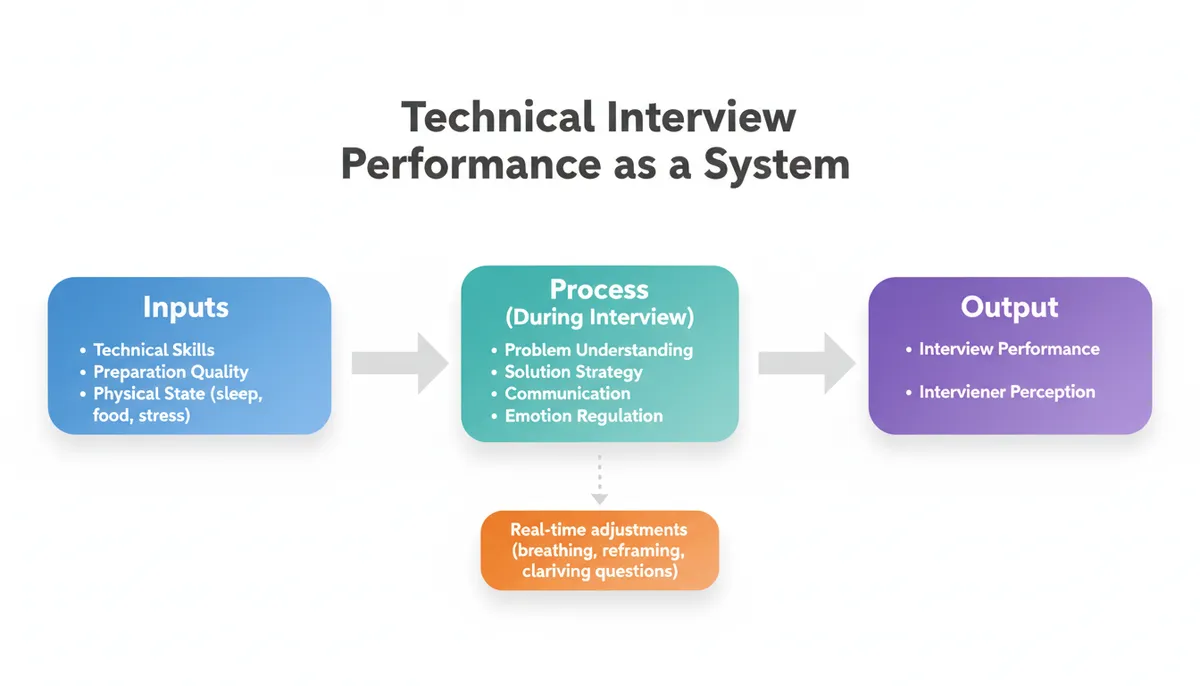
You can think of technical interview performance as a simple system:
- Inputs: skills, preparation, sleep, stress level
- Process: how you think and behave during the interview
- Output: your performance
Most people focus only on skill (DSA, system design) and ignore the other parts. To consistently stay calm in interviews, you need to engineer all three.
We’ll walk through each part with concrete interview performance tips.
Before the Interview: Build a Foundation that Reduces Anxiety
1. Replace “random practice” with pattern-based preparation
One major driver of anxiety is uncertainty: “What if they ask something I’ve never seen?”
You can’t predict exact questions, but you can drastically reduce uncertainty by learning patterns instead of isolated problems. For example:
- Sliding window
- Two pointers
- Fast & slow pointers
- Binary search on answer
- Topological sort
- Backtracking
- DP on sequences / grids / trees
- Graph traversal patterns
When you recognize the pattern, your brain switches from “I have no idea” to “I’ve seen this structure before,” which calms the threat response.
If you’re using a patterns sheet (like a curated DSA pattern list), organize your practice like this:
- Choose 1–2 patterns per week.
- For each pattern:
- Read the conceptual overview (when it applies, common pitfalls).
- Solve 3–5 problems of increasing difficulty.
- After each problem, summarize in your own words:
- “How did I recognize this pattern?”
- “What’s the typical time/space complexity?”
- At the end of the week, do a mixed set where you first identify the pattern before coding.
This converts “random question space” into “finite pattern space,” which is far less anxiety-inducing.
2. Simulate the real thing: time-boxed, spoken, and observed
You can’t train your nervous system to stay calm in interviews with silent, leisurely LeetCode sessions. You need high-fidelity simulations:
- Time-boxed: 30–45 minutes per problem.
- Spoken: verbalize your thoughts.
- Observed: ideally with another engineer or an AI interviewer.
This does two things:
- Desensitization: Your brain learns that “being watched while solving a problem” is safe and familiar.
- Skill integration: You practice coding + communication + time management together, as you will in the real interview.
A simple weekly structure:
- 2–3 sessions of:
- 5 minutes: read problem, restate, ask clarifying questions (out loud).
- 10–15 minutes: brainstorm approaches, compare trade-offs.
- 15–20 minutes: implement and test.
- 5 minutes: reflect on what went well and what didn’t.
If you don’t have a human partner, use a structured AI mock interview tool that enforces timing and gives feedback on both code and communication.
3. Create a pre-interview routine for your nervous system
Treat interviews like athletes treat competitions. Elite performers don’t just “show up and hope”—they have a routine that tells their body: “We’ve been here before; we know what to do.”
Design a 10–15 minute pre-interview routine that includes:
-
Breathing pattern (2–3 minutes)
Use a simple, evidence-backed pattern like physiological sighs:- Inhale through nose
- Short second inhale
- Long exhale through mouth
Repeat 5–10 times. This directly reduces physiological arousal.
-
Cognitive script (3–5 minutes)
Write and read a short script before each interview:- “My goal is to collaborate and show my thinking.”
- “It’s okay to not know immediately. I will ask questions and iterate.”
- “One interview does not define my worth or career.”
-
Micro warm-up (5 minutes)
Don’t let the interview be the first time you touch a problem that day:- Solve a very easy problem (e.g., reverse string, sum array).
- Or write a simple function in your interview language:
PYTHON
The point is not difficulty; it’s to remind your hands and brain: “We know how to code.”
During the Interview: A Step-by-Step Playbook to Stay Calm
Here’s a concrete, repeatable process you can follow in almost any coding interview.
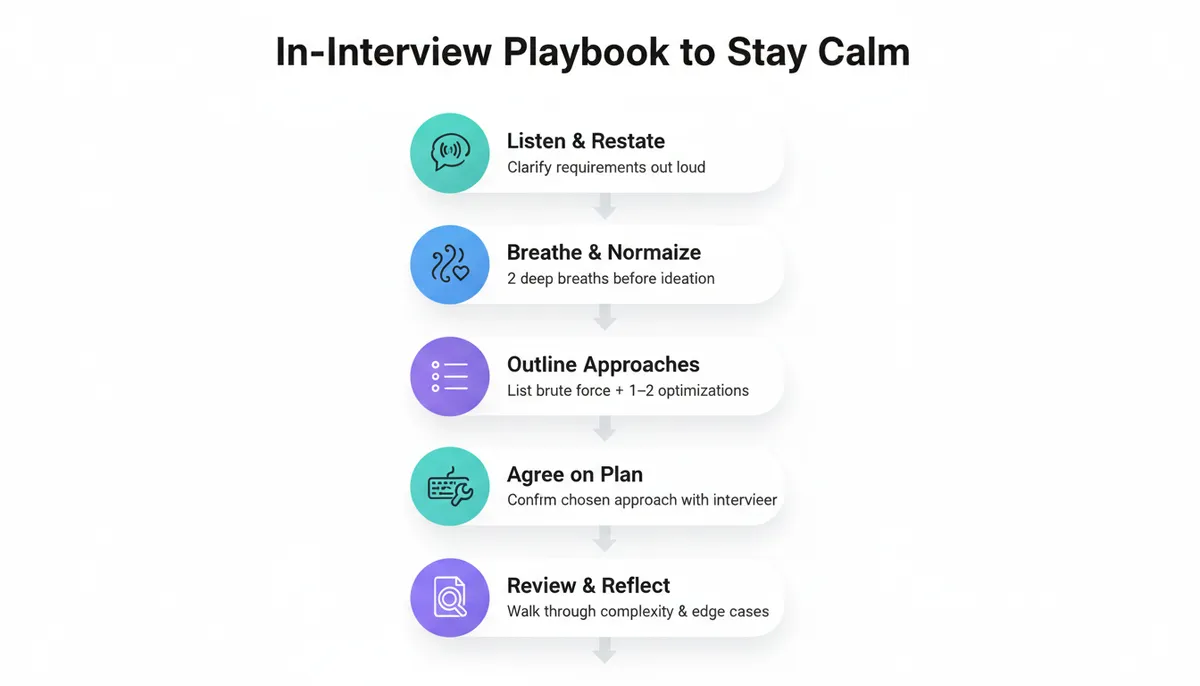
Step 1: Slow the start — restate and clarify
Most candidates rush to coding. This increases anxiety and errors. Instead:
- Listen fully to the problem. Don’t interrupt.
- Restate in your own words:
- “So if I understand correctly, we’re given … and we need to return …”
- Ask clarifying questions:
- Input size constraints?
- Are inputs sorted?
- Can we modify the input in place?
- Are there memory limits?
- What should we do on invalid inputs?
This accomplishes:
- Buys you time to breathe and think.
- Reduces ambiguity (a major anxiety source).
- Signals to the interviewer that you’re methodical.
Step 2: Insert a micro-pause before ideation
After you understand the problem, pause for 5–10 seconds. This feels long in the moment but is completely normal externally.
Use the pause to:
- Take 1–2 slow breaths.
- Mentally scan for patterns:
- “Is this sliding window? Two pointers? Graph? Tree? DP?”
You can narrate this to make it less awkward:
- “Let me think aloud for a moment about possible approaches.”
Step 3: Start from brute force, then optimize
A common anxiety pattern: you feel you must jump straight to the optimal solution or you’ve “failed.” This is false and counterproductive.
Instead, use a two-phase strategy:
- State a brute force approach:
- “A straightforward solution would be to try all pairs/triples/paths… That would be O(n²)/O(2ⁿ).”
- Then improve:
- “But that’s too slow for n up to 10⁵. We can do better by using a hash map / two pointers / binary search…”
This has several benefits for staying calm in interviews:
- You always have something to say quickly.
- You demonstrate structured thinking and complexity awareness.
- The interviewer can nudge you if you’re close to the right pattern.
Example structure you can reuse:
TEXT
Step 4: Get explicit agreement on the plan
Before coding, briefly summarize your chosen approach and ask for confirmation:
- “I’m thinking of using a sliding window with two pointers, expanding the right pointer and shrinking the left when the sum exceeds the target. That should give us O(n) time and O(1) extra space. Does that sound reasonable?”
If the interviewer agrees:
- Your anxiety drops: you’re aligned.
- You reduce the risk of implementing an approach they don’t want.
If they push back:
- You get real-time feedback before investing time in code.
- You can course-correct early.
Step 5: Code in small, verifiable steps
When nervous, people tend to:
- Write a lot of code before running anything.
- Avoid testing until the end (fear of seeing it fail).
- Make off-by-one and null-handling mistakes.
Instead, adopt a small-steps, constant-feedback style:
- Start with function signature and basic structure.
- Add simple base cases first.
- Use clear variable names.
- Test with a trivial case mentally or by printing.
- Incrementally add logic and test after each meaningful change.
Example (Python):
PYTHON
This style:
- Makes it easier to think under pressure.
- Gives you frequent “wins” (tests passing) that build confidence mid-interview.
- Shows the interviewer that you write maintainable code.
Step 6: Narrate your thinking, especially when stuck
Silence increases anxiety for both you and the interviewer. Instead, treat the interviewer as a collaborator:
- When you’re deciding between approaches:
- “We could use a hash map for O(n) time and O(n) space, or sort first for O(n log n) time and O(1) extra space. Given the constraints, I’d lean toward…”
- When you’re stuck:
- “I’m considering using DFS with memoization, but I’m worried about the recursion depth for n up to 10⁵. Let me think about an iterative alternative.”
- When you realize a mistake:
- “I just noticed an issue: if the input array is already sorted, my current approach will still sort it again. We can optimize by…”
This has two calming effects:
- Keeps your prefrontal cortex engaged in structured reasoning.
- Allows the interviewer to guide you, which reduces the feeling of “performing alone on stage.”
Tactical Anxiety Management: What To Do When You Feel Panic Rising
Even with preparation, there will be moments when you blank or feel overwhelmed. Here’s a concrete protocol.
1. Name it and normalize it (silently)
Internally, say something like:
- “This is anxiety, not incompetence.”
- “My brain is in fight-or-flight; that’s expected.”
Labeling the emotion reduces its intensity (this is well-documented in affect labeling research).
2. Use a 10–15 second reset
If you feel your mind racing:
- Ask for a brief moment:
- “Give me 10–15 seconds to collect my thoughts.”
- Do 2–3 cycles of slow breathing:
- 4 seconds in, 6 seconds out.
- Write something small on the screen or whiteboard:
- E.g., list knowns/unknowns or constraints.
Writing grounds you and re-engages the problem-solving part of your brain.
3. Externalize the problem state
Working memory is limited and highly affected by anxiety. Reduce the load by pushing information out of your head and onto the screen/board:
- Draw small diagrams (arrays, pointers, graph nodes).
- Write down:
- Input format
- Output format
- Constraints
- Edge cases list
Example for a tree problem:
TEXT
This both improves solution quality and calms you by making the task feel concrete and finite.
Common Mistakes That Increase Interview Anxiety
Mistake 1: Treating interviews as pass/fail judgments of your worth
Belief: “If I fail this, I’m not good enough to be a software engineer.”
Reality:
- Interviews are noisy signals.
- Different companies and interviewers optimize for different things.
- Many excellent engineers fail interviews regularly.
Reframe:
- “Each interview is a training sample, not a verdict.”
- Track process metrics (Did I clarify requirements? Did I communicate trade-offs?) rather than only outcome metrics (offer vs. no offer).
Mistake 2: Over-indexing on rare tricks instead of fundamentals
Belief: “I need to memorize 500+ LeetCode questions and rare tricks to succeed.”
Reality:
- Most interviews focus on a core set of patterns and fundamentals.
- Deep understanding of ~50–100 pattern-based problems beats shallow familiarity with 500.
Overloading yourself with random, unstructured problems increases cognitive load and anxiety. Focus on depth over breadth.
Mistake 3: Ignoring physical state
Common patterns:
- Skipping meals (“I’ll eat after the interview.”)
- Overdosing on caffeine.
- Sleeping poorly the night before.
These all amplify your stress response. Your technical interview confidence is tightly coupled to your physiological baseline.
Minimum checklist for day-of:
- Light meal 1–2 hours before.
- Hydrate, but not so much you’re uncomfortable.
- Avoid adding stressors (e.g., new coffee brand, heavy sugar).
Mistake 4: Never reviewing interviews systematically
Many candidates:
- Do an interview.
- Feel bad.
- Move on without analysis.
This keeps anxiety high because you never build a stable mental model of what’s going wrong or right.
Instead, after each interview, write a short debrief:
- What went well?
- Where did I get stuck? (pattern? communication? time?)
- What will I do differently next time?
Over time, this converts vague dread into specific, actionable improvements.
Best Practices and Actionable Interview Performance Tips
Here’s a consolidated checklist you can adapt.
Weekly habits to build technical interview confidence
- 2–3 pattern-focused sessions
- Choose a pattern (e.g., sliding window).
- Solve 3–5 problems.
- Summarize recognition cues and complexities.
- 1–2 timed mock interviews
- 30–45 minutes each.
- Speak out loud.
- Get feedback (human or AI).
- 1 review session
- Log patterns you struggled with.
- Note communication issues (e.g., not restating problem).
- Plan focus for next week.
Day-before checklist
- Solve 1–2 easy problems in your target language.
- Review 2–3 common patterns and their “trigger conditions.”
- Prepare logistics:
- Check IDE/editor setup or online coding platform.
- Test audio/video and internet.
- Confirm time zone and meeting link.
30 minutes before the interview
- Do your pre-interview routine:
- Breathing (2–3 minutes).
- Cognitive script (3–5 minutes).
- Micro warm-up (5 minutes of trivial coding).
- Prepare a one-line intention:
- “Today I will focus on clear communication and structured thinking.”
During the interview
- At problem start:
- Listen fully.
- Restate and clarify.
- Pause 5–10 seconds before ideation.
- While solving:
- Start with brute force, then optimize.
- Get agreement on approach before coding.
- Code in small steps with frequent tests.
- Narrate key decisions.
- If stuck or anxious:
- Ask for 10–15 seconds.
- Breathe.
- Externalize state (draw, list constraints).
A Quick Example: Applying the Calmness Playbook
Suppose you’re asked:
Given an array of integers and a target sum, return the length of the smallest contiguous subarray whose sum is greater than or equal to the target. If there is no such subarray, return 0.
Here’s how you might apply the process.
- Restate and clarify:
- “So we have an array of integers, possibly positive only? Are there negative numbers?”
- “We need the minimum length of a contiguous subarray whose sum ≥ target. If none exists, return 0. Is that correct?”
- Pause and pattern scan (5–10 seconds):
- Contiguous subarray + sum constraint → likely sliding window if all numbers are non-negative.
- State brute force:
- “Brute force would be to consider all subarrays and compute their sums, which is O(n²) time.”
- Optimize using pattern:
- “Since the numbers are non-negative, we can use a sliding window: expand right to increase sum, and shrink left while sum ≥ target to minimize length. That gives O(n) time.”
- Confirm approach:
- “I’ll implement the sliding window approach. Does that align with what you’re expecting?”
- Code in small steps, narrating:
PYTHON
- Analyze and review:
- “Time complexity is O(n) since each element is added and removed at most once. Space is O(1) extra. Edge cases: empty array returns 0, target larger than sum of all elements also returns 0.”
Notice how the structure itself (clarify → brute force → pattern → confirm → small steps) acts as a scaffold that keeps anxiety in check.
Key Takeaways
- Anxiety in technical interviews is normal and expected. The goal is not elimination but regulation so your reasoning stays online.
- Pattern-based preparation reduces uncertainty and boosts technical interview confidence more effectively than random problem grinding.
- High-fidelity mock interviews (timed, spoken, observed) train your nervous system for the real environment.
- A pre-interview routine (breathing, cognitive script, micro warm-up) is a low-effort, high-impact way to stay calm in interviews.
- During the interview, follow a structured playbook:
- Restate and clarify.
- Pause and breathe.
- Start with brute force, then optimize.
- Confirm the plan.
- Code in small steps with tests.
- Narrate your thinking and externalize state.
- Treat each interview as practice data, not a final verdict. Systematic review over time will steadily reduce anxiety and improve performance.
Confidence in technical interviews isn’t a personality trait; it’s a skill you can engineer with the right systems, habits, and in-the-moment techniques. If you integrate even a few of these strategies into your preparation, you’ll not only perform better—you’ll feel very different the next time you hear, “Let’s start with a coding question.”