
Interview
SHL Coding Simulation for Software Engineers: What Companies Test and How to Prepare
What is the SHL coding simulation for software engineers? Learn the languages, IDE, scoring, and how it differs from HackerRank. Start your prep plan today.
If you've been invited to complete an SHL coding simulation, you've probably noticed something frustrating: most of the search results explaining it are written for HR teams and talent leaders, not for the engineer who actually has to write the code. You don't need a pitch about "predictive hiring signals." You need to know what languages you can use, what the environment looks like, and exactly what gets scored when you hit submit.
This guide is the engineer-first explainer. We'll break down what an SHL coding simulation (often branded as SHL Automata) actually tests, how its scoring differs from a plain LeetCode-style judge, how it compares to HackerRank, CodeSignal, and Codility, and then give you a focused, time-boxed prep plan.
Want to start practicing now? Work through the DSA Patterns Sheet to cover the algorithm families these assessments lean on, or run a timed AI mock interview to rehearse coding under pressure.
What Is an SHL Coding Simulation?
An SHL coding simulation is an automated, online coding assessment that companies send candidates early in the hiring funnel — usually before any human ever reviews your resume in depth. SHL describes it as an "AI-powered coding simulation assessment that evaluates a candidate's programming ability" inside a familiar IDE.
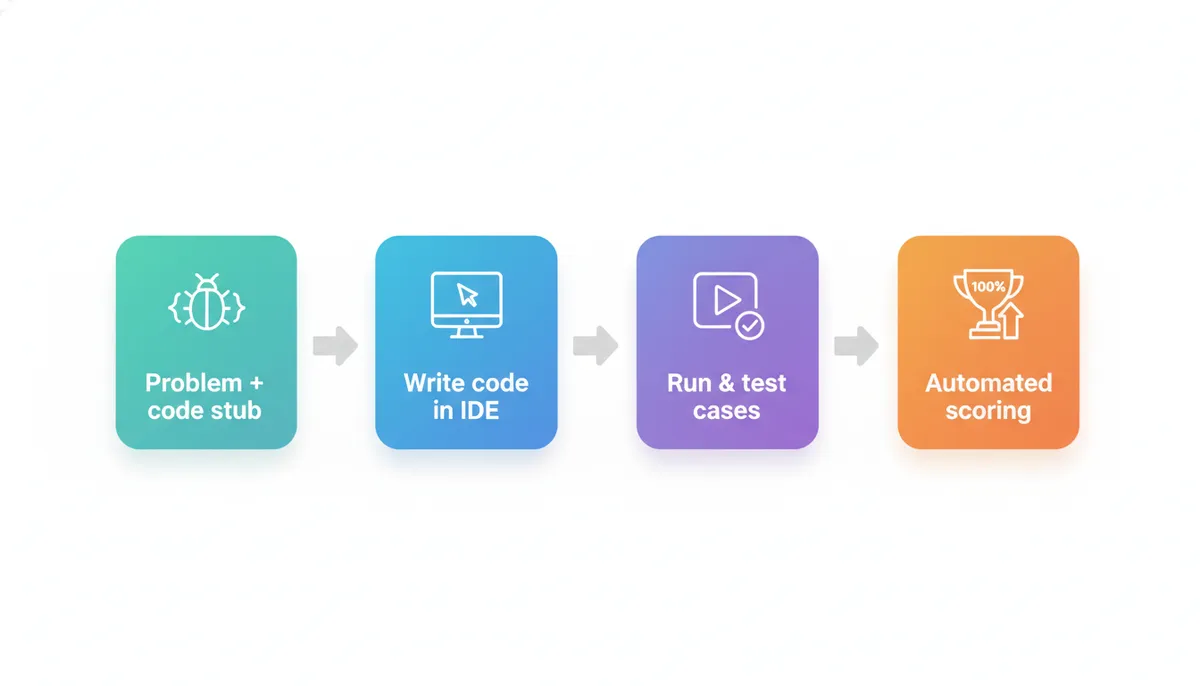
The key word is simulation. Unlike a quiz with multiple-choice questions about syntax, the SHL coding test drops you into a real editor where you write, run, and test actual source code against problems modeled on real-world engineering tasks. Per SHL's official product pages, the assessment provides code stubs "to reduce time spent in the assessment and simulate a familiar coding environment," and gives you an IDE where you can "run and test your own source code."
Here's what makes it different from a take-home or a whiteboard round:
- It's fully automated. No human watches you code in real time. Your submission is scored by SHL's engine.
- It's benchmarked. SHL scores your code "using a benchmark dataset," meaning your output is compared against a calibrated standard, not just pass/fail test cases.
- It scores more than correctness. This is the big one. The simulation evaluates "programming ability, solution logic, time complexity, and industry-accepted best practices" — not just whether your tests pass.
SHL offers these simulations for a wide range of roles. Per their official catalog, assessments are "available for Software Architect, Software Developer, DevOps, Quality Assurance, Data Science, Data Engineering, Full-stack, Front-end, Backend, and more roles." So the exact problem set you see depends on the role you applied for.
Languages and the Coding Environment
One of the most common questions: what languages does the SHL coding simulation support?
The good news is breadth. SHL's product pages state the coding simulations are available in "50+ coding languages," and the AI-powered version is described as available in "over 40 different programming languages." In practice, this covers everything you'd expect — the mainstream interview languages plus role-specific ones:
- General-purpose: Python, Java, C, C++, C#, JavaScript, TypeScript, Go, Ruby, PHP, Kotlin, Swift, Scala
- Data / backend: SQL, R, and language variants used in data-engineering and data-science role tracks
- Web / front-end: HTML/CSS and JavaScript-based tasks for front-end role simulations
💡 Pro Tip: Because SHL scores runtime complexity and best practices, pick the language you write most fluently — not the "fastest" one. A clean, idiomatic Python solution will out-score a cramped, hacky C++ one. The benchmark rewards readable, well-structured code, so play to your strengths.
The environment itself is a browser-based IDE. You typically get:
- A problem statement describing inputs, outputs, and constraints
- A code stub (function signature or skeleton) so you don't waste time on boilerplate
- The ability to compile, run, and test your code against sample cases before submitting
- A countdown timer — SHL lists completion times in the range of roughly 45–60 minutes depending on the specific product variant
⚠️ Important: The provided code stub defines the expected function signature and I/O contract. Don't rewrite it or change parameter names — the auto-grader feeds test cases into that exact signature. Read the stub before you read the problem.
What Gets Scored: The Four Metrics
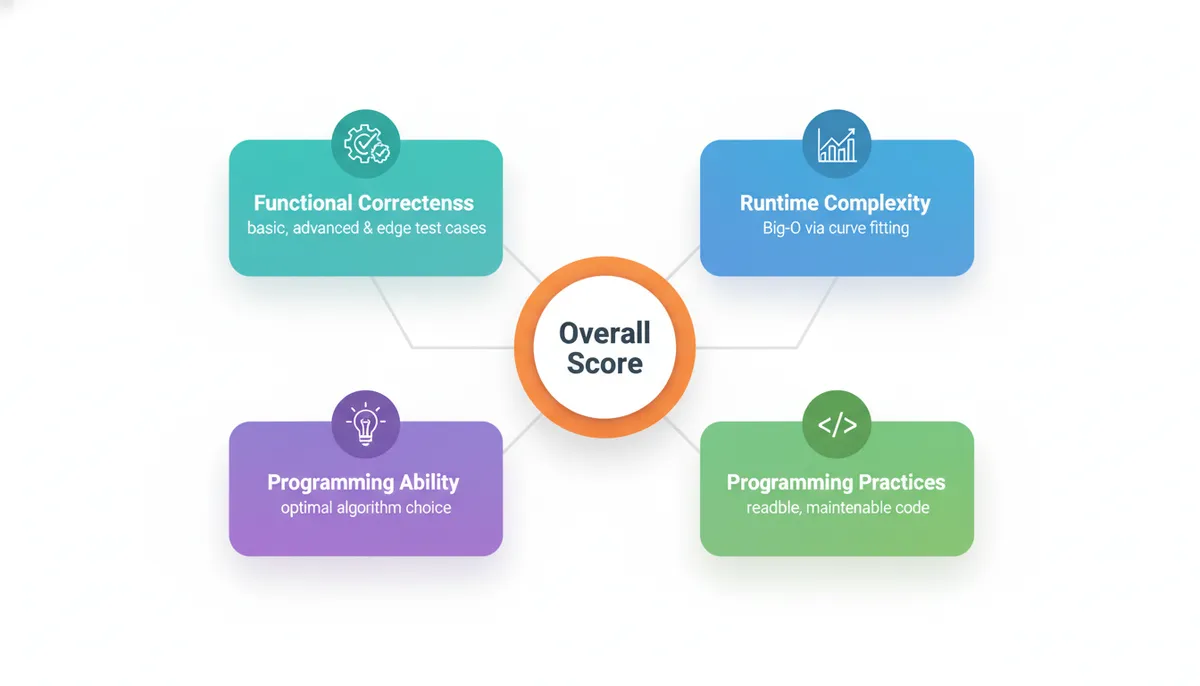
This is where the SHL coding test diverges hardest from a standard online judge. A typical LeetCode-style grader gives you a binary: your tests pass or they don't. SHL's Automata engine grades on multiple weighted dimensions, and the public sample reports from SHL break them into four core metrics.
1. Functional Correctness
Does your code produce the right output? SHL measures this "based on test-suite coverage," running your solution against three tiers of cases:
- Basic test cases — the happy path with typical inputs
- Advanced test cases — larger or more complex inputs
- Edge cases — empty inputs, single elements, boundary values, and unusual conditions
✅ Do: Explicitly handle empty inputs, nulls, single-element collections, and the maximum-size case. Edge-case coverage is a separate scored bucket — passing the basic cases alone leaves points on the table.
2. Runtime Complexity
Here's the metric most candidates don't expect. SHL doesn't just check that your code runs — it estimates your solution's average-case time complexity in Big-O terms. According to SHL's sample detailed reports, complexity is "detected by empirically fitting a curve to the run-time for different input sizes." In other words, the engine runs your code across growing inputs, measures how runtime scales, and infers whether you wrote an O(n), O(n log n), or O(n²) solution.
This means a brute-force O(n²) solution that passes every test case will still score lower than an optimal O(n) one. Correct-but-slow is not "full marks" on an SHL coding simulation.
3. Programming Ability
SHL defines this as "the ability to code in the most optimized way." It rewards solutions that are algorithmically sound and efficient — closely tied to, but distinct from, the runtime-complexity score. This is where knowing the right pattern (two pointers, sliding window, hashing, the correct graph traversal) pays off directly.
4. Programming Practices
SHL defines this as "the ability to code in a readable and maintainable fashion," scored against "industry-defined best practice." This includes things a human reviewer would notice: meaningful variable names, sensible structure, avoiding dead code, and not leaving obviously brittle constructs.
These four roll up into an Overall Score that the hiring company uses against their cutoff. SHL markets the approach as reducing "false negatives by 45%" — the pitch being that a strong engineer who fumbles one edge case still gets credit for clean, efficient code.
How SHL Differs from HackerRank, CodeSignal, and Codility
If you've taken a HackerRank or CodeSignal assessment before, you might assume an SHL coding test is the same thing. It isn't — and the differences change how you should prepare. The biggest one: SHL explicitly scores code quality and complexity as first-class metrics, where most competitor platforms center on test-case pass rate (with the General Coding Assessment / GCA model on CodeSignal being the notable scoring-model exception).
| Dimension | SHL (Automata) | HackerRank | CodeSignal | Codility |
|---|---|---|---|---|
| Primary signal | Multi-metric: correctness + complexity + best practices | Test cases passed | Coding score / score model | Correctness + performance |
| Scores Big-O complexity | Yes — empirically, via curve fitting | Partly (perf/timeout cases) | Indirectly | Yes (performance tests) |
| Scores code readability/style | Yes — explicit metric | Generally no | Generally no | Generally no |
| Languages | 40–50+ | 40+ | 70+ | 15+ common |
| Environment | Browser IDE with code stubs | Browser IDE | Browser IDE | Browser IDE |
| Typical length | ~45–60 min | Varies (30–90 min) | ~60–120 min | ~30–120 min |
| Common framing | Role-based simulations | DSA + role tracks | GCA score / framework | Algorithmic tasks |
Platform specifics evolve — always confirm details in your official invitation email.
The practical takeaway: on HackerRank you can often brute-force your way to full marks if every test passes. On SHL, a brute-force solution that passes all cases can still lose points on the Runtime Complexity and Programming Ability metrics. So the bar isn't "make it work" — it's "make it work well."
❌ Don't assume "all tests green = perfect score." On an SHL coding simulation, an inefficient or messy passing solution is partial credit, not full credit.
If you want platform-specific playbooks for other automated assessments, see our guides on the HireVue coding assessment and the Karat technical interview.
Time-Management Strategy
With ~45–60 minutes and typically two coding problems, time pressure is real. Here's a allocation that protects your score across all four metrics:
- First 5 minutes — read everything. Read both problems and their code stubs before writing a single line. Identify the easier one and note the input constraints (they hint at the expected complexity).
- Solve the easier problem first. Bank a high-quality, complete solution early. Confidence and points compound.
- Get correct before fast. Write a working solution, run the sample cases, confirm correctness — then optimize. A correct O(n²) beats a broken O(n).
- Then optimize for complexity. Once it's correct, ask: "Is there a pattern that drops this from O(n²) to O(n log n) or O(n)?" This directly lifts your Runtime Complexity and Programming Ability scores.
- Last 5 minutes — polish. Rename cryptic variables, delete dead code, add the edge-case handling you skipped. This is free Programming Practices score.
💡 Pro Tip: Don't spend 30 minutes chasing the optimal solution on a hard problem while leaving the easy one half-done. Partial, clean, correct work across both problems usually beats one perfect solution and one blank editor.
A Focused Prep Plan
You don't need months. A focused two-to-three week plan covers the ground that SHL actually scores. The trick is to practice for all four metrics, not just correctness.
- Week 1 — Pattern coverage. Work through the core algorithm families on the DSA Patterns Sheet: arrays and strings, two pointers, sliding window, hash maps, sorting/searching, recursion, and basic graph/tree traversal. These map directly to what SHL role simulations test. Use the structured DSA Learning Path if you want a guided sequence rather than picking problems at random.
- Week 1–2 — Complexity fluency. For every problem you solve, state its time and space complexity out loud before checking. Since SHL literally curve-fits your runtime to estimate Big-O, you need to reach for the optimal pattern instinctively. Practice recognizing "this nested loop is O(n²) — can a hash map make it O(n)?"
- Week 2 — Clean-code reps. Re-solve five problems you've already cracked, this time optimizing for readability: descriptive names, small helper functions, no dead code. Build the muscle memory so clean code is your default under time pressure — that's your Programming Practices score on autopilot.
- Week 2–3 — Timed simulations. Do at least three timed sessions of two medium problems in 50 minutes. Run an AI mock interview to rehearse explaining and coding under a clock, and to get feedback on approach — the closest thing to the real pressure.
- Final days — edge-case drills. For each practice problem, deliberately write the empty-input, single-element, and max-size test before you submit. Make edge-case thinking automatic, since it's a separately scored bucket.
✅ Do practice in the same language you'll use on the real assessment. Muscle memory for syntax, standard-library calls, and idioms saves minutes you can't afford to lose.
Frequently Asked Questions
What is the SHL coding simulation?
It's an automated online coding assessment (often branded SHL Automata) where you write, run, and test real code in a browser IDE. Companies use it early in software-engineering hiring. Unlike a simple pass/fail judge, it scores your code on correctness, runtime complexity, programming ability, and best practices against a benchmark dataset.
What programming languages does SHL support?
SHL's product pages cite "50+ coding languages" for the coding simulations and "over 40" for the AI-powered version. This covers all the mainstream interview languages — Python, Java, C++, C#, JavaScript, Go, and many more — plus role-specific languages like SQL and R for data tracks. Use the one you're most fluent in.
How long is the SHL coding test?
It varies by the specific product variant and role, but completion times generally fall in the 45–60 minute range, typically with two coding problems. Always check your invitation email for the exact time limit.
Does SHL score code quality, or just whether tests pass?
Both. This is the key difference from many other platforms. SHL grades Functional Correctness (test cases), Runtime Complexity (estimated Big-O), Programming Ability (optimal solutions), and Programming Practices (readable, maintainable code). A passing-but-inefficient or messy solution earns partial credit, not full marks.
Is the SHL coding simulation harder than HackerRank?
Not necessarily harder in problem difficulty — but it's scored more strictly. On many HackerRank assessments, passing every test case maxes your score. On SHL, you can pass all tests and still lose points for high complexity or poor code style. So you have to write code that's both correct and efficient and clean.
Can I run and test my code before submitting?
Yes. SHL provides an IDE where you can "run and test your own source code" against sample cases. Always use this to verify correctness — especially on edge cases — before you submit.
How do I prepare for the SHL coding assessment quickly?
Focus on three things: (1) cover the core DSA patterns, (2) build complexity fluency so you reach for optimal solutions instinctively, and (3) practice writing clean, readable code under a timer. The DSA Patterns Sheet plus a few timed AI mock interviews covers all three in two to three weeks.
Does SHL evaluate my code's time complexity automatically?
Yes. Per SHL's sample reports, average-case time complexity is "detected by empirically fitting a curve to the run-time for different input sizes." The engine runs your code across growing input sizes and infers your Big-O from how runtime scales — so an unoptimized solution is detectable even when it passes the tests.
Final Thoughts
The SHL coding simulation rewards exactly the habits that make someone a good engineer in the first place: correct logic, efficient algorithms, careful edge-case handling, and clean, readable code. That's good news — it means there are no cheap tricks, but also that solid, well-rounded preparation pays off directly.
Treat it as more than a "make the tests pass" exercise. Practice for all four scored dimensions, rehearse under a timer, and write the code you'd want a teammate to read.
Start here:
- Cover the patterns with the DSA Patterns Sheet
- Follow a guided sequence on the DSA Learning Path
- Rehearse under pressure with an AI mock interview
Prepare for the metrics SHL actually scores, and the simulation becomes a formality rather than a filter.
Sources: SHL Coding Simulations, SHL Skills & Simulations Assessments, SHL Automata product catalog.