
Interview
SIG Discovery Program 2026: Dates, OA & What to Expect
SIG Trading System Engineer Discovery Program 2026: application window status, how the resume screen and online assessment work, and a prep plan.
The SIG Trading System Engineer Discovery Program is one of the cleanest entry points into Susquehanna International Group (SIG) for students who are curious about trading systems but aren't yet eligible for a full internship. Discovery Programs at SIG exist specifically to introduce earlier-year students to the firm's technology, culture, and the engineers who build the systems that power its trading — long before a formal internship application would make sense.
If you're a computer science or engineering student wondering how to break into quant-adjacent software engineering, this guide walks you through the entire path: who's eligible, how the resume-first screen works, what the online assessment (OA) looks like, and a concrete preparation plan you can start this week.
Ready to start preparing? Run your resume through the Thita.ai Resume Analyzer before you apply, and begin sharpening your coding with the DSA Learning Path.
⚠️ Important: Program names, dates, and exact requirements change every cycle. Everything here is framed to stay accurate over time, but always confirm the current details on the official Susquehanna careers site before you apply.
Key Dates & Results (last checked 2026-09-07)
| Stage | Status |
|---|---|
| Application window (2026 cycle) | not announced yet (last checked 2026-09-07) — specific dates are not reliably fixed in advance |
| Time from invite link to OA submission | Typically around one week |
| Online Assessment length | About 60 minutes of active coding time |
Discovery and early-talent application windows shift each recruiting cycle. Check the official Susquehanna careers page for the current cycle's openings and deadlines rather than treating any secondhand date as fixed.
What Is the SIG Trading System Engineer Discovery Program?
Susquehanna International Group is a global quantitative trading firm, and its technologists design the trading systems that process massive amounts of market data while maintaining extreme performance and stability. According to SIG's technology careers page, the firm runs more than 20,000 physical, virtual, and containerized servers, and its engineers are "embedded in trading" — close to where ideas are generated and iterated.
SIG's Discovery Programs are early-talent offerings built for students who are not yet eligible for the firm's internships. They're designed to give you exposure to the work, the people, and the way SIG thinks about engineering, with a learning plan tailored to the skills participants already have.
A Trading System Engineer Discovery Program sits inside SIG's technology Discovery track. It's aimed at students who want a first look at what it means to build low-latency, high-reliability trading infrastructure — the kind of role where software engineering and markets meet.
Why the Discovery Route Matters
- Early access: You get in front of SIG before you're eligible for an internship, building relationships years ahead of competitors.
- A real preview: You see how trading systems engineering actually works, not a generic "tech open day."
- A pipeline, not a dead end: Discovery participants are exactly the people SIG wants to convert into future interns and full-time engineers.
- Skill-building: SIG structures these programs around hands-on learning, so you leave with more than a logo on your resume.
Eligibility: Who Should Apply
💡 Pro Tip: Discovery Programs target students who are too early for an internship — typically first- and second-year students. If you're in your penultimate or final year, you're likely a better fit for SIG's internship or full-time software/trading systems engineering pipeline instead.
Based on SIG's published early-talent materials, a strong Discovery candidate generally looks like:
- A currently enrolled university student, often in an earlier year of study (first or second year is the typical sweet spot for Discovery).
- Pursuing Computer Science, Computer Engineering, or a similar technical degree.
- Comfortable writing code and reasoning about data structures and algorithms.
- Genuinely curious about trading, markets, and quantitative problem-solving — not just "finance pays well."
There's no requirement to already be a markets expert. SIG cares far more about raw problem-solving ability and curiosity than about whether you can already explain options Greeks.
The Resume Screen: Upload First, Assessment Later
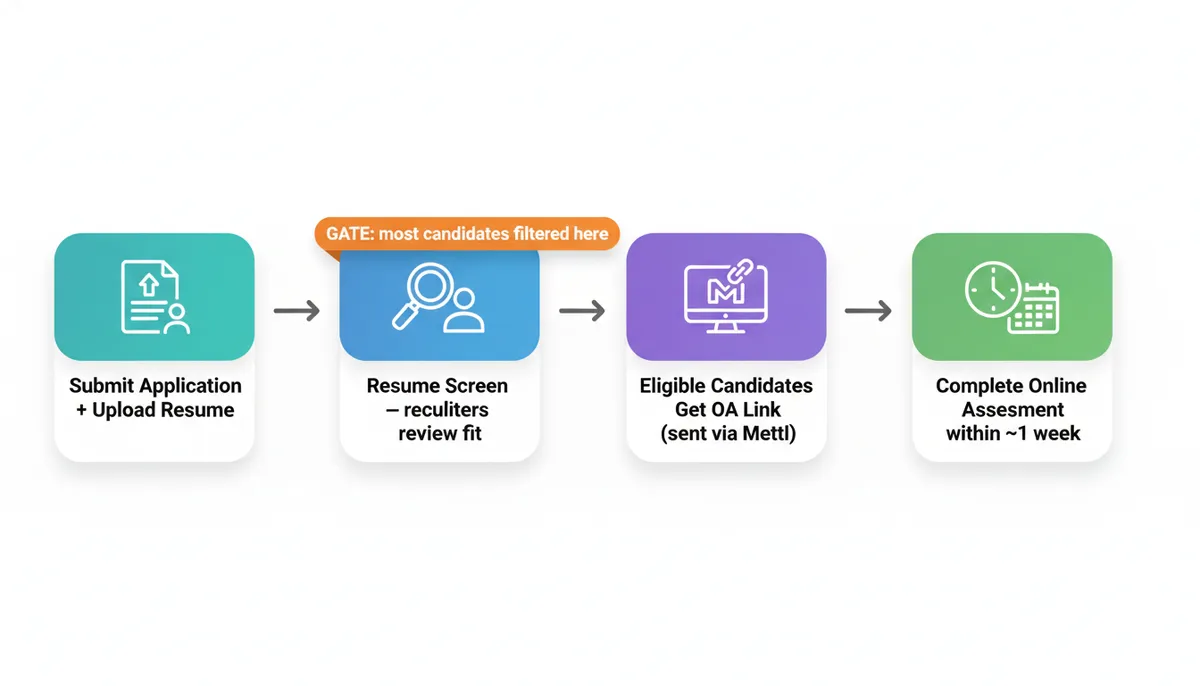
Here's the single most important thing to understand about the application flow: at SIG, you upload your resume first, and only candidates who pass the resume screen receive an online assessment link. Your resume is the gate. If it doesn't clear the screen, you never see the OA.
This is exactly why your resume is the highest-leverage thing to fix before you apply.
What SIG Looks For on a Resume
SIG's recruiting guidance consistently emphasizes a clean, well-structured, one-page resume. For a trading-systems-leaning technology role, prioritize:
- Technical projects — especially anything involving systems, performance, concurrency, data processing, or low-level programming.
- Languages and tools — SIG works heavily in C++, C#, Python, and Java. List the ones you genuinely know.
- Algorithms / data structures evidence — competitive programming, coursework, or strong project work that signals you can reason about complexity.
- Quantitative or competitive signals — math/CS competitions, chess, poker, or anything that demonstrates structured analytical thinking. SIG explicitly values these.
- Impact and metrics — "reduced query latency by 60%" beats "worked on the backend."
✅ Do: Tailor your resume toward systems and performance. Lead with the project that best demonstrates engineering depth, and quantify outcomes.
❌ Don't: Submit a generic, multi-page resume padded with every club and certificate. A cluttered resume signals you can't prioritize — a red flag for an engineering screen.
The fastest way to close the gap between "good enough to submit" and "passes the screen" is to get objective feedback. Run your draft through the Thita.ai Resume Analyzer to catch weak bullet points, missing metrics, and formatting issues before a recruiter ever sees it.
The SIG Online Assessment: What to Expect
If your resume clears the screen, you'll receive an online assessment link — typically delivered through Mettl, a third-party assessment platform, with roughly one week to complete it.
For software / trading systems engineering candidates, the SIG software engineer OA follows a well-documented pattern:
| Aspect | What to Expect |
|---|---|
| Questions | ~2 programming questions |
| Time limit | ~60 minutes |
| Language | Your choice (C++, Python, Java, C#, etc.) |
| Platform | Online (Mettl) |
| Window | ~1 week to start and submit |
| Focus | Data structures, algorithms, OOP design |
The two questions usually split into:
- An algorithmic problem — expect things like graph traversal (BFS/DFS), binary search, string/array manipulation, or a greedy/DP-flavored task.
- An object-oriented design problem — designing a class with specific methods and behavior, where clean structure matters as much as correctness.
⚠️ Important: SIG doesn't just check whether your code passes test cases. Reviewers care about your choice of data structures, time/space complexity, and clean coding practices. Brute-forcing a problem that clearly wants an efficient approach can hurt you even if it "works."
Because you only have ~60 minutes for two problems, speed and judgment both matter. You need to recognize the underlying pattern quickly, pick the right data structure, and write readable code under time pressure.
Languages and Skills to Focus On
SIG's technology roles repeatedly emphasize the same core stack and competencies. For a trading-systems-leaning path, focus your energy here:
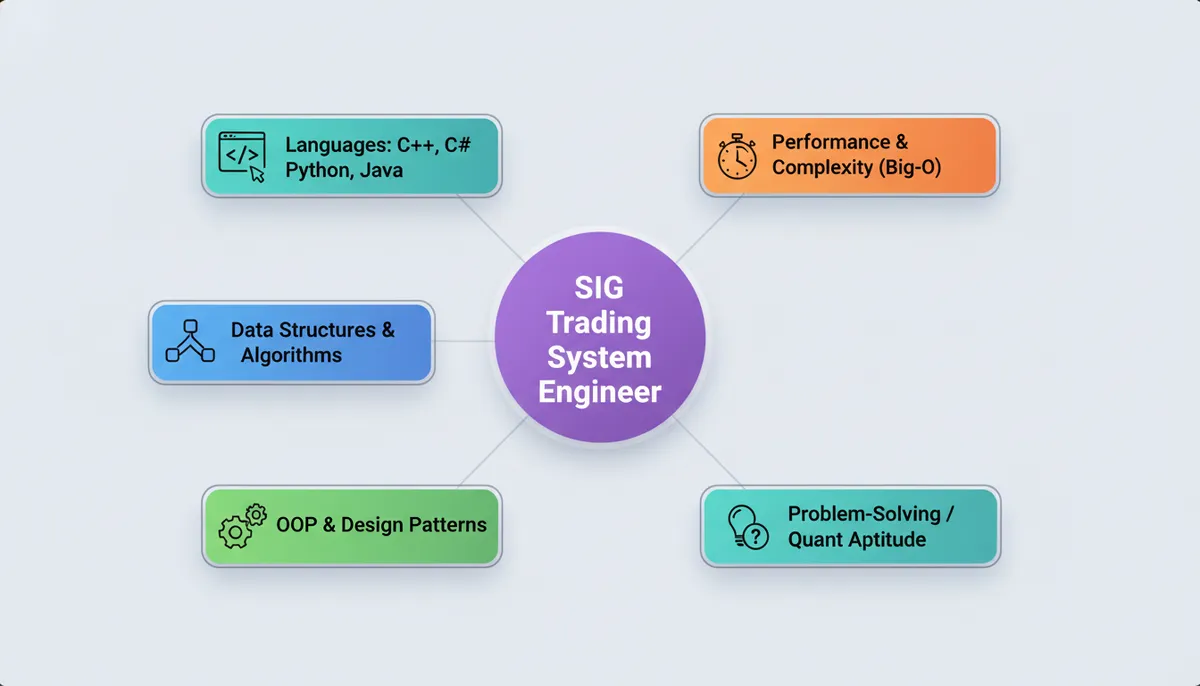
- Languages: SIG calls for "strong software skills in C++, C#, Python and/or Java." C++ is especially relevant for high-performance trading systems. You don't need all four — be genuinely strong in one or two.
- Data structures & algorithms: Arrays, strings, hash maps, stacks/queues, trees, graphs, and the core search/sort techniques. This is the backbone of the OA.
- Object-oriented design: Be ready to design clean classes with sensible methods, encapsulation, and clear responsibilities — one OA question often tests exactly this.
- Complexity reasoning: Always know the time and space complexity of your solution and be able to justify your data-structure choices.
- Quantitative / problem-solving aptitude: SIG is a quant firm. Comfort with logic, probability, and structured reasoning gives you an edge throughout the funnel.
💡 Pro Tip: Pick your OA language before the test arrives, and make sure you know its standard library cold — sets, maps, priority queues, sorting comparators. Fumbling syntax during a 60-minute timed test is a needless way to lose points.
How SWE Students Curious About Quant/Trading Systems Should Prep
You don't need a finance background to succeed here. You need strong fundamentals, fast pattern recognition, and a resume that clears the screen. Here's a focused, four-week plan.
| Week | Focus | Action Items |
|---|---|---|
| Week 1 | Resume + Foundations | Polish your resume with the Resume Analyzer; review arrays, strings, hash maps |
| Week 2 | Core Patterns | Work through the DSA Patterns Sheet — two pointers, sliding window, sorting/searching |
| Week 3 | Graphs, Trees & OOP | Practice BFS/DFS, binary search variants, and design 2-3 small classes from scratch |
| Week 4 | Timed Simulation | Do timed 2-problem sessions in 60 min; run AI mock interviews to pressure-test under stress |
Step-by-Step Prep Flow
- Fix the resume first. It's the gate to everything else. Get it scored, rewrite weak bullets, and trim to one tight page.
- Lock in your DSA fundamentals. Master arrays, strings, and hash maps before anything fancy. Use the structured DSA Learning Path so you're not solving random problems.
- Drill the high-frequency patterns. Two pointers, sliding window, BFS/DFS, binary search, and basic dynamic programming cover most of what an OA throws at you.
- Practice OOP design separately. Spend time designing classes — a parking lot, a deck of cards, an LRU cache — so the design question doesn't surprise you.
- Simulate the real OA. Two problems, 60 minutes, your chosen language, no IDE autocomplete crutches. Do this several times until it feels routine.
- Add quant/logic reps. Light probability and logic practice builds the analytical comfort SIG values across its process.
✅ Do: Practice under a strict timer. The OA is as much a time-management test as a coding test — recognizing the pattern in the first 5 minutes is half the battle.
❌ Don't: Grind hundreds of hard problems while ignoring your resume. If your resume doesn't pass the screen, your LeetCode rating never gets a chance to matter.
The Thita.ai DSA Patterns Sheet maps the exact patterns that show up in assessments like SIG's, so you can prepare deliberately instead of randomly. Pair it with AI mock interviews to rehearse explaining your approach out loud — a skill that pays off in every later round.
Frequently Asked Questions
What is the SIG Trading System Engineer Discovery Program?
It's an early-talent technology program from Susquehanna International Group designed to introduce students — typically those not yet eligible for an internship — to trading systems engineering, the firm's technology, and its culture. Confirm the exact current program name and scope on the official SIG careers site.
Who is eligible for the SIG Discovery Program?
Discovery Programs generally target earlier-year university students (often first or second year) in Computer Science, Computer Engineering, or related technical degrees who are comfortable coding and curious about quant/trading. Penultimate- and final-year students are usually directed toward internships or full-time roles instead. Always verify the current eligibility on the official page.
Do I upload my resume before the online assessment?
Yes. SIG's process is resume-first: you submit your application with a resume, recruiters screen it, and only candidates who meet the prerequisites receive an online assessment link. Your resume is effectively the first cut.
What does the SIG software engineer OA look like?
For software / trading systems engineering candidates, the OA is typically two programming questions in about 60 minutes, in a language of your choice, delivered through the Mettl platform with roughly a week to complete it. It tests data structures, algorithms, and object-oriented design — and reviewers care about complexity and clean code, not just passing test cases.
What programming languages should I use for SIG?
SIG emphasizes C++, C#, Python, and Java. C++ is especially relevant for high-performance trading systems. For the OA, use whichever of these you're strongest in, and make sure you know its standard library well.
Do I need a finance or trading background to apply?
No. SIG prioritizes strong engineering fundamentals, problem-solving ability, and curiosity. Quantitative aptitude (math, probability, logic) is a plus, but you don't need prior markets experience for a Discovery Program.
How long do I have to complete the online assessment?
Candidates typically get around one week from receiving the link to submit the assessment. The active coding window itself is short (about 60 minutes), so plan to start only when you're ready to focus.
When do applications open, and are the dates confirmed?
Discovery and early-talent application windows shift each recruiting cycle, and specific 2026 dates aren't reliably fixed in advance. Treat any date you see secondhand as tentative and check the official Susquehanna careers page for the current cycle's openings and deadlines.
Final Thoughts
The SIG Trading System Engineer Discovery Program is a rare early-stage opportunity: a way to get in front of one of the world's top quantitative trading firms before you're even eligible for an internship. The path is straightforward but unforgiving at the first gate — your resume has to pass the screen before you ever see the online assessment.
So prepare in the right order:
- Polish and score your resume so it clears SIG's screen.
- Build your DSA foundation and drill the core patterns that show up in the OA.
- Practice under timed pressure so two problems in 60 minutes feels routine.
Verify every date and requirement on the official SIG careers site, then put in the reps. The students who get into SIG's Discovery track aren't the ones with the flashiest backgrounds — they're the ones who prepared deliberately, in the right order, early.