
Interview
What Is a Good CodeSignal Score in 2026? (515, 550, and 600 Explained)
What is a good CodeSignal score in 2026? We explain the 200-600 GCA scale, what 515, 550, and 600 mean, and how to move up a band. Start practicing now.
You just finished a CodeSignal General Coding Assessment (GCA), saw a number like 515 or 550 on your screen, and now you're spiraling through Reddit threads trying to figure out whether that's good enough. Here's the clear answer most of those threads won't give you: a good CodeSignal score in 2026 generally sits in the 520-600 range on the 200-600 scale, but the honest truth is that "good" depends entirely on the company and role you applied for. There is no single universal pass line.
This guide explains the 200-600 scoring system exactly as CodeSignal defines it, breaks down what 515, 550, and 600 actually mean, shows how modules and bonus/speed points are calculated, and gives you a concrete plan to move from one score band to the next.
Want to stop guessing and start improving? Practice with the DSA Patterns Sheet to build the pattern recognition CodeSignal rewards, or run a timed AI mock interview to simulate the pressure of a real assessment.
The 200-600 CodeSignal Scoring System Explained
The CodeSignal GCA produces a single Assessment Score between 200 and 600. This replaced the older 300-850 "Coding Score" scale that CodeSignal used before spring 2023, so if you find old Reddit posts referencing a "770" or an "850," those numbers no longer apply.
One detail that surprises most candidates: according to CodeSignal's official documentation, the specific numbers in the 200-600 range were deliberately designed to carry no inherent meaning. CodeSignal chose this range specifically to avoid overlap with other standardized tests (like the SAT or GRE) and to prevent people from mentally mapping scores onto the familiar U.S. grading scale (where, say, 90% feels like an "A"). In other words, 600 is not "100%" and 400 is not "a fail" in any built-in sense — the numbers only become meaningful when a company sets a threshold.
So what actually drives the number up?
- Correctness — Do your solutions pass the hidden test cases?
- Speed — How quickly did you produce working solutions?
- Implementation — Is your code clean and functional, not just barely passing?
- Problem-solving ability — Did you handle the harder questions, not just the easy ones?
The GCA itself is structured as four questions to be solved in 70 minutes. You can move freely between tasks, submit as many times as you want, and split your time however you like. The questions increase in difficulty — the first is typically a warm-up, and the last is the one that separates strong candidates from the pack.
What 515, 550, and 600 Actually Mean
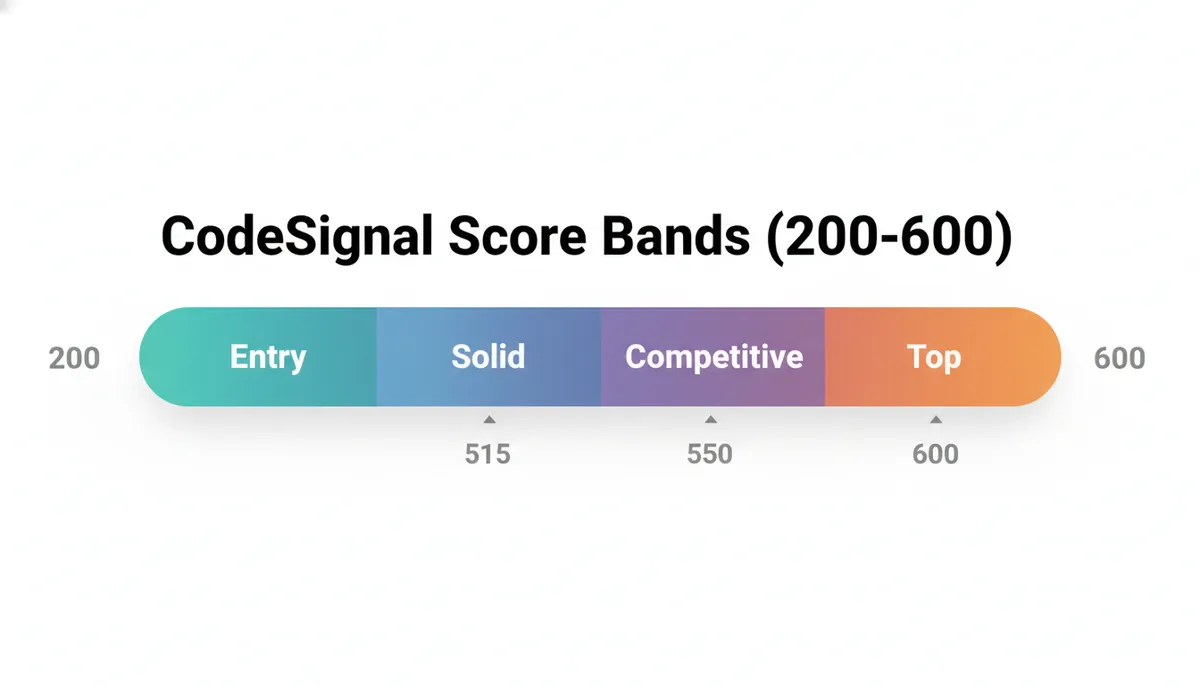
Because CodeSignal's scale has no built-in meaning, the practical interpretation below comes from how companies commonly use these scores — not from an official CodeSignal rubric. Treat these as community-reported ranges, not guarantees.
| Score Range | Rough Meaning | Typical Company Tier (commonly reported) |
|---|---|---|
| 200-350 | Below most thresholds — incomplete or several failing solutions | Usually screened out |
| 350-475 | Developing — solved the easy/medium questions, struggled on hard | Some early-stage startups, non-FAANG roles |
| 475-525 | Competitive — solid signal, recruiters engage | Many mid-to-large tech companies |
| 525-580 | Strong — most or all questions solved cleanly | Large tech, late-stage startups, many FAANG-tier screens |
| 580-600 | Elite — near-perfect, fast, clean | Top-tier / most selective bars |
Now the three numbers everyone asks about:
CodeSignal 515
A 515 is a genuinely competitive score. You almost certainly solved the first three questions and made meaningful progress on the fourth. For a large share of companies, 515 clears the bar or lands you in the "recruiter reaches out" zone. It's the kind of score that won't get you auto-rejected at most places — but for the very top of FAANG, it may sit just under the most aggressive cutoffs.
CodeSignal 550
A 550 is a strong score. At this level you typically solved all four questions, or solved three cleanly and got the fourth mostly working with good speed. This is comfortably above the threshold most companies set and is competitive for the majority of FAANG-tier screens.
CodeSignal score 600
A 600 is a perfect score — the maximum on the scale. To hit it you need all four questions fully correct, with strong speed and clean implementation, which is why it also requires earning the bonus points (more on those below). A 600 clears essentially every threshold. It is impressive, but here's the reassuring part: you almost never need a 600 to advance. Most companies set their cutoff well below the ceiling.
⚠️ Important: Do not treat any specific number as a universal cutoff. Reported thresholds vary widely by company, role, level, hiring quarter, and applicant volume. A score that advances at one company in one quarter might not at another. Communities like Blind and Levels.fyi track current, company-specific cutoffs far better than any static guide — including this one.
How Modules and Bonus / Speed Points Work
This is the part that confuses people the most, because the score isn't a simple "X out of 4 questions solved." CodeSignal uses a two-tier scoring system, and understanding it explains a lot of weird-looking results.
Tier 1: Base points
You earn base points for successfully completing the questions in a module (a module is a group of questions within the certified assessment). This is the foundation of your score and rewards correctness across the assessment.
Tier 2: Bonus points
Here's the rule that trips people up: you only earn the bonus points for a module if you solve 100% of the questions in it. Partial completion of a module earns the base points but forfeits that module's bonus.
Crucially, bonus points are not distributed evenly. CodeSignal allocates more bonus points to modules that are (a) more difficult and (b) better at differentiating between strong and weak candidates. In plain English: the hard questions are worth disproportionately more. Fully solving the toughest question can move your score far more than the difference between two easier ones.
Where speed comes in
Speed is one of the four official scoring factors. Two candidates who both solve all four questions can finish with different scores if one was meaningfully faster and cleaner. Speed matters most as a tiebreaker near the top of the scale — it's part of why a perfect-completion run can still land at, say, 585 instead of 600.
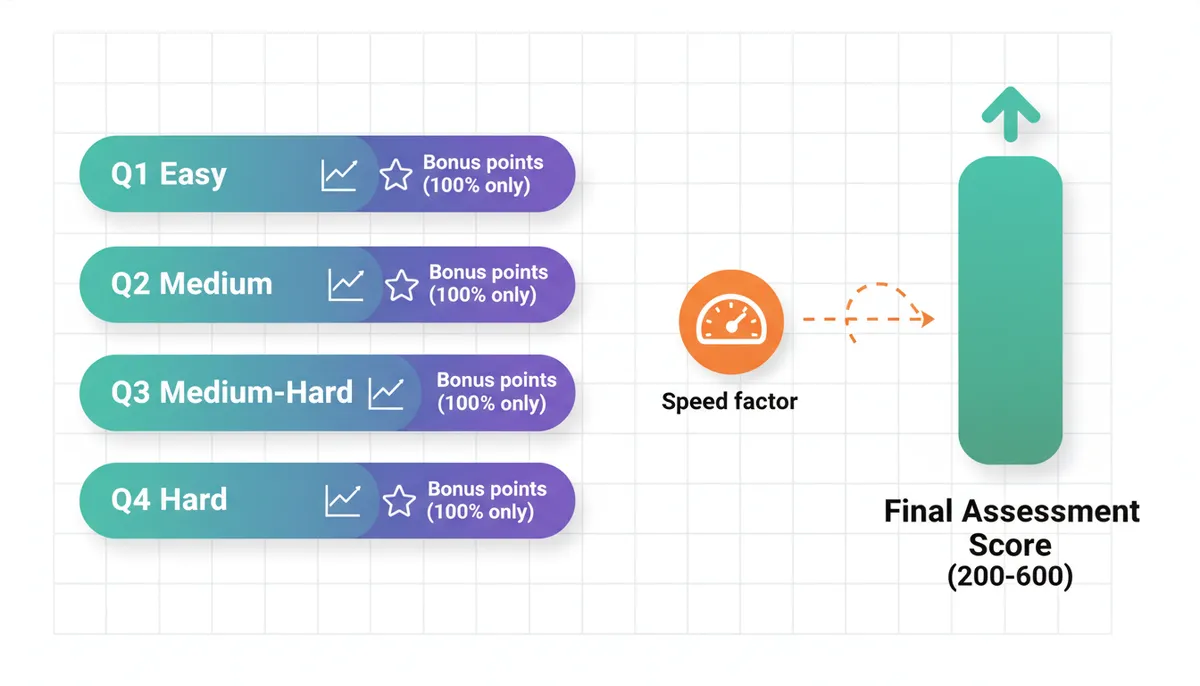
💡 Pro Tip: This is why "almost solving" the hard question hurts so much. If you get Q4 working at 95% but miss the last edge case, you can lose the entire bonus allocation for that module — the most valuable points on the test. Always reserve time to fully pass a question rather than spreading yourself thin across partial solutions on multiple questions.
Why Your Score Feels "Stuck"
If you've taken the GCA more than once and keep landing in the same band, you're not imagining it. A few structural reasons explain the plateau:
- You're solving the same difficulty ceiling. If you reliably solve Q1-Q3 but stall on Q4, your score clusters in the same range every time — because Q4 (and its bonus) is where the upside lives.
- You're optimizing for "passing" instead of "fully passing." Partial credit gives you base points but no bonus. The jump from a 480 to a 540 often isn't "solve more questions," it's "fully close out the hard one."
- Speed is silently capping you. You may be solving everything but burning so much time that you never reach the last question, or you finish too slowly to earn top-tier speed credit.
- Pattern gaps, not effort gaps. The hard GCA question usually maps to a specific algorithmic pattern (a particular graph traversal, a DP formulation, a clever hashing trick). If you haven't drilled that pattern, no amount of raw effort gets you there in 70 minutes.
✅ Do diagnose which question you fail, not just what score you got. The fix for "I never finish Q4" is completely different from "I'm too slow on Q1-Q2."
❌ Don't retake the assessment over and over hoping for an easier question set. The question difficulty is calibrated — grinding retakes without changing your preparation rarely moves the band, and many companies limit how often you can retake.
How to Move From One Band to the Next
Here's a concrete plan to climb a band. The biggest gains almost always come from mastering algorithmic patterns and rehearsing under realistic time pressure.
- Pinpoint your failure point. Look back at your last assessment. Did you run out of time? Fail the hard question entirely? Pass everything but score lower than expected (a speed problem)? Your answer decides your plan.
- Drill the patterns, not random problems. The GCA's hard questions cluster around a finite set of patterns. Work through the DSA Patterns Sheet so you recognize a problem's category in seconds instead of inventing an approach from scratch under the clock.
- Follow a structured progression. Don't bounce between random LeetCode links. Use the DSA Learning Path to move through arrays and strings, into hashing and two-pointers, then graphs and dynamic programming — the exact ladder the GCA tests.
- Train for speed deliberately. Set a 70-minute timer and solve four problems of increasing difficulty in one sitting. Speed is a scored factor; you only get faster by practicing under the constraint, not by solving untimed.
- Always fully close the hard question. In every practice session, force yourself to land all test cases on at least one hard problem rather than half-solving three. This rewires you to chase bonus points where they actually live.
- Simulate the pressure. A timed AI mock interview recreates the "one shot, clock running, no hints" feeling of the real GCA so the actual assessment isn't the first time you feel that pressure.
- Review every miss. After each timed set, write down the pattern you failed and re-solve it the next day from memory. Spaced repetition on patterns is what turns a 480 into a 540.
💡 Pro Tip: If you're stuck in the 475-525 band, your highest-leverage move is almost always graph and dynamic-programming fluency. These power most of the hard Q4 questions, and fully solving Q4 is where the heavy bonus points sit.
Score Expectations by Role and Seniority
A "good" score isn't fixed — what's expected of you shifts with the role you're targeting. These are general patterns, not official CodeSignal or company policy.
| Role / Level | Commonly Targeted Range | Notes |
|---|---|---|
| Internship / New grad | ~475-550 | Many programs weight the GCA heavily as a first-pass filter |
| Mid-level SWE (non-FAANG) | ~500-560 | Solving all four reliably matters more than perfect speed |
| Senior SWE | ~520-580 | Cleaner implementation and speed start to weigh in |
| FAANG-tier / top selective | ~560-600 | Higher reported bars; the hard question is effectively required |
| Specialized (data, ML, infra) | Varies | These tracks may use the ICA, DAA, or role-specific assessments instead of the GCA |
⚠️ Important: Notice the overlap and the wide ranges. That's intentional — because thresholds genuinely vary by company and quarter, treating any single number as "the cutoff for my level" is a mistake. Aim to comfortably clear the top of your target range so you have margin.
If you're preparing for a specific company's pipeline, it helps to understand the whole funnel, not just the coding score. Our guides on the HireVue coding assessment and the JP Morgan Code for Good selection process walk through how the coding screen fits alongside interviews and other rounds.
Frequently Asked Questions
What is a good CodeSignal score in 2026?
On the 200-600 scale, a score of roughly 520 or above is generally considered good, and 550+ is strong for most companies, including many FAANG-tier screens. But "good" is defined by your target company's threshold, not by the number alone. Many roles advance candidates well below 600.
Is a 515 CodeSignal score good enough to pass?
For a large share of companies, yes — a 515 is competitive and often clears the bar or triggers recruiter outreach. It typically means you solved the easier questions and made real progress on the hard one. For the most selective top-tier roles, it may sit just under the cutoff, so it depends on where you applied.
Do I need a 600 to get an interview?
Almost never. A 600 is a perfect score, and the vast majority of companies set their cutoff well below the ceiling. Chasing 600 is rarely the right goal — clearing your target company's threshold with some margin is.
Why is my CodeSignal score lower than expected even though I solved all the questions?
Two likely causes. First, speed is a scored factor — solving everything slowly scores lower than solving everything fast. Second, the bonus points only count if you fully pass 100% of a module's questions; if even one hidden test case failed, you may have forfeited a chunk of bonus points. Clean, complete, fast solutions score highest.
How are CodeSignal modules and bonus points calculated?
You earn base points for completing questions, and bonus points only when you solve 100% of a module's questions. Bonus points are weighted toward harder, more differentiating questions — so fully solving the toughest question is worth disproportionately more than the easier ones.
What changed in CodeSignal scoring (the old 300-850 vs 200-600)?
CodeSignal moved from the older 300-850 Coding Score to the current 200-600 Assessment Score (around spring 2023) to align with its other assessments and avoid confusion with scales like the SAT/GRE. If you see old scores in the 700s or 800s online, ignore them — they're on the retired scale.
How many times can I retake the CodeSignal GCA?
CodeSignal and individual companies impose retake limits, and these have tightened in recent years (third-party prep sources commonly report caps like a couple of attempts per month). The exact policy depends on the company and your invitation, so check the rules in your specific assessment invite rather than assuming.
What's the best way to raise my score fast?
Drill algorithmic patterns rather than random problems, practice four questions in a strict 70-minute window, and always force yourself to fully solve at least one hard problem per session to train for bonus points. Start with the DSA Patterns Sheet and a timed AI mock interview.
Final Thoughts
A good CodeSignal score in 2026 lives in the 520-600 band, but the more useful framing is this: your score is only "good" relative to the threshold your target company set, and those thresholds are moving targets. Instead of obsessing over whether 515 or 550 is "enough," focus on the two levers that actually raise the number — mastering the patterns behind the hard question and rehearsing under real time pressure.
Start closing the gap today:
- Work through the DSA Patterns Sheet to recognize problem types instantly
- Follow the DSA Learning Path for a structured climb through every GCA topic
- Run a timed AI mock interview to make the real assessment feel routine
The candidates who move up a band aren't the ones who retake the test the most — they're the ones who practice the right patterns under the right pressure.
Official scoring details in this guide are drawn from the CodeSignal Knowledge Base: Understanding Assessment Score, What should I expect when I take the GCA, and Converting Historical Coding Score Thresholds. Company-specific cutoffs are commonly reported community estimates and vary by company, role, and hiring period.