PM
How to Answer Product Case Study Questions in PM Interviews
Most product managers can talk about strategy, metrics, and roadmaps. But in a PM interview, all of that compresses into a single pressure test: the product ...
Most product managers can talk about strategy, metrics, and roadmaps. But in a PM interview, all of that compresses into a single pressure test: the product case study.
You’re given an ambiguous prompt (“Improve retention for Spotify,” “Design a product for restaurant owners,” “What would you build for Gen Z creators?”) and 30–45 minutes to show how you think. For many candidates, pm case interviews feel like a black box. What exactly are interviewers looking for? Is there a “right” framework? How deep is deep enough?
This guide breaks down how to answer product case study questions in PM interviews with the same clarity and rigor you’d expect from a strong engineering design doc. We’ll walk through a reusable structure, concrete examples, and common pitfalls—so you can focus less on memorizing frameworks and more on demonstrating product thinking.
What Interviewers Actually Test in Product Case Study Rounds
Before diving into frameworks, it helps to understand the evaluation criteria. Strong PMs don’t just list features; they show structured thinking under uncertainty.
Most PM case interviews evaluate:
-
Problem framing
- Can you clarify an ambiguous prompt?
- Do you ask sharp, non-obvious questions?
- Can you restate the problem in your own words?
-
Customer & market understanding
- Do you identify the right users and their needs?
- Can you distinguish symptoms from root causes?
-
Product strategy
- Do you define a clear goal and success metrics?
- Can you prioritize tradeoffs based on impact and constraints?
-
Solution design
- Are your ideas grounded in user needs and business context?
- Do you think in systems (not just isolated features)?
-
Execution & tradeoffs
- Can you sequence work (MVP vs v2 vs v3)?
- Do you consider risks, edge cases, and adoption?
-
Communication
- Is your structure clear and logical?
- Do you guide the interviewer through your thinking?
The “framework” is just a scaffold to make these dimensions visible. Interviewers don’t care whether you use CIRCLES, AARM, or your own acronym; they care that your thinking is coherent and rigorous.
A Reusable Framework for Any Product Case Study
You can treat product case questions like a lightweight product spec you’re writing in real time.
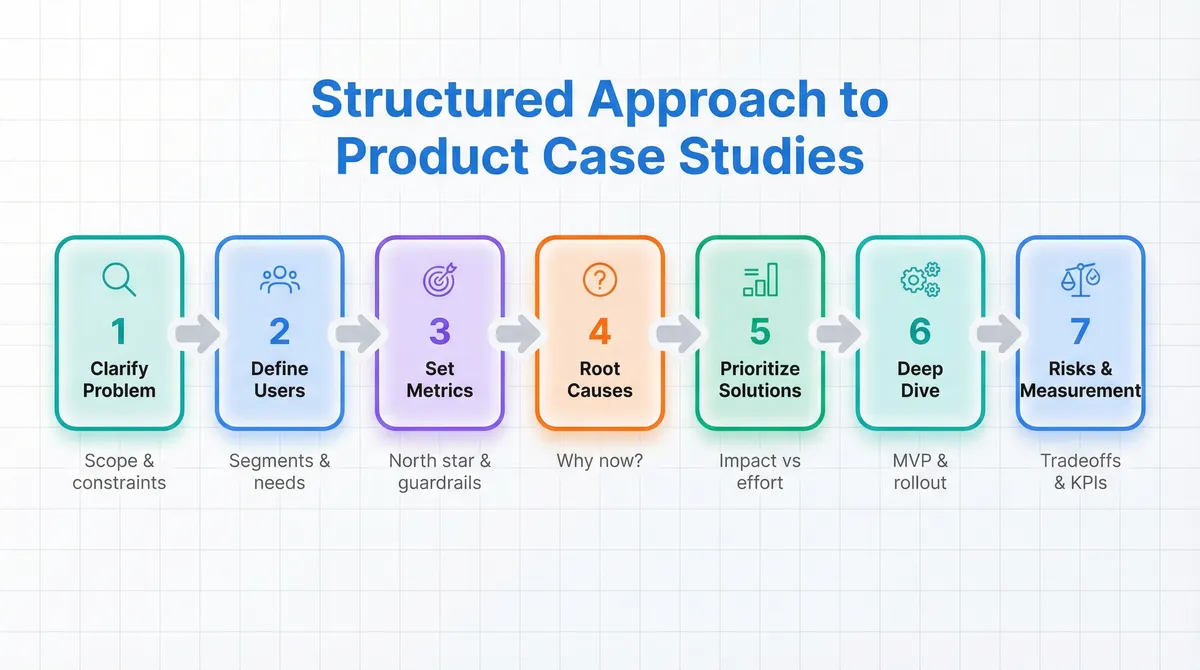
Here is a simple, robust structure:
- Clarify the problem
- Define users and use cases
- Set goals and metrics
- Explore root causes and constraints
- Propose and prioritize solutions
- Deep dive on the top solution
- Wrap up with risks, tradeoffs, and measurement
Think of this as a flow rather than a checklist—adapt to the prompt and time.
We’ll walk through each step using a sample prompt:
“You’re the PM for YouTube’s mobile app. How would you improve user engagement?”
Step 1: Clarify the Product Case Study Prompt
Why clarification matters
Jumping straight into solutions is one of the fastest ways to fail a product case interview. Real-world PMs rarely get perfectly scoped problems; they ask questions to define them. Interviewers want to see that behavior.
What to clarify
For the YouTube example, you might ask:
-
User scope
- Are we focusing on viewers, creators, or both?
- Any specific geography or segment (e.g., new users, power users, kids/teens)?
-
Engagement definition
- What does “engagement” mean here? Watch time, sessions per week, likes/comments, uploads?
- Is there an internal north-star metric we care about?
-
Business context
- Are we optimizing for ad revenue, creator ecosystem health, or user satisfaction?
- Any constraints on engineering bandwidth or timeline?
-
Platform scope
- Only mobile app, or also web and TV?
- iOS and Android both?
Then, restate the problem:
“So we’re focusing on increasing weekly watch time for viewers on the YouTube mobile app in the US, over the next 6–12 months, with a secondary goal of improving creator engagement. I’ll assume engineering capacity is moderate but not unlimited.”
This shows structure and alignment before you build anything.
Step 2: Define Users and Use Cases
Segment your users
Even in a short pm case interview, you should avoid talking about “the user” as a monolith. Segment at a level that changes your strategy.
For YouTube, you might define:
- New users: installed in the last 30 days, low history, low personalization
- Casual users: 1–3 sessions/week, short watch time, mostly home feed
- Power users: daily use, subscribed channels, playlists, notifications enabled
- Creators: upload content, manage channels, interact with comments
You don’t need perfect segments, just ones that lead to different product decisions.
Map key use cases
For each segment, list 1–2 core jobs-to-be-done:
- New users: “Find content I like quickly so I understand why this app is useful.”
- Casual users: “Fill short downtime with entertaining or informative content.”
- Power users: “Keep up with my favorite creators and discover deeper content.”
- Creators: “Grow my audience and engage with my community.”
Then pick a focus based on impact:
“To keep this focused, I’ll primarily target casual viewers, since they’re a large segment with room to grow engagement, and secondarily consider how solutions affect creators.”
Step 3: Define Product Strategy via Goals and Metrics
Choose a clear primary metric
This is where product strategy starts to appear. You’re making a decision about what “success” means.
For engagement, candidates often propose:
- Primary metric
- Weekly watch time per active user
- Secondary metrics
- Sessions per week per active user
- 7-day retention for new users
- Creator uploads per week (if creators are in scope)
Explicitly call out guardrail metrics to show strategic thinking:
- User satisfaction (e.g., NPS, app store rating)
- Content policy violations (no engagement at any cost)
- Ad load / revenue per user (don’t tank revenue)
You might say:
“My primary goal is to increase weekly watch time per active user by 10% over 6 months. I’ll also track sessions per week and 7-day retention, with user satisfaction and policy compliance as guardrails.”
This turns a vague product case study into a concrete strategy problem.
Step 4: Explore Root Causes and Constraints
Before ideating, show that you think like a diagnostician, not a feature vending machine.
Hypothesize why engagement is suboptimal
Without data, you can state assumptions:
-
Discovery issues
- New/casual users don’t see relevant content quickly
- Recommendation cold start for new users
-
Friction in the flow
- App feels heavy; too many taps to find something to watch
- Poor offline experience for users with unstable networks
-
Notification & re-engagement gaps
- Users forget about the app
- Notifications are noisy or irrelevant
-
Creator-side issues
- Not enough fresh content in certain niches
- Creators lack tools to engage their audience
Voice it like this:
“Given typical video platforms, I’d hypothesize that the biggest levers are content discovery for casual users, re-engagement via notifications, and creator-side incentives. I’ll focus on discovery and re-engagement as they’re more directly tied to viewer engagement.”
Note constraints
- Limited engineering bandwidth: must focus on 1–2 big bets
- Policy & trust/safety constraints
- Platform limitations (OS notifications, background playback rules)
Constraints force prioritization and more realistic product strategy.
Step 5: Generate and Prioritize Solutions
Now you move into solution space—but stay structured.
Generate solution themes
Instead of listing random features, group into themes:
- Improve first-session and home feed personalization
- Better onboarding questions (topics, languages)
- Lightweight interactive signals (swipes / quick reactions)
- Increase session depth
- Smarter “Up Next” recommendations
- Mini-queue or “continue watching” improvements
- Boost re-engagement
- Smarter notifications based on creator affinity and time-of-day
- Digest emails or in-app summaries
- Creator tools to drive engagement
- Better analytics on engagement drivers
- Easy ways to respond to comments or create follow-up content
You don’t need to build all of these—just enough to show breadth before going deep.
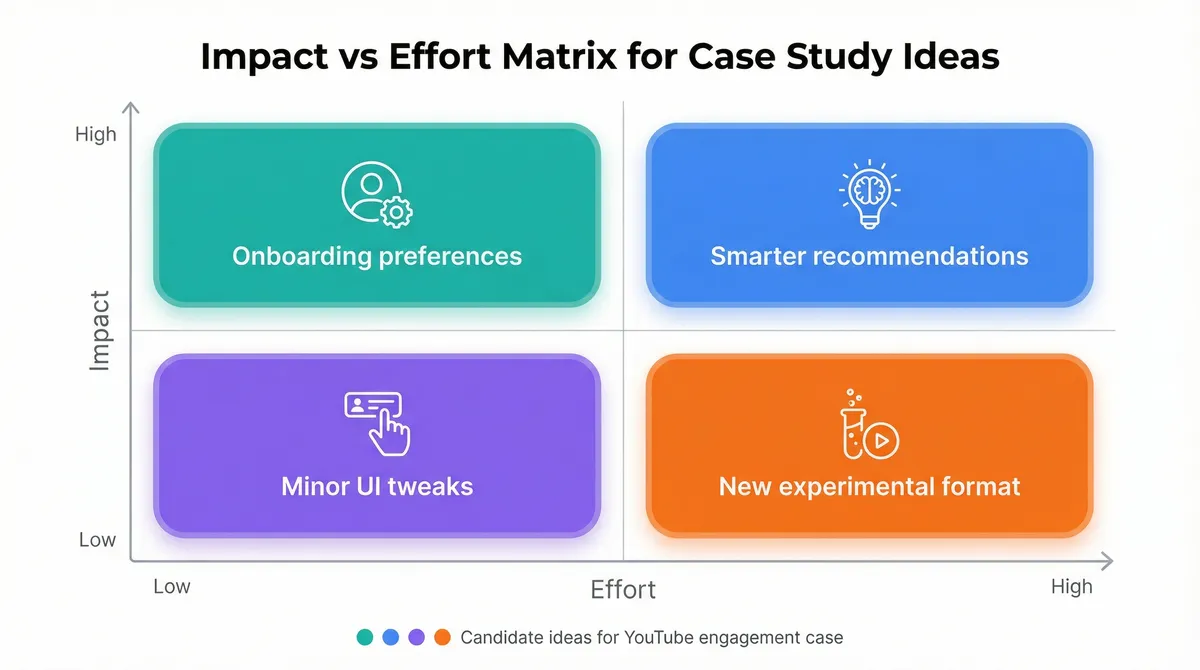
Prioritize with a simple framework
You can use an “impact vs effort” or RICE-style lens:
- Impact: potential to move weekly watch time
- Confidence: how confident you are in that impact
- Effort: rough engineering/product/design cost
- Risk: user trust, policy, or ecosystem risks
Example:
- High impact, medium effort
- Smarter notifications and re-engagement journeys
- Improving “Up Next” and home feed for casuals
- Medium impact, low effort
- Better onboarding preference collection
- High impact, high risk
- Aggressive autoplay changes that may hurt satisfaction
Then pick one main bet to deep dive:
“I’ll focus on improving discovery for casual viewers via a better home feed and ‘Up Next’ experience, as I expect that to have the highest sustainable impact on weekly watch time with reasonable effort.”
Step 6: Deep Dive on the Top Solution
This is where strong candidates differentiate themselves. Instead of staying at “improve recommendations,” you describe what you’d actually build.
Example deep dive: Improve home feed & “Up Next” for casual users
6.1 Objective & hypothesis
- Objective: Increase weekly watch time per casual user by 10% via more relevant recommendations.
- Hypothesis: If we surface more personally relevant videos earlier in a session, casual users will watch longer and start forming habits.
6.2 User experience design (at a conceptual level)
Describe the UX in words (you don’t need pixel-perfect UI):
- Home feed
- For casual users with sparse history, mix:
- Topic-based clusters (e.g., “Tech reviews”, “Comedy clips”)
- Lightweight onboarding: “Pick 3 topics you like” inline in feed
- Social proof (view counts, likes) to reduce choice anxiety
- For casual users with sparse history, mix:
- “Up Next”
- Bias towards:
- Same creator if user watches creator-heavy content
- Related topics if user is exploring
- Add a small “Not interested / Show more like this” control for explicit signals
- Bias towards:
You can say:
“On the home feed, I’d introduce an inline ‘quick interests’ module for casual users, asking them to pick a few topics. This both improves recommendations and gives users a sense of control. In the ‘Up Next’ module, I’d leverage those topics and recent viewing behavior to keep them in a satisfying content loop without feeling trapped.”
6.3 Data and ranking signals
Show that you understand how a real system might work:
- Content signals: topic, length, freshness, creator type
- User signals: recently watched topics, session length, time of day
- Feedback signals: skips, likes, ‘not interested’, watch-through rate
You don’t need ML details, but you should talk about signals and feedback loops.
6.4 MVP vs v2
-
MVP (3 months)
- Add interest-selection module for casual users
- Tune “Up Next” ranking with simple heuristics using existing signals
- Basic A/B test to compare watch time and satisfaction
-
v2 (6–12 months)
- Train a dedicated model for casual user recommendations
- Personalize interest modules based on implicit behavior
- Add creator tools to tag content and see engagement impact
Sequencing shows execution maturity.
6.5 Success metrics and experiment design
Tie back to your earlier metrics:
- Primary: weekly watch time per casual user (treatment vs control)
- Secondary:
- Sessions per week
- 7-day retention
- Satisfaction scores (in-app survey)
- Guardrails:
- Policy violation rates
- Complaint tickets related to recommendations
Explain:
“I’d run an A/B test on a representative sample of casual users, targeting at least X weeks to capture habit formation, and monitor both engagement and satisfaction to ensure we’re not optimizing purely for watch time at the expense of user trust.”
Step 7: Wrap Up with Tradeoffs, Risks, and Next Steps
Strong PMs don’t end with “and that’s my solution.” They acknowledge risks and show how they’d adapt.
Discuss tradeoffs
- Personalization vs control
- More algorithmic recommendations can feel opaque
- Mitigation: clear controls (“not interested”, “show more like this”), transparent settings
- Engagement vs well-being
- Risk of encouraging overconsumption
- Mitigation: time-watched reminders, optional break nudges
Identify key risks
- Cold start for new users
- If onboarding fails, recommendations still weak
- Creator ecosystem
- Algorithm changes might disadvantage some creators
- Mitigation: creator dashboards explaining changes, feedback channels
Outline next steps
- Validate assumptions with quick user research (interviews, surveys)
- Run small experiments on a subset of markets
- Iterate based on quantitative and qualitative feedback
End with a concise summary:
“To improve engagement on YouTube’s mobile app, I focused on casual viewers and defined weekly watch time as the north-star metric. I proposed improving home feed and ‘Up Next’ recommendations using lightweight interest signals and better session-aware ranking. I’d launch an MVP via A/B testing, monitor engagement and satisfaction, and iterate while managing tradeoffs around transparency, well-being, and creator impact.”
That’s a complete, structured answer to a product case study.
Adapting the Framework to Different PM Case Interview Types
Not all pm case interviews are pure “design a feature” prompts. You’ll see variations.
1. Product design / new product case
Example: “Design a product for remote teams to build culture.”
Adjust emphasis:
- Spend more time on user research hypotheses and problem discovery
- Explore multiple solution concepts before picking one
- Less emphasis on optimization metrics, more on adoption and product-market fit
2. Product strategy case
Example: “Instagram’s growth has plateaued in developed markets. What’s your strategy?”
Adjust emphasis:
- More time on market analysis, competitive landscape, and long-term bets
- Discuss portfolio of initiatives (e.g., new formats, new markets, monetization)
- Talk about resource allocation and sequencing over 1–3 years
3. Metrics / diagnostic case
Example: “DAU is flat but revenue is down 20%. What do you do?”
Adjust emphasis:
- Start with a metrics breakdown (e.g., ARPU = impressions × CTR × CVR × price)
- Hypothesize where the drop is and what data you’d pull
- Propose experiments and analyses rather than features
In all cases, the same skeleton holds: clarify → define users → set goals → diagnose → propose → prioritize → evaluate.
Common Mistakes in Product Case Study Interviews
1. Jumping to features immediately
Symptom: “We could add a new tab, push notifications, and a rewards program…”
Fix: Force yourself to spend the first 5–7 minutes on clarifying, users, and metrics before naming a single feature.
2. Over-indexing on memorized frameworks
Symptom: Reciting CIRCLES or AARM mechanically without adapting to the prompt.
Fix: Use frameworks as checklists, not scripts. It’s fine to say “I’ll start by clarifying the problem, then talk about users, metrics, and solutions.”
3. Ignoring metrics or success definition
Symptom: Great ideas, but no way to know if they worked.
Fix: Always define:
- A primary metric (north star)
- 1–2 secondary metrics
- At least one guardrail
4. Being too generic
Symptom: “We’ll improve personalization” without saying how.
Fix: Add one level of detail:
- What signals would you use?
- What user experience changes would the user notice?
- How would you roll it out?
5. Time mismanagement
Symptom: Spending 25 minutes on discovery, then rushing through solutions.
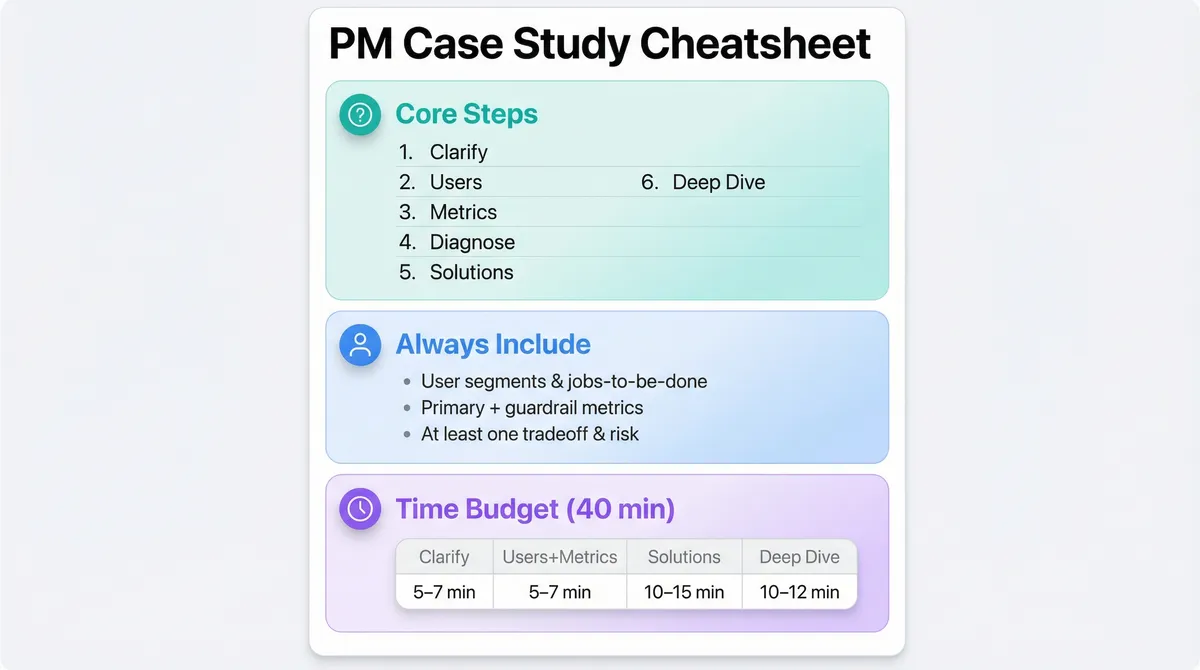
Fix: Rough time budget for a 40-minute case:
- 5–7 min: Clarify + users
- 5–7 min: Metrics + diagnosis
- 10–15 min: Solutions + prioritization
- 10–12 min: Deep dive + risks + wrap-up
6. Not thinking about risks or tradeoffs
Symptom: “We’ll just increase engagement” with no mention of negative side effects.
Fix: Always ask: “What could go wrong?” and mention at least:
- User trust / privacy
- Ecosystem impact (creators, partners)
- Long-term vs short-term tradeoffs
Best Practices and Actionable Tips for PM Case Interviews
1. Talk in “headings” as you go
Guide the interviewer like you’d structure a design doc:
- “First, I’ll clarify the problem.”
- “Next, I’ll define the key user segments.”
- “Now I’ll propose a few solution themes and then prioritize.”
This makes your thinking traceable and easy to follow.
2. Use simple, consistent mini-frameworks
For example, when ideating, always think in terms of:
- Acquire → Activate → Engage → Retain → Monetize
or
- User value → Business value → Execution feasibility
It’s better to use one or two consistent mental models than to memorize ten acronyms.
3. Ground abstract ideas in concrete examples
Instead of: “We’ll improve notifications.”
Say: “We’ll send a ‘New video from your top 3 creators’ notification at the time each user is most likely to open the app, based on their past behavior.”
Concrete examples demonstrate real product sense.
4. Verbalize tradeoffs explicitly
Use phrases like:
- “The tradeoff here is…”
- “If we optimize for X, we might hurt Y, so I’d mitigate by…”
This is often the difference between a “hire” and a “strong hire.”
5. Practice under realistic conditions
Simulate 30–45 minute pm case interviews with a timer. If you’re using an AI mock interview tool (for example, something like Thita’s AI interview practice: free mock interview simulator with real-time feedback for technical interviews, focus less on “getting the right answer” and more on:
- Did I structure my response clearly?
- Did I define metrics?
- Did I prioritize and then deep dive?
Over time, you’ll build muscle memory for the flow.
Example: 5-Minute Skeleton Answer for a Common Product Case
Prompt: “Design a product to improve LinkedIn feed engagement.”
Here’s how a compressed but structured answer might sound:
-
Clarify
- “Are we focused on desktop, mobile, or both? Which geographies? Is our primary goal to increase time spent, meaningful interactions (comments, shares), or ad revenue?”
- Restate: “I’ll focus on improving meaningful engagement (comments, shares, saves) in the LinkedIn mobile feed for working professionals in the US.”
-
Users & use cases
- Segments: job seekers, active professionals, recruiters, creators.
- Focus: active professionals who scroll but rarely interact.
- Jobs-to-be-done: stay informed, build professional brand, maintain network.
-
Metrics
- Primary: meaningful interactions per DAU (comments + shares + saves).
- Secondary: feed session length, sessions per week.
- Guardrails: content quality reports, spam/abuse rates.
-
Diagnosis (hypotheses)
- Feed content feels low-relevance or repetitive.
- High friction to comment/share (social risk, time).
- Overload of low-signal content (generic “Congrats” posts).
-
Solutions (themes)
- Better content ranking for professional relevance.
- Lower-friction engagement (quick reactions, prompts).
- Creator tools for higher-quality posts.
-
Prioritize & deep dive
- Pick: “Lower-friction, higher-context engagement.”
- Propose:
- Inline prompts under posts: “Add your perspective?” with 1-tap templates.
- Contextual reactions tailored to content (e.g., “Insightful”, “Question”).
- MVP: rollout to a subset, measure uplift in meaningful interactions per DAU.
- Risks: low-quality comments; mitigate with templates that encourage depth.
-
Wrap-up
- Recap focus, metric, main solution, and how you’d measure and iterate.
This skeleton is enough to demonstrate your structure; you’d add depth interactively based on interviewer questions.
Key Takeaways
- Product case study questions in PM interviews are not about guessing the “right” feature; they’re about making your product thinking visible.
- Use a consistent flow:
- Clarify the problem
- Define users and use cases
- Set goals and metrics
- Diagnose root causes and constraints
- Propose and prioritize solutions
- Deep dive on one solution
- Close with tradeoffs, risks, and measurement
- Always anchor your product strategy in users + metrics + tradeoffs, not just features.
- Avoid common pitfalls: jumping to solutions, ignoring metrics, staying generic, and neglecting risks.
- Practice under realistic constraints (time, ambiguity, back-and-forth) to build fluency.
With enough deliberate practice, pm case interviews stop feeling like puzzles and start feeling like what they really are: condensed versions of the product decisions you’ll make on the job.