
PM
Technical PM vs Non-Technical PM: Interview Expectations Compared
Most product management job descriptions look similar until you reach one crucial phrase: “technical PM preferred” or “non-technical PM role.” The difference...
Most product management job descriptions look similar until you reach one crucial phrase: “technical PM preferred” or “non-technical PM role.” The difference isn’t just semantics—it changes what your interviewers expect, how you’ll be evaluated, and even how you should tell your stories.
This guide breaks down technical PM vs non-technical PM interview expectations in detail: what changes, what stays the same, and how to prepare for both without guessing.
What Do Companies Mean by “Technical PM” vs “Non-Technical PM”?
The core of product management is the same: understand users, define problems, prioritize, and ship value. The difference is where you spend your time and how deep you’re expected to go into the technical stack.
Technical PM: Definition and Typical Scope
A technical PM (often called TPM, PM-T, or Product Manager, Technical) is expected to:
- Work closely with engineering on APIs, systems, data models, and architecture tradeoffs
- Own platforms, infrastructure, internal tools, or deeply technical products (e.g., ML platforms, payment gateways, developer APIs)
- Make and explain technical tradeoffs: latency vs cost, consistency vs availability, build vs buy, etc.
- Communicate effectively with senior engineers and architects
You’re not writing production code, but you’re expected to be “engineering-fluent.”
Non-Technical PM: Definition and Typical Scope
A non-technical PM (often just called PM or Product Manager) is expected to:
- Focus more on user experience, market, and business outcomes
- Own consumer-facing features, workflows, and end-to-end experiences
- Drive user research, metrics, and go-to-market alignment
- Understand the product at a conceptual level, not necessarily at the API or system-design level
You still work with engineers, but your depth in implementation details is less critical than your strength in product thinking and execution.
How Interview Loops Differ: Technical PM vs Non-Technical PM
Most PM interview loops cover similar dimensions:
- Product sense
- Execution
- Strategy
- Leadership & collaboration
- Behavioral / culture fit
The difference is in emphasis and depth of technical probing.
Typical Interview Loop Comparison
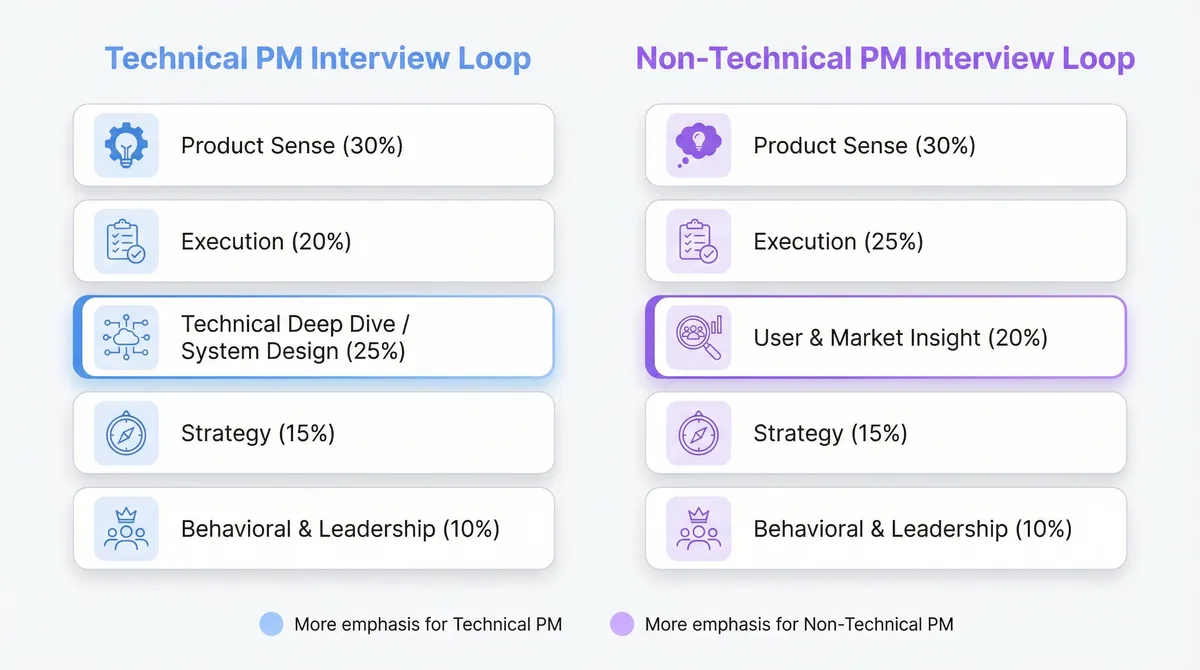
For Technical PM Roles
You will likely see:
- A technical deep dive or system design style interview
- More probing on:
- How APIs work
- Data flows and system boundaries
- Performance, reliability, and scalability constraints
- Questions about how you’ve handled technical tradeoffs and engineering constraints
For Non-Technical PM Roles
You will likely see:
- Heavier emphasis on:
- Product sense and UX
- Market understanding and positioning
- Cross-functional execution with design, marketing, sales
- Less emphasis on system design; more on roadmapping, prioritization, and stakeholder management
Both roles need strong product thinking. The technical PM role simply adds an extra dimension: can you reason about the system as well as the user?
Core Skills Both Technical and Non-Technical PMs Need
Regardless of track, PM interviews evaluate the same foundations.
1. Product Sense
You’ll be asked to:
- Design a product for a specific user segment
- Improve an existing feature
- Prioritize among competing user needs
Interviewers look for:
- Clear articulation of user segments and use cases
- Ability to define success metrics
- Structured approach: clarify → explore → prioritize → propose
Example prompt (both roles):
Design a payments experience for a ride-sharing app.
A strong answer for either PM type:
- Identifies users: riders, drivers, operations, support
- Breaks down flows: add payment method, pay for ride, refunds, receipts
- Discusses risks: fraud, chargebacks, failed payments
- Defines metrics: payment success rate, time to complete payment, NPS for payment experience
2. Execution and Delivery
Execution interviews test:
- How you prioritize (RICE, MoSCoW, impact vs effort)
- How you manage ambiguity and unblock teams
- How you define MVP vs v2 vs v3
Example prompt:
You’re behind on a critical launch. How do you decide what to cut?
You should:
- Re-anchor on goal and constraints
- Identify must-have vs nice-to-have based on user impact and risk
- Communicate tradeoffs to stakeholders
3. Communication and Leadership
Both roles must:
- Translate between business, design, and engineering
- Drive alignment without authority
- Handle conflict and tradeoffs
Behavioral questions (both roles):
- “Tell me about a time you disagreed with engineering.”
- “Describe a time you had to influence without authority.”
What’s Different: Technical Depth Expectations
Here’s where expectations diverge.
Technical PM: How Deep Do You Need to Go?
For a technical PM, interviewers test:
-
Systems Thinking
Can you model a system end-to-end?
Example prompt:
Design an API for a file storage service like Google Drive.
You should be able to discuss:
- Resources: files, folders, permissions, users
- API endpoints:
POST /files,GET /files/{id},PATCH /files/{id} - Auth and permissions: OAuth, scopes, sharing models
- Non-functional requirements: latency, consistency, rate limits
-
Architecture-Level Reasoning
You’re not drawing production-grade diagrams, but you should:
- Identify major components (frontend, backend, database, cache, external services)
- Explain data flow between them
- Reason about bottlenecks and failure modes
-
Technical Tradeoffs
Example prompt:
Your team suggests moving from a monolith to microservices. How do you evaluate this?
You should cover:
- Pros: independent deployability, team autonomy, scalability
- Cons: operational complexity, distributed systems challenges, data consistency
- Decision criteria: team maturity, deployment frequency, scaling patterns
Non-Technical PM: What “Technical Enough” Means
Non-technical PMs are still expected to be technically literate, but at a different level:
-
Conceptual Understanding
- What’s a client-server model?
- What’s the difference between frontend and backend?
- What’s an API in plain language?
-
Constraints and Dependencies
You should be able to:
- Ask engineers the right questions
- Understand when something is risky or complex
- Communicate constraints to non-technical stakeholders
-
Data and Metrics
You’re expected to:
- Define clear, measurable success metrics
- Understand basics of experimentation (A/B tests, control groups)
- Interpret dashboards and data trends
Example Interview Questions: Technical PM vs Non-Technical PM
Product Sense Questions (Mostly Shared)
These are largely the same for both roles:
- “Design a product to help remote teams collaborate better.”
- “Improve the onboarding flow for our mobile app.”
- “How would you increase engagement for feature X?”
Differences show up in follow-up questions:
- Technical PM: “How would you instrument this feature to track performance and errors?”
- Non-Technical PM: “How would you validate this with users before full rollout?”
Technical / System Design Questions (Technical PM Focus)
Common technical PM prompts:
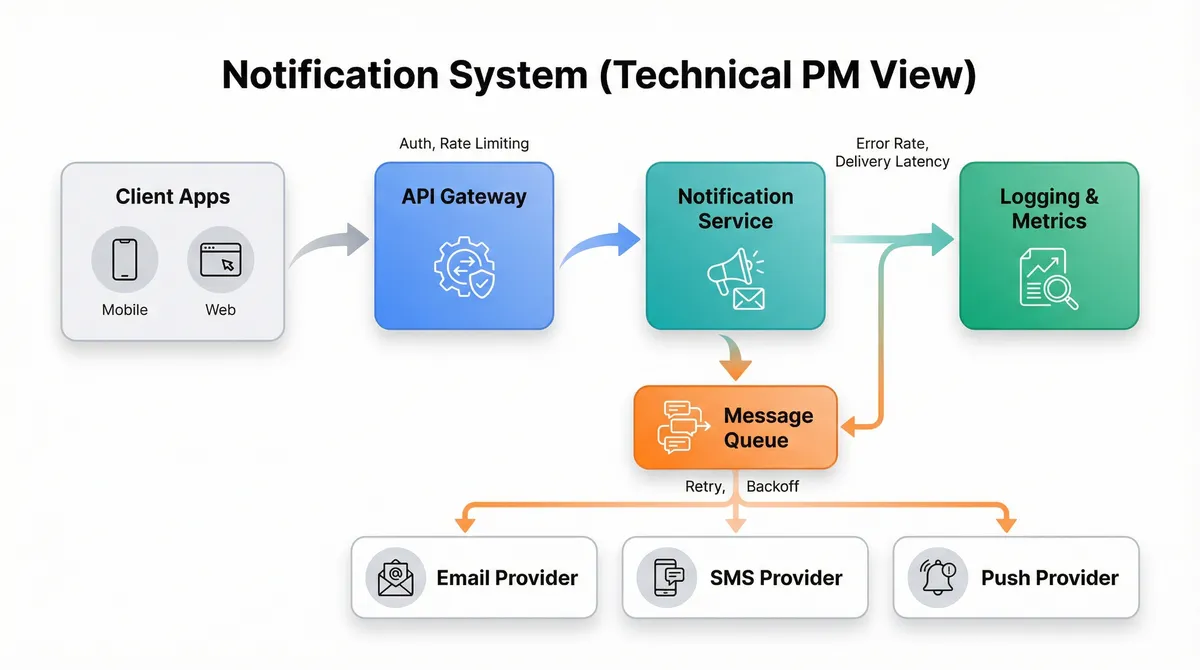
- “Design a notification system for our app.”
- “How would you design an API for third-party developers to integrate with our platform?”
- “Walk me through how you’d handle rate limiting for an external API.”
What interviewers look for:
- Clear decomposition into components
- Awareness of data flow and failure modes
- Ability to reason about scale, latency, and reliability
Execution and Process Questions (Non-Technical PM Emphasis)
Common non-technical PM prompts:
- “How do you prioritize your roadmap?”
- “Tell me about a time you managed conflicting stakeholder priorities.”
- “Describe your process for launching a new feature.”
Technical PMs will also get these, but for non-technical roles they often dominate the loop.
How to Prepare for Technical PM Interviews (Without Being a Full-Time Engineer)
You don’t need to be able to implement complex algorithms, but you do need to be comfortable with system-level thinking.
1. Learn the Basics of System Design
Focus on:
- Client-server architecture
- REST APIs and basic HTTP concepts
- Databases (relational vs NoSQL) at a high level
- Caching and queues conceptually
You can practice using simplified diagrams and short explanations. For example:
TEXT
Be able to answer:
- What does each component do?
- What happens if one fails?
- Where are the likely bottlenecks?
2. Practice Explaining Technical Concepts in Plain Language
Technical PMs are bridges between engineering and the rest of the org.
Take a concept like “caching” and practice:
- Explaining it to a non-technical stakeholder
- Explaining it to a junior engineer
- Explaining why it matters for a specific product (e.g., page load time)
3. Use Your Past Projects as Technical Stories
Even if your background is not software engineering, find stories where you:
- Worked with APIs or integrations
- Dealt with data pipelines or analytics
- Managed performance, reliability, or scalability issues
Frame them with:
- Problem → Technical constraints → Options considered → Tradeoff → Outcome
How to Prepare for Non-Technical PM Interviews (If You’re Very Technical)
Engineers transitioning into PM often over-index on technical depth and under-index on user and business.
1. Shift from “How to Build” to “Why to Build”
When answering product questions:
- Start with user problem, not architecture
- Talk about impact and metrics, not implementation details
- Use language like:
- “The core user need is…”
- “The success metric is…”
- “We’d validate this by…”
2. Build a Repertoire of Product Stories
Prepare examples around:
- User research you conducted or used
- Tough prioritization decisions
- Cross-functional collaboration with design, marketing, or sales
- Launches and post-launch iterations
3. Practice Product Sense Frameworks
For design/product sense questions, use a structure such as:
- Clarify the goal and user
- Enumerate use cases
- Prioritize use cases
- Propose solutions
- Define success metrics
- Discuss tradeoffs and risks
A Simple Framework to Decide Which Track Fits You
If you’re early in your product management career, you might be unsure which path to optimize for.
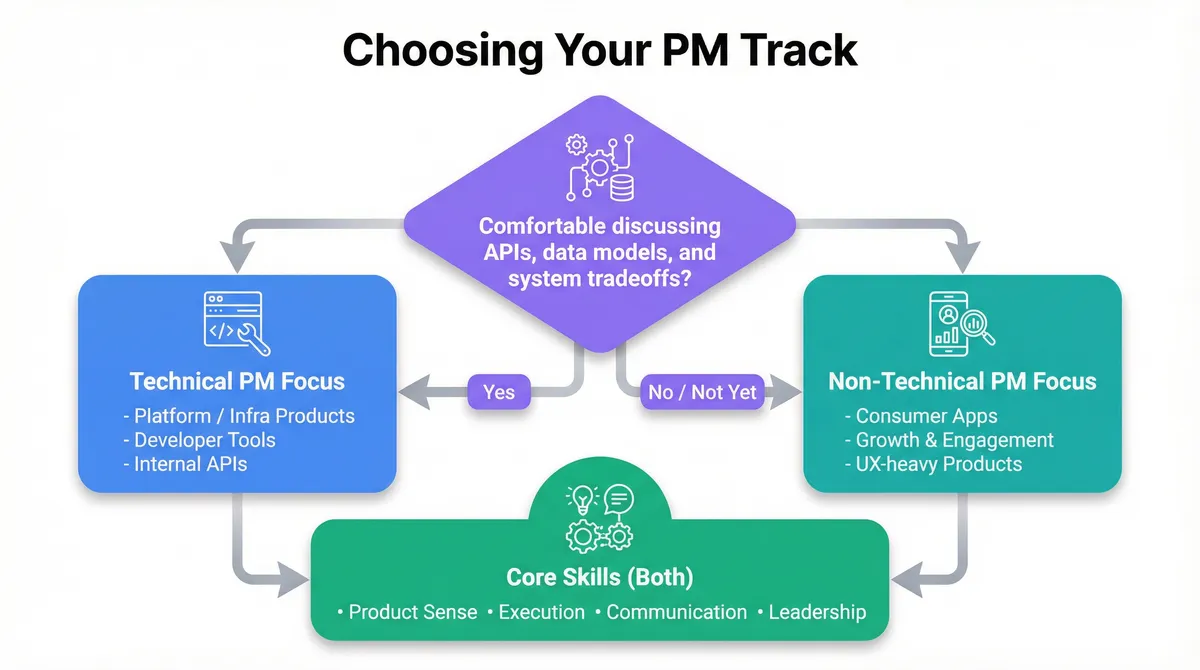
Ask yourself:
- Do you enjoy diving into technical constraints and architecture diagrams?
- Are you comfortable reading API docs or discussing data models?
- Do you get energy from developer tools, platforms, or infrastructure topics?
If yes, technical PM might be a strong fit.
If you’re more energized by user research, UX, and storytelling, and you prefer to keep tech at a conceptual level, non-technical PM roles might be a better starting point.
You can always shift over time; many PMs move between tracks as their skills and interests evolve.
Common Mistakes Candidates Make (And How to Avoid Them)
Mistake 1: Overstating Technical Ability (Technical PM)
Pattern:
- Candidate claims to be very technical
- Struggles with basic API or system questions
- Loses credibility quickly
Avoid it by:
- Being honest about your level
- Demonstrating learning ability and structured thinking
- Saying “I’m not familiar with that, but here’s how I’d reason about it…”
Mistake 2: Ignoring Users in Favor of Systems (Technical PM)
Pattern:
- Candidate jumps straight to system design
- Forgets to define the user, use cases, or metrics
- Designs a scalable system that solves a vague problem
Avoid it by:
- Always starting with user and problem definition
- Using systems thinking as a way to implement a clear product vision, not replace it
Mistake 3: Hiding from Technical Topics (Non-Technical PM)
Pattern:
- Candidate says “I’m not technical” too often
- Avoids asking clarifying technical questions
- Appears dependent on engineering for all implementation understanding
Avoid it by:
- Demonstrating curiosity about how things work
- Asking structured questions: “What are the main components?”, “Where are the main risks?”
- Showing you can translate technical constraints into product decisions
Mistake 4: Unstructured Answers
Pattern:
- Rambling, non-linear responses
- Jumps between ideas without clear prioritization
Avoid it by:
- Using simple, repeatable structures:
- For product design: User → Use Cases → Priorities → Solution → Metrics → Risks
- For behavioral: STAR (Situation, Task, Action, Result)
Best Practices for Preparing for PM Interviews (Both Tracks)
1. Build a Story Bank
Prepare 8–12 stories covering:
- Leading a project end-to-end
- Handling conflict
- Making a tough tradeoff
- Dealing with failure
- Working with engineering
- Working with non-engineering stakeholders
Tag each story with:
- Skills demonstrated (leadership, execution, technical depth, user focus)
- Role type relevance (technical PM, non-technical PM, or both)
2. Practice Out Loud with Realistic Prompts
Don’t just read frameworks—speak your answers:
- Time yourself on 30–45 minute mock interviews
- Record and review for:
- Clarity
- Structure
- Level of detail
If you want structured practice with feedback, an AI mock interviewer (for example, Thita’s /blog/interview/ai-interview-practice-free-mock-simulator) can simulate both technical PM and non-technical PM styles and push on your weak spots.
3. Tailor Your Preparation to the Company and Team
For each role:
- Read the job description carefully
- Look for signals:
- “APIs”, “platform”, “infrastructure”, “developer tools” → more technical
- “growth”, “engagement”, “consumer”, “UX” → more non-technical
- Research the team’s products and tech stack at a high level
Then adjust:
- For technical PM: add more system design and technical deep dives (consider following a system design roadmap to master key concepts)
- For non-technical PM: add more product sense and go-to-market prep
How Technical Should a PM Be? A Practical Benchmark
You don’t need to know algorithms at the level of a software engineer preparing with a full /blog/dsa/dsa-90-pattern, but you should hit a reasonable bar.
A technical PM should be able to:
- Sketch a basic architecture for a common web product
- Describe how an API works end-to-end
- Reason about caching, queues, and database basics conceptually
- Ask engineers informed questions and challenge assumptions respectfully
A non-technical PM should be able to:
- Understand architectural diagrams at a conceptual level
- Ask clarifying questions about dependencies and risks
- Translate technical constraints into clear user and business implications
If you can do that, you’re “technical enough” for many PM roles; the rest is role-specific depth.
Key Takeaways
- Technical PM vs non-technical PM is mostly about depth of technical expectations, not a completely different job.
- Both roles require strong product sense, execution, and communication.
- Technical PM interviews add:
- System design / technical deep dives
- Technical tradeoff discussions
- Closer alignment with engineering teams and platform/infrastructure products
- Non-technical PM interviews emphasize:
- User and market understanding
- UX, growth, and go-to-market
- Cross-functional execution with non-engineering teams
- Don’t overstate or understate your technical ability. Demonstrate honesty, curiosity, and structured thinking.
- Prepare deliberately:
- Build a story bank
- Practice answering out loud with structure
- Tailor depth based on the specific role and company
If you align your preparation with the right track—and understand where expectations differ—you’ll be evaluated for what you actually bring to the table, not for a skill set the role doesn’t need.