
System Design
How Much System Design Is Enough for SDE-1 vs SDE-2 Interviews?
Most candidates hear “system design” and immediately think of diagrams for YouTube, Twitter, or Uber. Then they open a job description for SDE‑1 or SDE‑2 and...

Most candidates hear “system design” and immediately think of diagrams for YouTube, Twitter, or Uber. Then they open a job description for SDE‑1 or SDE‑2 and wonder: how much of this do I actually need to know for my level?
This post is a practical guide to system design for SDE1 vs SDE2: what interviewers expect, how deep you need to go, and how to prioritize your preparation.
We’ll stay grounded in how real teams build systems and how real interviewers think, not in memorized architectures.
Why “How Much System Design?” Is the Wrong First Question
Before comparing SDE‑1 and SDE‑2 expectations, it helps to reframe the problem.
Interviewers are usually not grading you on whether you know Kafka vs RabbitMQ, or Redis vs Memcached. They’re assessing:
- How you reason about requirements and tradeoffs
- How you structure a solution under constraints
- How you communicate and collaborate
The amount of system design you need is really about how far you’re expected to go along these dimensions:
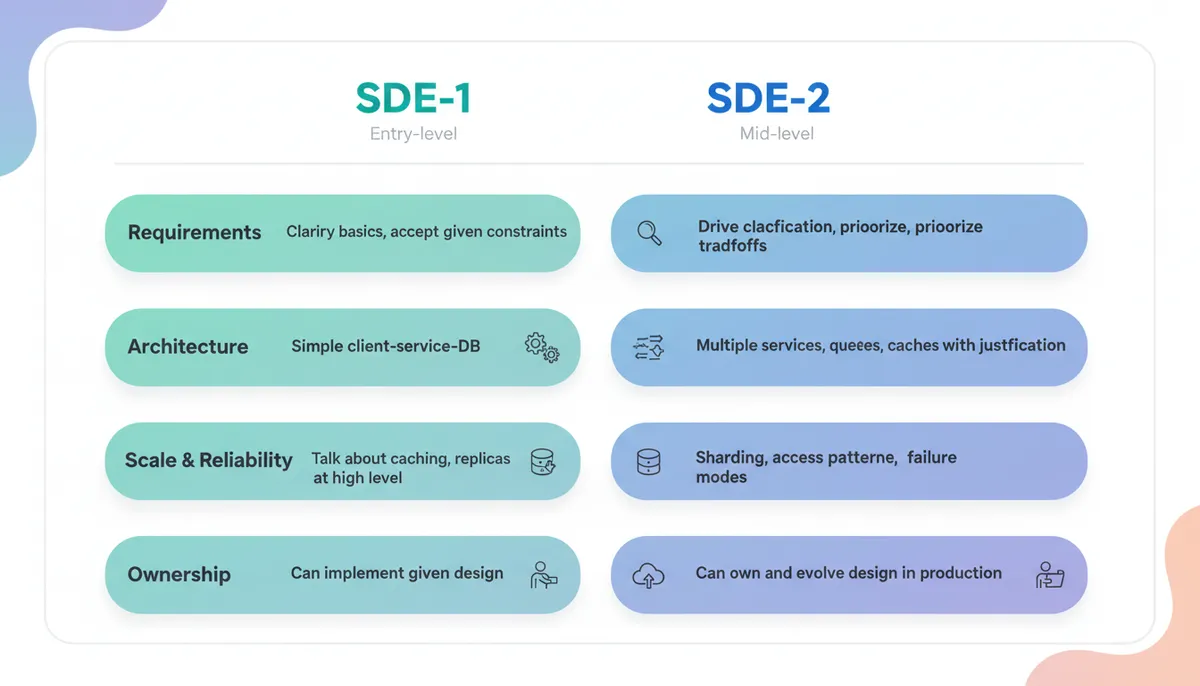
- From “can follow a design” (SDE‑1)
- To “can own and evolve a design” (SDE‑2)
The rest of this article breaks that down concretely.
What “System Design” Means at Different Levels
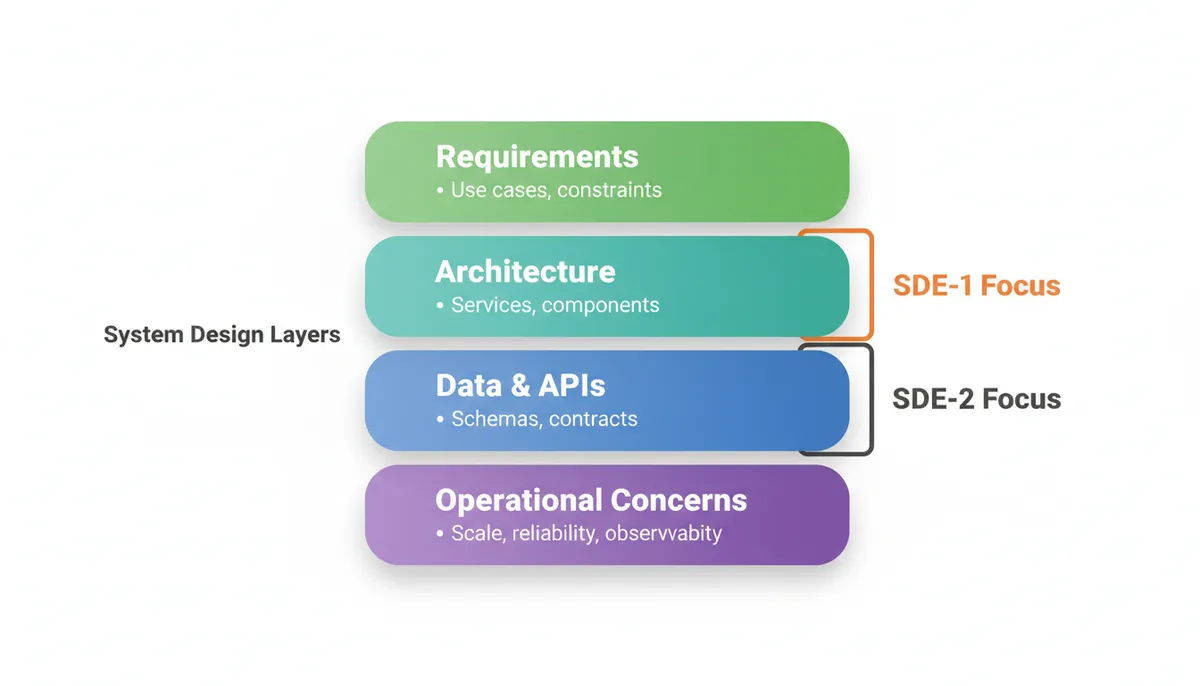
System design is a broad term. For interviews, it usually spans four layers:
- Requirements and use cases
- High-level architecture
- Data modeling and APIs
- Operational concerns (scale, reliability, observability, etc.)
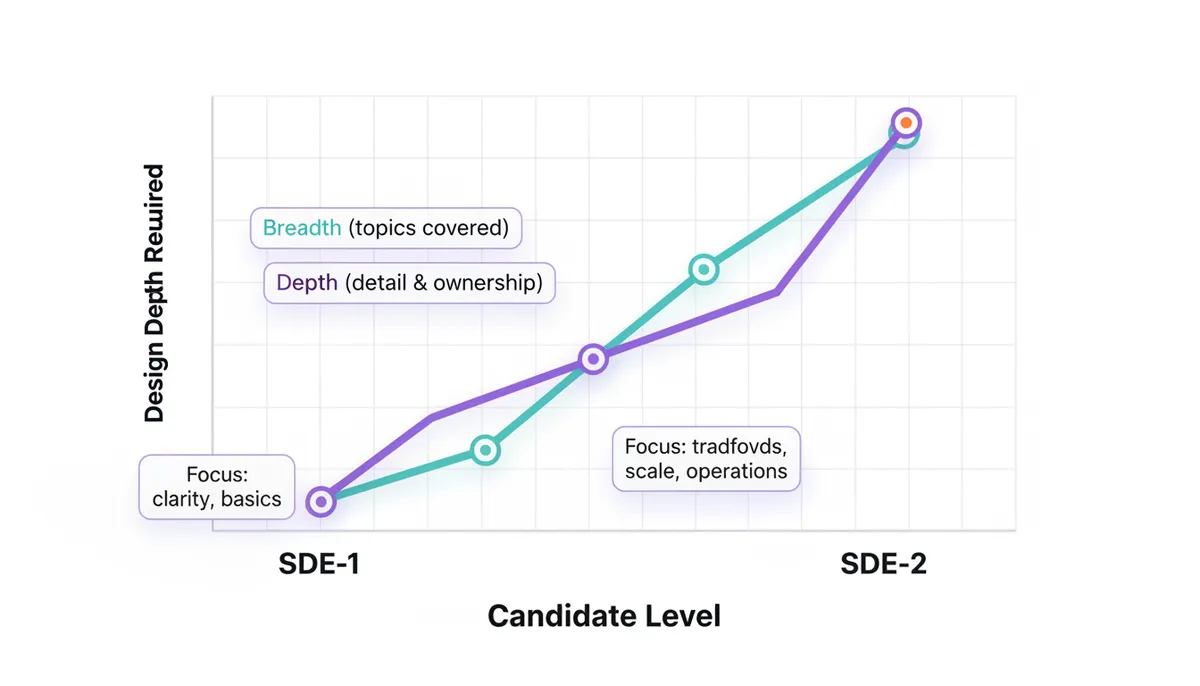
The difference between system design for SDE1 and system design for SDE2 is not the topics themselves, but the depth and ownership at each layer.
System Design for SDE1: What’s Actually Expected
For most companies, SDE‑1 (entry-level / junior) system design expectations are:
- You can reason about a simple system end-to-end
- You understand basic tradeoffs (e.g., SQL vs NoSQL at a high level)
- You can communicate a design clearly and respond to feedback
You are not expected to design a globally distributed payment system from scratch. You are expected to think clearly about a feature or small service in a realistic environment.
Typical SDE‑1 System Design Interview Format
For SDE‑1, system design often appears as:
- A “component design” question inside a coding round
“Design the API and data model for a URL shortener” - A lightweight system design round, 30–45 minutes
“Design a basic notes app backend” - Follow-up questions in behavioral/experience rounds
“Tell me about a service you worked on and how it scaled”
Core Skills for SDE‑1 System Design
Think of SDE‑1 system design as applied fundamentals.
1. Clarifying Requirements and Constraints
At SDE‑1, interviewers look for:
- Can you ask basic clarifying questions?
- Do you separate functional and non-functional requirements?
Example questions you might ask:
- “Is this internal or external-facing?”
- “How many users do we expect? Rough order of magnitude?”
- “What’s more important here: latency or consistency?”
You don’t need exact numbers, but you should anchor your design:
- “Let’s assume 100K daily active users at first, potentially growing to a few million.”
2. Producing a Reasonable High-Level Design
You should be comfortable sketching a simple architecture:
- Client → API Gateway / Load Balancer → Application Service → Database
- Maybe a cache layer in front of the DB
For SDE‑1, this is usually enough:
- A single stateless app service
- One primary data store
- Possibly:
- Cache (e.g., Redis)
- Message queue (for async tasks) if the prompt suggests it
You’re not expected to talk about multi-region replication or complex sharding strategies unless prompted.
3. Basic Data Modeling and API Design
This is where many SDE‑1 candidates can stand out.
You should be able to:
- Define core entities and relationships
- Choose between relational vs document databases in simple terms
- Sketch RESTful APIs
Example (URL shortener):
- Entities:
UrlMapping { id, shortCode, longUrl, createdAt, createdBy }
- APIs:
POST /shorten→ create short URLGET /{shortCode}→ redirect to original
You don’t need to know every normalization form, but you should avoid obviously flawed designs (e.g., storing everything as a single JSON string when relationships are clear).
4. Simple Scalability and Reliability Considerations
At SDE‑1, interviewers mainly want to see that:
- You know vertical vs horizontal scaling
- You understand stateless vs stateful services
- You can mention basic failure modes
Example lines of reasoning:
- “We should keep the app stateless so we can scale it horizontally behind a load balancer.”
- “If the database goes down, we need a backup/restore strategy and maybe read replicas for heavy read traffic.”
You don’t need to derive exact throughput or capacity numbers, but you should be able to say:
- “If reads dominate writes, we could add a cache to reduce load on the DB.”
5. Communication and Iteration
At SDE‑1, how you talk about your design often matters more than what you choose.
Interviewers look for:
- Do you draw a diagram (even verbally) in a structured way?
- Do you check in with the interviewer: “Does this direction make sense?”
- Can you adapt when they introduce a new constraint?
System Design for SDE2: Stepping Into Ownership
For SDE‑2 (mid-level), the bar is significantly higher.
You’re expected to:
- Own medium-to-large components of a system
- Make and justify non-trivial tradeoffs
- Think about operational realities (deployments, observability, failure modes)
- Collaborate with other engineers and stakeholders on design
System design for SDE2 is less about “can you draw boxes” and more about “can we trust you to design something we’ll still be running in two years?”
Typical SDE‑2 System Design Interview Format
Common patterns:
- A dedicated 60-minute system design round
- Example: “Design a rate limiter for a distributed API gateway” (see How to Design a Rate Limiter: System Design Interview Guide)
- Example: “Design a news feed system”
- Sometimes two design rounds:
- One high-level system design
- One deep dive (e.g., storage engine, pub/sub system)
You’ll be pushed on:
- Scale: “What happens at 10x traffic?”
- Edge cases: “How do we handle hot keys?”
- Tradeoffs: “Why choose eventual consistency here?”
Core Skills for SDE‑2 System Design
1. Systematic Requirements Analysis
At SDE‑2, you’re expected to drive the requirements conversation:
- Categorize requirements:
- Functional: what the system does
- Non-functional: performance, availability, consistency, security
- Identify priorities and tradeoffs:
- “Is it okay if users see slightly stale data?”
- “Is write latency more critical than read latency?”
You might say:
“Let’s clarify the scale: are we talking about 10K, 1M, or 100M DAUs? The architecture can be very different at each order of magnitude.”
Interviewers want you to shape the problem, not just accept it.
2. Coherent High-Level Architecture With Justified Choices
You should be able to propose a design with:
- Clear service boundaries
- Thoughtful choice of communication patterns:
- Sync (HTTP/gRPC) vs async (message queues, event streams)
- Justified storage technologies:
- OLTP vs OLAP
- SQL vs NoSQL (and which flavor)
For example, for a news feed:
- Write path:
- User action service → Event bus (Kafka) → Fan-out workers → Feed store
- Read path:
- Feed service → Cache → Feed store
You should be able to justify:
- Why use event streaming?
- Why pre-compute feeds vs compute on read?
- Where to add caching?
3. Detailed Data Modeling and API Contracts
SDE‑2 candidates should:
- Design schemas with attention to:
- Indexing
- Access patterns
- Growth over time
- Think about API versioning and backward compatibility
- Consider multi-tenant vs single-tenant data models if relevant
For example, for a multi-tenant SaaS:
- Partitioning by
tenant_id - Composite indexes on
(tenant_id, resource_id) - Consideration of noisy neighbor problems
You’re not expected to reproduce a database internals textbook, but you should be able to reason about:
- When to denormalize for performance
- When to use secondary indexes
- How to avoid hot partitions
4. Scaling Strategies and Capacity Thinking
At SDE‑2, you’re expected to talk about:
- Sharding and partitioning
- Read/write separation
- Back-of-the-envelope capacity estimates
Example:
“If we expect 10K writes/sec and each write is ~1KB, that’s ~10MB/s, or ~864GB/day. We’ll need a storage strategy that can handle a few TB/month and a plan for archiving or summarizing old data.”
You don’t need perfect math, but you should:
- Speak in orders of magnitude
- Use those estimates to justify design choices
Common patterns to mention appropriately:
- Rate limiting and backpressure
- Idempotency for retries
- Batching vs real-time processing
5. Reliability, Consistency, and Failure Modes
This is a key differentiator.
SDE‑2 system design expectations include:
- Understanding of CAP tradeoffs in practical terms
- Ability to reason about eventual vs strong consistency
- Awareness of SLOs/SLAs and error budgets at a high level
You should be able to answer:
- “What happens if this service goes down?”
- “How do we degrade gracefully under load?”
- “How do we avoid data loss in this pipeline?”
Examples:
- Using circuit breakers to protect downstream dependencies
- Designing idempotent consumers for event streams
- Implementing dead-letter queues for poison messages
6. Observability, Operations, and Evolution
SDE‑2 isn’t just about building; it’s about running systems.
Interviewers may probe:
- What would you log and why?
- How would you monitor this system?
- How would you roll out changes safely?
You might discuss:
- Metrics: latency, error rate, throughput, saturation
- Tracing for debugging cross-service issues
- Canary deployments or feature flags for risky changes
You’re expected to think about how this system will evolve:
- “How would you add this new feature without breaking existing clients?”
- “How would you support a new region in the future?”
Side-by-Side: SDE‑1 vs SDE‑2 System Design Expectations
Concrete Examples: How the Same Question Differs by Level
To make this less abstract, let’s walk through how system design for SDE1 vs SDE2 might look for the same prompt.
Example Prompt: “Design a URL Shortener”
SDE‑1 Answer (Good Enough)
Focus on:
- Clarifying:
- “Do we need authentication?”
- “How long should URLs be valid?”
- Simple architecture:
- Client → API Service → Relational DB
- Data model:
UrlMapping(id, shortCode, longUrl, createdAt, expiresAt)
- Basic flow:
POST /shorteninserts into DB, returns shortCodeGET /{shortCode}looks up in DB, redirects
- Basic scale:
- “If traffic grows, we can add a cache like Redis in front of the DB for reads and horizontally scale the app servers behind a load balancer.”
This is enough for SDE‑1 if you communicate clearly and handle basic edge cases (e.g., expired links).
SDE‑2 Answer (Expected Depth)
In addition to all of the above, you’d discuss:
- ID generation and collision avoidance:
- Base62 encoding of auto-increment ID vs random tokens
- Tradeoffs for guessing difficulty and security
- Scale and capacity:
- Rough QPS assumptions
- Read-heavy access → cache design
- Handling hot URLs
- Data partitioning:
- Sharding by shortCode hash
- Mitigating hot shards
- Availability and consistency:
- What happens if the DB is down?
- Do we accept eventual consistency for analytics?
- Additional features:
- Click tracking via async pipeline (e.g., log to Kafka, process later)
- Rate limiting to prevent abuse
You’d be expected to justify choices and discuss tradeoffs, not just name components.
Common Mistakes by Level (and How to Avoid Them)
Common SDE‑1 System Design Mistakes
-
Jumping straight to tech buzzwords
- Mentioning Kafka, Cassandra, and microservices for a toy problem with 1K users.
- Fix: Start with requirements. Use the simplest thing that can work at the given scale.
-
Ignoring data modeling
- Treating the database as a black box with “some table.”
- Fix: Explicitly define entities and key fields. Think about how queries will use them.
-
Not asking clarifying questions
- Designing a global, multi-tenant system when the interviewer meant a single-team internal tool.
- Fix: Always ask 3–5 clarifying questions up front.
-
Over-optimizing for scale
- Spending most of the time on sharding strategies for a system that might never need it.
- Fix: Design for the current scale with a path to evolve.
Common SDE‑2 System Design Mistakes
-
High-level hand-waving
- Saying “we’ll just shard it” without explaining how or why.
- Fix: Pick a concrete strategy (e.g., consistent hashing on user ID) and explain implications.
-
Ignoring operational reality
- No discussion of monitoring, logging, or deployments.
- Fix: Reserve 5–10 minutes to talk about observability and rollout.
-
Inconsistent requirements thinking
- Claiming strong consistency and 99.999% availability without acknowledging tradeoffs.
- Fix: Be explicit: “We’ll prioritize availability over strict consistency here because…”
-
Over-focusing on one layer
- Spending 40 minutes on data schema and 5 minutes on everything else.
- Fix: Allocate time: 10 min requirements, 15–20 min architecture, 15–20 min deep dives, 5–10 min ops & recap.
How to Prepare Systematically (Without Memorizing Architectures)
You don’t need to memorize “design Twitter” answers. You do need structured practice.
Step 1: Learn the Core Building Blocks
For both SDE‑1 and SDE‑2, make sure you understand:
- Load balancers
- Stateless vs stateful services
- Relational vs NoSQL databases
- Caches (local vs distributed)
- Message queues / event streams
- CDN basics for content-heavy systems
For each, know:
- When to use it
- What problems it solves
- Typical failure modes
Step 2: Practice a Reusable Design Framework
Use a repeatable structure for any design question:
- Clarify requirements
- Define APIs and data model (at least at a high level)
- Sketch high-level architecture
- Address scaling and bottlenecks
- Discuss reliability and operations
- Summarize tradeoffs and potential improvements
With enough repetitions—ideally through mock interviews or an AI coach—you’ll internalize this flow and reduce cognitive load during real interviews.
If you’re already using pattern-based DSA prep (for example via something like Thita’s /dsa-patterns-sheet), you can treat these system design steps as patterns too: the same skeleton applied to different problems.
Step 3: Calibrate Depth to Your Level
-
For SDE‑1:
- Focus on clarity and correctness over scale.
- Aim to be solid on:
- Requirements clarification
- Basic data modeling
- Simple, coherent architecture
-
For SDE‑2:
- Practice capacity estimation, partitioning, and failure handling.
- Push yourself to:
- Justify tradeoffs explicitly
- Discuss evolution and operations
Step 4: Get Feedback on Your Thinking Process
System design is as much about how you think as what you know.
- Record yourself explaining a design in 30–45 minutes.
- Listen back and ask:
- Did I start with requirements?
- Did I talk about data and APIs?
- Did I consider failures and operations?
- Use mock interviews—human or AI-based (e.g., tools like AI Interview Practice: Free Mock Interview Simulator with Real-Time Feedback for Technical Interviews or /ai-coach)—to simulate the pressure and timing of real interviews.
Best Practices During the Interview
Regardless of level, these habits improve your performance:
-
Narrate your thought process
- “I’ll start with requirements, then propose a simple design and refine it for scale.”
-
Use the whiteboard (or virtual equivalent) early
- Even a simple three-box diagram helps anchor the conversation.
-
Periodically summarize
- “So far, we have a single service and DB handling ~1K QPS. Next, I’ll talk about scaling this up.”
-
Invite feedback
- “I’m thinking of using a message queue here to decouple services. Does that align with what you’re looking for?”
-
Timebox deep dives
- Don’t spend 25 minutes on one micro-optimization. Make sure you hit requirements, architecture, data, scale, and reliability at least briefly.
Key Takeaways
- System design for SDE1 vs SDE2 differs mainly in depth and ownership, not in the list of buzzwords you know.
- SDE‑1:
- Show you can reason about a simple system end-to-end.
- Prioritize clear requirements, basic data modeling, and straightforward architectures.
- SDE‑2:
- Demonstrate you can own and evolve a system in production.
- Dive into scaling strategies, tradeoffs, failure modes, and operations.
- For both:
- Use a structured approach to every question.
- Practice articulating your design and tradeoffs under time pressure.
- Focus on understanding building blocks rather than memorizing famous architectures.
If you calibrate your preparation to your target level and practice systematically, system design interviews become less about guessing what the interviewer wants and more about showing how you already think as an engineer on real systems.