15% off all plans & roadmaps Use code
See plans
Editorial
Core insight
Distinct Subsequences · Dynamic Programming (DP) Patterns
Core Insight for Distinct Subsequences
Define:
dp[i][j] = number of ways to form t[:j] using s[:i]Here:
iranges from0tos.length.jranges from0tot.length.
The empty target prefix has exactly one construction: choose no characters.
Therefore:
dp[i][0] = 1For each character s[i - 1], there are two possibilities:
- Skip it. All existing ways remain available.
- Use it if it equals
t[j - 1]. Every way to formt[:j-1]can be extended with this character.
Thus, when the characters match:
dp[i][j] = dp[i - 1][j] + dp[i - 1][j - 1]When they do not match:
dp[i][j] = dp[i - 1][j]The implementation compresses this table into dp[j]. During processing of one character from s:
dp[j]represents the old row before updating.dp[j - 1]must still represent the old row when it is used.- Therefore,
jis processed from right to left.
This descending order is the key constraint of the one-dimensional optimization. It prevents an update from the current character from being reused again during the same iteration.
Visual Description
The full DP table has one row for every prefix of s and one column for every prefix of t. At a matching cell, the value combines:
- The cell directly above it, representing skipping the current character of
s. - The diagonally upper-left cell, representing using the current character to extend a shorter target prefix.
The one-dimensional implementation processes one source character at a time. For each row, it updates target columns from the last column toward the first. This preserves the previous row's diagonal values while the current row is being written. In the recursion tree equivalent, each matching source character splits a state into a skip branch and a use branch; the DP array merges all identical prefix states into one count.
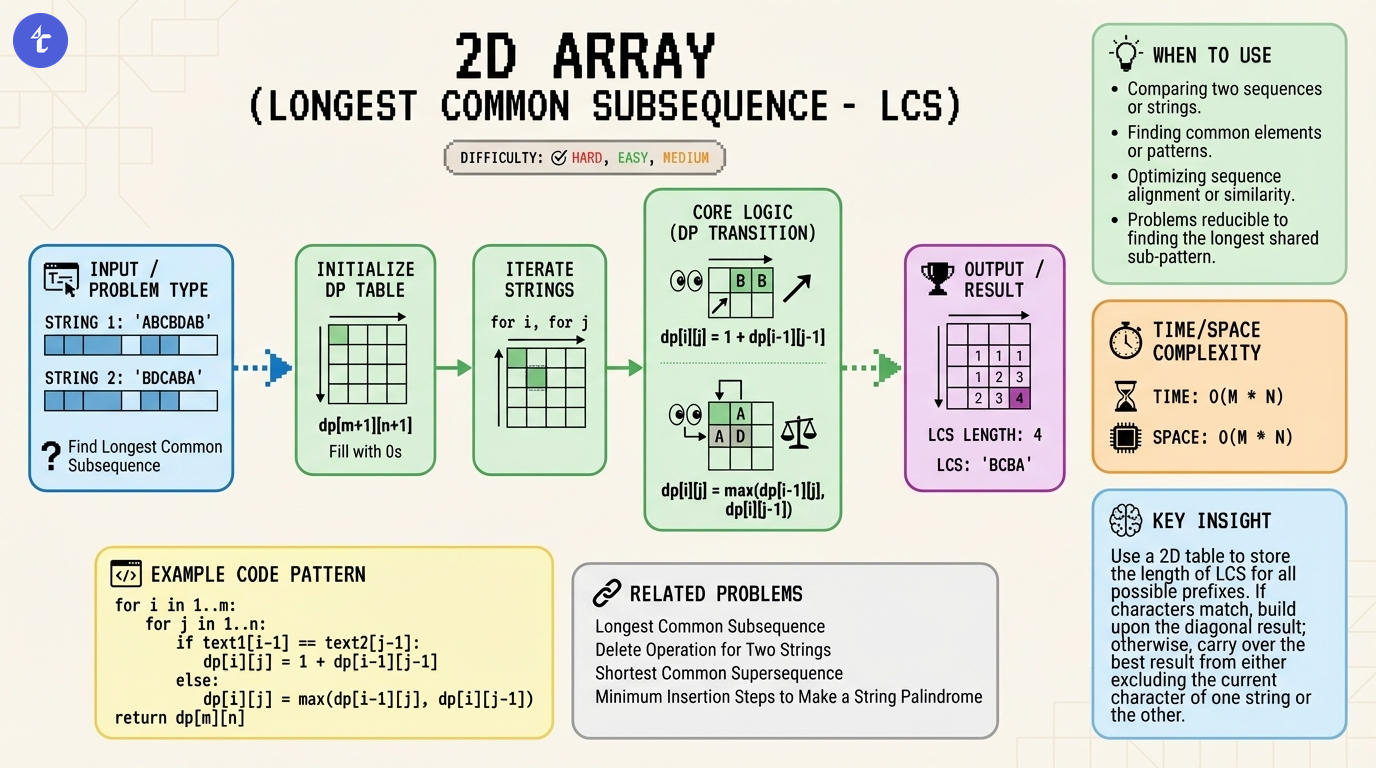
Deep dive
Full breakdown
Full reasoning, pitfalls, and implementation flow
LeetCode 115: Distinct Subsequences Solution & Explanation
Problem Overview
TL;DR: Use dynamic programming to count how many ways each prefix of t can be formed from each processed prefix of s, storing the 2D state in a one-dimensional array updated from right to left.
In LeetCode 115, Distinct Subsequences, the task is to count index selections from s whose characters appear in order and spell t. Selected characters do not need to be adjacent, and two selections are different when they use different indices.
For example, if s = "aaaaa" and t = "aaa", selecting positions (0, 1, 2) differs from selecting (0, 1, 3), even though both selections produce the same string.
This is a popular interview question because it combines string processing, counting, and dynamic programming. The LeetCode 115 Solution uses a 2D-array dynamic programming state compressed into one dimension.
Brute Force Approach for Distinct Subsequences
A direct approach considers every character in s and decides whether to:
- Skip the current character.
- Use the current character to match the next character of
t, if they are equal.
The recursion tracks:
- The current index in
s. - The current index in
t.
When all characters of t have been matched, one valid subsequence has been found. If s is exhausted before t, that branch contributes zero.
Naive Pseudocode
count(i, j):
    if j == length(t):
        return 1

    if i == length(s):
        return 0

    ways = count(i + 1, j)  // Skip s[i]

    if s[i] == t[j]:
        ways += count(i + 1, j + 1)  // Use s[i]

    return ways
The recursion can branch into two paths for many positions of s. In the worst case, it explores an exponential number of choices.
Complexity
- Time:
O(2^m), wherem = s.length - Space:
O(m)for the recursion stack
With s.length and t.length up to 1000, exponential recursion quickly becomes infeasible and results in Time Limit Exceeded. Many recursive calls also solve the same (i, j) state repeatedly.
Algorithm Strategy: Dynamic Programming (DP Patterns)
Maintain a one-dimensional array:
dp[j] = number of ways to form the first j characters of t
        using the characters of s processed so far
Initialize:
dp[0] = 1This represents the one valid way to form an empty target: select no indices.
For every character c in s:
- Traverse
tfrom its last character toward its first. - If
cmatchest[j - 1], adddp[j - 1]todp[j]. - If the characters do not match, leave
dp[j]unchanged.
The right-to-left traversal enforces the prefix-state boundary: dp[j - 1] must refer to the state before processing the current character of s.
After all characters of s are processed, dp[t.length()] contains the number of distinct index selections that form t.
Execution Flow
- Create an array of length
t.length() + 1. - Set
dp[0] = 1. - Process each character of
sfrom left to right. - For the current source character, process target lengths from
t.length()down to1. - Compare the source character with
t[j - 1]. - If they match:
dp[j - 1]counts ways to form the shorter target prefix before using the current source character.- Add that count to
dp[j].
- If they do not match, no new subsequence ending at this source character is created.
- Continue until every character of
shas been processed. - Return
dp[t.length()].
For s = "abac" and t = "ac":
- The first
acreates one way to form"a". - The
bchanges nothing. - The second
acreates another way to form"a". - The final
cextends both existing"a"formations into"ac".
The final count is 2.
Proof of Correctness
We prove that the algorithm returns the number of distinct subsequences of s equal to t.
Invariant
After processing a prefix of s, dp[j] equals the number of ways to select indices from that processed prefix so that the selected characters form t[:j].
Initialization
Before processing any characters of s:
dp[0] = 1, because the empty target can be formed by selecting no characters.- Every
dp[j]forj > 0is0, because a nonempty target cannot be formed from an empty source prefix.
Thus, the invariant holds initially.
Maintenance
Consider processing a source character c.
For a target prefix of length j:
- If
c != t[j - 1], the current character cannot be the final selected character oft[:j]. All valid selections remain the selections counted before processingc, sodp[j]remains unchanged. - If
c == t[j - 1], every existing way to formt[:j-1]can either:- Avoid
c, already counted in the olddp[j]. - Use
cas the final character, contributing the olddp[j-1].
- Avoid
Therefore:
new dp[j] = old dp[j] + old dp[j - 1]Because j is processed from right to left, dp[j - 1] still contains the value from before processing c. Thus, the update exactly represents the two valid choices without reusing c more than once.
The invariant is preserved after every source character.
Termination
After all characters of s are processed, dp[t.length()] counts every index selection whose characters spell the complete target t. Therefore, the algorithm returns the correct answer.
Pattern Reuse Notes
The following problems share the same pattern/subpattern:
- LeetCode 1143: Longest Common Subsequence
- LeetCode 1092: Shortest Common Supersequence
- LeetCode 1312: Minimum Insertion Steps to Make a String Palindrome
These problems define states over two string prefixes and transition based on whether the current characters match. The stored value changes by problem: counting ways for Distinct Subsequences, maximizing length for LCS, minimizing construction length for Shortest Common Supersequence, and minimizing insertions for the palindrome problem.
Feynman coach · Before you peek at the code
Can you explain the core insight in your own words?
If you can explain it before reading code, you’re far more likely to recall it under interview pressure.
Loading your attempt…
Reference Implementation
C++ Solution for LeetCode 115
1class Solution {
2public:
3    int numDistinct(string s, string t) {
4        vector<long long> dp(t.size() + 1, 0);
5        dp[0] = 1;
6
7        for (char c : s) {
8            for (size_t j = t.size(); j > 0; --j) {
9                if (c == t[j - 1]) {
10                    dp[j] += dp[j - 1];
11                }
12            }
13        }
14
15        return static_cast<int>(dp[t.size()]);
16    }
17};
Java Solution for LeetCode 115
1class Solution {
2    public int numDistinct(String s, String t) {
3        int[] dp = new int[t.length() + 1];
4        dp[0] = 1;
5
6        for (int i = 0; i < s.length(); i++) {
7            char ch = s.charAt(i);
8            for (int j = t.length(); j >= 1; j--) {
9                if (ch == t.charAt(j - 1)) {
10                    dp[j] += dp[j - 1];
11                }
12            }
13        }
14
15        return dp[t.length()];
16    }
17}
Python Solution for LeetCode 115
1class Solution:
2    def numDistinct(self, s: str, t: str) -> int:
3        # dp[j] is the number of ways to form t[:j] from the processed part of s.
4        dp = [0] * (len(t) + 1)
5        dp[0] = 1
6
7        for ch in s:
8            for j in range(len(t), 0, -1):
9                if ch == t[j - 1]:
10                    dp[j] += dp[j - 1]
11
12        return dp[len(t)]