
Editorial
Core insight
Find All Duplicates in an Array · Array/Matrix Manipulation Patterns
Core Insight for Find All Duplicates in an Array
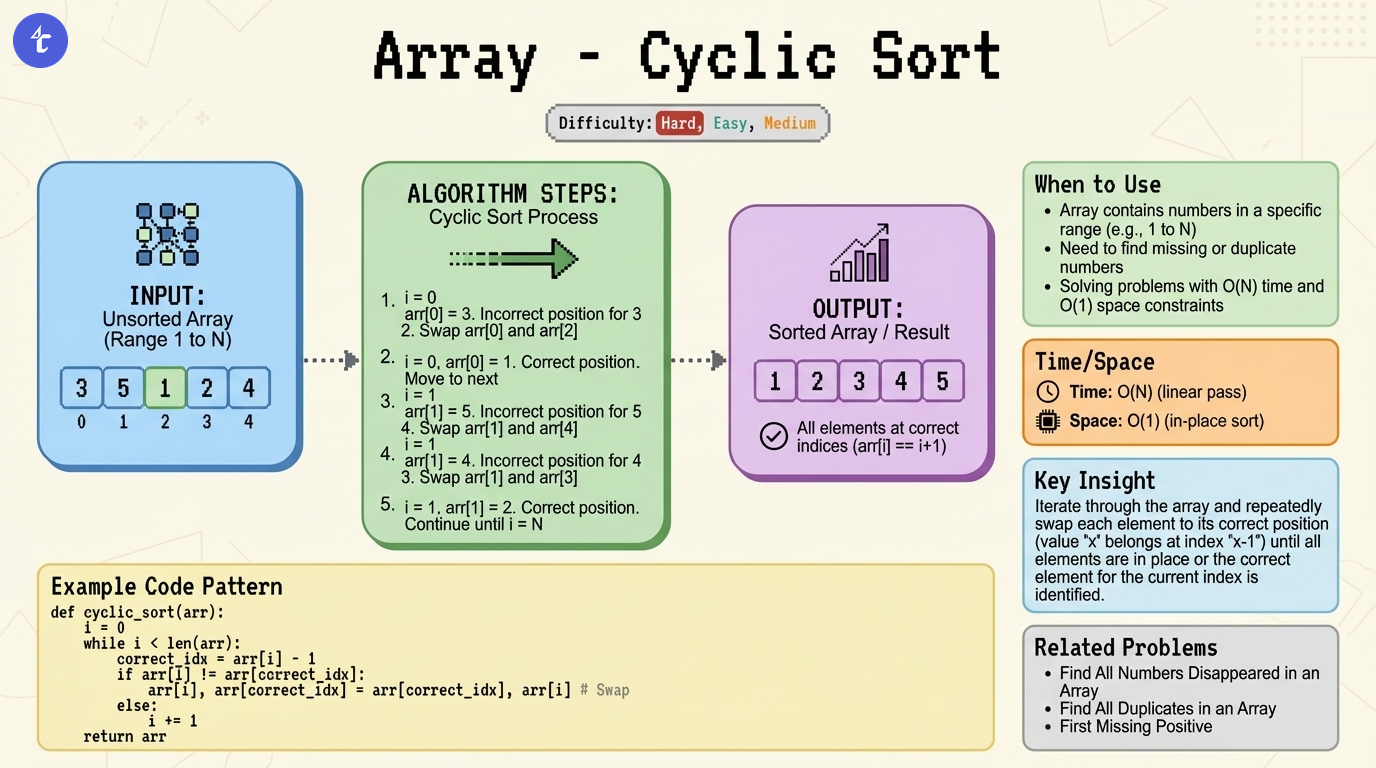
The key intuition behind the LeetCode 442 solution lies in the Pigeonhole Principle and the specific range of the data. Since the numbers are strictly between 1 and n, each number x has a "correct" or "ideal" position in the array, which is index x-1.
For example, the number 1 belongs at index 0, and the number 5 belongs at index 4.
If the array were perfectly sorted with no duplicates, every index i would contain the value i+1. Since we have duplicates and the array is unsorted, we can attempt to sort the array in-place by swapping numbers to their correct positions.
The Invariant:
After performing a Cyclic Sort, if the number at index i is not i+1, then the number currently residing at index i must be a duplicate that "stole" the spot of a missing number.
Visual Description:
Imagine iterating through the array. When we see a number, say 4, at index 0, we know 4 belongs at index 3. We look at index 3.
- If index
3already contains a4, we have found a duplicate. We leave the current4at index0and move on (or mark it). - If index
3contains a different number (e.g.,7), we swap the4and the7. Now4is in its correct home. We then check the7which is now at index0and repeat the process.
This process rearranges the array so that every unique number sits at its corresponding index. Any number that appears twice will eventually be forced into a position where it does not belong because its "correct" home is already occupied by its twin.
Deep dive
Full breakdown
Full reasoning, pitfalls, and implementation flow
LeetCode 442: Find All Duplicates in an Array Solution & Explanation
Problem Overview
TL;DR: By utilizing the Cyclic Sort pattern, we can place each number into its correct index (mapping value to index ) in time, allowing us to identify duplicates by checking which indices hold the wrong values.
The problem asks us to identify all integers that appear twice in a given integer array nums. The array has length n, and all integers within it fall within the range [1, n]. Importantly, every element appears either once or twice. The solution must be efficient, running in linear time, and must not use any extra space for data structures like hash sets (constant auxiliary space).
This is a classic interview question, often referred to as LeetCode 442, which tests a candidate's ability to recognize relationships between array values and array indices.
Brute Force Approach for Find All Duplicates in an Array
A naive approach to solving Find All Duplicates in an Array typically involves counting the frequency of each number.
The most straightforward method is to use a Hash Map (or Hash Set) to store the elements we have encountered so far. As we iterate through the array, we check if the current number already exists in our set.
- Initialize an empty Hash Set.
- Iterate through
nums. - If
nums[i]is in the set, add it to the output list (it is a duplicate). - Otherwise, add
nums[i]to the set.
Pseudo-code:
function findDuplicates(nums):
    seen = new HashSet()
    duplicates = []
    for num in nums:
        if num in seen:
            duplicates.add(num)
        else:
            seen.add(num)
    return duplicates
Why this fails:
While this solution runs in time, it requires space to store the seen set. The problem constraints explicitly demand constant auxiliary space ().
Another brute force method involves sorting the array first () and then checking adjacent elements. This fails the time complexity constraint of .
Algorithm Strategy: Array - Cyclic Sort
We will implement the Cyclic Sort pattern in two passes (or a single pass with specific logic, but the two-pass approach is cleaner for explanation).
-
Placement Phase (Cyclic Sort): Iterate through the array with a pointer
i. For each elementnums[i]:- Calculate its correct destination index:
correct_index = nums[i] - 1. - If
nums[i]is not already atcorrect_indexAND the value atcorrect_indexis not equal tonums[i]:- Swap
nums[i]andnums[correct_index]. - Decrement
i(or stay at the samei) to re-evaluate the new number that was just swapped into the current position.
- Swap
- If the value at
correct_indexIS alreadynums[i], we simply move to the next index. This means we have found a duplicate, but we leave it in the "wrong" position for now.
- Calculate its correct destination index:
-
Identification Phase: Iterate through the sorted array.
- Check if
nums[i] != i + 1. - If this condition is true, it means
nums[i]is a duplicate (it is occupying the seat of the missing numberi+1). - Add
nums[i]to the result list.
- Check if
This strategy strictly adheres to time because each number is swapped to its correct position at most once. It uses space because we modify the input array in-place.
Execution Flow
Let's trace the algorithm with nums = [4, 3, 2, 7, 8, 2, 3, 1].
Phase 1: Cyclic Sort
- i = 0, val = 4: Target index is 3.
nums[3]is 7. Swap.- Array:
[7, 3, 2, 4, 8, 2, 3, 1]
- Array:
- i = 0, val = 7: Target index is 6.
nums[6]is 3. Swap.- Array:
[3, 3, 2, 4, 8, 2, 7, 1]
- Array:
- i = 0, val = 3: Target index is 2.
nums[2]is 2. Swap.- Array:
[2, 3, 3, 4, 8, 2, 7, 1]
- Array:
- i = 0, val = 2: Target index is 1.
nums[1]is 3. Swap.- Array:
[3, 2, 3, 4, 8, 2, 7, 1]
- Array:
- i = 0, val = 3: Target index is 2.
nums[2]is 3. Match found. Sincenums[2]is already 3, we stop swapping for this position and moveiforward. - i = 1, val = 2: Correct position is index 1. It is already there. Move
i. - i = 2, val = 3: Correct position is index 2. It is there. Move
i. - i = 3, val = 4: Correct position is index 3. It is there. Move
i. - i = 4, val = 8: Target index is 7.
nums[7]is 1. Swap.- Array:
[3, 2, 3, 4, 1, 2, 7, 8]
- Array:
- i = 4, val = 1: Target index is 0.
nums[0]is 3. Swap.- Array:
[1, 2, 3, 4, 3, 2, 7, 8]
- Array:
- i = 4, val = 3: Target index is 2.
nums[2]is 3. Match found. Movei. - ...Proceed through rest of array. No more swaps occur.
Final sorted state: [1, 2, 3, 4, 3, 2, 7, 8]
Phase 2: Identification
- Index 0:
nums[0] == 1. Correct. - Index 1:
nums[1] == 2. Correct. - Index 2:
nums[2] == 3. Correct. - Index 3:
nums[3] == 4. Correct. - Index 4:
nums[4] == 3. Expected5. Duplicate found: 3. - Index 5:
nums[5] == 2. Expected6. Duplicate found: 2. - Index 6:
nums[6] == 7. Correct. - Index 7:
nums[7] == 8. Correct.
Result: [3, 2]
Proof of Correctness
The algorithm relies on the fact that indices are unique. If the array contains the range [1, n], each number k has exactly one reserved index k-1.
- If a number
kappears once, the Cyclic Sort places it exactly atnums[k-1]. - If a number
kappears twice, the first instance takes the slotnums[k-1]. The second instance cannot occupynums[k-1]because it is already taken by the firstk. - Consequently, the second instance of
kis forced to remain in a slotjwherej != k-1. - Since the problem guarantees elements appear at most twice, checking
nums[i] != i+1is sufficient to identify these displaced duplicates.
Pattern Reuse Notes
The Cyclic Sort pattern is a powerful tool for optimal interview solutions involving arrays with continuous ranges.
- LeetCode 268: Missing Number: Uses Cyclic Sort to find the one number missing from the range
0ton. - LeetCode 448: Find All Numbers Disappeared in an Array: Almost identical to LeetCode 442, but instead of collecting the numbers that appear twice, you collect the indices that hold the wrong numbers (the missing ones).
- LeetCode 287: Find the Duplicate Number: Similar constraint, but finding a single duplicate. Often solved with Floyd's Cycle Detection, but Cyclic Sort also works if modifying the array is allowed.
- LeetCode 41: First Missing Positive: The hardest variation. You must ignore numbers outside the
1tonrange while Cyclic Sorting to find the first index that doesn't match.
Feynman coach · Before you peek at the code
Can you explain the core insight in your own words?
If you can explain it before reading code, you’re far more likely to recall it under interview pressure.
Loading your attempt…
Reference Implementation
C++ Solution for LeetCode 442
1class Solution {
2public:
3    vector<int> findDuplicates(vector<int>& nums) {
4        int n = nums.size();
5        int i = 0;
6
7        // Phase 1: Cyclic Sort
8        while (i < n) {
9            int correctIndex = nums[i] - 1;
10            // Swap if the element is not at the correct index
11            // AND the correct index doesn't already contain the correct element
12            if (nums[i] != nums[correctIndex]) {
13                swap(nums[i], nums[correctIndex]);
14            } else {
15                i++;
16            }
17        }
18
19        // Phase 2: Identify Duplicates
20        vector<int> duplicates;
21        for (int j = 0; j < n; j++) {
22            // If the number at index j is not j+1, it's a duplicate
23            if (nums[j] != j + 1) {
24                duplicates.push_back(nums[j]);
25            }
26        }
27
28        return duplicates;
29    }
30};
Java Solution for LeetCode 442
1class Solution {
2    public List<Integer> findDuplicates(int[] nums) {
3        int i = 0;
4        int n = nums.length;
5
6        // Phase 1: Cyclic Sort
7        while (i < n) {
8            int correctIndex = nums[i] - 1;
9            // If the current number is not at its correct index
10            // and the target position doesn't already hold the correct number
11            if (nums[i] != nums[correctIndex]) {
12                swap(nums, i, correctIndex);
13            } else {
14                i++;
15            }
16        }
17
18        // Phase 2: Identify Duplicates
19        List<Integer> duplicates = new ArrayList<>();
20        for (int j = 0; j < n; j++) {
21            if (nums[j] != j + 1) {
22                duplicates.add(nums[j]);
23            }
24        }
25
26        return duplicates;
27    }
28
29    private void swap(int[] arr, int first, int second) {
30        int temp = arr[first];
31        arr[first] = arr[second];
32        arr[second] = temp;
33    }
34}
Python Solution for LeetCode 442
1class Solution:
2    def findDuplicates(self, nums: List[int]) -> List[int]:
3        i = 0
4        n = len(nums)
5
6        # Phase 1: Cyclic Sort
7        while i < n:
8            correct_index = nums[i] - 1
9            # Check if nums[i] is at the correct position
10            if nums[i] != nums[correct_index]:
11                # Swap nums[i] with the element at its correct position
12                nums[correct_index], nums[i] = nums[i], nums[correct_index]
13            else:
14                i += 1
15
16        # Phase 2: Identify Duplicates
17        duplicates = []
18        for j in range(n):
19            if nums[j] != j + 1:
20                duplicates.append(nums[j])
21
22        return duplicates