
AI
AI vs Human Mock Interviews: Which One Improves Faster?
Most candidates preparing for technical interviews eventually face the same decision: should you practice with an AI mock interview or with a human? Under ti...
Most candidates preparing for technical interviews eventually face the same decision: should you practice with an AI mock interview or with a human? Under time pressure, the real question becomes sharper: which one helps you improve faster?
This post takes a systematic, engineering-style look at AI vs human mock interviews for technical interview practice. We’ll break down the feedback loop, latency, signal quality, and failure modes—then map them to different stages of your prep so you can choose the right tool at the right time.
We’ll focus on technical interview practice (coding, system design, behavioral for engineers), not general job search coaching.
What does “improve faster” actually mean?
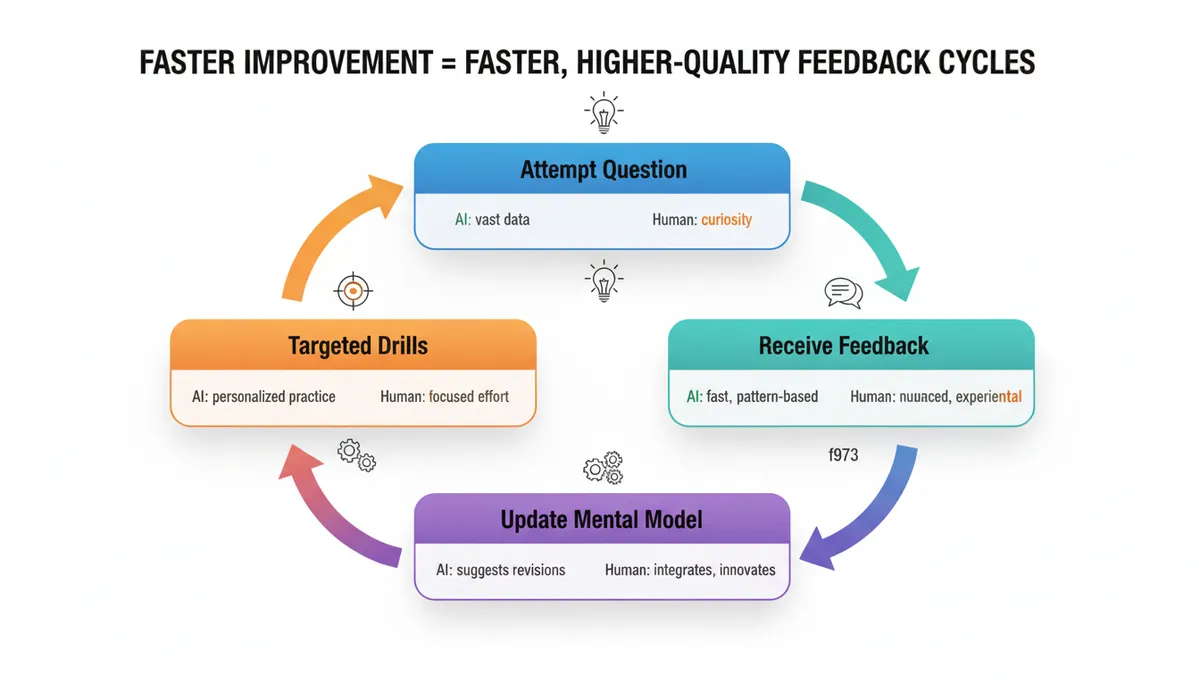
“Improving faster” in interview prep is not vague motivation. You can make it concrete by thinking in terms of learning cycles:
- Attempt a problem / question
- Get feedback
- Adjust your mental model and behavior
- Repeat with variation
You improve faster when:
- You complete more cycles per unit time (low latency, high availability)
- Each cycle gives high-quality, specific feedback (strong learning signal)
- The practice matches the real environment enough that skills transfer
So when we compare AI mock interview vs human, we’ll evaluate:
- Cycle speed: how many realistic reps can you do per week?
- Feedback quality: how precise, accurate, and actionable is the feedback?
- Coverage: how broad is the range of problems, styles, and scenarios?
- Psychological realism: how close does it feel to the real interview?
- Cost and scalability: how much friction to get those reps?
How AI mock interviews work (and what they’re good at)
AI mock interviews are essentially interactive simulators built on large language models (LLMs). Under the hood, they:
- Parse your input (code, explanations, answers)
- Compare it against patterns learned from massive datasets
- Generate questions, hints, and feedback conditioned on your behavior
- Optionally track your performance over time and adjust difficulty
On platforms like Thita.ai’s AI Mock Interviews vs Real Interviews: Do They Actually Help?, this is combined with pattern-based DSA learning, so the system can also reason about which pattern you should have used and where your reasoning diverged.
Strength 1: Extremely fast feedback loops
With AI, you can run:
- 3–5 coding mock interviews in a single evening
- 10+ behavioral question reps in one sitting
- System design drills on multiple architectures back-to-back
Cycle speed is limited only by your own attention span.
Why this matters for improvement speed:
- Early in prep, you need volume to expose weaknesses.
- Frequent, low-friction practice helps you automate basics (syntax, common DSA patterns, standard behavioral stories).
- You can replay a scenario instantly if you want to try a different approach.
Strength 2: Consistent, structured feedback
AI is very good at:
- Identifying obvious correctness issues in code
- Spotting common complexity mistakes (e.g., O(n²) where O(n log n) exists)
- Pointing out missing edge cases
- Highlighting communication gaps (“You didn’t state constraints”, “You didn’t discuss trade-offs”)
Because it can be trained on patterns (e.g., the 94 DSA patterns in Thita.ai’s The 90 DSA Patterns That Cover 99% of Coding Interviews), it can also say:
- “This is a classic Sliding Window problem; your brute-force approach is O(n²), but a window-based O(n) approach exists.”
- “You tried to use a Hash Map pattern, but the constraints suggest a Two Pointers pattern is more appropriate.”
This pattern-aware feedback is extremely valuable for building a mental index of problem types.
How human mock interviews work (and what they’re good at)
Human mock interviews—whether with friends, mentors, or paid platforms—are closer to the real social and psychological context of an interview.
A human interviewer:
- Interprets your body language, tone, and hesitation
- Adapts questions dynamically based on your personality and responses
- Has their own biases, preferences, and communication style
- Brings personal experience from real interviews and hiring decisions
Strength 1: High-fidelity simulation of real pressure
Humans bring:
- Social pressure: you don’t want to look unprepared
- Unpredictability: follow-up questions, clarifications, interruptions
- Subjectivity: reactions to your communication style, confidence, and clarity
This matters because real interviews are not pure algorithm exams; they’re human interactions under time pressure.
If you only practice with AI, you may:
- Underestimate how nerves affect your performance
- Overestimate your ability to explain clearly to a skeptical listener
- Miss practice on handling ambiguous or poorly specified questions
Strength 2: Nuanced, experience-informed feedback
Experienced human interviewers can:
- Tell you which behaviors are deal-breakers vs minor issues
- Share company-specific expectations (“At X, we care a lot about trade-off discussions”)
- Give meta-feedback: “You’re technically strong but sound defensive when corrected”
- Spot non-obvious patterns: “You always rush into coding before clarifying constraints”
This type of holistic feedback is hard to get from AI today.
AI mock interview vs human: side-by-side comparison
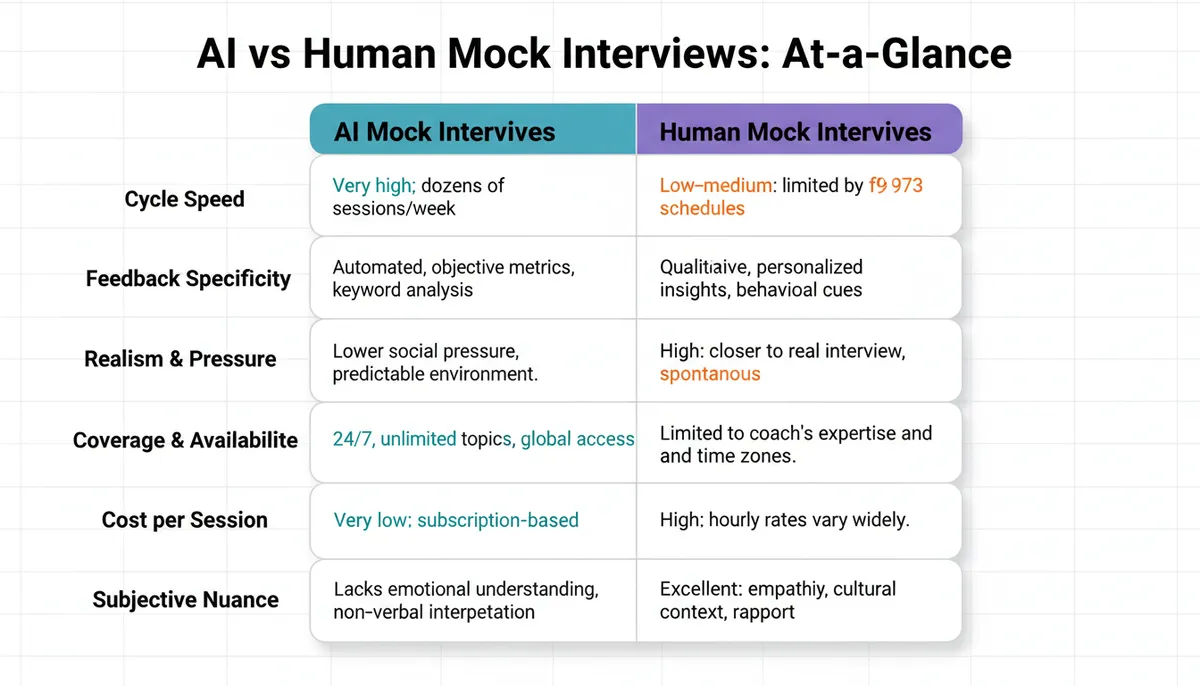
Summary table
| Dimension | AI Mock Interviews | Human Mock Interviews |
|---|---|---|
| Cycle speed | Very high; on-demand, 24/7 | Low–medium; limited by schedules and availability |
| Feedback specificity | High on code, patterns, structure | High on behavior, nuance, company expectations |
| Realism & pressure | Moderate; lower social pressure | High; closer to real interview dynamics |
| Coverage & availability | Broad; can simulate many roles and levels | Narrow; depends on interviewer’s experience |
| Cost per session | Very low marginal cost | High; each session consumes human time |
| Subjective nuance | Limited; approximated via heuristics | Strong; lived experience and subtle judgment |
Named tools, not just categories
“Human mock interview” usually means one of a small number of actual products. Here’s the same comparison with names and prices attached, using only what each provider states publicly.
| Dimension | Thita AI Mock Interview | Exponent (formerly Pramp) — live peer | interviewing.io — live expert |
|---|---|---|---|
| Format | AI-led, voice interviewer, adaptive follow-ups | Live peer-to-peer video, roles rotate mid-session | Live, anonymous, senior/staff/principal engineers |
| Code execution | Yes, 6 languages | Yes, built-in collaborative editor | Yes, via CoderPad |
| Round types | DSA, System Design, LLD, Machine Coding, Behavioral, PM, Data Science/AI | DSA, System Design, Behavioral, PM, Data Science, Frontend | DSA, System Design, ML, Frontend, EM, Behavioral |
| Feedback | Instant, written, per question | Verbal from your peer partner | Written, from the interviewer, after the session |
| Price | Free Starter forever; Pro USD 14.99/mo; Elite USD 29.99/mo | Free with monthly credits; paid membership for unlimited + AI transcripts | AI interviewer free; live expert sessions start at USD 179/session |
| Free tier | Yes | Yes | Yes, for the AI interviewer only |
Sources, checked 2026-09-07: tryexponent.com/practice; interviewing.io and interviewing.io/faq ("Interviews start at USD 179"). Thita figures from productFacts.ts and lib/geo.ts.
Where AI mock interviews help you improve faster
For most candidates, AI gives faster improvement in the early and mid stages of prep, where volume and pattern recognition matter most.
1. Building DSA and coding fundamentals
When you’re still making basic mistakes like:
- Forgetting to handle empty input
- Writing O(n²) where O(n) is possible
- Mixing off-by-one indices
- Not checking null pointers or boundary conditions
You benefit most from:
- High-volume, low-stakes practice
- Immediate feedback on correctness and complexity
- Exposure to a wide range of DSA patterns
An AI mock interview can:
- Quickly diagnose that you don’t yet recognize common patterns (e.g., Sliding Window, Binary Search on answer, BFS/DFS variations)
- Recommend targeted practice on specific patterns
- Give structured hints that guide you from brute force → optimized approach
This is essentially compiling your mental library of solutions. A human can do this too, but it’s an inefficient use of a senior engineer’s time.
2. Practicing communication structure
You can use AI to drill:
- How you start a coding question:
- Restating the problem
- Asking clarifying questions
- Identifying constraints and edge cases
- How you explain your approach:
- High-level idea first
- Trade-offs between approaches
- Time and space complexity
- How you think aloud while coding
Because AI can be programmed with a rubric, it can:
- Flag when you skip clarifications
- Ask, “What’s the time complexity of your approach?”
- Push you: “Can you find a more space-efficient solution?”
Doing this 20–30 times with AI makes these behaviors automatic, so you don’t burn cognitive energy on them in a real interview.
3. Behavioral and situational drills
For behavioral interviews, AI can:
- Ask standard questions: “Tell me about a time you disagreed with a teammate.”
- Enforce frameworks like STAR (Situation, Task, Action, Result)
- Point out missing elements: “You didn’t clearly state the Result.”
While AI can’t fully judge authenticity or culture fit, it’s excellent for:
- Rehearsing your stories until they are concise and structured
- Stress-testing your examples against variations: “What would you do differently?” “What was the hardest trade-off?”
You improve faster because you can iterate on each story multiple times in one session.
Where human mock interviews help you improve faster
Humans become more valuable as you approach your final prep phase and need to close the gap between “good in practice” and “strong in the real room.”
1. Calibrating against real hiring standards
An experienced interviewer can:
- Tell you whether your performance would be a hire, strong hire, or no hire at specific companies
- Explain how bar differs between teams or levels (e.g., L4 vs L5)
- Provide company-specific guidance:
- “At Company X, they expect you to drive the problem more independently.”
- “At Company Y, they care a lot about test coverage and edge cases.”
This kind of calibration is essential in the last 2–3 weeks before interviews.
2. Training under real social pressure
Human mock interviews are:
- Harder to schedule
- More expensive
- More stressful
That’s exactly why they’re valuable:
- You learn how your nerves affect your performance
- You practice recovery strategies when you get stuck
- You experience awkward silences, misunderstandings, and interruptions
These sessions surface issues you may not see with AI, like:
- Speaking too fast when nervous
- Becoming defensive when corrected
- Freezing when asked an unexpected follow-up
3. Getting nuanced meta-feedback
A good human interviewer might say:
- “You’re over-optimizing prematurely; focus more on a working solution first.”
- “Your explanations are technically correct but too abstract; add concrete examples.”
- “You seem uncomfortable asking clarifying questions; that’s a red flag in collaborative environments.”
These are meta-level patterns about your behavior, not your code. AI can approximate some of this, but humans still have the edge in reading how you come across.
How to combine AI and human mock interviews for maximum improvement
The fastest improvement typically comes from a hybrid strategy that uses each tool where it’s strongest.
Phase 1: Foundation (2–4 weeks, depending on your baseline)
Goals:
- Refresh core DSA patterns and problem-solving
- Build muscle memory for interview structure
- Identify major weaknesses
Recommended approach:
- 80–100% AI mock interviews
- Focus on:
- Coding questions across key patterns (arrays, trees, graphs, DP, etc.)
- Behavioral question structure drills
- Track:
- Patterns where you consistently struggle
- Typical time to first working solution
- Common feedback themes (e.g., “forgets edge cases”, “weak complexity analysis”)
This is where a pattern-based AI coach (like Thita.ai’s AI Tools for Interview Preparation: Benefits and Pitfalls) is particularly effective, because it can map your performance to specific DSA categories and suggest targeted practice.
Phase 2: Simulation & refinement (1–3 weeks before interviews)
Goals:
- Simulate real interviews
- Fix remaining gaps in communication and behavior
- Calibrate against actual hiring standards
Recommended approach:
- 60–70% AI mock interviews, 30–40% human mock interviews
- Use AI for:
- Daily coding reps
- System design variations
- Behavioral story refinement
- Use humans for:
- 3–6 full-length mock interviews (coding + behavioral)
- Company- or level-specific calibration
- Meta-feedback on style and demeanor
You improve faster here by:
- Using AI to quickly implement feedback you got from humans
- Running targeted drills on weaknesses identified in human sessions
Common pitfalls with AI mock interviews (and how to avoid them)
Pitfall 1: Overfitting to the AI’s style
If you always practice with one AI system:
- You may get used to its question phrasing and hint style
- You might unconsciously rely on patterns of help that won’t exist in a real interview
How to avoid:
- Occasionally disable hints or ask the AI to be “strict and minimal.”
- Practice with different prompt styles: “Act as a skeptical senior engineer,” “Act as a quiet interviewer who only answers direct questions.”
- Mix in human mocks to expose yourself to different personalities.
Pitfall 2: Treating AI feedback as infallible
LLMs can:
- Misjudge edge cases
- Overlook subtle bugs in complex code
- Provide plausible but incorrect complexity analysis
How to avoid:
- Always self-verify complexity and correctness.
- When feedback seems off, ask the AI to:
- Show specific counterexamples
- Walk through the code step-by-step on sample inputs
- Use AI as a collaborator, not an oracle.
Pitfall 3: Ignoring psychological factors
AI practice is comfortable:
- No fear of judgment
- You can restart anytime
- You can edit your responses
If you only do AI mocks, you may be underprepared for:
- Anxiety spikes in real interviews
- Dealing with abrupt or unfriendly interviewers
- Recovering from early mistakes in a session
How to avoid:
- Occasionally simulate pressure:
- Timebox yourself strictly
- Do a session in one take without editing
- Ask the AI to be “critical and terse”
- Still schedule some human mocks before real interviews.
Common pitfalls with human mock interviews
Pitfall 1: Low sample size, over-weighting one opinion
If you only do 1–2 human mocks:
- You might overreact to one interviewer’s bias
- You may misinterpret feedback as universal
How to avoid:
- Treat each human mock as one data point, not the whole truth.
- Look for patterns across multiple sessions:
- “Three different interviewers said I talk too fast.”
- “Everyone said my code quality is solid but I need better trade-off discussions.”
Pitfall 2: Using humans for what AI could do cheaper and faster
If you’re still:
- Forgetting basic syntax
- Struggling with standard LeetCode mediums
- Unfamiliar with common patterns
Then using a senior engineer’s time to correct these is inefficient.
How to avoid:
- Use AI for baseline skill building and pattern recognition.
- Save humans for higher-level calibration and nuance once fundamentals are solid.
Best practices: designing your interview practice loop
Think like an engineer designing a learning system:
1. Instrument your practice
Track at least:
- Number of coding problems per week
- Distribution across DSA patterns
- Average time to solution
- Types of mistakes:
- Implementation bugs
- Wrong complexity
- Misidentified pattern
- Communication gaps
AI tools can help auto-log this; if not, keep a simple spreadsheet.
2. Use deliberate practice, not just volume
For each mock (AI or human):
- Attempt the question under realistic constraints.
- Get feedback.
- Summarize your key mistake in your own words.
- Do a targeted follow-up drill:
- If you misused Sliding Window, do 2–3 more Sliding Window problems.
- If you skipped clarifying questions, do a 5-minute “start-of-interview” drill.
AI is particularly good at step 4: you can ask it for “three more problems of the same pattern but slightly varied.”
3. Separate “learning mode” from “exam mode”
- Learning mode:
- Pause to ask questions
- Accept hints
- Take your time to deeply understand patterns
- Exam mode:
- No hints
- Strict time limits
- One take
Use AI to switch between these modes explicitly. Human mocks should mostly be exam mode.
Example: A 3-week hybrid plan for a mid-level engineer
Assume:
- You have 3 weeks before interviews
- You’re comfortable with basic DSA but rusty on edge cases and communication
Week 1: Diagnostic and fundamentals
- 5 AI coding mocks (45–60 min each)
- 3 AI behavioral sessions (30 min each)
- After each session:
- Log patterns and mistakes
- Ask AI for 1–2 follow-up drills on weak patterns
Week 2: Pattern mastery and structure
- 5–7 AI coding drills focused on weak patterns
- 2 AI system design practice sessions
- 1–2 human mocks (coding + light behavioral)
- After human mocks:
- Write down meta-feedback (communication, pace, confidence)
- Ask AI to help design drills targeting those issues
Week 3: Simulation and polish
- 3–4 AI full-length mocks (coding + behavioral)
- 2–3 human mocks (ideally with experienced interviewers)
- Focus:
- Timeboxing
- Managing nerves
- Clear communication and trade-off discussions
This structure exploits AI’s volume and responsiveness while using human time for high-leverage calibration.
Visualizing the feedback loop
Key takeaways
-
Improvement speed = feedback cycle speed × feedback quality × realism.
-
AI mock interviews are better for:
- High-volume practice
- DSA pattern recognition and coding fundamentals
- Structured communication drills
- Rapid iteration on behavioral stories
-
Human mock interviews are better for:
- Simulating real social pressure and ambiguity
- Company- and level-specific calibration
- Nuanced feedback on communication style and behavior
-
The fastest path is usually a hybrid:
- Use AI heavily in early/mid prep to build skills and patterns.
- Use humans in late prep to calibrate and practice under realistic pressure.
- Use AI between human sessions to quickly implement and reinforce feedback.
If you treat your interview prep like an engineering problem—optimizing feedback loops, using the right tools for each layer of the stack—you’ll not only improve faster, you’ll understand why you’re improving. That understanding tends to stick with you long after the interviews are over.