
AI
AI Mock Interviews vs Real Interviews: Do They Actually Help?
Most engineers know they *should* practice interviews. The harder question is *how*: live mock interviews with friends? Paid coaching? Or AI mock interviews ...
Most engineers know they should practice interviews. The harder question is how: live mock interviews with friends? Paid coaching? Or AI mock interviews that promise unlimited practice on demand?
As AI interview simulators and technical interview practice tools get better, a natural skepticism appears: Do AI mock interviews actually help with real interviews, or are they just a safe sandbox that doesn’t transfer to the real thing?
This post takes a practical, engineering-style look at that question. We’ll break down what AI mock interviews do well, where they fall short, and how to integrate them into a serious technical interview prep plan—especially for coding and system design interviews.
We’ll focus on AI mock interviews as they exist today: not science fiction, but real systems like Thita.ai’s AI interviewer, LeetCode-style bots, and in-house tools teams sometimes build for training.
What Is an AI Mock Interview, Really?
When people say ai mock interviews or mock interview ai, they usually mean:
- An interactive interview simulator (chat or voice) that:
- Asks you coding, system design, or behavioral questions
- Lets you respond in natural language and/or code
- Gives real-time feedback (hints, complexity checks, edge cases)
- Evaluates your performance and suggests improvements
Under the hood, a typical AI interviewer combines:
-
Question engine
- Curated question bank (e.g., “Top K Elements”, “LRU Cache”, “Design Twitter”)
- Pattern-based selection (e.g., from a 94 DSA pattern library)
- Difficulty progression (easy → medium → hard)
-
LLM-based interviewer
- Parses your answers (code + explanation)
- Asks follow-up questions (“What’s the complexity?”, “How would you handle scale?”)
- Simulates interviewer styles (supportive, neutral, skeptical)
-
Evaluation and feedback engine
- Checks correctness (tests, edge cases)
- Assesses communication, structure, and clarity
- Maps your solution to patterns (e.g., sliding window, binary search on answer)
-
Analytics and coaching layer
- Tracks weak areas (e.g., graph problems, concurrency)
- Suggests next problems or patterns to review
- Generates summaries and improvement plans
You can think of it as a state machine: question → candidate response → AI critique → candidate revision → final evaluation.
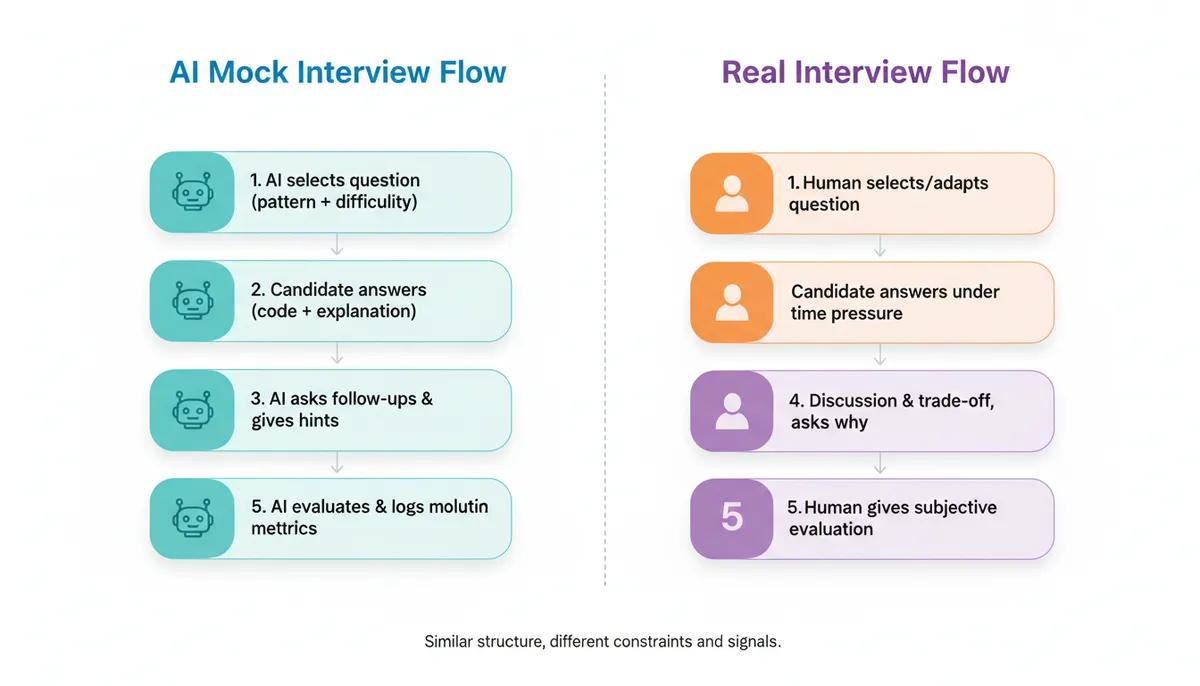
How Close Are AI Mock Interviews to Real Interviews?
To answer “Do they help?”, we first need to ask “How close is the simulation to reality?”
Let’s look at the main dimensions of a technical interview:
- Problem selection
- Time pressure
- Interviewer behavior
- Evaluation criteria
- Psychological factors
1. Problem Selection
AI mock interviews:
- Can systematically cover:
- DSA patterns (e.g., two pointers, BFS, DP on trees)
- Difficulty levels
- Topic coverage (arrays, graphs, concurrency, systems)
- Rarely “go off script” to improvise mid-question
Real interviews:
- Vary by company/team:
- Some stick to classic patterns
- Others ask domain-specific or hybrid questions
- Interviewers may:
- Change the problem mid-way
- Add constraints (“Now make it distributed”)
Gap: AI is excellent at structured coverage, weaker at the “quirky” or idiosyncratic questions some humans ask. But for most FAANG-style DSA and system design, the overlap is high.
2. Time Pressure and Constraints
AI mock interviews:
- Can enforce timers (e.g., 35–45 minutes)
- Can simulate:
- “You have 10 minutes left” warnings
- Hard cutoffs on coding time
- But you know you can always retry without consequences
Real interviews:
- One shot per round
- Higher stakes: job offer, visa, comp, etc.
- Social pressure: someone is watching you code
Gap: Time pressure can be approximated; psychological pressure can’t be fully replicated. But repeated timed practice does reduce your baseline anxiety.
3. Interviewer Behavior and Follow-Ups
AI mock interviews:
- Can simulate:
- Clarifying questions
- “Why this approach?” probes
- Complexity and trade-off questions
- Can be consistent: same question → same evaluation logic
Real interviews:
- Highly variable:
- Some interviewers are helpful; others are terse
- Some guide you; others sit silently
- Follow-ups are often based on subtle cues:
- Your confidence level
- Your past experience
- Time remaining
Gap: AI is getting better at dynamic follow-ups, but can still miss nuance: when to push, when to let you think, when to change direction.
4. Evaluation Criteria
AI mock interviews:
- Can explicitly score:
- Correctness
- Time/space complexity
- Code quality
- Communication structure
- Can map your approach to known patterns, e.g., “You used sliding window but missed edge case X”
Real interviews:
- Evaluate:
- Technical depth
- Problem-solving approach
- Communication and collaboration
- Culture/team fit
- Signal from your resume/background
- Scoring is noisy and subjective
Gap: AI captures the explicit criteria very well. It struggles with the implicit, human aspects (team fit, subtle communication cues).
5. Psychological Factors
AI mock interviews:
- Low stakes → easier to experiment and learn
- Good for:
- Building muscle memory
- Trying new strategies
- Failing fast and often
Real interviews:
- High stakes → affects:
- Cognitive load
- Risk tolerance
- Communication clarity
- Performance is affected by:
- Sleep, stress, prior rounds
Gap: AI can’t reproduce the stakes, but it can train you so that under stress, more of your behavior is automatic.
AI mock interview vs. the other practice formats
Putting a real number on “how close” means comparing what each practice format actually gives you, not just the real interview.
| Dimension | Real Company Interview | Thita AI Mock Interview | Live Peer Mock (Exponent, formerly Pramp) | Self-Paced Practice (LeetCode) |
|---|---|---|---|---|
| Format | Live, one interviewer, unscripted | AI-led, adaptive follow-up questions | Live, peer-to-peer, scheduled 30–45 min | Solo, timed problem sets |
| Live voice | Yes | Yes — voice interviewer | Yes (video/audio) | No |
| Code execution | Interviewer’s own tooling | Yes, 6 languages (Python, C++, Java, JavaScript, Go, C#) | Yes, shared code editor | Yes, LeetCode’s own judge |
| Feedback type | Verbal in the moment, sometimes written later | Instant written report per question (correctness, complexity, code quality, communication) | Verbal from a peer; quality depends on who you’re matched with | Automated pass/fail; a Premium “mock interview” mode adds a timer but not a live evaluator |
| Round types covered | Whatever the company assigns | DSA, System Design, LLD, Machine Coding, Behavioral, PM, Data Science/AI, resume-based | DSA, System Design, Behavioral, PM, Data Science, Frontend | DSA only |
| Price | — (the real thing) | Free Starter plan forever; Pro USD 14.99/mo (USD 75/yr); Elite USD 29.99/mo (USD 120/yr) | Free with monthly credits; paid membership for unlimited sessions + AI transcripts | Premium USD 35/mo or USD 159/yr |
| Free tier | — | Yes | Yes | Free problems; mock-interview mode needs Premium |
Sources, checked 2026-09-07: tryexponent.com/practice (Pramp redirects here — "As of July 2024, all new Pramp sessions are hosted on Exponent Practice"); LeetCode Premium price and mock-interview-mode description from codeswiftr.com's 2026 review (leetcode.com blocks automated page fetches, so pricing is confirmed via this third-party review rather than the primary page). Thita figures from productFacts.ts and lib/geo.ts.
Where AI Mock Interviews Excel (and Why They Work)
AI mock interviews are not a replacement for all forms of practice, but they are extremely good at certain things that humans are bad at doing consistently.
1. Volume and Repetition
Humans get tired. AI doesn’t.
- You can run:
- 3–5 coding interviews per day
- Targeted sessions on one pattern (e.g., binary search variants)
- Repeated practice on your weak topics
This matters because interview performance is a skill, not just knowledge. Like leetcode grinding, but interactive.
Example:
You struggle with graph problems. With an AI interviewer, you can:
- Do 10 graph problems in a row
- Get immediate pattern-level feedback:
- “You consistently miss cycle detection”
- “You default to DFS where BFS is simpler”
- See improvement metrics over a week
2. Pattern Recognition and Mapping
Modern platforms (including Thita.ai) use pattern-based learning:
- Each question maps to one or more patterns:
- Sliding window
- K-way merge
- Topological sort
- DP on subsets
- The AI can:
- Detect which pattern you’re using
- Suggest a better-suited pattern if you’re off track
- Recommend patterns to review (e.g., via a DSA patterns sheet)
Over time, you build an internal mapping:
Problem description → underlying pattern(s) → standard solution shapes
That’s exactly what strong interviewers do mentally.
3. Immediate, Specific Feedback
Good feedback is:
- Timely – right after you attempt
- Specific – pointing to concrete behaviors
- Actionable – telling you what to change
AI mock interviews can do this reliably:
- “You jumped into coding without clarifying constraints.”
- “You didn’t ask about input size; your solution is O(n²).”
- “You didn’t test for empty input or single-element arrays.”
- “Your explanation skipped trade-offs vs alternative approaches.”
Humans can give this feedback, but often don’t have the time or structure.
4. Safe Environment to Practice Communication
Many engineers underestimate how much interview performance is about how you talk through your solution:
- Do you restate the problem?
- Do you propose a plan before coding?
- Do you narrate your thought process?
- Do you handle hints gracefully?
An AI interviewer can:
- Prompt you to explain your reasoning
- Nudge you if you’re silent for too long
- Flag when your explanation is unclear or incomplete
Over many sessions, this becomes muscle memory—so in real interviews, you default to structured communication instead of freezing.
Where AI Mock Interviews Fall Short
AI mock interviews are powerful, but they’re not magic. Understanding their limitations helps you design a better prep strategy.
1. Human Dynamics and Soft Signals
Real interviews involve:
- Reading the interviewer’s body language
- Adapting to their style:
- Collaborative vs adversarial
- Talkative vs quiet
- Handling:
- Interruptions
- Whiteboard or shared doc constraints
- Awkward silences
AI can simulate some of this in text or voice, but:
- It won’t sigh, look bored, or glance at the clock
- It won’t misconfigure the coding environment
- It won’t be unfair or distracted
You still need at least a few real human mocks (friends, colleagues, or platforms) to train these muscles.
2. Behavioral and Culture-Fit Nuance
Behavioral interviews are about:
- Storytelling (STAR: Situation, Task, Action, Result)
- Self-awareness and reflection
- Alignment with company values
AI can:
- Help you structure answers
- Identify missing elements (no clear result, no metrics)
- Suggest follow-up questions an interviewer might ask
But it can’t fully:
- Judge authenticity
- React emotionally
- Evaluate subtle interpersonal cues
Use AI to draft and refine your stories, then practice them with humans to tune tone and delivery.
3. Overfitting to the Simulator
If you only practice with one AI interviewer:
- You may learn to game its patterns:
- Saying the “right buzzwords”
- Over-optimizing for its scoring rubric
- You might get used to:
- Certain hint styles
- Certain question distributions
Real interviewers will not match that exact style.
Mitigation:
- Use multiple tools/styles if possible
- Mix in:
- Solo practice (no feedback)
- Human mock interviews
- Past real interviews as “data”
How to Use AI Mock Interviews Effectively (Step-by-Step)
Here’s a practical plan to integrate AI mock interviews into your prep.
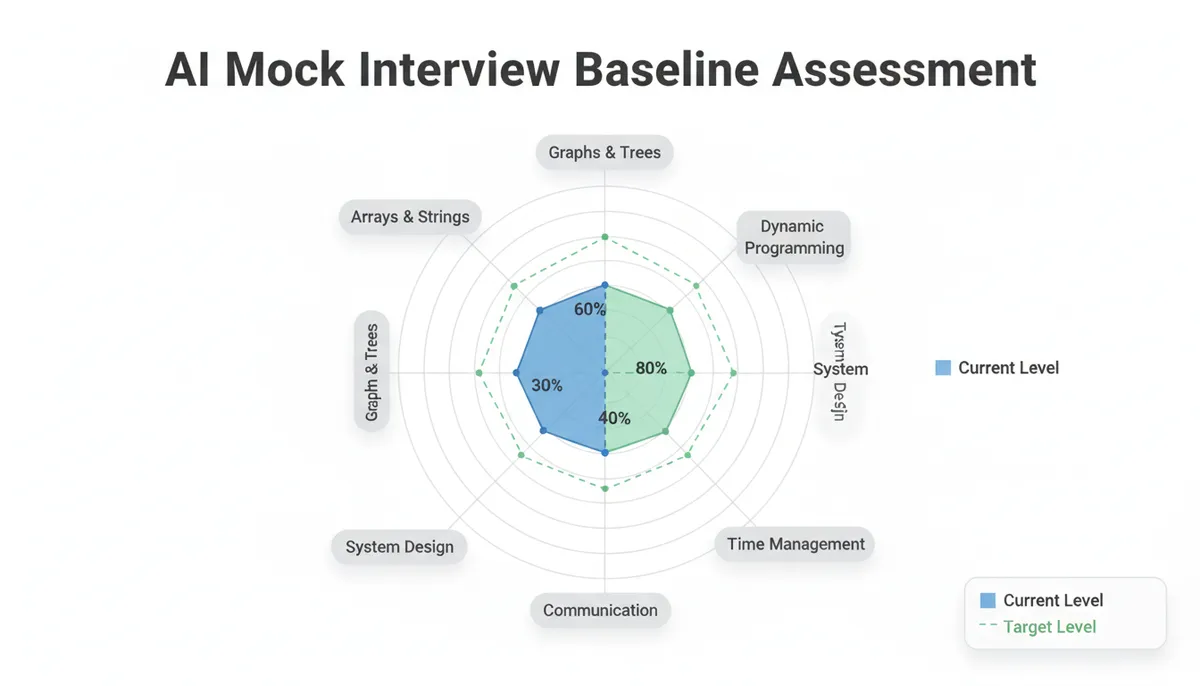
Step 1: Baseline Assessment
Before grinding, you need a baseline.
- Take 1–2 full-length AI mock interviews:
- 45–60 minutes each
- Mix of DSA and system design if relevant
- Don’t optimize; just perform as you would today.
- After each session, analyze:
- Which patterns did you struggle with?
- Did you run out of time?
- Did you ask clarifying questions?
- Did you handle edge cases?
Use this to build a profile of weaknesses.
Step 2: Targeted Pattern Practice
Once you know your weak areas, use AI mocks in focused mode:
- Pick 1–2 patterns for a week (e.g., “Binary Search on Answer”, “Topological Sort”)
- Run short, 30-minute AI sessions focusing only on those
- After each session:
- Summarize what you learned
- Note recurring mistakes
If your platform supports it, tie this to a pattern sheet (e.g., Thita’s DSA patterns sheet) to systematically cover the space.
Step 3: Full-Length Simulations Under Constraints
As you get closer to real interviews:
- Schedule full-length AI interviews:
- Same duration as your target company’s rounds
- Same format (coding, design, behavioral)
- Enforce constraints:
- No pausing the timer
- No external resources
- Use the same environment (IDE, whiteboard, collaborative doc)
After each session, do a post-mortem:
- What went well?
- Where did you lose time?
- Where did you need hints?
- Did you communicate clearly?
Treat each session like a deploy: run → observe → adjust.
Step 4: Mix in Human Mocks
AI is great for volume. But before real interviews, add:
- 2–5 human mock interviews:
- Friends, colleagues, or structured services
- Preferably with people who’ve recently interviewed at similar companies
- Focus on:
- Handling interruptions
- Dealing with different interviewer personalities
- Real-time collaboration on ambiguous problems
Use AI mocks to fix issues identified in human mocks. Example:
- If a human interviewer says:
- “You didn’t ask enough clarifying questions.”
- Then in your next AI session:
- Force yourself to ask 3–5 clarifying questions before coding
- Ask the AI interviewer if your assumptions are reasonable
Step 5: Behavioral and Story Practice
For behavioral interviews:
- Use AI to:
- Generate likely questions (e.g., “Tell me about a time you disagreed with a teammate.”)
- Evaluate your STAR structure
- Suggest missing metrics or outcomes
- Iterate on your stories until:
- They’re concise (2–3 minutes each)
- They have clear conflict and resolution
- They highlight the skills your target role values
Then, practice out loud with humans to tune tone and authenticity.
Concrete Example: Coding Interview With AI vs Real
Let’s walk through a simplified example.
Scenario
Question: “Given an array of integers and a target, return indices of the two numbers such that they add up to the target.”
With AI Mock Interview
- AI asks the question.
- You restate the problem and ask:
- “Can there be negative numbers?”
- “Can there be multiple solutions?”
- “What should I return if no solution exists?”
- You propose:
- Brute force O(n²)
- Optimized hash map O(n)
- You code the hash map solution:
PYTHON
- AI runs tests, then says:
- “Correct. Time complexity: O(n), space: O(n).”
- “You did not discuss potential collisions in the hash map, but in Python dict this is abstracted.”
- “You could also discuss edge cases: empty array, single element.”
- You adjust your explanation accordingly.
In a Real Interview
A human interviewer might:
- Ask follow-ups:
- “What if the array is sorted?”
- “How would you handle streaming input?”
- Judge your communication:
- Did you jump straight into coding?
- Did you check for off-by-one errors?
- React to your behavior:
- If you get stuck, do you ask for hints?
- Do you remain calm?
Transfer: The core skills you practiced with AI—clarifying requirements, proposing multiple approaches, coding cleanly, analyzing complexity—map directly to this real scenario. The extra layer is human dynamics and stress.
Common Mistakes When Using AI Mock Interviews
Engineers often misuse AI interview simulators in ways that reduce their effectiveness.
Mistake 1: Treating AI Mocks as LeetCode With Commentary
If you:
- Ignore time limits
- Rely heavily on hints
- Don’t reflect after each session
…you’re just doing slightly fancier problem-solving, not interview practice.
Fix: Treat each AI session as a real interview:
- Time-box it
- Limit hints
- Do a structured retro afterward
Mistake 2: Chasing Scores Instead of Skills
Many tools give you a numeric score. It’s tempting to:
- Optimize for the score
- Memorize patterns that “please” the AI
Fix: Focus on specific skill improvements:
- “I want to get better at:
- Clarifying questions
- Time management
- Handling graph problems”
Use the AI’s feedback to track these, not just a composite score.
Mistake 3: Ignoring Behavioral Practice
Some candidates over-index on coding and neglect:
- Behavioral questions
- System design discussions
- Communication under ambiguity
Fix: Dedicate specific AI sessions to:
- Behavioral-only interviews
- System design walkthroughs
- Explaining trade-offs verbally
Mistake 4: Not Bridging to Real Human Interactions
If you never:
- Practice on a whiteboard
- Share your screen with another person
- Deal with awkward pauses
…you might be surprised in the real thing.
Fix: Use AI for 80–90% of volume, but ensure you:
- Do at least a few human mocks
- Simulate the exact environment of your target interviews
Best Practices for Getting Maximum Value From AI Mock Interviews
To make AI mock interviews truly help with real interviews, treat them like a training loop you’d build for any complex system.
1. Define Clear Objectives Per Session
Before starting a session, write down:
- Primary goal:
- “Practice graph traversal under time pressure”
- “Focus on communication and clarifying questions”
- “Refine behavioral stories about conflict resolution”
- Secondary goal:
- “Reduce reliance on hints”
- “Finish within 35 minutes”
After the session, check whether you met those goals.
2. Limit Hints and Auto-Completion
If the tool offers:
- Step-by-step hints
- Code auto-completion
- Partial solutions
Use them sparingly:
- First attempt: no hints
- Second attempt (if stuck): one hint
- Only after the session: review full solution
You’re training for a context where no one will rescue you mid-interview.
3. Keep a Learning Log
Maintain a lightweight log (notebook, doc, or tool):
- Session date, type (coding/design/behavioral)
- Questions/topics covered
- 2–3 things you did well
- 2–3 things to improve
- Concrete next steps (e.g., “Review BFS vs DFS trade-offs”)
Over time, you’ll see patterns in your own behavior.
4. Vary Difficulty and Domains
Don’t just practice medium DSA questions. Include:
- Easy questions:
- To warm up
- To practice communication and speed
- Hard questions:
- To push your problem-solving under uncertainty
- System design and behavioral:
- To simulate full interview loops
5. Periodically Benchmark With Real Humans
Every 1–2 weeks:
- Do a human mock interview
- Compare:
- How you felt vs AI sessions
- What feedback you got
- Adjust your AI practice plan accordingly
How AI Mock Interviews Fit Into a Complete Prep Plan
A robust technical interview prep strategy typically combines:
-
Fundamentals
- Data structures and algorithms
- System design basics
- Language-specific nuances
-
Pattern-Based Practice
- Using resources like Thita’s 94 DSA patterns
- Solving representative problems per pattern
-
AI Mock Interviews
- High-volume, structured, feedback-rich practice
- Both coding and behavioral/system design
-
Human Mock Interviews
- Final-stage simulation of real dynamics
- Feedback on soft skills and presence
-
Real Interviews as Feedback Loops
- Each real interview → retro
- Feed insights back into AI/human practice
AI mock interviews are most effective when used as the central practice engine (step 3), surrounded by fundamentals, human practice, and real-world feedback.
If you’re using a platform like Thita.ai that integrates:
- Pattern-based question selection
- AI mock interviews
- Real-time feedback and analytics
- Optional human-like interview flows (/ai-interview, /ai-coach)
…you can keep most of this loop in one place, then supplement with a few external human mocks. For a broader view on how AI is transforming technical interviews, see How AI Is Changing Technical Interviews in 2026.
Key Takeaways: Do AI Mock Interviews Actually Help?
Summarizing the evidence and reasoning:
-
Yes, AI mock interviews help significantly with:
- Pattern recognition and problem selection
- Coding speed and correctness under time constraints
- Structured communication and explanation
- Building confidence through repetition
-
They do not fully replace:
- Human dynamics and interpersonal nuance
- Behavioral and culture-fit evaluation
- The psychological stress of high-stakes interviews
-
They work best when you:
- Use them deliberately (clear goals, constraints, retros)
- Combine them with fundamentals and human mocks
- Avoid overfitting to one simulator’s style or scoring
If you want to understand common pitfalls, check out Common Mistakes When Using AI for Interview Preparation.
If you treat AI mock interviews as a serious training tool—not just another way to grind problems—they can be one of the highest-leverage components of your interview preparation, especially for technical roles where pattern-based problem solving is central.
The core idea is simple: use AI to automate the repetitive, structured parts of practice so that when you walk into a real interview, your brain is free to handle the one thing AI can’t simulate perfectly yet—the human on the other side of the table. For a detailed comparison of AI and human mock interviews, see AI vs Human Mock Interviews: Which One Improves Faster?.