
AI
How AI Is Changing Technical Interviews in 2026
If you’ve done a technical interview recently, you’ve probably noticed it already: the questions may look familiar, but the experience feels different. Codin...
If you’ve done a technical interview recently, you’ve probably noticed it already: the questions may look familiar, but the experience feels different. Coding environments flag edge cases as you type. Follow-up questions adapt in real time to your approach. Feedback is instant and oddly specific. This isn’t just better tooling—it’s the growing impact of AI in interviews.
In 2026, AI technical interviews are no longer an experiment at a few big tech companies; they’re steadily becoming the default. That shift is changing what gets evaluated, how it’s measured, and how candidates should prepare.
This post walks through how AI is reshaping the future of coding interviews, what’s actually happening under the hood, and how you can adapt your preparation strategy accordingly.
Why AI in Interviews Is Inevitable
Traditional technical interviews have well-known problems:
- They’re noisy: performance varies with interviewer, mood, and time of day.
- They’re expensive: senior engineers spend hours interviewing instead of building.
- They’re narrow: a couple of 45-minute sessions can’t fully capture a candidate’s capabilities.
- They’re biased: unconscious bias creeps into interpersonal evaluation.
AI systems are particularly good at three things that map directly onto these problems:
- Standardization – consistent scoring across candidates and time.
- Scalability – ability to run thousands of interviews in parallel.
- Fine-grained telemetry – detailed logs of what actually happened during problem solving.
As a result, AI technical interviews are not just about automating questions; they’re about instrumenting the entire problem-solving process.
The New Pipeline: How AI Technical Interviews Actually Work
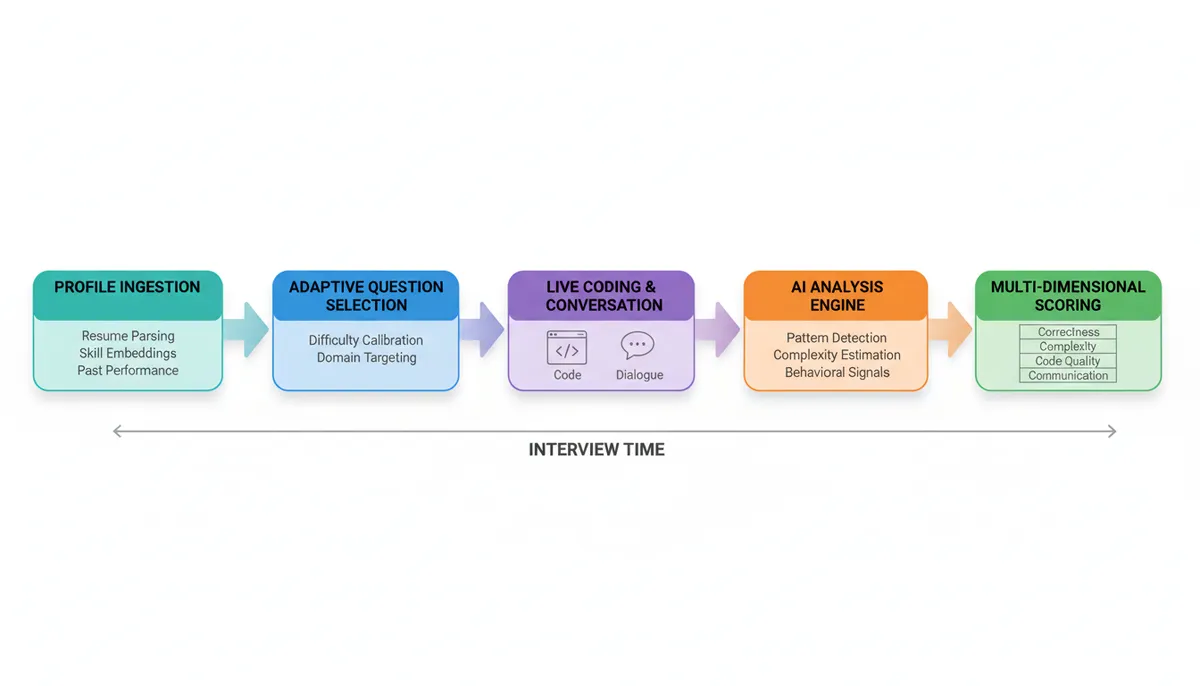
Most AI-driven interview platforms in 2026 follow a similar high-level pipeline.
1. Candidate Modeling Before the Interview
Before you write a single line of code, AI systems often build an initial model of your profile:
- Resume parsing and embedding (skills, experience, tech stack).
- Public signals (GitHub, publications, open-source contributions).
- Historical performance (if you’ve interviewed or practiced on the platform before).
This profile helps the system:
- Choose an appropriate difficulty range.
- Select relevant domains (e.g., systems, ML, frontend).
- Predict where you might struggle and plan targeted follow-up questions.
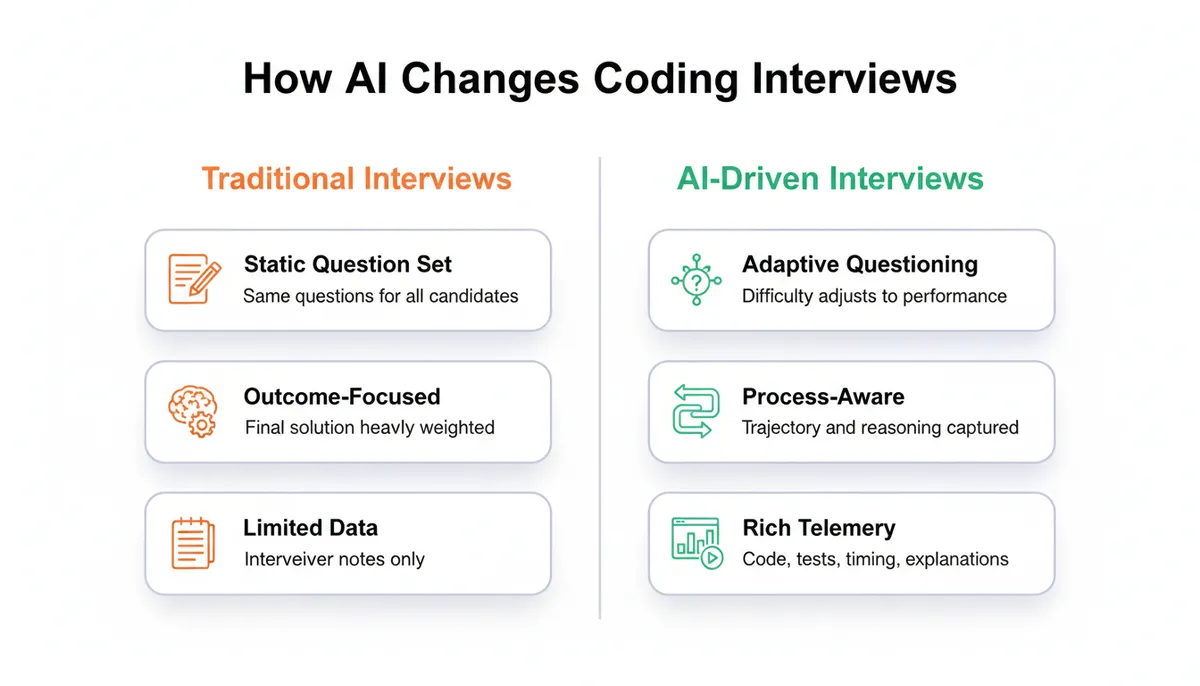
Implication: “One-size-fits-all” question sets are being replaced by personalized interview paths.
2. Adaptive Question Selection
Instead of a fixed question list, AI systems use adaptive selection:
- Start with a “calibration” question (medium difficulty, common pattern).
- Observe:
- Time to first compile.
- Error frequency.
- How you break down the problem (comments, helper functions, tests).
- Adjust subsequent questions:
- If you breeze through: increase difficulty or add complexity (e.g., from arrays to graphs, from single-threaded to concurrent).
- If you struggle: shift to simpler variants or probe fundamentals.
This is similar to how adaptive testing works in standardized exams, but with a richer signal: code, reasoning, and interaction.
3. Real-Time Code Understanding
Modern AI interview systems don’t just run your code; they interpret it.
They can:
- Parse your program structure (functions, classes, control flow).
- Infer the algorithmic pattern (e.g., sliding window, binary search, BFS).
- Generate and run hidden test cases targeted to your approach.
- Detect common pitfalls (off-by-one errors, missing edge cases, incorrect complexity).
Underneath, this usually involves:
- A language model (LLM) specialized on code.
- Static analysis (control-flow graphs, data-flow analysis).
- Dynamic analysis (instrumented execution with test inputs).
This is where platforms like Thita.ai can map your solution to one of 94 DSA patterns and provide pattern-level feedback, not just “passed/failed.”
4. Conversational AI as the “Interviewer”
A major change in 2026: AI is now often the primary interviewer, not just the grader.
The AI interviewer can:
- Ask clarifying questions (“What’s the time complexity of your approach?”).
- Nudge you when stuck (“Have you considered using a heap instead of sorting each time?”).
- Simulate behavioral questions and follow-ups.
- Request design extensions (“How would you handle 10x more data?”).
The quality of this interaction depends on:
- The underlying LLM.
- Fine-tuning on real interview transcripts.
- Guardrails to avoid leaking hints or being inconsistent.
Key Ways AI Is Changing What Gets Evaluated
1. From “Did You Solve It?” to “How Did You Solve It?”
Traditional interviews heavily weight the final outcome:
- Did you get to a working solution in 45 minutes?
- Did you hit all the required edge cases?
AI technical interviews can measure the trajectory:
- How quickly did you understand the problem?
- Did you start with a brute-force approach and then optimize?
- Did you refactor once the solution worked?
- How did your solution evolve across iterations?
This leads to richer evaluation dimensions:
- Problem decomposition – breaking complex tasks into smaller functions.
- Iteration quality – how each change improves correctness or complexity.
- Debugging behavior – how you respond to failing tests or errors.
Example:
PYTHON
If you then refactor to a hash map solution, an AI system can explicitly recognize:
- Awareness of time complexity (O(n²) → O(n)).
- Application of a common DSA pattern (hashing / complement lookup).
- Ability to trade space for time.
This is a fundamentally different evaluation from “Your final answer uses a hash map.”
2. Granular Scoring Across Multiple Axes
AI interview platforms increasingly use multi-dimensional scoring:
- Algorithmic correctness – % of test cases passed, including edge cases.
- Complexity – time/space complexity vs. expected baseline.
- Code quality – readability, structure, naming, modularity.
- Communication – clarity of explanation, reasoning steps.
- Adaptability – how you respond to constraints or changes.
- Pattern mastery – ability to recognize and apply canonical patterns.
This is often represented as a vector of scores rather than a single “pass/fail.” For example:
| Dimension | Score (0–5) |
|---|---|
| Correctness | 4.5 |
| Time Complexity | 4.0 |
| Code Quality | 3.5 |
| Communication | 4.0 |
| Pattern Recognition | 3.0 |
Implication: A single mistake doesn’t necessarily tank your interview; a strong trajectory and solid fundamentals can compensate.
3. Pattern-Based Evaluation Becomes First-Class
Because AI systems can map your code to algorithmic patterns, interviews can be constructed and scored around them:
- “Can this candidate reliably apply sliding window patterns?”
- “Do they only know BFS/DFS on trees, or can they generalize to arbitrary graphs?”
- “Are they comfortable with two-pointer techniques on sorted arrays and linked lists?”
Platforms that organize preparation around patterns (like a structured DSA patterns sheet) align well with how AI systems evaluate solutions.
AI Interview Trends in 2026 You Should Expect
Trend 1: AI Mock Interviews as a Standard Part of Preparation
AI mock interviews have moved from “nice-to-have” to “default”:
- Realistic interviewer simulation with technical and behavioral questions.
- Instant, structured feedback (not just “you did fine”).
- Repeated practice without scheduling overhead.
Candidates now commonly:
- Run multiple AI mock sessions per week.
- Target specific weaknesses (e.g., “graph DP questions only”).
- Track progression over time with metrics.
If you’ve never seen an AI interviewer before your actual interview, you’re at a disadvantage compared to candidates who’ve practiced extensively with them.
Trend 2: Continuous Assessment Instead of Single High-Stakes Rounds
Companies are starting to combine:
- Asynchronous AI coding assessments – take-home style, proctored by AI.
- Live AI-led interviews – adaptive coding + discussion.
- Human interviews – focused on culture, system design, and senior-level judgment.
AI handles the bulk of standardized evaluation. Humans focus on areas where nuance and context matter most.
The future of coding interviews looks more like a pipeline of signals than a single high-pressure event.
Trend 3: Deeper Telemetry and Behavioral Analytics
AI interview systems log far more than final code:
- Keystroke timelines (when you pause, when you refactor).
- Test execution patterns (when you run tests, how often).
- Error-handling strategies (do you read stack traces carefully?).
This data can be used to:
- Detect cheating or external assistance.
- Identify “panic debugging” vs. systematic reasoning.
- Spot candidates who think clearly but type slowly (and not penalize them unfairly).
While this raises important privacy and fairness questions, it also enables more nuanced evaluation than “you didn’t finish in time.”
Concrete Examples: How an AI Interview Differs from a Traditional One
Example 1: Adaptive Follow-Up in a Coding Problem
Scenario: You’re asked to implement an LRU cache.
In a traditional interview:
- You might discuss options (list + map, ordered dict, etc.).
- The interviewer nudges you if you go off track.
- You’re judged on the final implementation and some discussion.
In an AI interview:
- The system recognizes your initial approach (e.g., using a doubly linked list + hash map).
- It detects your operations’ complexity from code structure.
- If you implement basic operations correctly, it might ask:
- “How would you modify this to be thread-safe?”
- “What changes are needed to support persistence to disk?”
- It can generate additional test cases:
- Heavy read workloads.
- Frequent evictions.
- Edge cases like capacity = 0.
This creates a more layered test of your understanding.
Example 2: Pattern Recognition in Graph Problems
Problem: “Given a grid of 0s and 1s, count the number of islands.”
An AI system can:
- Detect whether you’re using DFS, BFS, or union-find.
- Evaluate your recursion depth and potential stack overflow risk.
- Suggest follow-up:
- “What if the grid is extremely large and recursion depth is a problem?”
- “Can you write an iterative version?”
Your ability to pivot between patterns (DFS recursion → iterative with stack → BFS queue) becomes a measurable skill.
Common Pitfalls in AI Technical Interviews
Pitfall 1: Over-Relying on IDE-Like Hints
Some AI interview environments provide:
- Inline error messages.
- Suggested test cases.
- Occasional hints when you’re stuck.
A common mistake is to treat this like a coding assistant rather than an interview:
- Accepting suggestions without understanding.
- Letting the environment drive your next step.
- Optimizing for “green tests” instead of understanding.
Best practice: Use hints as you would with a human interviewer—sparingly, and always explain your reasoning after applying them.
Pitfall 2: Ignoring the Explanation Channel
Even in AI-led interviews, you’re usually asked to:
- Explain your approach.
- Justify complexity.
- Discuss trade-offs.
Many candidates focus entirely on code because “it’s just an AI.” This is a mistake:
- The AI is explicitly scoring communication clarity.
- Weak explanations can drag down your overall evaluation vector.
- Future human reviewers may see your transcript.
Best practice: Narrate your thinking clearly, even if the interviewer is not human.
Pitfall 3: Treating AI Interviews as “Less Serious”
Some candidates assume:
- “It’s just an automated screen; the real interview is with humans.”
- “AI won’t catch subtle mistakes.”
- “I can brute force and still pass.”
In 2026, this is increasingly untrue:
- AI screens are often gatekeepers; failing them means you never reach humans.
- They’re good at catching complexity issues and edge-case gaps.
- They can compare you against a large pool of candidates statistically.
Best practice: Treat AI interview rounds with the same seriousness and preparation as traditional ones.
Pitfall 4: Overfitting to LeetCode-Style Problems
AI systems are better at generating variations of classic problems:
- Twists on known patterns.
- Domain-specific constraints.
- Multi-step problems that build on earlier parts.
If you only memorize solutions, you’ll struggle when:
- The problem is phrased differently.
- Constraints require a hybrid of patterns.
- You must adapt your approach mid-interview.
Best practice: Focus on pattern-based understanding rather than specific problems.
Best Practices: How to Prepare for AI Technical Interviews
1. Train on Patterns, Not Just Problems
Because AI interview systems evaluate pattern mastery, you should:
- Systematically cover core DSA patterns (e.g., two pointers, sliding window, fast/slow pointers, BFS/DFS, backtracking, DP, greedy, union-find, heaps, etc.).
- Practice mapping new problems to known patterns.
- Reflect after each problem: “Which pattern was this? How could I recognize it faster next time?”
A structured resource like a DSA patterns sheet helps you organize this practice.
2. Practice Under Instrumented Conditions
Prepare in environments that mimic AI interviews:
- Use online editors that track time and test runs.
- Avoid copy-pasting from elsewhere.
- Practice narrating your thoughts out loud or in written form.
If possible, use platforms that provide:
- AI mock interviews with adaptive questioning.
- Feedback on both code and communication (similar to an AI mock interviews vs real interviews comparison setup).
- Pattern-level analysis of your solutions.
3. Optimize for Trajectory, Not Perfection
AI systems care about:
- How you improve your solution.
- Whether you can move from brute force to optimal.
- How you respond to failing tests.
A simple preparation loop:
- First pass: Solve with any correct approach, even if suboptimal.
- Second pass: Identify bottlenecks and optimize.
- Third pass: Refactor for clarity and modularity.
- Fourth pass: Explain your solution as if to an AI interviewer.
This trains the exact trajectory AI systems are scoring.
4. Develop a Clear Communication Template
For each problem, practice a consistent explanation structure:
- Restate the problem in your own words.
- Clarify constraints and assumptions.
- Outline a naive approach and its complexity.
- Propose an optimized approach and pattern.
- Walk through a small example.
- Discuss complexity (time, space).
- Mention trade-offs and edge cases.
This helps AI models (and humans) parse and score your communication more reliably.
5. Be Explicit About Trade-Offs
AI systems can recognize and reward nuanced trade-off discussions:
- Time vs. space (e.g., caching vs. recomputation).
- Simplicity vs. optimality.
- Precomputation vs. runtime cost.
When you intentionally choose a non-optimal solution for clarity (and mention it), that’s often better than silently writing suboptimal code.
Visualizing the AI Interview Flow
Comparing Traditional vs AI-Driven Coding Interviews
What This Means for the Future of Coding Interviews
AI in interviews is not about replacing human judgment entirely. It’s about:
- Standardizing the parts we can quantify (algorithmic skill, code quality, basic communication).
- Freeing humans to focus on higher-level evaluation (system design, collaboration, product thinking).
- Providing candidates with more actionable, granular feedback.
For candidates, the future of coding interviews in 2026 and beyond will reward:
- Deep understanding of patterns over rote memorization.
- Clear reasoning and communication, even with an AI interviewer.
- The ability to improve and adapt mid-interview.
Key Takeaways
- AI technical interviews are now mainstream and increasingly drive the early and mid stages of hiring pipelines.
- Evaluation is shifting from binary outcomes to multi-dimensional scoring, capturing correctness, complexity, code quality, communication, and pattern mastery.
- Adaptive, AI-led questioning creates more personalized interviews that adjust to your performance in real time.
- Preparation strategies must evolve: focus on pattern-based learning, process quality, and clear explanation—not just collecting solved problems.
- AI mock interviews and pattern-oriented practice are becoming essential tools to stay competitive in this new landscape.
The candidates who thrive in AI-driven interviews will be those who treat the interviewer—human or AI—as a collaborator in exploring their thinking, not just a judge of their final answer.