
Data Science
Top Machine Learning Interview Questions for 2026 (With Concepts Breakdown)
Preparing for machine learning interviews in 2026 feels different from even a couple of years ago. You’re no longer just asked to derive logistic regression ...
Preparing for machine learning interviews in 2026 feels different from even a couple of years ago. You’re no longer just asked to derive logistic regression from first principles—you’re expected to reason about foundation models, evaluate LLM behavior, and still not miss basic bias–variance tradeoffs.
This guide walks through top machine learning interview questions for 2026, grouped by concept. For each, we break down what the interviewer is really testing, how to structure a strong answer, and where people commonly stumble. Use it as a checklist for ML interview prep across data science, ML engineering, and AI roles.
1. Core ML Fundamentals: Questions You Must Nail
These are the “table stakes” machine learning interview questions. You’re expected to answer them cleanly and quickly.
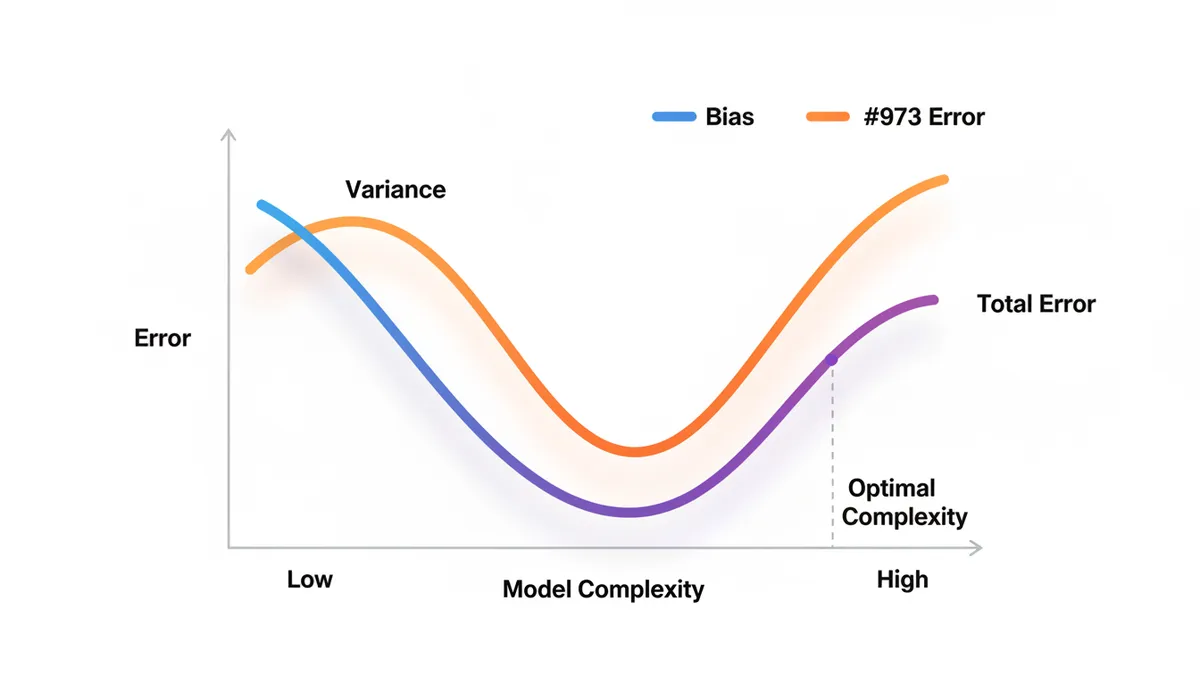
1.1 What is the bias–variance tradeoff, and how does it affect model performance?
Concept breakdown
- Bias: Error from erroneous assumptions in the learning algorithm (underfitting).
- Variance: Error from sensitivity to small fluctuations in the training set (overfitting).
- Tradeoff: As model complexity increases, bias tends to decrease and variance tends to increase.
How to answer
- Define both terms precisely.
- Explain with a simple example (e.g., polynomial regression).
- Connect to practical levers: model complexity, regularization, data size.
Sample answer structure
- High-bias model: linear regression on a clearly nonlinear relationship → low variance, high bias, underfits.
- High-variance model: very deep decision tree on small dataset → memorizes training data, poor generalization.
- We manage the tradeoff via:
- Regularization (L1/L2, dropout)
- Model architecture/complexity
- More data / data augmentation
- Ensembling (bagging reduces variance, boosting can reduce bias)
Follow-up questions you may get
- How does bagging affect variance and bias?
- How does L2 regularization change the bias–variance balance?
1.2 Explain underfitting and overfitting. How do you detect and fix them?
Concept breakdown
- Underfitting: Model too simple to capture patterns → high training and validation error.
- Overfitting: Model learns noise → low training error, high validation/test error.
How to answer
-
Detection:
- Plot training vs validation loss/accuracy.
- Underfitting: both high error, curves close together.
- Overfitting: training error low, validation error much higher or starts increasing.
-
Fixes:
- Underfitting: increase model capacity, add features, reduce regularization, train longer.
- Overfitting: regularization, early stopping, dropout, data augmentation, reduce model capacity.
Common pitfall: Saying “overfitting is when test accuracy is low” without mentioning the gap between train and validation metrics.
1.3 What is the difference between supervised, unsupervised, and self-supervised learning?
Key points
- Supervised learning: Learn mapping from inputs to labeled outputs.
- Examples: classification, regression.
- Unsupervised learning: Discover structure in unlabeled data.
- Examples: clustering, dimensionality reduction, density estimation.
- Self-supervised learning: Create supervision signals from the data itself via pretext tasks.
- Examples: masked language modeling (BERT), next-token prediction (GPT), contrastive learning (SimCLR).
In 2026, interviewers expect you to mention that self-supervised learning underpins modern foundation models and is a major paradigm for representation learning.
2. Model Evaluation & Metrics: Beyond Accuracy
2.1 How do you choose evaluation metrics for an imbalanced classification problem?
Concept breakdown
Accuracy is often misleading when classes are imbalanced. You should discuss:
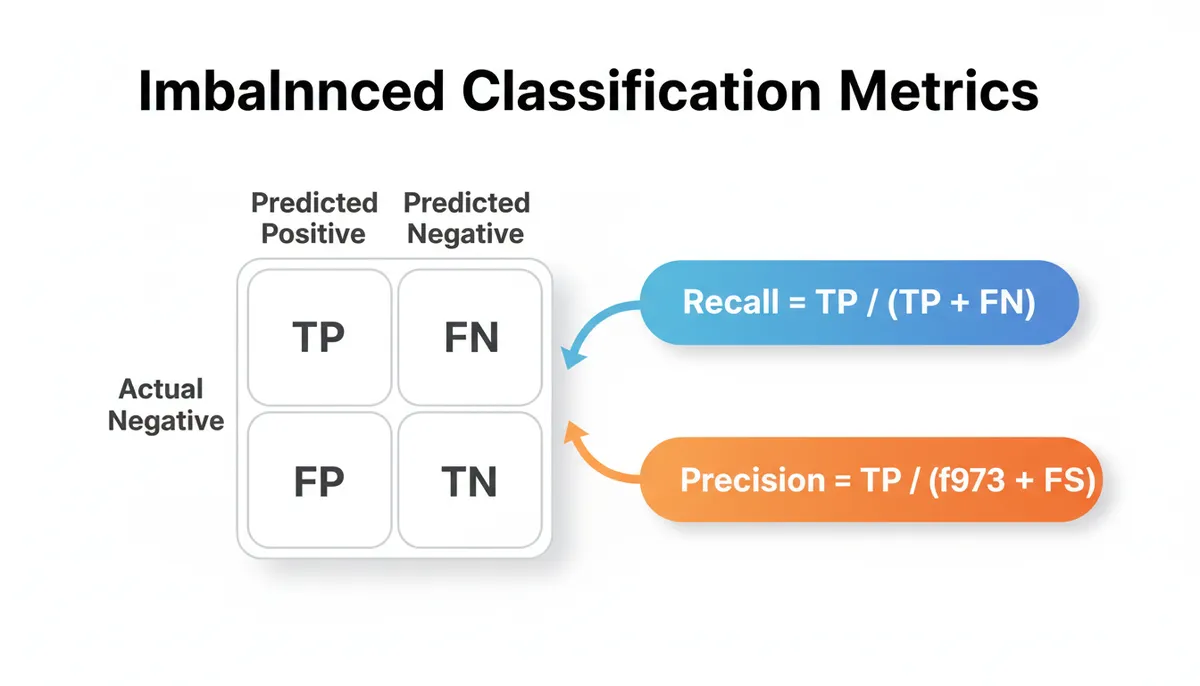
- Confusion matrix: TP, FP, TN, FN.
- Precision: TP / (TP + FP) – “Of predicted positives, how many were correct?”
- Recall (TPR): TP / (TP + FN) – “Of actual positives, how many did we catch?”
- F1-score: Harmonic mean of precision and recall.
- ROC AUC vs PR AUC:
- ROC AUC robust to class imbalance but can be optimistic when negatives dominate.
- PR AUC focuses on positive class performance; often more informative for rare events.
How to answer
- Start from the problem domain:
- Fraud detection, medical diagnosis → false negatives are costly → prioritize recall / sensitivity.
- Spam detection, content moderation → false positives are costly → emphasize precision.
- Explain why accuracy is insufficient.
- Propose 1–2 metrics and justify them.
Example
For a rare disease classifier:
- Use recall and PR AUC as primary metrics.
- Possibly also track specificity and F1 for a balanced view.
2.2 What is cross-validation, and when would you use different variants (k-fold, stratified, time-series)?
Key ideas
- Goal: Estimate generalization performance more robustly than a single train/validation split.
- k-fold cross-validation:
- Split data into k folds, train on k-1, validate on remaining, rotate.
- Use when data is limited and i.i.d.
- Stratified k-fold:
- Preserve label distribution in each fold.
- Use for classification, especially with class imbalance.
- Time-series CV (rolling/expanding window):
- Respect temporal order: train on past, validate on future.
- Use for forecasting, sequences, or any temporal leakage risk.
Common pitfall: Using standard k-fold CV for time-series data and leaking future information into training.
2.3 How do you evaluate large language models (LLMs) or generative models?
For 2026 interviews, expect questions that go beyond BLEU scores.
Key dimensions
-
Automatic metrics:
- LLMs: perplexity (for open-vocab models), BLEU/ROUGE (legacy), newer benchmarks (MMLU, GSM8K, Big-Bench style tasks).
- Vision generative models: FID, IS, CLIP-based scores.
-
Human-centric metrics:
- Helpfulness, harmlessness, factuality, coherence.
- User satisfaction, task success rates.
-
Behavioral evaluation:
- Red-teaming for safety.
- Robustness to prompt variations.
- Jailbreak resistance.
-
Task-based evaluation:
- “Evaluate the model on downstream tasks” (e.g., code generation success on a curated problem set, QA accuracy on domain data).
Interviewers like to see:
- Awareness that automatic metrics are proxies and often incomplete.
- Understanding of evaluation leakage (e.g., benchmarks in training data).
- Mention of eval harnesses and standardized suites (e.g., HELM-style evaluations).
3. Regularization, Optimization, and Training Dynamics
3.1 Explain L1 vs L2 regularization. When would you choose one over the other?
Concept breakdown
-
L2 (Ridge):
- Adds penalty: λ‖w‖².
- Encourages small but non-zero weights.
- Leads to weight shrinkage, usually no exact zeros.
- Often preferred when features are correlated and you want stability.
-
L1 (Lasso):
- Adds penalty: λ‖w‖₁ = λ∑|wᵢ|.
- Encourages sparsity: many weights exactly zero.
- Useful for feature selection or when you suspect many irrelevant features.
Good interview answer
- Define mathematically.
- Explain geometric intuition (L1 diamond vs L2 circle constraint).
- Provide a practical example:
- High-dimensional text features → L1 can zero out unhelpful n-grams.
- Dense numerical features with multicollinearity → L2 for stability.
3.2 Why is feature scaling important, and which algorithms are sensitive to it?
Key points
-
Why:
- Many algorithms assume features are on comparable scales.
- Gradient-based methods converge faster when features are normalized.
- Distance-based methods (k-NN, k-means) can be dominated by high-variance features.
-
Sensitive algorithms:
- k-NN, k-means, SVMs with RBF kernel, logistic regression, neural networks.
-
Less sensitive:
- Tree-based models (decision trees, random forests, gradient boosting) generally invariant to monotonic transformations of features.
Common scaling methods
- Standardization: (x - μ) / σ.
- Min-max scaling: (x - min) / (max - min).
- Robust scaling: using median and IQR.
3.3 Explain gradient descent and its variants (SGD, mini-batch, Adam). When would you use which?
Core concepts
-
Batch gradient descent:
- Computes gradient on entire dataset.
- Stable but expensive; rarely used for large datasets.
-
Stochastic gradient descent (SGD):
- Gradient per single sample.
- Noisy updates, can escape shallow local minima, but high variance.
-
Mini-batch SGD:
- Gradient on small batches (e.g., 32–1024 examples).
- Standard for deep learning; balances noise and efficiency.
-
Adam / adaptive methods:
- Maintain per-parameter learning rates using moving averages of gradients and squared gradients.
- Often faster convergence, especially in sparse or noisy settings.
Good answer touches on
- Tradeoffs: convergence speed, generalization, memory.
- Practical norms:
- Use mini-batch SGD with momentum or Adam for deep networks.
- Sometimes switch from Adam to SGD later for better generalization.
4. Feature Engineering, Leakage, and Data Issues
4.1 What is data leakage? Give examples and how to prevent it.
Definition
Data leakage occurs when information from outside the training dataset, or from the future (relative to prediction time), is used to create the model, leading to overly optimistic performance estimates.
Examples
- Using target-encoded features computed on the full dataset (including validation/test).
- Scaling or imputing using statistics (mean, std) computed on the full dataset instead of training-only.
- Including post-outcome features:
- Predicting customer churn using “number of support tickets in the next 3 months” as a feature.
- Using future prices to predict current risk.
Prevention
- Strict separation of train/validation/test.
- Pipeline-based transformations that fit only on training data (e.g.,
sklearn.Pipeline). - For time-series: ensure all features are known at prediction time and respect temporal ordering.
Interviewers often probe with “Can you give a concrete leakage example from a project you worked on?” Prepare one.
4.2 How do you handle missing data in ML pipelines?
Key strategies
-
Deletion:
- Drop rows or columns with too many missing values.
- Risk: bias if missingness is not random.
-
Simple imputation:
- Numeric: mean, median, constant.
- Categorical: mode, “Unknown” category.
-
Model-based imputation:
- k-NN imputation, MICE, or training separate models to predict missing values.
-
Indicator features:
- Add binary flags indicating whether a value was missing.
Consider missingness mechanisms
- MCAR (Missing Completely At Random)
- MAR (Missing At Random)
- MNAR (Missing Not At Random)
In 2026 interviews, being able to say “If I suspect MNAR, I’d treat missingness as informative and add explicit missing-value indicators” is a strong signal.
5. Tree-Based Models and Ensembles
5.1 How do random forests and gradient boosting differ?
Random Forests
- Ensemble of decision trees built on:
- Bootstrapped samples of data (bagging).
- Random subsets of features at each split.
- Aggregation:
- Classification: majority vote.
- Regression: average.
- Strengths:
- Robust, low tuning, good baseline.
- Reduces variance relative to single tree.
Gradient Boosting (e.g., XGBoost, LightGBM, CatBoost)
- Trees added sequentially to correct residual errors of previous ensemble.
- Each new tree fits gradient of loss function.
- Strengths:
- Often achieves state-of-the-art on tabular data.
- More flexible, but more sensitive to hyperparameters.
Key contrasts
- RF: parallel trees, reduce variance.
- GBM: sequential trees, reduce bias (but can overfit if too many trees).
5.2 Explain feature importance in tree-based models. What are pitfalls?
Types of importance
-
Gini/impurity-based:
- Sum of impurity reduction over splits using that feature.
- Biased towards features with more categories or higher cardinality.
-
Permutation importance:
- Measure increase in error when feature values are randomly permuted.
- Model-agnostic, more reliable but more expensive.
Pitfalls
- Correlated features:
- Importance can be split across correlated features; individually they may look unimportant.
- Leakage:
- If leakage exists, some features may appear highly important but are unusable in production.
6. Deep Learning & Representation Learning
6.1 Explain the vanishing/exploding gradient problem. How is it mitigated?
Concept
In deep networks, gradients can become extremely small or large as they propagate through many layers, especially with certain activations or poor initialization. This leads to:
- Early layers learning very slowly (vanishing).
- Numerical instability, NaNs (exploding).
Mitigations
- Activation functions:
- Use ReLU, GELU instead of sigmoid/tanh in deep stacks.
- Initialization:
- Xavier/Glorot, He initialization tailored to activation.
- Normalization:
- BatchNorm, LayerNorm, RMSNorm.
- Architecture design:
- Residual connections (ResNets, Transformers) to ease gradient flow.
- Gradient clipping to prevent explosions.
6.2 What is transfer learning? How has it evolved with foundation models?
Traditional transfer learning
- Pretrain on large dataset (e.g., ImageNet).
- Fine-tune model on smaller target dataset.
With foundation models (2024–2026)
- Pretraining on web-scale multimodal data.
- Reuse via:
- Fine-tuning (full or parameter-efficient methods like LoRA).
- Prompting / in-context learning (for LLMs).
- Adapters, prefix-tuning.
Interviewers expect you to know that:
- Transfer learning is often the default for NLP and vision tasks.
- For many problems, prompting + careful evaluation can be enough; fine-tuning is not always necessary.
6.3 What is the attention mechanism, and why did it replace many RNNs?
Key ideas
- Attention computes a weighted sum of value vectors, where weights depend on similarity between query and key vectors.
- Self-attention allows each token to attend to all others in a sequence.
Advantages over RNNs
- Parallelization across sequence positions.
- Better modeling of long-range dependencies.
- More stable gradients (no recurrent unrolling).
Mention the Transformer architecture and how it uses multi-head self-attention plus feedforward layers, and that this is the backbone of modern LLMs.
7. Modern AI & LLM-Focused Interview Questions
In 2026, many “machine learning interview questions” are really “AI interview questions” about large models.
7.1 How would you design an evaluation pipeline for a domain-specific LLM (e.g., legal or medical)?
Key components
-
Task definition:
- Contract summarization, question answering, code generation, etc.
-
Benchmark datasets:
- Curated domain-specific QA pairs, documents, or coding tasks.
- Hold-out test set with high-quality labels.
-
Automatic metrics:
- Exact match / F1 for QA.
- BLEU/ROUGE/BERTScore for summarization (with caveats).
- Code execution success for code generation.
-
Human evaluation:
- Domain experts rating:
- Correctness / factuality.
- Completeness.
- Safety / compliance.
- Domain experts rating:
-
Safety and robustness tests:
- Red-teaming with adversarial prompts.
- Checks for hallucinations, privacy leaks, bias.
-
Continuous evaluation:
- Feedback loops from real users.
- Monitoring drift in query distribution.
Interview tip: Explicitly mention guardrails (e.g., retrieval-augmented generation, tool use) and how to evaluate them.
7.2 What is retrieval-augmented generation (RAG), and why is it useful?
Definition
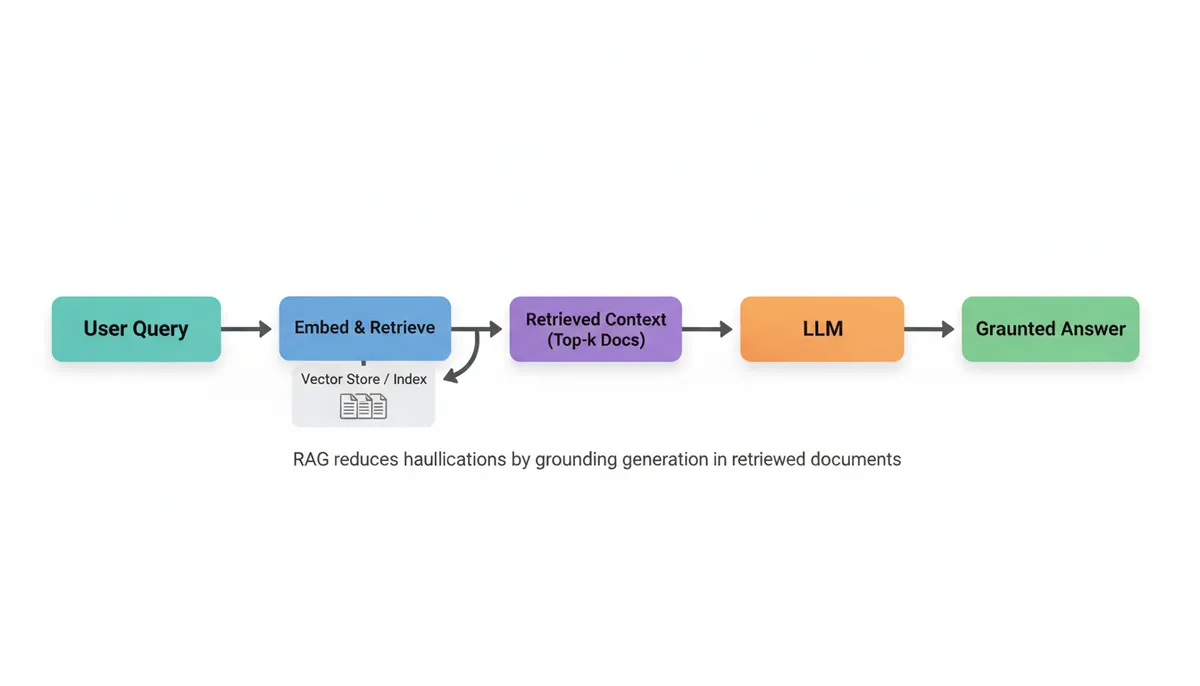
RAG combines an LLM with an external retrieval system:
- User query → embed and retrieve relevant documents from a knowledge store.
- LLM conditions on both the query and retrieved documents to produce an answer.
Benefits
- Reduces hallucinations by grounding responses in actual documents.
- Enables up-to-date knowledge without retraining the base model.
- Better control over information sources and citations.
Key design decisions
- Retrieval index: BM25 vs dense retrieval vs hybrid.
- Chunking strategy and metadata.
- How many documents to retrieve.
- How to format context in the prompt.
7.3 How do you mitigate hallucinations in LLMs?
Strategies
-
Grounding via RAG:
- Retrieve and pass relevant documents, instruct model to answer only from context.
-
Constrained decoding:
- Use structured outputs and schemas (JSON, tools) to restrict possible outputs.
- For code, compile/run checks and feedback loops.
-
Self-consistency and verification:
- Sample multiple outputs and aggregate.
- Use a verifier model or separate pipeline to check factuality.
-
Prompt engineering:
- Explicitly instruct model to say “I don’t know” when unsure.
- Ask for citations and then verify them.
-
Fine-tuning / RLHF:
- Train models to avoid making up facts and prefer abstention.
8. ML System Design & Productionization
8.1 Design a system to serve a real-time recommendation model. What do you consider?
Interviewers want to see you think beyond the model:
Core components
-
Offline training pipeline:
- Data ingestion, feature engineering, model training, validation.
- Versioning of data, code, and models.
-
Online serving:
- Low-latency feature store (precomputed vs real-time features).
- Model inference service (possibly GPU/CPU mix).
- Caching strategies (popular items, user segments).
-
Feedback loop:
- Logging user interactions (clicks, dwell time, purchases).
- Periodic retraining and A/B testing.
Key considerations
- Latency and throughput requirements.
- Cold-start problem for new users/items.
- Feature consistency between training and serving.
- Monitoring: performance, drift, anomalies.
8.2 How do you monitor ML models in production?
Dimensions to monitor
-
Data:
- Input feature distributions (drift).
- Missing values, out-of-range values.
-
Predictions:
- Score distributions over time.
- Calibration (predicted probabilities vs actuals).
-
Performance:
- Online metrics (CTR, conversion, etc.).
- Offline metrics on recent labeled data (if available).
-
System health:
- Latency, error rates, resource usage.
Tools & techniques
- Population stability index (PSI), KL divergence for drift.
- Shadow deployments and canary releases.
- Periodic re-evaluation using freshly labeled data.
9. Common Mistakes and Pitfalls in ML Interviews
9.1 Over-indexing on buzzwords
- Saying “We’ll just use a Transformer” without considering data size, latency, or simpler baselines.
- Using “LLM” as a hammer for every nail.
Fix: Start from problem constraints and baselines; justify complexity.
9.2 Ignoring data and problem formulation
- Jumping to model architecture before clarifying:
- What is the target variable?
- How is success measured?
- What is the data distribution and volume?
Fix: In open-ended questions, begin with problem framing and data understanding.
9.3 Hand-wavy evaluation
- Saying “We’ll use accuracy and F1” without explaining why.
- Not addressing class imbalance, temporal leakage, or domain-specific costs.
Fix: Tie metrics to business/real-world costs and data characteristics.
9.4 No consideration of deployment or constraints
- Proposing huge models for mobile or low-latency environments.
- Ignoring memory, inference time, or cost.
Fix: Ask clarifying questions about constraints; discuss distillation, quantization, or smaller architectures where relevant.
10. Best Practices for ML Interview Prep in 2026
10.1 Build a layered understanding
- Foundations:
- Revisit supervised/unsupervised learning, bias–variance, regularization, optimization.
- Classical ML:
- Tree-based methods, linear/logistic regression, SVMs.
- Modern DL & LLMs:
- Transformers, attention, transfer learning, RAG, evaluation of generative models.
- Systems & MLOps:
- Pipelines, monitoring, drift, experiment tracking.
Pattern-based learning can help here: grouping problems and questions by concept (e.g., “evaluation & metrics”, “regularization & generalization”) and practicing across variations.
10.2 Practice explaining, not just doing
Many candidates can implement models but struggle to explain:
- Why a certain metric is appropriate.
- How they’d debug a failing model.
- What tradeoffs a particular architecture implies.
Practice mock interviews, especially for open-ended AI interview questions, and focus on clear, structured reasoning. A resource like AI Mock Interviews vs Real Interviews: Do They Actually Help? can help simulate this style of questioning.
10.3 Combine coding with ML reasoning
Even for ML roles, you’ll often face coding screens. Prepare to:
- Implement common algorithms (gradient descent, k-means, logistic regression) from scratch.
- Manipulate data structures efficiently.
- Recognize patterns in algorithmic problems (sliding window, binary search on answer, graph traversal), as in a pattern-based DSA sheet like The 90 DSA Patterns That Cover 99% of Coding Interviews.
11. Example: Simple Logistic Regression from Scratch (Concept + Code)
To tie fundamentals together, here’s a basic logistic regression implementation in Python using NumPy—something you might be asked to sketch or reason about.
PYTHON
Complexity
- Per iteration: O(n_samples × n_features).
- Total: O(n_iters × n_samples × n_features).
What interviewers look for
- Understanding of:
- Sigmoid function and its role.
- Binary cross-entropy loss and gradient.
- How gradient descent updates parameters.
- Ability to discuss:
- Feature scaling for faster convergence.
- Adding L2 regularization (just add λ‖w‖² to loss, adjust gradients accordingly).
Key Takeaways
- Machine learning interview questions in 2026 span classical ML, deep learning, and modern AI/LLM systems.
- You’re expected to:
- Explain core concepts clearly (bias–variance, regularization, metrics).
- Reason about evaluation and data issues (leakage, imbalance, drift).
- Understand LLM-specific topics (attention, RAG, hallucination mitigation, evaluation).
- Think in systems terms for production ML (pipelines, monitoring, constraints).
- Strong answers are:
- Structured: definition → intuition → example → tradeoffs.
- Grounded in practical experience and real-world constraints.
- Aware of both algorithmic and product/business implications.
Use this as a roadmap for your ML interview prep: identify which sections feel shaky, then deepen your understanding with targeted practice, code, and mock interviews.