
DSA
Blind 75 vs NeetCode vs Pattern-Based Preparation: Full Comparison
Most engineers preparing for coding interviews eventually ask the same question: *Should I do Blind 75, NeetCode, or focus on patterns instead?* Search resul...
Most engineers preparing for coding interviews eventually ask the same question: Should I do Blind 75, NeetCode, or focus on patterns instead? Search results are full of opinions, but very few break down how these approaches differ in structure, learning depth, and long-term payoff.
This article compares Blind 75 vs NeetCode vs pattern-based preparation from a systems-thinking perspective: how they shape your problem-solving model, how they scale with time, and how to combine them into a robust DSA preparation strategy.
We’ll treat these not as “brands” but as three different learning models for data structures and algorithms.
1. The Landscape: What Are Blind 75, NeetCode, and Pattern-Based Prep?
Before comparing, we need precise definitions.
Blind 75: The Minimalist Checklist
Blind 75 is a curated list of ~75 LeetCode problems covering core topics:
- Arrays & Strings
- Linked Lists
- Trees & Graphs
- Dynamic Programming
- Backtracking
- Intervals
- Heaps, etc.
Key characteristics:
- Small, fixed list: 75 problems.
- Topic coverage: decent breadth, shallow depth.
- Learning model: repetition of specific questions until they’re memorized.
- Goal: “hit the essentials” with minimal time.
It’s popular because it feels finite and achievable. But it’s also easy to turn it into a glorified memorization exercise.
NeetCode: Structured Lists with Increasing Coverage
NeetCode provides:
- Multiple curated lists (NeetCode 75, 150, 300, etc.).
- Problems grouped by topic (Arrays, DP, Graphs) and difficulty.
- Video explanations and structured progressions.
Key characteristics:
- Scalable list size: start with 75, move to 150/300.
- Topic-based organization: more systematic than Blind 75.
- Learning model: practice by topic, with more variations per concept.
- Goal: build deeper familiarity with problem types and patterns.
Compared to Blind 75, NeetCode is larger, more structured, and less “memorize this exact set”.
Pattern-Based Preparation: Learning the Underlying Templates
Pattern-based preparation (what Thita.ai and some other platforms emphasize) focuses on reusable problem-solving templates, such as:
- Sliding Window
- Two Pointers
- Fast & Slow Pointers
- Binary Search on Answer
- Topological Sort
- Monotonic Stack
- Matrix Traversal
- Interval Merging
- Subsequence DP / Knapsack DP / Partition DP
- Tree DFS variants (preorder/postorder, path-based, etc.)
Key characteristics:
- Pattern-first: group problems by the algorithmic idea, not just topic.
- Emphasis on generalization: “What family of problems does this belong to?”
- Learning model: understand the shape of problems and map new questions to known patterns.
- Goal: reduce cognitive load during interviews by recognizing patterns instead of re-deriving from scratch.
This approach is more about building a mental library of strategies than completing a fixed list.
2. Blind 75 vs NeetCode vs Patterns: High-Level Comparison
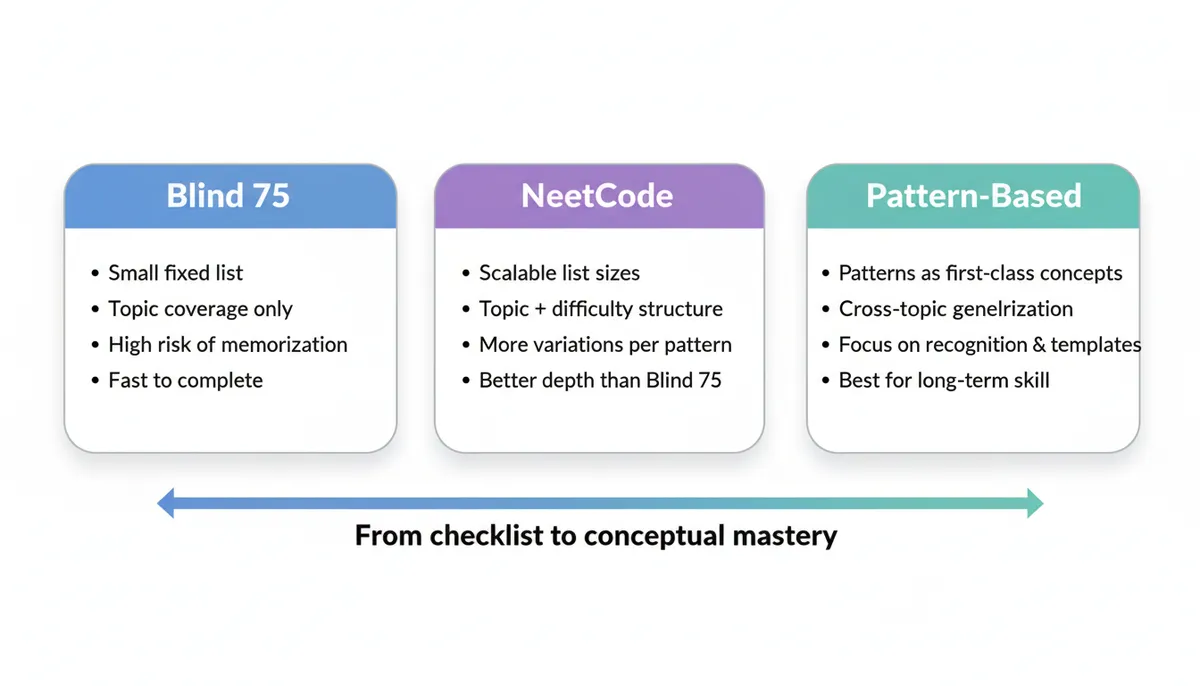
Quick Feature Matrix
| Dimension | Blind 75 | NeetCode | Pattern-Based Prep |
|---|---|---|---|
| Primary unit of learning | Individual problems | Topic-based problem sets | Algorithmic patterns |
| Typical list size | ~75 | 75 / 150 / 300+ | 50–100+ patterns, many problems each |
| Depth per concept | Low–Medium | Medium–High | High |
| Risk of memorization | High | Medium | Low |
| Generalization to new Qs | Weak–Medium | Medium–Strong | Strong |
| Best for | Very tight timelines | Systematic topic coverage | Long-term mastery & adaptability |
| Maintenance over time | Hard (need re-memorize) | Medium | Easier (reuse patterns) |
3. How Each Approach Changes Your Mental Model
The core difference is how your brain organizes knowledge.
3.1 Blind 75: Problem-Centric Memory
If you follow Blind 75 naively, your internal representation often looks like:
“For Two Sum, I use a hash map. For Merge Intervals, I sort and merge. For Maximum Subarray, I use Kadane’s algorithm.”
You remember problem–solution pairs, not pattern–family relationships.
This works if:
- The interviewer asks similar problems.
- You’ve practiced them recently enough to recall the exact trick.
It fails when:
- The problem is a twist on what you’ve seen.
- The constraints push you to a different data structure.
- The problem combines multiple ideas (e.g., sliding window + hash map + frequency tracking).
3.2 NeetCode: Topic-Centric Clustering
NeetCode improves this by grouping problems by topic:
“These are all array problems. These are all graph problems. These are all DP problems.”
You start to see:
- Arrays → sliding window, prefix sums, two pointers.
- Graphs → BFS, DFS, topological sort, Dijkstra.
- DP → 1D, 2D, subsequence, knapsack-style, etc.
Still, the emphasis is often on problem lists, not explicitly on the patterns as first-class concepts. You may know that several problems use sliding window, but you might not have an explicit, generalized template in your head.
3.3 Pattern-Based: Strategy-Centric Thinking
Pattern-based preparation flips the hierarchy:
“This is a sliding window problem with a constraint on distinct elements.”
“This is a binary search on answer problem over a monotonic predicate.”
“This is a graph + topological sort problem with prerequisites.”
You start the solution with:
- Identify pattern(s) that match the problem structure.
- Adapt template to the specific constraints.
- Combine patterns if needed (e.g., BFS + bitmasking).
For example, for “Longest Substring Without Repeating Characters”, you don’t think:
“I remember this exact LeetCode solution.”
You think:
“This is a sliding window where the constraint is ‘no duplicates’. Use a window [l, r) and a map from char → index, move
lwhen we see a duplicate.”
This is more robust when the interviewer changes:
- Characters → integers.
- “No duplicates” → “at most K distinct”.
- String → array.
4. Concrete Example: Sliding Window Across Approaches
To make the comparison less abstract, consider the sliding window pattern.
4.1 Blind 75 Approach
You might solve:
- Longest Substring Without Repeating Characters
- Minimum Window Substring
- Best Time to Buy and Sell Stock
You remember each as a separate trick. When you see a new problem like:
“Find the length of the longest subarray with sum ≤ K”
you might not immediately recognize it as a sliding window variant.
4.2 NeetCode Approach
You practice a set of sliding window problems under the “Arrays & Strings” topic. You start to notice:
- Windows that expand and shrink based on:
- Count of distinct elements
- Sum constraints
- Frequency of elements
- Number of allowed violations (e.g., at most K zeros)
But you may still lack a formalized template in your notes.
4.3 Pattern-Based Approach
You explicitly learn the sliding window template:
Template (for many “longest subarray/substring satisfying constraint” problems):
PYTHON
You then map multiple questions to this template by changing:
window_stateis_valid- How you update the answer.
This makes new problems feel like parameterization rather than reinvention.
5. How Do These Approaches Perform Under Real Interview Conditions?
5.1 Time Pressure and Recall
- Blind 75: Under pressure, if you’ve recently memorized the problem, you might recall the exact solution. If the problem is unfamiliar, you may struggle.
- NeetCode: Better coverage increases odds you’ve seen something similar. Topic grouping helps you quickly pick a relevant technique.
- Pattern-Based: You spend the first 30–60 seconds classifying the problem by pattern(s). Once classified, you can lean on a well-practiced template.
In real interviews, pattern recognition is often what separates “stuck for 20 minutes” from “structured progress in 5 minutes”.
5.2 Handling Variants and Follow-Ups
Interviewers often ask:
- “What if the array is sorted?”
- “What if we need the actual subarray, not just length?”
- “What if we need to handle streaming input?”
Pattern-based prep helps because:
- Sorted array → think two pointers or binary search.
- Need actual subarray → store indices or reconstruct from decisions.
- Streaming input → can we maintain the sliding window or heap incrementally?
You’re thinking in transformations of patterns, not memorized code.
6. Common Pitfalls in Blind 75 and NeetCode-Only Prep
6.1 Mistake: Treating Lists as Checkboxes
Many candidates:
- Download Blind 75 or NeetCode 150.
- Grind through problems in order.
- Mark them “Done” after AC.
- Move on without reflection.
Problems:
- You optimize for completion rate, not understanding depth.
- You rarely revisit problems to generalize patterns.
- You don’t maintain a structured map of “what pattern did I just use?”
6.2 Mistake: Ignoring Pattern Overlaps
Blind 75 and NeetCode lists contain many problems that:
- Share the same core pattern with minor variations.
- Differ only by constraints or output requirements.
Without explicitly labeling patterns, you:
- Re-solve the same pattern multiple times without recognizing it.
- Fail to compress your knowledge into reusable templates.
6.3 Mistake: No Active Recall or Pattern Notes
A common anti-pattern:
“I’ll just keep solving new problems; quantity will turn into quality.”
In practice:
- Without active recall (e.g., trying to re-derive a solution days later), you forget.
- Without pattern notes, you lose the meta-structure of your learning.
7. How to Turn Any List (Blind 75 / NeetCode) into Pattern-Based Learning
You don’t have to choose between lists and patterns. You can overlay a pattern-based lens on top of any list.
7.1 Step 1: Tag Every Problem with a Primary Pattern
When you solve a problem, annotate it with:
- Primary pattern (e.g., Sliding Window, Two Pointers, Binary Search, BFS, DFS, DP – Subsequence, etc.).
- Secondary patterns if applicable (e.g., “Sliding Window + HashMap”).
Example tags:
- “Longest Repeating Character Replacement” → Sliding Window
- “3Sum” → Two Pointers + Sorting
- “Course Schedule” → Graph + Topological Sort
- “Word Ladder” → BFS on implicit graph
- “Coin Change” → DP – Unbounded Knapsack variant
Over time, you build your own pattern index over Blind 75 or NeetCode.
7.2 Step 2: Maintain Pattern-Centric Notes
Instead of per-problem notes, maintain per-pattern notes:
For each pattern:
- Short description: when to use it.
- Generic template (pseudocode).
- List of problems that use it (from Blind 75 / NeetCode).
- Common variations (e.g., fixed-size vs variable-size windows).
Example (Two Pointers):
- When: Sorted arrays/strings, need pair/sum/partition-type operations.
- Template: left/right indices moving inward or outward.
- Problems: 3Sum, Container With Most Water, Remove Duplicates from Sorted Array, etc.
- Variations:
- Opposite ends → sum/area optimization.
- Fast/slow pointers → cycle detection, middle of list.
7.3 Step 3: Practice Pattern-Based Recall
Once a week:
- Pick a pattern (e.g., Sliding Window).
- Without looking at code, list 3–5 problems that used it.
- For each, sketch the high-level solution in 2–3 sentences.
- Optionally, implement the generic template from memory.
This reinforces:
- Pattern recognition.
- Template recall under mild pressure.
- Ability to adapt templates to specific constraints.
Platforms like Thita’s /dsa-patterns-sheet essentially give you this structure out of the box, but you can also build a lightweight version yourself.
8. Example: From Topic-Based to Pattern-Based (Graph Problems)
Graph questions are a common place where list-based approaches break down. Let’s see how each model handles them.
8.1 Topic-Based (NeetCode / Blind 75 Perspective)
You see a bucket called “Graphs” with problems like:
- Number of Islands
- Clone Graph
- Course Schedule
- Word Ladder
- Pacific Atlantic Water Flow
- Graph Valid Tree
You may think: “These are all graph problems; I’ll just learn BFS and DFS.”
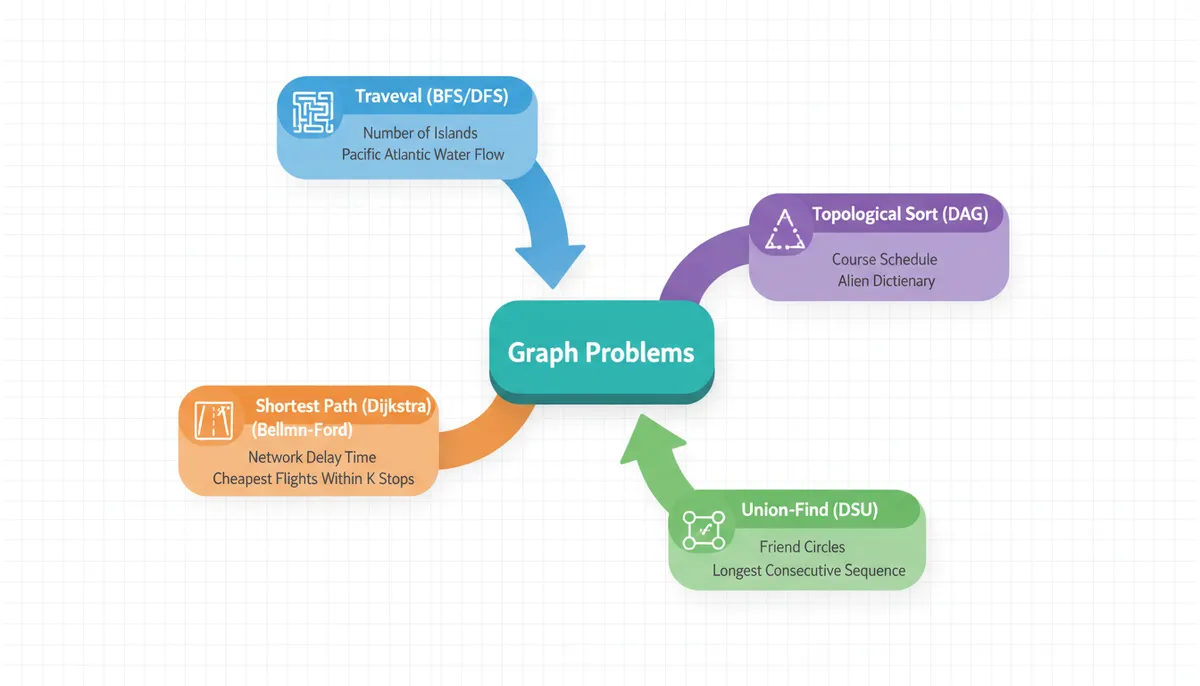
8.2 Pattern-Based Perspective
You decompose “Graphs” into sub-patterns:
- Traversal:
- BFS for shortest path (unweighted).
- DFS for connectivity, components, recursion-based problems.
- Topological Sort:
- DAGs, course schedules, ordering constraints.
- Union-Find (Disjoint Set Union):
- Connectivity, number of components, cycle detection in undirected graphs.
- Shortest Path (Weighted):
- Dijkstra, Bellman-Ford, etc.
Now:
- “Number of Islands” → DFS/BFS on grid (implicit graph).
- “Course Schedule” → Topological sort (cycle detection in directed graph).
- “Graph Valid Tree” → Union-Find or DFS with edge count constraints.
- “Word Ladder” → BFS on implicit graph (words as nodes, 1-letter edges).
This lets you solve new graph problems by pattern matching rather than ad hoc reasoning.
9. Time Investment vs. Return: Which Strategy When?
9.1 If You Have < 4 Weeks Before Interviews
Constraints:
- You need coverage quickly.
- You can’t deeply internalize 50+ patterns.
Suggested approach:
- Use NeetCode 75 or Blind 75 as the backbone.
- Overlay lightweight pattern tagging:
- For each problem, write down: “Pattern: X”.
- Focus on:
- Arrays/Strings: Sliding Window, Two Pointers.
- Trees/Graphs: BFS, DFS, basic recursion.
- Fundamental DP: 1D/2D table, simple transitions.
Goal: Get breadth + shallow patterns rather than pure memorization.
9.2 If You Have 1–3 Months
You have time for a more robust strategy:
- Pick a curated list (NeetCode 150, for example).
- Group problems by pattern, not just topic.
- For each pattern:
- Learn the template.
- Solve 3–5 problems of increasing difficulty.
- Maintain pattern notes and revisit them weekly.
This is where pattern-based prep shines: you can build a pattern library and still cover many problems.
9.3 If You’re Building Long-Term Systems Design + Coding Strength
If you see DSA as a long-term skill:
- Prioritize pattern mastery over list completion.
- Use lists like NeetCode as problem banks to exercise patterns.
- Add:
- Time-boxed mock interviews (human or AI).
- Whiteboard or scratchpad practice without IDE.
Tools like AI Interview Practice: Free Mock Interview Simulator with Real-Time Feedback for Technical Interviews or /ai-coach can simulate this environment, but the core idea is: practice pattern recognition + communication under realistic constraints.
10. Code Example: Pattern vs Problem-Specific Thinking
Consider a classic DP problem: “Climbing Stairs” (ways to reach step n with 1 or 2 steps at a time).
Problem-Specific Solution
PYTHON
Time: O(n), Space: O(n).
You might memorize this as “the Climbing Stairs trick”.
Pattern-Based Interpretation: Linear DP with Recurrence
You recognize this as:
- A 1D DP where:
dp[i]= number of ways to reach statei.- Transition depends on previous k states (here, 2).
General pattern:
PYTHON
This pattern applies to:
- Climbing Stairs
- Fibonacci
- House Robber (with modified transition)
- Some stock problems (with slightly more complex state)
You’re not just solving “Climbing Stairs”; you’re learning a linear DP pattern with rolling variables.
11. Best Practices for a Solid DSA Preparation Strategy
11.1 Combine Lists with Patterns, Not Lists vs Patterns
- Use Blind 75 / NeetCode to ensure coverage and problem diversity.
- Use pattern-based thinking to turn that coverage into reusable knowledge.
11.2 Maintain a Pattern Index
Whether you use a notebook, Notion, or a spreadsheet:
- Rows: Patterns (Sliding Window, Two Pointers, …).
- Columns: Description, Template, Example Problems, Common Pitfalls.
This becomes your personal DSA map.
11.3 Practice Explaining Patterns Out Loud
In interviews, you’re evaluated on:
- Clarity of thought.
- Ability to justify choices.
Before coding, say:
“This looks like a sliding window problem because we’re asked for a longest subarray with constraint X. I’ll maintain a window [l, r) and adjust it to maintain the constraint.”
This demonstrates:
- Pattern recognition.
- Intentional algorithm selection.
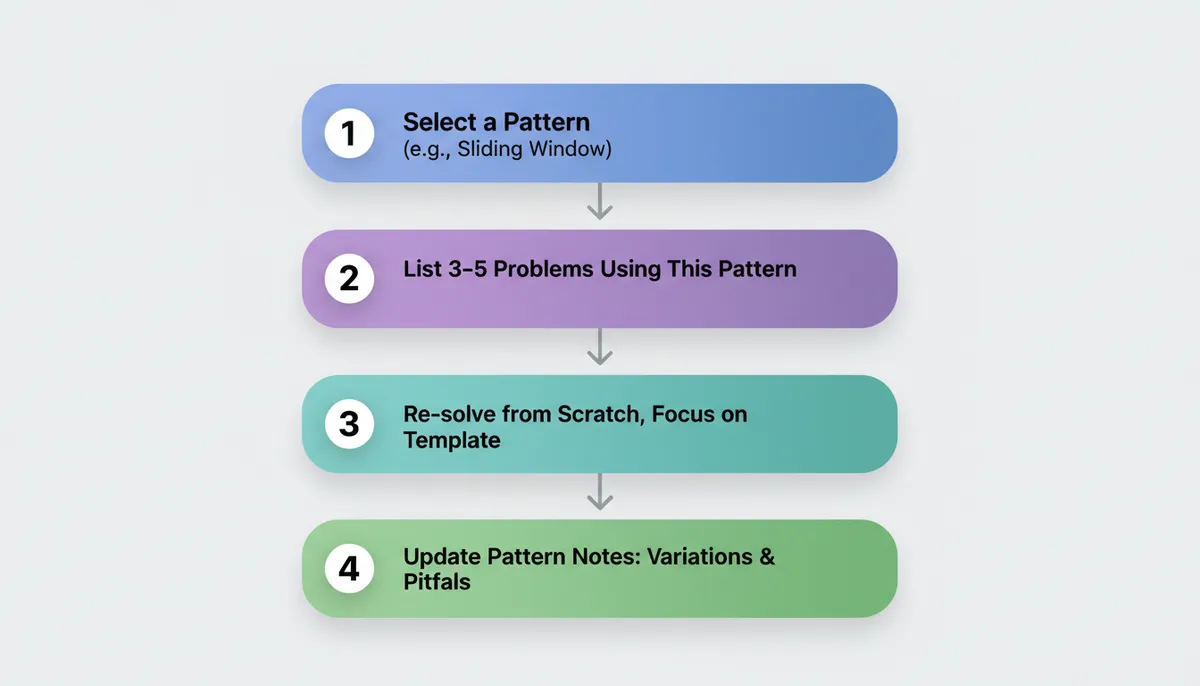
11.4 Revisit Problems by Pattern, Not by List
Instead of “I’ll redo Blind 75 in 2 weeks”:
- Pick a pattern (e.g., Binary Search).
- Re-solve 3–5 problems that use it.
- Focus on:
- Identifying the monotonic predicate.
- Correct low/high/mid updates.
- Off-by-one handling.
12. Key Takeaways: Blind 75 vs NeetCode vs Pattern-Based Prep
-
Blind 75:
- Good for short timelines and initial exposure.
- High risk of problem-by-problem memorization.
- Use only if you actively tag patterns and generalize.
-
NeetCode:
- Better structure and coverage than Blind 75.
- Topic-based grouping helps, but patterns are often implicit.
- Ideal as a problem bank to exercise patterns.
-
Pattern-Based Preparation:
- Focuses on reusable templates and recognition.
- Scales better to unseen and variant problems.
- Best for long-term skill and real interview adaptability.
The most effective DSA preparation strategy is not choosing one over the others, but using Blind 75/NeetCode as structured content and patterns as your primary mental model.
If you architect your prep like a system—inputs (problems), processing (pattern recognition), and outputs (clear, efficient solutions)—you’ll be better equipped not just to pass interviews, but to tackle real-world engineering problems that don’t come with a LeetCode ID.
For those looking to integrate AI into their preparation, exploring the Best Ways to Use AI for DSA and Coding Interview Preparation can provide valuable insights on leveraging modern tools effectively.