
DSA
DSA for Beginners: What to Study First and in What Order
Most beginners start DSA by opening a random LeetCode problem and getting stuck in the first 10 minutes. Not because they’re “bad at algorithms,” but because...
Most beginners start DSA by opening a random LeetCode problem and getting stuck in the first 10 minutes. Not because they’re “bad at algorithms,” but because they’re trying to jump into pattern recognition before they’ve built the underlying mental model.
This guide is a structured roadmap for DSA for beginners: what to study first, in what order, and why. We’ll focus on a sequence that builds durable understanding for coding interview basics, not just memorizing solutions.
1. Before DSA: The Minimal Prerequisites
You don’t need to be an expert software engineer to start DSA—but a few basics are non‑negotiable.
1.1 Programming fundamentals you should know
Pick one language (commonly C++, Java, Python, or JavaScript) and make sure you’re comfortable with:
- Variables, conditionals (
if/else) - Loops (
for,while) - Functions (parameters, return values)
- Basic data types (int, float, string, bool)
- Arrays or lists and simple operations (indexing, iteration)
If you can’t yet:
- Write a function to compute the sum of an array
- Reverse a string
- Count how many times a character appears in a string
…pause DSA and practice those first. Everything else builds on this.
1.2 How much math do you need?
For coding interview basics, you don’t need advanced math. The essentials:
- Comfort with arithmetic and simple algebra
- Understanding of logarithms at a conceptual level (e.g., “log₂ n grows slowly”)
- Ability to reason about growth rates (what happens as n gets large)
You’ll pick up the rest while learning time complexity.
2. Step 1: Learn Time and Space Complexity Early
The first real DSA concept to learn is asymptotic complexity. Without it, you can’t reason about whether an approach is “good enough.”
2.1 Big-O notation: what you actually need
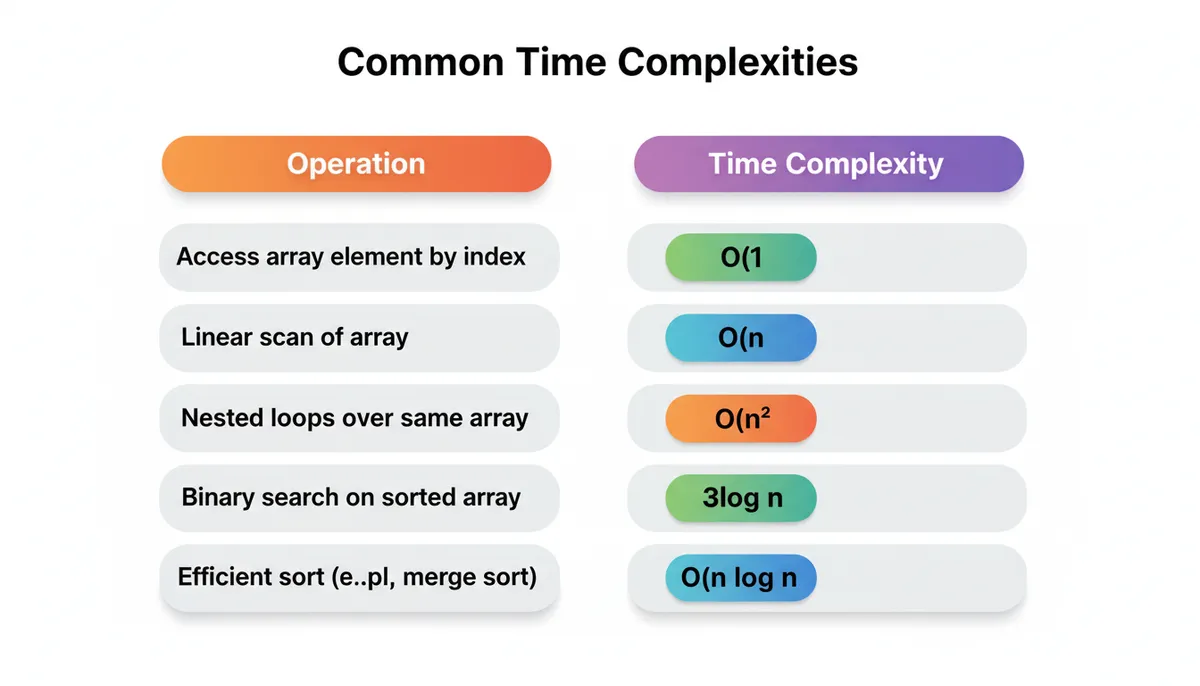
Focus on these core complexities:
- O(1) – constant time
- O(log n) – logarithmic (often from divide-and-conquer or binary search)
- O(n) – linear scan
- O(n log n) – common for efficient sorting
- O(n²) – nested loops over the same input
- O(2ⁿ), O(n!) – usually too slow for large n
You don’t need formal proofs; you need intuition.
2.2 Practice: classify simple snippets
Example in Python:
PYTHON
Ask yourself for each: what happens to the number of operations as n grows?
2.3 Why start here?
- It shapes your thinking: you’ll naturally ask “can I do better than O(n²)?”
- It helps you evaluate tradeoffs later (e.g., using extra memory to save time)
- Interviewers expect you to reason about complexity out loud
3. Step 2: Master Arrays and Strings (Your First Workhorses)
For DSA for beginners, arrays and strings are the most important starting data structures. Most easy and medium coding interview problems can be framed as array or string problems.
3.1 Core operations to learn
For arrays (or lists):
- Access by index: O(1)
- Iterate through all elements: O(n)
- Insert/delete at end: O(1) amortized for dynamic arrays
- Insert/delete in middle: O(n) (shifting elements)
For strings:
- Length, indexing
- Concatenation
- Substrings / slicing
- Basic library functions (split, join, toUpperCase, etc.)
3.2 Key patterns to practice first
These patterns are foundational and appear everywhere:
-
Single pass / running count
- Example: count occurrences, track min/max, compute prefix sums.
PYTHON -
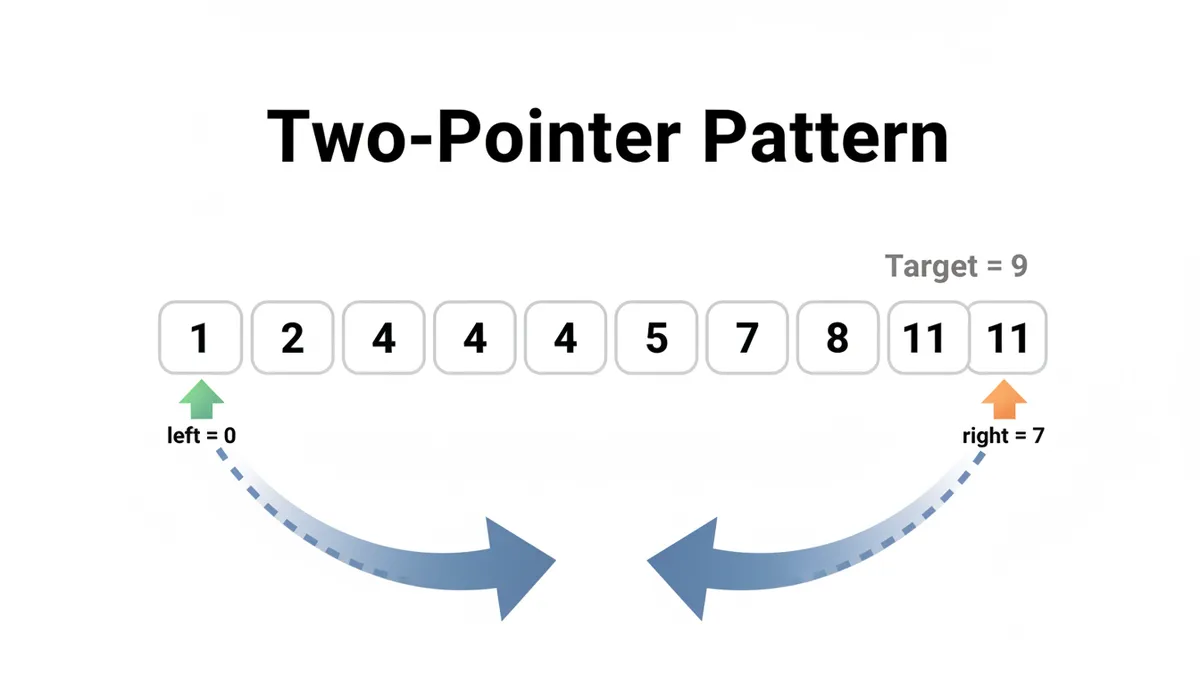
Two pointers (on arrays or strings)
- Example: check if a string is a palindrome.
PYTHON -
Sliding window (fixed and variable size)
- Example: maximum sum of any subarray of size k.
PYTHON
These are the first “algorithmic patterns” you should internalize. A pattern-based approach (like a DSA patterns sheet) is often more effective than grinding random problems.
3.3 What to practice
- Reverse an array in place
- Rotate an array by k positions
- Remove duplicates from a sorted array
- Find the longest substring without repeating characters
- Implement basic string compression (e.g., “aaabb” → “a3b2”)
Focus on:
- Writing from scratch without looking up syntax
- Explaining the logic and complexity
4. Step 3: Hash Tables (Maps and Sets)
Once you’re comfortable with arrays and strings, the next high-leverage tool is the hash table: dictionaries/maps and sets.
They are the backbone of many coding interview basics problems because they provide O(1) average-time lookups.
4.1 Concepts to understand
- Key–value storage (
map[key] = value) - Existence checks (
key in mapormap.containsKey(key)) - Sets for membership without values
- Typical operations: insert, delete, lookup in O(1) average time
You don’t need to implement a hash table from scratch yet; focus on using them effectively.
4.2 Classic beginner problems
-
Two Sum
Given an array and a target, find indices of two numbers that add up to the target.
PYTHON -
First non-repeating character in a string
-
Check if two strings are anagrams
These problems train you to think: “Can I trade space for time with a hash map?”
4.3 When to reach for a hash table
- Frequency counting
- Detecting duplicates
- Fast membership testing
- Mapping one value to another (e.g., value → index)
5. Step 4: Sorting and Binary Search
At this point, you can solve a wide range of easy–medium problems. Next, you should understand sorting and binary search, because they show up both directly and as building blocks.
5.1 Sorting: what you need to know
You don’t need to memorize every sorting algorithm, but you should:
- Know the complexity of built-in sorts: typically O(n log n)
- Understand the high-level idea of:
- Merge sort (divide-and-conquer, stable)
- Quick sort (partitioning, average O(n log n), worst O(n²))
You should be able to:
- Explain why O(n log n) is better than O(n²)
- Recognize when sorting first simplifies a problem
Example: given an unsorted array, find all unique triplets that sum to zero. Sorting first then using two pointers is a standard approach.
5.2 Binary search: more than just “find x”
Core binary search:
PYTHON
You should be comfortable with:
- Basic binary search on a sorted array
- Variants: search for first/last occurrence, lower/upper bound
- Recognizing when a problem has a monotonic property that can be binary searched (e.g., minimum capacity to ship packages in D days)
6. Step 5: Linked Lists – Pointers and References
Linked lists are less common in day-to-day application code than arrays, but they are important for interviews and for understanding memory and pointers.
6.1 Core concepts
- Node: contains
valueandnextpointer - Head of the list
- Singly vs doubly linked lists
- Insert/delete at head: O(1)
- Traversal: O(n)
6.2 Essential problems
- Reverse a singly linked list (iterative first, then recursive)
- Detect a cycle in a linked list (Floyd’s cycle detection with slow/fast pointers)
- Find the middle of a linked list
- Merge two sorted linked lists
Example: reverse a linked list (iterative):
PYTHON
Linked list problems reinforce pointer manipulation and two-pointer patterns.
7. Step 6: Stacks and Queues – Managing Order
Stacks and queues are conceptually simple but extremely powerful abstractions.
7.1 Stacks
- LIFO: last in, first out
- Operations:
push,pop,peek,isEmpty - Typical implementations: dynamic array or linked list
Common use cases:
- Valid parentheses checking
- Undo/redo functionality
- Evaluating expressions (postfix/prefix)
- DFS (using an explicit stack instead of recursion)
Example: valid parentheses:
PYTHON
7.2 Queues
- FIFO: first in, first out
- Operations:
enqueue,dequeue,peek,isEmpty - Used in:
- Breadth-first search (BFS)
- Scheduling, buffering
Understand both simple queues and priority queues (heaps) at a high level, though full heap implementation can come slightly later.
8. Step 7: Trees and Binary Search Trees (BSTs)
Once you’re comfortable with linear structures, move to hierarchical ones: trees.
8.1 Tree basics
- Root, parent, child, leaf
- Height, depth, level
- Binary tree: each node has at most 2 children
You should learn traversal orders:
- Preorder (root, left, right)
- Inorder (left, root, right)
- Postorder (left, right, root)
- Level-order (BFS)
Example: inorder traversal (recursive):
PYTHON
8.2 Binary Search Trees (BSTs)
BST property:
- Left subtree < node < right subtree (by some key)
Implications:
- Search, insert, delete in average O(log n)
- Inorder traversal of a BST gives sorted order
You should understand:
- Searching in a BST
- Inserting a node
- Why unbalanced BSTs can degrade to O(n)
9. Step 8: Graphs and Traversal Algorithms
Graphs generalize trees and model many real-world problems: networks, dependencies, paths.
9.1 Core concepts
- Directed vs undirected graphs
- Weighted vs unweighted
- Representations:
- Adjacency list (most common in interviews)
- Adjacency matrix
9.2 BFS and DFS
These are fundamental traversal algorithms:
- BFS (queue-based):
- Shortest path in unweighted graphs
- Level-order exploration
- DFS (stack or recursion):
- Path existence
- Topological sort
- Cycle detection
Example: BFS using adjacency list:
PYTHON
You don’t need Dijkstra’s or advanced graph algorithms at the very beginning, but BFS/DFS are must-haves. For a deeper dive into graph traversal, see Master Graph Traversal Patterns (DFS & BFS): 11 templates for Coding Interviews.
10. Step 9: Dynamic Programming (DP) – When Simple Recursion Isn’t Enough
Dynamic programming is intimidating for many beginners because they encounter it too early. It’s best learned after you’re comfortable with recursion, arrays, and basic graph/tree traversal.
10.1 What is DP?
Informally:
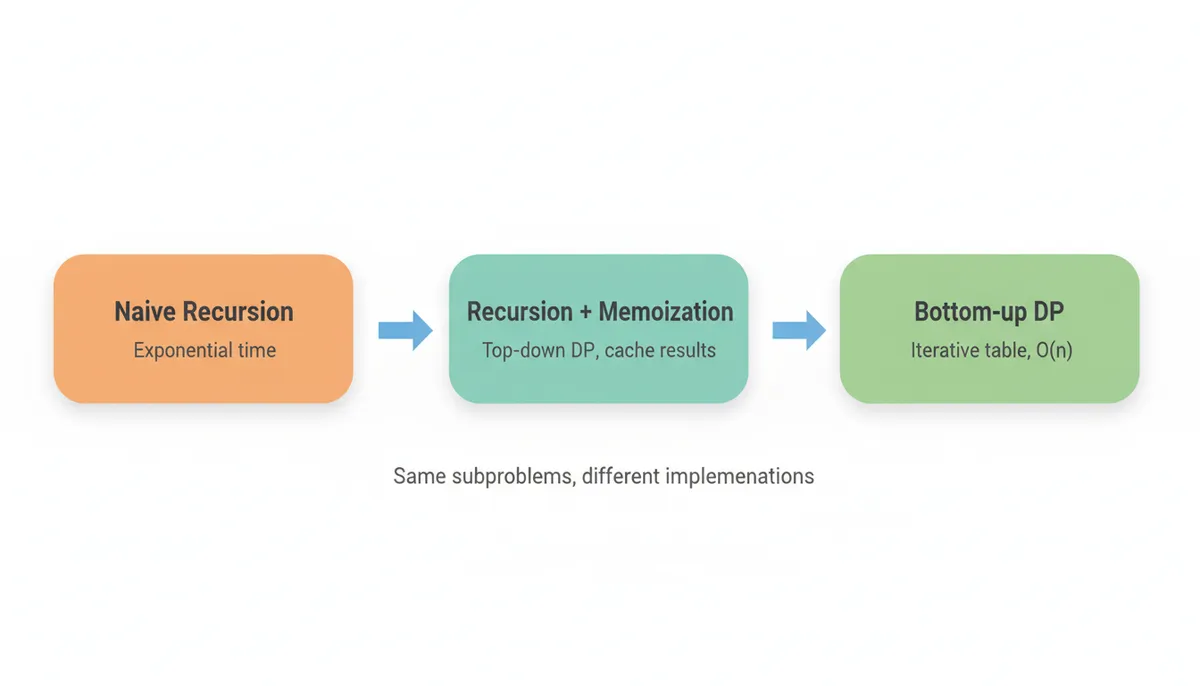
DP is about solving problems with overlapping subproblems and optimal substructure by caching and reusing results.
The two main flavors:
- Top-down: recursion + memoization
- Bottom-up: iterative table filling
10.2 Starter DP problems
Begin with 1D DP on sequences:
- Fibonacci numbers
- Climbing stairs (ways to reach n-th step with steps of 1 or 2)
- House robber (max non-adjacent sum)
- Coin change (minimum coins to make an amount)
Example: climbing stairs (bottom-up):
PYTHON
Focus on:
- Defining
dp[i]clearly in words - Deriving the recurrence relation
- Identifying base cases
For a structured approach, consider following a dynamic programming (DP) patterns guide.
11. Putting It All Together: A Practical DSA Roadmap
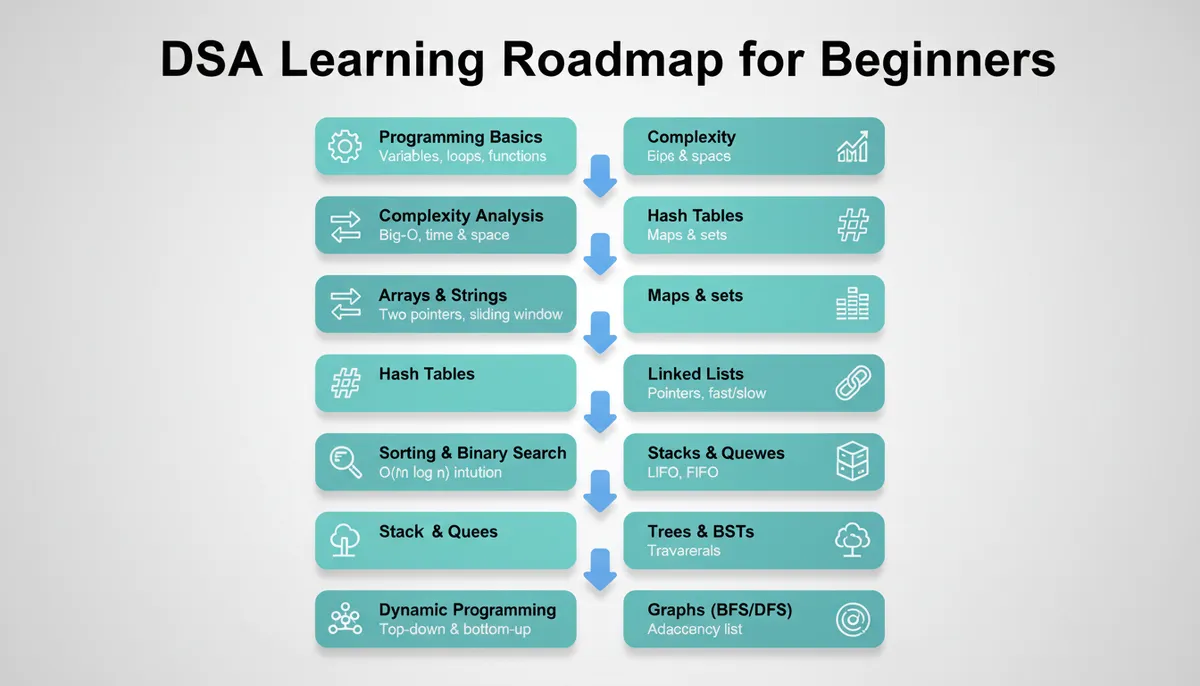
Here’s a condensed, ordered roadmap for what to learn first in DSA and in what sequence. This is roughly how you might structure 8–12 weeks of consistent study.
11.1 Phase 1: Foundations (Week 1–2)
- Programming language basics
- Time and space complexity
- Arrays and strings (with two pointers and sliding window)
11.2 Phase 2: Core Data Structures (Week 3–5)
- Hash tables (maps, sets)
- Sorting and binary search
- Linked lists
- Stacks and queues
11.3 Phase 3: Non-linear Structures (Week 6–8)
- Trees and BSTs
- Graphs (BFS/DFS)
11.4 Phase 4: Optimization and Patterns (Week 9–12)
- Dynamic programming (1D, then 2D)
- Common patterns across problems:
- Sliding window
- Two pointers
- Fast/slow pointers
- BFS/DFS templates
- Backtracking basics
A pattern-based approach (like using a structured patterns sheet or an AI coach to surface patterns during practice) accelerates this phase significantly.
12. Suggested Problem Progression for Beginners
To make this concrete, here’s a progression of problem types aligned with the roadmap:
-
Arrays & Strings
- Reverse array, rotate array
- Move zeros to end
- Remove duplicates in sorted array
- Check palindrome, reverse words in a string
-
Hash Tables
- Two Sum
- Valid Anagram
- Group Anagrams
- First Unique Character in a String
-
Two Pointers & Sliding Window
- Container With Most Water
- Longest Substring Without Repeating Characters
- Minimum Size Subarray Sum
-
Linked Lists
- Reverse Linked List
- Merge Two Sorted Lists
- Linked List Cycle detection
-
Stacks & Queues
- Valid Parentheses
- Min Stack
- Implement Queue using Stacks
-
Trees
- Maximum Depth of Binary Tree
- Validate Binary Search Tree
- Binary Tree Level Order Traversal
-
Graphs
- Number of Islands
- Clone Graph
- Course Schedule (topological sort)
-
Dynamic Programming
- Climbing Stairs
- House Robber
- Coin Change
- Longest Increasing Subsequence (once comfortable)
13. Common Mistakes Beginners Make (and How to Avoid Them)
13.1 Grinding random problems with no structure
If you pick random problems every day, you’ll feel busy but improve slowly. Instead:
- Focus on one topic at a time (e.g., arrays + two pointers for a week)
- Within that topic, solve multiple problems that share a pattern
- Only then move on
13.2 Ignoring complexity analysis
Many beginners stop once their code “works.” In interviews, that’s not enough.
Make it a habit to:
- State time and space complexity for every solution you write
- Ask yourself if you can do better
- Compare brute force vs optimized approaches
13.3 Jumping into DP and graphs too early
Dynamic programming and complex graph problems are easier once you:
- Are fluent with recursion
- Have seen enough simpler patterns
If DP feels like magic, step back to recursion, arrays, and trees.
13.4 Memorizing solutions instead of patterns
If you can only solve a problem you’ve seen before, you’re memorizing, not learning.
Instead:
- After solving a problem, write down the pattern (e.g., “fixed-size sliding window,” “two pointers on sorted array”)
- Try to implement a “template” for that pattern
- Apply that template to a new problem
13.5 Not revisiting problems
You forget what you don’t revisit.
- Re-solve key problems after a few days without looking at your code
- Track problems by topic and difficulty
- Aim for retention, not just first-time success
14. Best Practices and Actionable Tips
14.1 Use a consistent problem-solving template
For every problem:
- Restate the problem in your own words
- Work through small examples by hand
- Identify constraints and target complexity
- Decide on a data structure and pattern
- Write a high-level approach before coding
- Code, then test on edge cases
- Analyze time and space complexity
14.2 Talk through your thought process
Even when practicing alone:
- Explain out loud why you chose a certain data structure
- Justify your complexity
- Mention tradeoffs you considered
This mirrors real interviews and reveals gaps in understanding.
14.3 Alternate between learning and doing
A good rhythm:
- 30–45 minutes: study a concept or pattern
- 60–90 minutes: solve 2–4 problems using that pattern
- 10–15 minutes: reflect and summarize what you learned
14.4 Track patterns, not just problems
Maintain a simple table or notes like:
| Pattern | Typical DS | Example Problems |
|---|---|---|
| Sliding Window | Array/String | Max subarray sum, longest substring |
| Two Pointers | Array/String | Palindrome, container with most water |
| Fast/Slow Pointers | Linked List | Cycle detection, middle of list |
| BFS | Graph/Tree | Number of islands, shortest path |
| DP – 1D | Array | Climbing stairs, house robber |
This is how you build a reusable mental toolkit.
15. Visual Roadmap and Concept Diagrams
To make the data structures and algorithms roadmap more concrete, here are some suggested visuals.
16. Key Takeaways
- Start with complexity analysis, then master arrays and strings before touching more advanced structures.
- Learn and practice patterns (two pointers, sliding window, hash map lookups) rather than isolated problems.
- Progress through a clear data structures and algorithms roadmap: arrays → hash tables → sorting & search → linked lists → stacks/queues → trees/BSTs → graphs → DP.
- Avoid jumping into dynamic programming and advanced graph algorithms too early; build your foundation first.
- Focus on explaining your reasoning and analyzing complexity—that’s what interviewers evaluate.
If you follow this sequence and deliberately practice each layer, you’ll move from “I don’t know where to start with DSA” to having a structured, repeatable approach to cracking coding interviews.