
DSA
How to Identify the Right DSA Pattern in a Coding Interview
In most coding interviews, you’re not actually being tested on whether you’ve seen a specific LeetCode problem before. You’re being tested on whether you can...

In most coding interviews, you’re not actually being tested on whether you’ve seen a specific LeetCode problem before. You’re being tested on whether you can recognize what kind of problem you’re looking at—and then map it to the right data structure and algorithm pattern.
Strong candidates don’t brute-force their way through hundreds of questions. Instead, they learn to identify DSA patterns quickly: sliding window, two pointers, binary search on answer, backtracking, BFS/DFS, and so on. Once you see the pattern, the solution space shrinks dramatically.
This post is a practical guide to doing exactly that: how to identify the right DSA pattern in a coding interview, under time pressure, using systematic problem solving techniques instead of guesswork.
Why Pattern Recognition Matters More Than Problem Count
You can grind 500+ LeetCode questions and still feel stuck in interviews if you solve each question as an isolated puzzle. Interviewers are looking for:
- How you classify a problem (“This smells like sliding window with a hashmap”)
- How you justify that choice (“Because we need the longest subarray with a constraint on distinct elements”)
- How you adapt a known pattern to a new variant
Patterns give you:
- A starting point: You don’t stare at a blank editor; you recall the template for that pattern.
- Complexity intuition: You know typical time/space trade-offs for that pattern.
- Communication structure: You can explain your approach clearly and systematically.
Thita.ai’s pattern-based learning (94 DSA patterns across 15 categories) is built around this idea, but let’s focus on the underlying skill: how to identify the pattern from the problem statement.
A Three-Step Framework to Identify DSA Patterns
When you get a new problem, resist the urge to code. Instead, run this three-step mental process:
-
Normalize the problem
- Restate it in your own words
- Identify input types (array, string, tree, graph, matrix, etc.)
- Clarify the goal (max/min, count, existence, construct, enumerate)
-
Spot structural cues
- Look for keywords and constraints that hint at a pattern
- Map to 1–2 likely coding interview patterns
- Eliminate patterns that don’t fit constraints
-
Validate with complexity and invariants
- Does the pattern give the required time/space complexity?
- Can you define an invariant that stays true as the algorithm runs?
- Can you outline the core loop/recurrence in 1–2 minutes?
We’ll walk through this framework across common pattern families, with concrete examples.
Step 1: Normalize the Problem Before Picking a Pattern
1.1 Extract the “Shape” of the Problem
Ask yourself:
- What is the primary data structure?
- Array / string (linear)
- Linked list
- Tree / binary tree / BST
- Graph
- Matrix / grid
- What is the operation?
- Search / find / locate
- Count / aggregate
- Optimize (min/max/shortest/longest)
- Enumerate / generate all
- Reorder / transform / partition
Example (LeetCode-style):
Given an array of integers
numsand an integerk, return the length of the longest subarray whose sum is less than or equal tok.
Normalized:
- Data structure: array
- Operation: find longest subarray satisfying a constraint on sum
- Output: a single integer (length)
Already, “longest subarray with constraint” should make you think of sliding window or two pointers.
1.2 Clarify Constraints Early
Constraints often eliminate entire categories of approaches:
nup to10^5or10^6→ O(n²) is too slow, think O(n) or O(n log n)- Output may be large (e.g., “return all subsets”) → exponential patterns (backtracking) are acceptable
- “Online” or streaming data → need O(1)/O(log n) per update, maybe heaps or balanced trees
Constraints are your first filter for which problem solving techniques are viable.
Step 2: Map Problem Cues to Common DSA Patterns
Below is a pattern-to-cue mapping you can internalize. This is not exhaustive, but it covers the majority of coding interview patterns you’ll see on platforms like LeetCode.
Array & String Patterns: Sliding Window, Two Pointers, Prefix Sums
2.1 When to Use Sliding Window
Question to ask:
“Am I looking for a contiguous subarray or substring with some constraint (length, sum, distinct elements)?”
Cues:
- “Longest/shortest subarray/substring” with:
- sum ≤ / ≥ / == K
- at most K distinct elements
- at most K replacements
- “Number of subarrays/strings that satisfy…” where subarrays are contiguous
Typical patterns:
- Fixed-size window (size K)
- Variable-size window (expand/shrink)
Example:
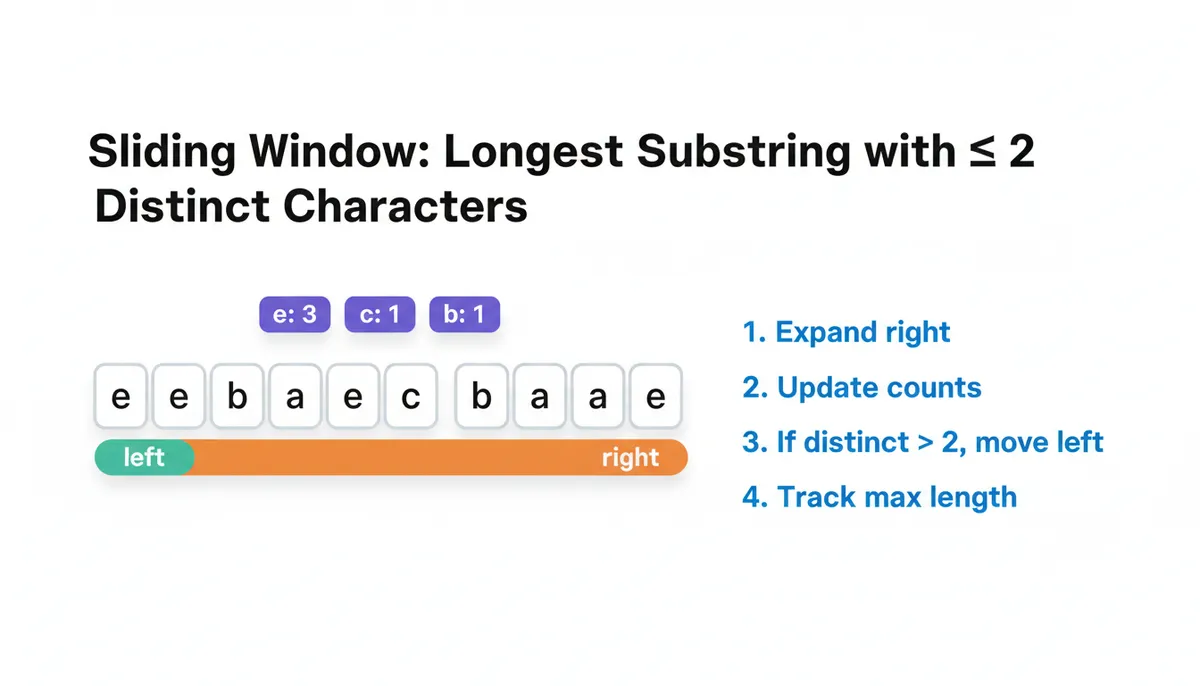
“Find the length of the longest substring with at most two distinct characters.”
Pattern: Sliding Window + HashMap
- Expand right pointer
- Track counts of characters in window
- Shrink left pointer when distinct count > 2
Time: O(n), Space: O(1) or O(k)
For a deeper dive into this technique, consider exploring the Master Sliding Window: 4 templates for Coding Interviews which provides comprehensive examples and templates.
2.2 When to Use Two Pointers
Question to ask:
“Can I solve this by moving two indices through a sorted or linear structure, often from ends or with a slow/fast relationship?”
Cues:
- Sorted array + target sum / target difference
- Remove duplicates in-place
- Partition array based on condition
- Linked list cycle detection (Floyd’s algorithm)
- Merge two sorted lists or arrays
Example:
“Given a sorted array of integers and a target, return indices of the two numbers such that they add up to target.”
Pattern: Two Pointers from both ends
- Start
left = 0,right = n - 1 - If
nums[left] + nums[right] < target, moveleft++ - If
> target, moveright-- - If
== target, return indices
Time: O(n), Space: O(1)
For more patterns involving two pointers, check out Master the Two Pointer Pattern: Complete Guide with Examples.
2.3 When to Use Prefix Sum / Difference Array
Question to ask:
“Am I repeatedly querying sums of subarrays or ranges, or applying many range updates?”
Cues:
- “Sum of elements from i to j” asked many times
- “Number of subarrays with sum equal to K”
- Range increment updates (e.g., add v to all elements in [l, r])
Patterns:
- Prefix sum array:
prefix[i] = sum(nums[0..i-1]) - Hashmap of prefix sums to count subarrays with given sum
- Difference array for efficient range updates
Search & Optimization Patterns: Binary Search, Binary Search on Answer
3.1 Classic Binary Search
Question to ask:
“Am I searching in a sorted array or a monotonic structure?”
Cues:
- “Given a sorted array, find index of X”
- “Find first/last occurrence of X”
- “Find smallest element ≥ X” (lower bound)
- Rotated sorted array variants
Pattern: Binary search on index/value in sorted space
Time: O(log n), Space: O(1)
3.2 Binary Search on Answer (Parametric Search)
Question to ask:
“Is there an answer space where feasibility is monotonic (if I can do it with X, I can do it with >X or <X)?”
Cues:
- “Minimize the maximum …”
- “Find minimum capacity / speed / time to satisfy condition”
- “Can we do this with K machines / days / speed?”
Examples:
- Split array into m subarrays to minimize the largest sum
- Minimum eating speed to finish bananas in H hours
- Allocate pages/books to minimize maximum pages per student
Pattern:
- Define search space [low, high] over answers (not indices)
- Write
can(answer)function that returns true/false - Binary search the smallest/largest answer that satisfies
can
For a detailed comparison of techniques like binary search and others, see RAG vs Fine-Tuning vs Prompt Engineering: How to Choose the Right One.
Combinatorial Patterns: Backtracking, DFS, Subsets, Permutations
4.1 When to Use Backtracking
Question to ask:
“Am I asked to generate all valid combinations, permutations, subsets, or paths with constraints?”
Cues:
- “Return all subsets / permutations / combinations”
- “Generate all valid parentheses”
- “Solve Sudoku / N-Queens”
- “All paths from source to target with constraints”
Pattern: DFS with state + undo (backtrack)
Pseudo-template:
PYTHON
Time: Often exponential (O(2^n), O(n!), etc.), Space: O(n) recursion depth
Graph & Tree Patterns: BFS, DFS, Topological Sort, Union-Find
5.1 When to Use BFS
Question to ask:
“Do I need the shortest path in an unweighted graph, or level-by-level traversal?”
Cues:
- “Minimum number of steps / moves / transformations”
- “Shortest path in grid with obstacles (no weights)”
- “Number of levels / distance from source”
- Multi-source shortest reach (e.g., from all gates to nearest walls)
Pattern: BFS with queue
- States: nodes (graph) or cells (grid)
- Edges: neighbors
- Use queue to propagate frontier
- Track visited to avoid cycles
5.2 When to Use DFS
Question to ask:
“Do I need to explore all paths, detect cycles, or compute properties recursively?”
Cues:
- “Number of connected components”
- “Is there a cycle in this directed/undirected graph?”
- “Count paths, sizes of subtrees”
- Tree traversals (pre/in/post-order)
Pattern: Recursive or explicit stack DFS
Time: O(V + E), Space: O(V) for recursion/stack
5.3 When to Use Topological Sort
Question to ask:
“Is there a dependency ordering or prerequisite structure?”
Cues:
- “Course schedule with prerequisites”
- “Build order of tasks with dependencies”
- “Can we finish all tasks?”
Pattern: Topological sort via BFS (Kahn’s) or DFS
- Directed acyclic graph (DAG)
- Track in-degrees, push 0 in-degree nodes to queue
- Pop, reduce neighbors’ in-degrees, repeat
5.4 When to Use Union-Find (Disjoint Set)
Question to ask:
“Am I dynamically merging groups and checking connectivity/equivalence?”
Cues:
- “Number of connected components after unions”
- “Are two nodes in the same set?”
- “Redundant connection” in a graph
- “Accounts merge” by common email
Pattern: Union-Find with path compression + union by rank
Time: ~O(α(n)) per operation (inverse Ackermann, effectively constant)
Heap & Greedy Patterns
6.1 When to Use Heaps (Priority Queues)
Question to ask:
“Do I repeatedly need the smallest/largest element among a changing set?”
Cues:
- “Find K largest/smallest elements”
- “Merge K sorted lists”
- “Schedule tasks to minimize lateness / penalty”
- “Running median of data stream”
Pattern: Min-heap / max-heap
- Maintain heap of size K (for top-K)
- Or full heap for global ordering
6.2 When to Use Greedy
Question to ask:
“Can a locally optimal choice at each step lead to a global optimum, with a provable argument?”
Cues:
- Interval scheduling (max non-overlapping intervals)
- Activity selection
- Minimum number of arrows to burst balloons
- Huffman coding, etc.
Often combined with:
- Sorting
- Heaps
- Proof via exchange argument or cut property
Putting It Together: A Pattern Identification Flow
Here’s a high-level decision flow you can internalize.
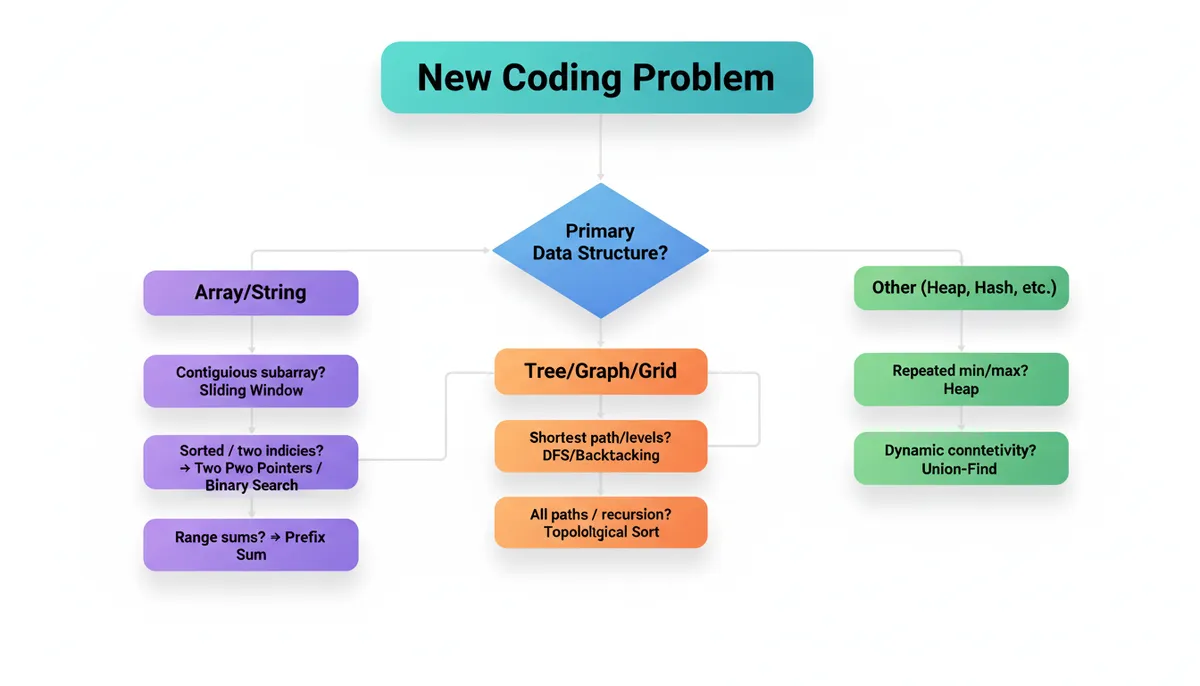
This isn’t a rigid checklist, but a mental model. With practice, you’ll jump between these branches quickly.
Example Walkthrough: Identifying Patterns Under Pressure
Let’s apply the framework to a concrete problem.
Problem:
You are given an array of integers
numsand an integerk. Return the number of subarrays whose sum is equal tok.
Step 1: Normalize
- Data structure: array
- Operation: count number of subarrays (contiguous) with sum == k
- Constraints (assume):
nup to 10^5, numbers can be negative
Step 2: Spot Cues
- “Subarrays” → contiguous → sliding window / prefix sums
- “Sum equal to k” → sum constraint
- But: numbers can be negative, so sliding window with two pointers (which relies on monotonic sum changes) breaks.
This suggests prefix sum + hashmap rather than sliding window.
Step 3: Validate
- Prefix sum
prefix[i] = sum(nums[0..i]) - For each index
i, we want number ofj < isuch thatprefix[i] - prefix[j] == k- Rearranged:
prefix[j] == prefix[i] - k
- Rearranged:
- Maintain a hashmap of prefix sums → counts
- Complexity: O(n) time, O(n) space → fits constraints
Pattern identified: Prefix Sum + HashMap.
Code Sketch (Python):
PYTHON
- Time: O(n)
- Space: O(n)
Common Mistakes When Identifying Coding Interview Patterns
Mistake 1: Forcing a Favorite Pattern Onto Every Problem
Example: Trying to use sliding window for any subarray sum problem, even when negatives are involved.
Fix:
Start from the problem’s structure, not from your favorite pattern. Ask the key questions first:
- Is the subarray length fixed or variable?
- Are elements non-negative?
- Do I need count vs. max/min?
Mistake 2: Ignoring Constraints Until It’s Too Late
- Proposing O(n²) for
n = 10^5 - Using recursion with depth
nwhenncan be 10^5 (stack overflow)
Fix:
Read constraints as soon as you understand the problem. Use them to:
- Rule out brute force
- Decide between O(n log n) vs O(n²) vs O(2^n)
Mistake 3: Not Verbalizing the Pattern to the Interviewer
Even if you recognize the pattern, if you don’t say it out loud, the interviewer can’t evaluate your reasoning.
Fix:
Use explicit language:
- “This looks like a sliding window problem because we’re asked for the longest subarray with a sum constraint.”
- “Given the sorted array requirement, I’d like to try two pointers from both ends.”
This also gives the interviewer a chance to redirect you early if you’re off.
Mistake 4: Overfitting on LeetCode Problem Text
Relying on exact phrasing you’ve seen before (“longest substring without repeating characters”) instead of understanding the underlying idea (“variable-size window with a uniqueness constraint”).
Fix:
After solving a problem, always:
- Name the pattern
- Generalize: “This is any problem where we maintain a window with a uniqueness constraint using a hashmap.”
Best Practices and Actionable Tips
1. Build a Personal Pattern Map
Don’t just memorize solutions. Build a mental (or written) map:
- For each pattern:
- Typical problem signatures (keywords)
- Template code
- Complexity
- 2–3 example problems
Thita’s /dsa-patterns-sheet is one way to structure this; you can also maintain your own notes.
2. Practice Classification Without Coding
Take 10–20 random problems and, for each:
- Spend 1–2 minutes only classifying:
- Primary data structure
- Likely pattern(s)
- Expected complexity
- Don’t code; just label the pattern and move on
This trains the identify DSA patterns muscle separately from implementation.
3. Develop Pattern “Smells”
Over time, you should develop quick “smells”:
- “Longest/shortest subarray/substring” → sliding window
- “Kth smallest/largest” → heap, quickselect, or binary search
- “All combinations/subsets” → backtracking
- “Min days / speed / capacity” with feasibility check → binary search on answer
- “Dynamic connectivity” → union-find
- “Shortest path unweighted” → BFS
- “Shortest path weighted (non-negative)” → Dijkstra
4. Always Cross-Check Complexity
Before committing:
- Ask: “What’s the expected complexity for this problem size?”
- Check: “Does my chosen pattern naturally achieve that?”
If you’re using:
- Sliding window / two pointers → O(n)
- BFS/DFS → O(V + E)
- Binary search → O(log n)
- Backtracking → exponential (only acceptable when output is exponential)
5. Use Mock Interviews to Stress-Test Pattern Recognition
Under pressure, it’s easy to forget patterns you know in theory. Simulate real conditions:
- Time-box yourself (30–45 minutes per problem)
- Verbally explain your pattern choice
- Ask for feedback specifically on:
- How quickly you identified the pattern
- Whether there was a simpler pattern you missed
Tools like Thita’s AI Interview Practice: Free Mock Interview Simulator with Real-Time Feedback for Technical Interviews can automate this kind of practice and feedback loop.
Quick Reference: Problem Cues → Likely Patterns
| Problem Cue / Phrase | Likely Pattern(s) |
|---|---|
| Longest/shortest subarray/substring with constraint | Sliding Window, Two Pointers |
| Kth smallest/largest, running min/max | Heap, Quickselect |
| Sorted array + search / boundaries | Binary Search, Two Pointers |
| Minimize maximum / capacity / speed | Binary Search on Answer |
| All subsets/permutations/combinations | Backtracking, DFS |
| Shortest path (unweighted graph/grid) | BFS |
| Shortest path (weighted, non-negative) | Dijkstra (Heap + Graph) |
| Count islands / connected components | DFS/BFS, Union-Find |
| Course schedule / prerequisites | Topological Sort |
| Range sum queries | Prefix Sum, Segment Tree/Fenwick |
| Dynamic connectivity, merging groups | Union-Find |
| Non-overlapping intervals, scheduling | Greedy + Sorting |
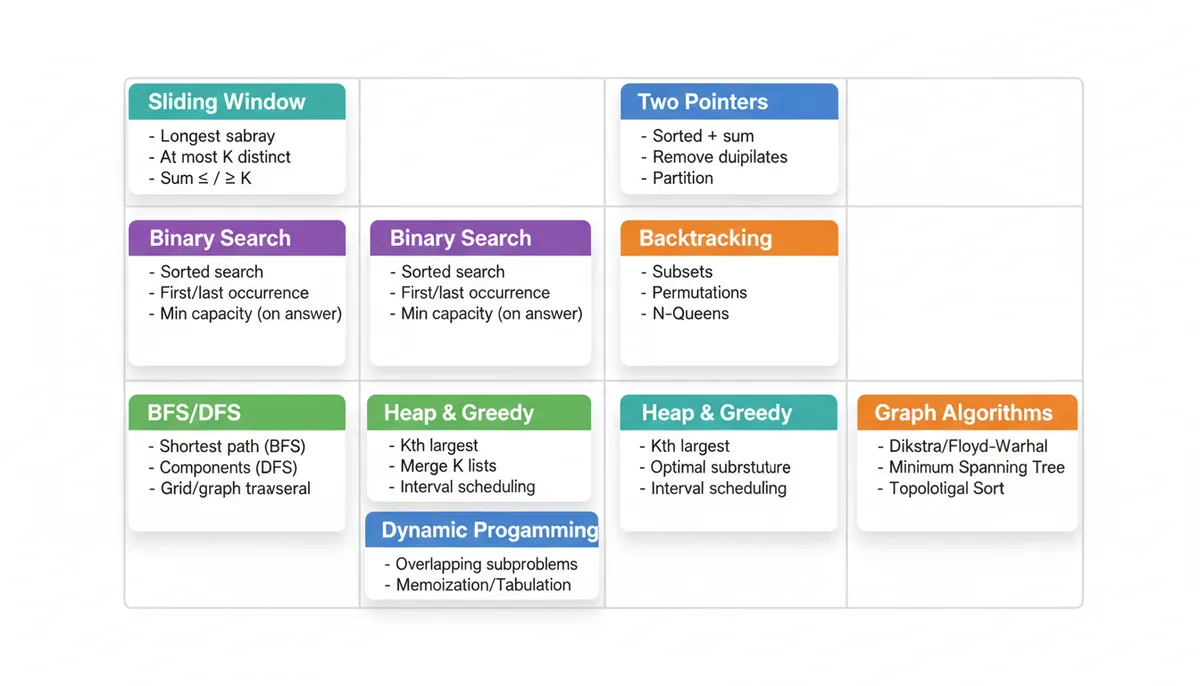
Conclusion: From Memorizing Problems to Recognizing Patterns
To perform well in coding interviews, you don’t need to have seen every problem. You need to:
- Normalize the problem: data structures, operations, constraints.
- Spot structural cues that map to known coding interview patterns.
- Validate with complexity and invariants before implementing.
The more intentionally you practice pattern recognition—classifying problems, naming patterns, and explaining your choices—the more interviews start to feel familiar, even when the questions are new.
Over time, you’ll find that when you read a problem, your brain automatically narrows it down to 1–2 candidate patterns. That’s when you’re no longer just grinding LeetCode; you’re thinking like an algorithm designer.