DSA
Master the Two Pointer Pattern: Complete Guide with Examples
In the realm of coding interviews, mastering various algorithmic patterns is crucial to success. Among these, the two pointer pattern stands out due to its v...

In the realm of coding interviews, mastering various algorithmic patterns is crucial to success. Among these, the two pointer pattern stands out due to its versatility and efficiency in solving a wide range of problems. Whether it's finding pairs in a sorted array or detecting cycles in a linked list, the two pointer technique is a powerful tool in a developer's arsenal.
What is the Two Pointer Pattern?
The two pointer pattern involves using two pointers to traverse data structures, typically arrays or linked lists. These pointers can move in the same direction or in opposite directions, depending on the problem requirements. By efficiently narrowing down the search space, the two pointer technique can often reduce the time complexity from O(n^2) to O(n). This pattern is one of the fundamental dsa patterns that every software engineer should master for coding interviews.
Use Cases and Examples
The two pointer pattern is particularly useful in problems involving:
- Finding pairs in a sorted array: Problems that ask for two elements that sum to a specific value.
- Reversing an array or a subarray: Swapping elements from both ends moving towards the center.
- Detecting cycles in a linked list: Using a fast and slow pointer to determine cycle existence.
- Merging two sorted arrays: Efficiently combining two sequences into one.
Let's dive into some practical examples to solidify your understanding.
Example 1: Two Sum Problem
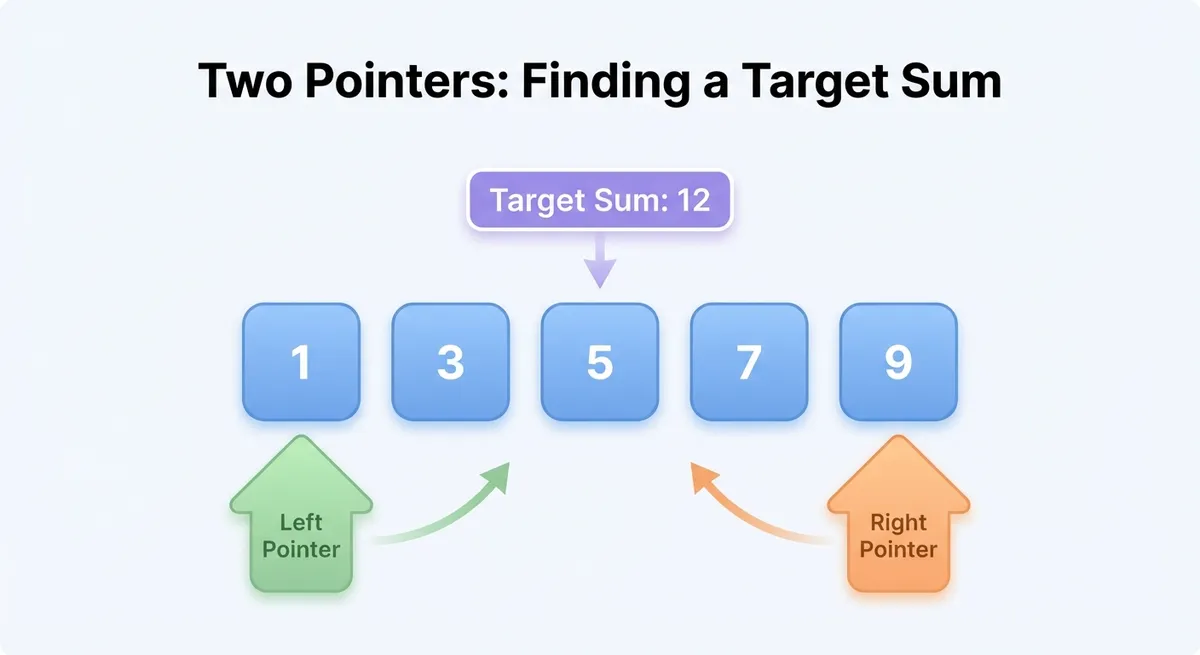
Imagine you are given a sorted array and asked to find two numbers that add up to a specific target. This classic problem can be efficiently solved using the two pointer pattern.
Problem Statement
Given a sorted array of integers, find two numbers such that they add up to a specific target number. Return the indices of the two numbers.
Approach
- Initialize two pointers:
leftat the start andrightat the end of the array. - Calculate the sum of the elements at the two pointers.
- If the sum equals the target, return the indices.
- If the sum is less than the target, move the
leftpointer to the right. - If the sum is greater than the target, move the
rightpointer to the left. - Repeat until the pointers meet.
Here's a clean implementation in Python:
PYTHON
Complexity Analysis
- Time Complexity: O(n) since each element is processed at most once.
- Space Complexity: O(1) as no additional data structures are used.
Example 2: Detecting a Cycle in a Linked List
The two pointer technique is also effective in linked lists, particularly for cycle detection using the Floyd’s Cycle-Finding Algorithm.
Problem Statement
Given a linked list, determine if it has a cycle. Use two pointers, where one moves twice as fast as the other.
Approach
- Initialize two pointers:
slowandfast. - Move
slowby one step andfastby two steps. - If there is a cycle,
fastwill eventually meetslow. - If
fastreaches the end of the list, there is no cycle.
Here's a concise implementation:
PYTHON
Complexity Analysis
- Time Complexity: O(n) where n is the number of nodes in the linked list.
- Space Complexity: O(1) as only two pointers are used.
Advanced Concepts: Three Pointer Variations
In more complex scenarios, you might encounter problems that require more than two pointers. For example, sorting an array of three distinct values can be efficiently handled with the Dutch National Flag problem using three pointers.
Problem Statement
Sort an array consisting of only 0s, 1s, and 2s.
Approach
- Maintain three pointers:
low,mid, andhigh. - Iterate through the array and partition it into three sections.
- Adjust the pointers based on the current element's value.
This approach ensures a single pass sorting with O(n) complexity.
Key Takeaways
- The two pointer pattern is an essential technique for optimizing search problems and reducing complexity.
- It is versatile, applicable to arrays, linked lists, and more.
- Mastery of this pattern involves recognizing when and how to apply it to different problem types.
By incorporating the two pointer pattern into your DSA toolkit, you'll be well-prepared for a range of coding interview challenges. For further practice, explore additional Master Two Pointer Patterns: 7 Techniques for Coding Interviews to enhance your problem-solving skills.