
DSA
LeetCode Patterns vs Topic-Wise Preparation: Which One Works Better?
Most people start LeetCode prep the same way: open the problem list, filter by “Arrays” or “Dynamic Programming,” and grind. A few weeks later, they’ve solve...

Most people start LeetCode prep the same way: open the problem list, filter by “Arrays” or “Dynamic Programming,” and grind. A few weeks later, they’ve solved dozens of questions—but struggle badly when the interviewer asks a problem that looks different from anything they’ve seen.
This is where “LeetCode patterns” come in. Instead of memorizing solutions topic by topic, you learn recurring problem structures like “sliding window,” “two pointers,” or “topological sort.” The natural question is: LeetCode patterns vs topic-wise preparation—what actually works better as a coding interview strategy?
This post breaks that down in detail, with a focus on how to build a robust LeetCode preparation strategy that scales beyond memorization.
What Do We Mean by “Topic-Wise” vs “Pattern-Based” Preparation?
Before comparing them, we need precise definitions.
Topic-wise preparation
Topic-wise (or tag-based) preparation organizes your study by data structure or algorithm category:
- Arrays & Strings
- Linked Lists
- Stacks & Queues
- Trees & Graphs
- Dynamic Programming
- Greedy
- etc.
You might:
- Filter LeetCode by “Array,” solve 50 problems
- Then move to “Tree,” solve 40 problems
- Then “Dynamic Programming,” and so on
The mental model is: “If I practice enough problems using trees, I’ll be good at tree questions.”
Pattern-based preparation (LeetCode patterns)
Pattern-based preparation organizes your study by recurring problem archetypes, regardless of specific topic or data structure:
- Sliding Window
- Two Pointers
- Fast & Slow Pointers
- Binary Search on Answer
- Backtracking (DFS with state)
- Topological Sort (Kahn’s / DFS)
- Interval Merging
- Monotonic Stack
- Prefix Sum & Difference Array
- BFS Level Order / Multi-source BFS
- etc.
The mental model is: “If I master the patterns that repeatedly appear in problems, I can quickly recognize and adapt them during interviews.”
Patterns cut across topics. For example:
- Sliding window appears in arrays, strings, and sometimes in DP optimizations.
- BFS/DFS patterns appear in trees, graphs, matrices, and even word ladder problems.
Why LeetCode Patterns Exist in the First Place
Interview problems are not random. Most of them are:
- A familiar core pattern
- Wrapped in a different story (words, constraints, domain)
- With minor twists (extra conditions, different return values, etc.)
For instance:
- “Longest substring without repeating characters”
- “Longest subarray with sum ≤ k”
- “Number of subarrays with at most K distinct integers”
These all share the sliding window pattern with slightly different bookkeeping.
Patterns are a way to:
- Compress many problems into a handful of core ideas
- Build reusable mental templates
- Reduce the cognitive load during interviews
This is the core argument for pattern-based learning.
How Topic-Wise Preparation Works (and Where It Breaks)
What topic-wise prep does well
Topic-wise preparation is useful, especially early on:
-
Builds basic vocabulary
You need to know what a stack, queue, tree, or graph is before you can recognize patterns that use them. Topic-wise practice helps you:
- Learn basic operations (insert, delete, traverse)
- Understand time/space complexity of each structure
- Get comfortable with syntax in your language of choice
-
Clarifies your weak areas
If you consistently fail “Graph” problems, you know where to focus. Topic-wise tags act as a diagnostic tool.
-
Matches some interview question categorization
Many interviewers think in terms of topics:
- “Let’s ask a tree traversal question.”
- “Let’s do a DP problem.”
Topic familiarity ensures you’re not blindsided by basic constructs.
Where topic-wise prep fails
Topic-wise prep often falls short in problem-solving transfer:
-
You learn what is used, but not how it’s used
Example: You know what a stack is, but you don’t see that:
- Valid Parentheses
- Daily Temperatures
- Largest Rectangle in Histogram
all share a stack pattern (sometimes a monotonic stack).
Without the pattern, these remain three separate memorized solutions.
-
Poor generalization
Topic-wise prep encourages a mindset of:
“Have I seen this exact problem before?”
Instead of:
“Which pattern does this problem map to?”
That’s dangerous in interviews, where problems are intentionally unfamiliar.
-
Overfitting to tags
Many LeetCode tags are broad:
- A “Tree” problem might be BFS, DFS, recursion, DP on trees, or binary search on trees.
- A “DP” problem might actually be solvable with greedy + sorting.
“Topic” doesn’t tell you the approach; patterns do.
How Pattern-Based Preparation Works (and Where It Shines)
What pattern-based prep does well
-
Improves problem recognition speed
In interviews, time is limited. Recognizing that a problem is:
- “Sliding window with at most K distinct”
- “Binary search on answer with monotonic predicate”
- “Graph + BFS shortest path on unweighted edges”
lets you skip a lot of exploration and jump into implementation.
-
Compresses your mental model
Instead of 300 separate problems, you might think in terms of:
- 10–15 core graph patterns
- 10–15 core array/string patterns
- 10–15 core DP/backtracking patterns
Each pattern has:
- A template
- Typical variations
- Edge cases to watch for
-
Mirrors how experienced engineers think
Senior engineers rarely think: “Ah, this is a Tree problem.” They think:
- “This is BFS over state space.”
- “This is a topological order problem.”
- “This is a greedy interval scheduling problem.”
Pattern-based thinking is closer to how you’ll solve real-world problems.
-
Helps with explanation and communication
In interviews, saying:
“This looks like a sliding window problem where we maintain a frequency map of characters and shrink the window when constraints are violated.”
is much stronger than:
“I’ll use a couple of pointers and try to keep track of the substring somehow.”
Patterns give you precise language and structure.
Where pattern-based prep can go wrong
Pattern-based learning is not a silver bullet:
-
Pattern overfitting
You can try to force every problem into a known pattern:
- Using sliding window when you need binary search
- Using DFS when BFS is more appropriate
The goal is not to shoehorn, but to recognize when a pattern truly fits.
-
Shallow understanding of underlying topics
Patterns assume you can:
- Implement a queue, stack, or heap quickly
- Write recursive DFS without bugs
- Use hash maps and sets fluently
Without topic fundamentals, pattern templates become hard to implement.
-
Memorizing patterns, not mastering them
Simply reading a “pattern sheet” is not enough. You need:
- Multiple problems per pattern
- Variations and edge cases
- Active recall (explain pattern from scratch)
Concrete Example: Topic vs Pattern Thinking
Let’s compare how the two approaches might tackle a problem.
Problem (simplified):
“Given an array of integers and a target sum k, return the length of the longest subarray with sum ≤ k.”
Topic-wise reasoning
- Topic: Arrays
- Sub-topic: Prefix sum? Two pointers? Not obvious.
- You might:
- Try brute force O(n²) by checking all subarrays
- Then think about prefix sums
- Possibly get stuck on how to maintain ≤
kefficiently
Pattern-based reasoning
You might recognize:
- We’re looking for a longest subarray with a constraint on sum.
- The array has non-negative numbers (assume that’s given).
- For non-negative numbers, subarray sum is monotonic as we expand the window.
This maps to a sliding window pattern:
PYTHON
- Time complexity: O(n)
- Space complexity: O(1)
You didn’t need to think “array problem” versus “prefix sum problem.” You recognized a pattern: variable-size window with a constraint that can be checked and fixed by moving the left pointer.
When Topic-Wise Preparation Is Necessary
Pattern-based learning works best once you’re comfortable with fundamental tools. Topic-wise prep is particularly important for:
1. Early stage: Building foundations
If you struggle to:
- Implement a linked list
- Traverse a binary tree
- Use a hash map effectively
- Write a simple BFS or DFS
then you need topic-wise practice first.
A reasonable progression is:
- Arrays & Strings → practice indexing, sliding window basics
- Hash Maps & Sets → frequency counting, deduplication
- Linked Lists → pointer manipulation
- Trees & Graphs → BFS, DFS, recursion basics
- Heaps → priority queues, top-K problems
2. Deep-diving into complex topics (e.g., DP)
Dynamic Programming is a topic where both topic and pattern matter:
- Topic-wise: You need to understand overlapping subproblems, optimal substructure, tabulation vs memoization.
- Pattern-wise: You learn common DP patterns:
- 1D DP (climbing stairs, house robber)
- 2D DP (edit distance, longest common subsequence)
- DP on trees
- Bitmask DP
- Knapsack variants
Topic-wise gives you the conceptual framework; patterns give you reusable templates.
When LeetCode Patterns Become the Primary Tool
Once you’re comfortable with basics, your coding interview strategy should shift:
1. Use patterns as your primary organization unit
Instead of:
- “Today I’ll do 10 array problems.”
Try:
- “Today I’ll do 5 sliding window problems and 5 two-pointer problems.”
Concretely, a pattern-based sheet (like a structured DSA patterns sheet) helps you:
- See related problems grouped together
- Practice variations intentionally
- Avoid random, unstructured grinding
2. Focus on “pattern recognition + adaptation”
For each pattern, practice:
-
Recognition
Given a new problem, can you say within 2–3 minutes:- “This is sliding window with counts”
- “This is BFS shortest path”
- “This is topological sort on a DAG”
-
Adaptation
Can you modify the base template to handle:- Additional constraints (e.g., at most K distinct, exactly K distinct)
- Different outputs (indices vs counts vs boolean)
- Edge cases (empty input, duplicates, negative numbers)
A Hybrid Strategy: DSA Patterns vs Topics in Practice
The best approach is not patterns or topics, but patterns built on top of topics.
Phase 1: Foundation (2–4 weeks, depending on level)
Goal: Be comfortable with basic data structures and algorithms.
- Arrays & Strings: indexing, two pointers, basic sliding window
- Hash Maps/Sets: frequency maps, lookups, deduplication
- Linked Lists: reversing, merging
- Trees: traversals (inorder, preorder, postorder), BFS level order
- Graphs: adjacency list, BFS/DFS, connected components
- Basic recursion and backtracking
During this phase:
- Use topic-wise lists.
- Don’t worry too much about patterns yet, but start noticing them.
Phase 2: Pattern-first practice (4–8+ weeks)
Goal: Build a library of patterns and internalize them.
Pick a curated list of patterns (e.g., 40–60 core DSA patterns across categories). For each pattern:
-
Learn the template
Example: Sliding Window (variable size)
PYTHON -
Solve 3–5 problems per pattern
- Start with straightforward ones
- Move to trickier variations
- After each, summarize:
- What was the twist?
- How did I adapt the template?
-
Implement from scratch without looking
- Close the tab.
- Re-implement the solution from memory.
- Explain it out loud as if in an interview.
This is where an AI coach or mock interviewer (e.g., something like AI Mock Interviews) can be useful: forcing you to articulate pattern choice and trade-offs under time pressure.
Phase 3: Mixed mock interviews and random sets
Goal: Test generalization and robustness.
- Mix random LeetCode problems (by difficulty) with mock interviews.
- For each new problem, explicitly ask:
- Which pattern(s) might apply?
- If none fit, which topic gives me tools to explore?
Over time, your brain will naturally default to pattern recognition.
Common Mistakes in LeetCode Preparation (and How Patterns Help)
Mistake 1: Grinding hundreds of problems with low retention
Symptoms:
- You’ve solved 300+ LeetCode questions.
- In interviews, you still feel like you’re seeing problems for the first time.
Cause:
- You’re treating each question as unique, not part of a family.
Fix:
- After solving a problem, categorize it by pattern:
- Sliding window? Two pointers? BFS? Binary search on answer?
- Write a 2–3 sentence summary:
- “This is a BFS on a grid with multiple sources.”
- “This is DP on a sequence with state [index][remaining capacity].”
Mistake 2: Memorizing solutions verbatim
Symptoms:
- You remember “the code from that one LeetCode discussion.”
- A slight variation in the problem breaks your approach.
Fix:
- Focus on why the pattern works:
- For sliding window: why is it safe to move
leftforward? - For two pointers on sorted arrays: why does moving one pointer reduce the search space?
- For topological sort: why does in-degree zero represent “ready to process”?
- For sliding window: why is it safe to move
Mistake 3: Ignoring constraints and problem shape
Patterns are often determined by:
- Input size (n up to 1e5 suggests O(n log n) or O(n))
- Data structure (grid → BFS/DFS; DAG → topological sort)
- Optimization target (min/max/first occurrence → binary search on answer, greedy, DP)
If you jump into coding without reading constraints, you miss these signals.
Visualizing the Difference: Topics vs Patterns
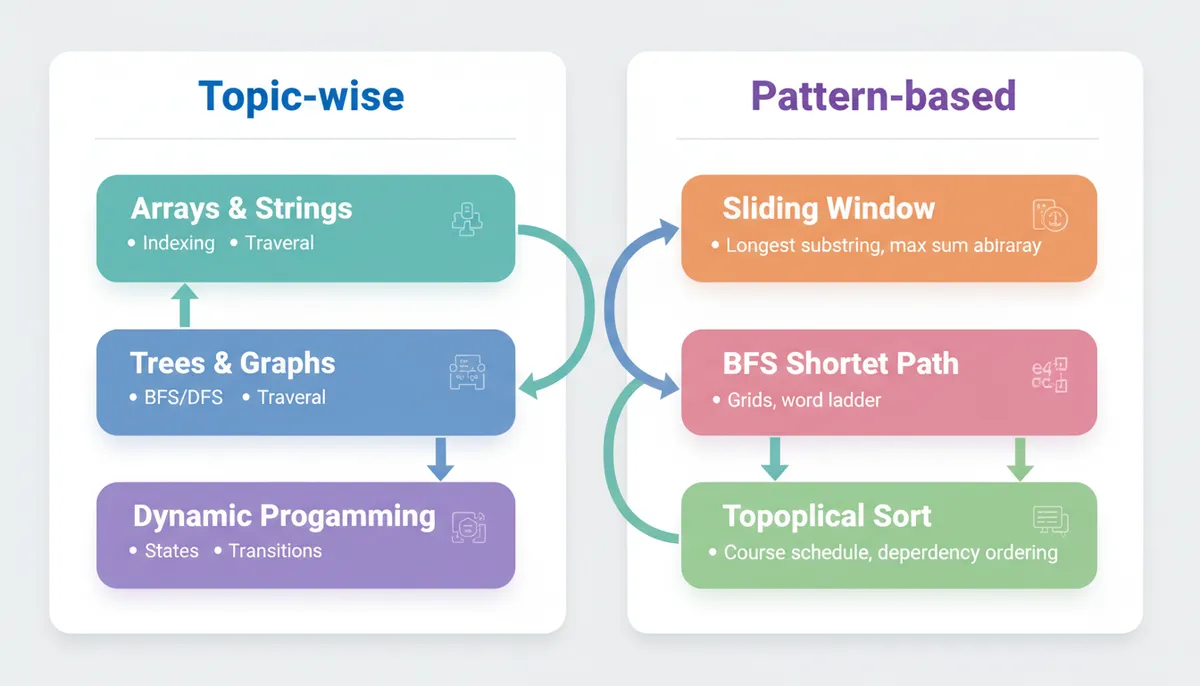
This visualization highlights:
- Topics are containers of tools.
- Patterns are ways of using those tools effectively.
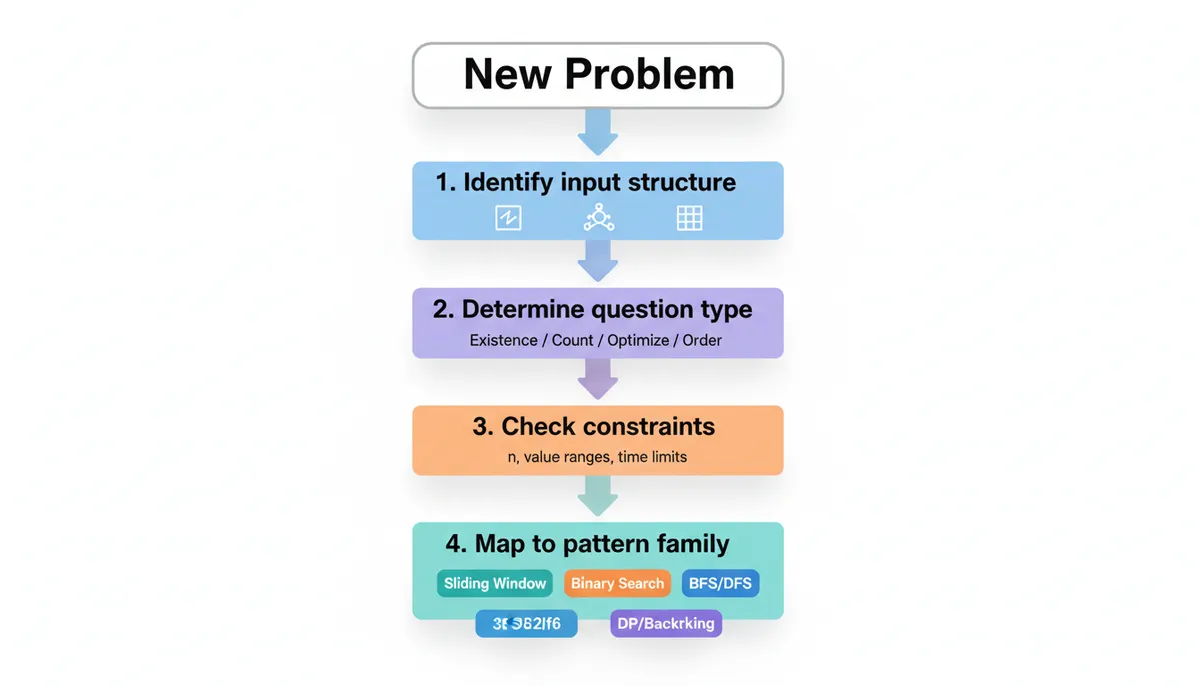
Practical Checklist: Identifying Patterns During an Interview
When you read a new problem, run through a mental checklist:
-
What is the input structure?
- Array / String → two pointers, sliding window, prefix sum, sorting + greedy
- Linked List → fast & slow pointers, in-place manipulation
- Tree / Graph → BFS, DFS, topological sort, DP on trees
- Grid / Matrix → BFS/DFS, multi-source BFS, union-find
-
What is the question type?
- Existence: “Is there a …?” → often BFS/DFS, binary search
- Count: “How many …?” → combinatorics, DP, prefix sums
- Optimize: “Maximum/Minimum …?” → sliding window, DP, greedy, binary search on answer
- Order: “In what order …?” → topological sort, sorting + greedy
-
What are the constraints?
- n up to 1e5 or 1e6 → O(n) or O(n log n) needed
- Graph edges up to 1e5 → adjacency list + BFS/DFS
- Values small (e.g., <= 1000) → maybe frequency array or DP on value dimension
-
Which pattern family does this resemble?
- “This looks like sliding window with a constraint on distinct elements.”
- “This looks like multi-source BFS from all starting points.”
- “This looks like DP on subsequences (LCS-like).”
Over time, this checklist becomes automatic.
Example: Same Topic, Different Patterns
Consider three “Tree” problems:
-
Binary Tree Level Order Traversal
- Pattern: BFS level order
- Key idea: Use a queue, process nodes level by level.
-
Binary Tree Maximum Path Sum
- Pattern: DFS + DP on trees
- Key idea: At each node, compute best downward path and use it to update global maximum.
-
Course Schedule (prerequisites as edges)
- Topic: Graph (DAG)
- Pattern: Topological sort (Kahn’s algorithm or DFS)
Topic-wise, they’re all “tree/graph” problems. Pattern-wise, they’re fundamentally different.
Best Practices for Building a Pattern-Based LeetCode Preparation Strategy
-
Maintain a personal pattern notebook
For each pattern:
- Name: e.g., “Sliding Window – at most K distinct”
- Template: pseudocode or code skeleton
- Common variations: at most K, exactly K, longest/shortest, count of subarrays
- 2–3 example problems you’ve solved
-
Explain patterns out loud
Practice explaining:
- When to use the pattern
- Why it works
- Complexity and trade-offs
This directly translates to better interview communication.
-
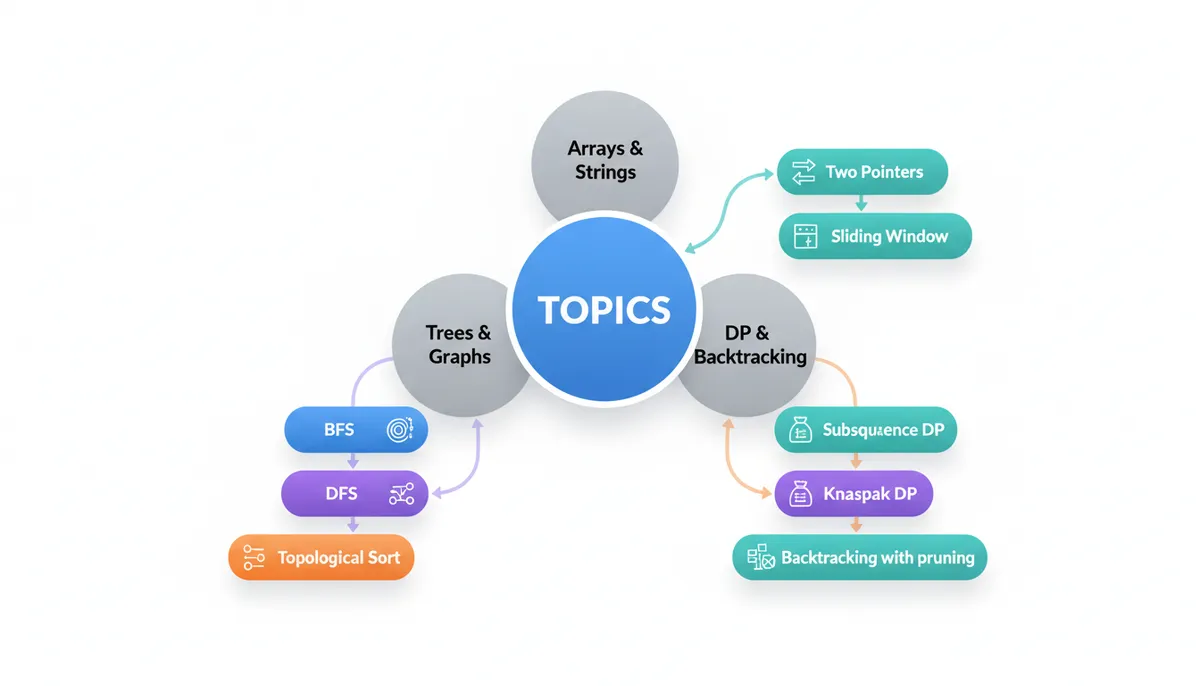
Cross-link topics and patterns
For example:
- Arrays & Strings → two pointers, sliding window, prefix sums
- Trees & Graphs → BFS, DFS, topological sort, DP on trees
- DP → 1D, 2D, knapsack, subsequences, intervals
Build a mental map: each topic → which patterns are most common.
-
Regularly do mixed-pattern sessions
Instead of only focusing on one pattern per day, occasionally:
- Pick 4–5 random problems.
- Force yourself to identify the pattern before coding.
- If you misclassify, review your pattern library.
-
Use feedback loops
After each mock interview or timed session:
- Classify each problem by pattern.
- Ask: “Did I recognize the pattern quickly? If not, why?”
- Update your notebook with new variations.
So… LeetCode Patterns vs Topic-Wise Preparation: Which One Wins?
If you have to choose a primary organizing principle for serious interview prep, patterns win:
- They match how interview problems are constructed.
- They improve recognition and implementation speed.
- They compress hundreds of problems into manageable mental models.
However:
- Topic-wise prep is essential early on to build the raw tools.
- Patterns without fundamentals lead to brittle understanding.
- The most effective coding interview strategy uses topics for foundations and patterns for mastery and speed.
In practice:
- Use topics to learn what data structures and algorithms exist.
- Use patterns to learn how to apply them under time and pressure.
Key Takeaways
- Topic-wise preparation (arrays, trees, DP) is great for foundations but weak for transfer.
- LeetCode patterns (sliding window, BFS, topological sort, etc.) capture reusable problem-solving templates.
- Effective LeetCode preparation strategy:
- Phase 1: Build topic fundamentals.
- Phase 2: Organize practice around patterns, not tags.
- Phase 3: Mix random problems and mock interviews to test pattern recognition.
- Avoid grinding hundreds of problems without extracting patterns; focus on recognition, adaptation, and explanation.
- Think in terms of DSA patterns vs topics: topics give you tools; patterns teach you how to use them effectively.
If you structure your prep this way, you’ll stop asking “Have I seen this exact problem before?” and start asking the much more powerful question: “Which pattern does this problem belong to, and how do I adapt it?”
Related on Thita
Your next step
Master DSA patterns
99 patterns and 410 problems, free to browse and solve in the browser.