
DSA
Most Important DSA Topics for Coding Interviews (Ranked by Frequency)
Most candidates don’t fail coding interviews because they’re “bad at algorithms.” They fail because they study everything a little instead of a few important...
Most candidates don’t fail coding interviews because they’re “bad at algorithms.” They fail because they study everything a little instead of a few important DSA topics deeply.
If you look at real interview loops at companies like Google, Meta, or Stripe, you’ll notice the same patterns: arrays, strings, trees, graphs, and a small set of classic techniques show up again and again. This post ranks the most important DSA topics for coding interviews by frequency, explains why they matter, and shows you how to study them effectively.
We’ll focus on the 20% of data structures and algorithms that generate 80% of the dsa interview questions you’ll actually see.
1. Arrays & Strings (Most Frequent)
If you only mastered one category of coding interview topics, it should be arrays and strings. They’re simple to define, but they’re where companies test your problem-solving patterns, complexity trade-offs, and code clarity.
Typical question families:
- Two pointers (e.g., 2-sum in sorted array, remove duplicates)
- Sliding window (e.g., longest substring without repeating characters)
- Prefix sums and difference arrays
- In-place modification (rotate array, reverse words)
- Frequency counting / hash maps over arrays or strings
1.1 Core Techniques: Two Pointers & Sliding Window
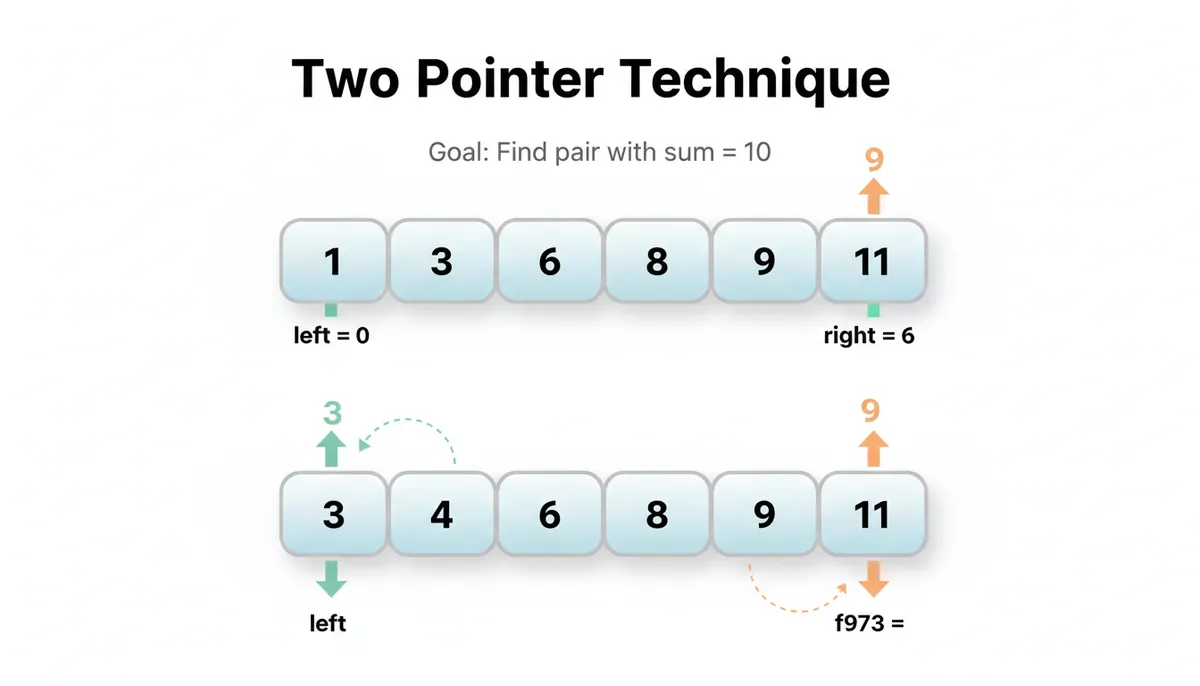
Two pointers and sliding window are the highest-yield patterns in all of DSA.
Two Pointers
Use when:
- The data is in a sorted array or a sequence where order matters
- You need to find pairs/triples that satisfy a condition
- You want to do in-place partitioning
Canonical examples:
- Check if array has a pair that sums to target (sorted)
- Reverse an array or string in-place
- Partition negatives and positives
Example: Reverse a string in-place
PYTHON
- Time: O(n)
- Space: O(1)
Sliding Window
Use when:
- You need the best/longest/shortest subarray or substring satisfying a constraint
- The constraint can be updated incrementally as you move start/end indices
Common patterns:
- Fixed-size window: maximum sum of subarray of size k
- Dynamic window: longest substring with at most k distinct characters
Example: Longest substring without repeating characters
PYTHON
- Time: O(n)
- Space: O(min(n, alphabet_size))
For a deeper dive into these techniques, you can explore the comprehensive Master the Two Pointer Pattern: Complete Guide with Examples and Master Sliding Window: 4 templates for Coding Interviews which cover practical implementations and variations.
1.2 Prefix Sums & Frequency Counting
These show up in many frequently asked DSA questions involving ranges or counts.
Prefix sums:
- Use when you need repeated range sums or counts:
sum[l..r] - Precompute
prefix[i] = sum of nums[0..i-1]so thatsum[l..r] = prefix[r+1] - prefix[l]
Frequency counting / hash maps:
- Count characters, numbers, or patterns
- Used in anagrams, majority element variants, subarray sum equals k, etc.
2. Hash Maps & Sets (Hashing)
Hash-based structures are the backbone of many optimized solutions. They turn many O(n²) brute-force checks into O(n).
Typical uses:
- Membership checks in O(1) average time
- Counting frequencies
- Caching / memoization
- Detecting duplicates, cycles, visited states
2.1 Classic Hash Map Interview Patterns
-
Two Sum (unsorted)
- Store
value -> indexwhile iterating. - Check if
target - valueis already in map.
- Store
-
Subarray Sum Equals K
- Use prefix sums and a map from prefix sum to count.
- For each prefix sum
curr, number of subarrays ending here with sumkiscount[curr - k].
-
Group Anagrams
- Key: sorted string or character count tuple.
- Value: list of words.
Example: Two Sum using hash map
PYTHON
- Time: O(n)
- Space: O(n)
3. Linked Lists
Linked lists test your ability to manage pointers, edge cases, and in-place operations.
Frequently asked linked list questions:
- Reverse a linked list (iterative and recursive)
- Detect cycle (Floyd’s tortoise and hare)
- Merge two sorted lists
- Remove N-th node from end
- Find middle of list
3.1 Pointer Manipulation Patterns
You’ll see these patterns repeatedly:
- Two pointers (fast/slow):
- Find middle node
- Detect cycle, find cycle start
- Dummy head node:
- Simplify insert/delete at head
- In-place reversal:
- Reverse entire list or sublist
Example: Reverse a singly linked list (iterative)
PYTHON
- Time: O(n)
- Space: O(1)
For more on linked list manipulations and patterns, see Master Linked List Manipulation Patterns: 5 templates for Coding Interviews.
4. Binary Search (and Variants)
Binary search is not just “search in sorted array.” It’s a general pattern for searching in monotonic spaces (where a predicate switches from false to true once).
High-frequency uses:
- Search in sorted array / rotated sorted array
- Find first/last occurrence
- Find minimum/maximum feasible value (answer space binary search)
- Search on answer: minimum capacity, minimum time, etc.
4.1 Classic Binary Search Template
PYTHON
4.2 Binary Search on Answer
Use when:
- You’re asked for a minimum/maximum value that satisfies some condition.
- You can write a function
can(x)that is:- Monotonic: if
can(x)is true, thencan(y)is true for ally > x(or the reverse).
- Monotonic: if
Examples:
- Minimum capacity to ship packages within D days
- Minimum eating speed (Koko eating bananas)
- Allocate books to minimize maximum pages per student
For detailed templates, refer to Master Binary Search Patterns: 5 templates for Coding Interviews.
5. Trees (Binary Trees & BSTs)
Trees are a core part of important DSA topics because they combine recursion, traversal, and structural reasoning.
Common patterns:
- DFS (preorder, inorder, postorder)
- BFS (level-order)
- Recursive problem decomposition: solve for left and right subtrees, then combine
- Binary Search Tree (BST) invariants
5.1 Binary Tree Traversals
You should be able to implement all of these quickly.
Recursive DFS traversals:
PYTHON
5.2 High-Frequency Tree Questions
- Maximum depth / balanced tree check
- Diameter of binary tree
- Lowest common ancestor (LCA)
- Path sum variants
- Serialize / deserialize binary tree
These often follow a pattern:
- Define what each recursive call should return.
- Combine children results to compute the answer at the current node.
- Track global state if needed (e.g., maximum).
For a comprehensive guide, check out Master Tree Traversal Patterns (DFS & BFS): 6 templates for Coding Interviews.
6. Graphs (BFS, DFS, and Topological Sort)
Graph questions are less frequent than arrays/strings/trees, but they’re critical for mid/senior roles and system-oriented interviews.
Core patterns:
- BFS for shortest path in unweighted graphs
- DFS for connectivity and cycle detection
- Topological sort for DAGs (dependency ordering)
- Union-Find (Disjoint Set Union) for connectivity and cycle detection in undirected graphs
6.1 BFS and DFS Templates
BFS (queue-based):
PYTHON
Use BFS for:
- Shortest path in unweighted graphs
- Level-order traversal
- Multi-source BFS (initialize queue with multiple starting nodes)
DFS (recursive or stack-based):
PYTHON
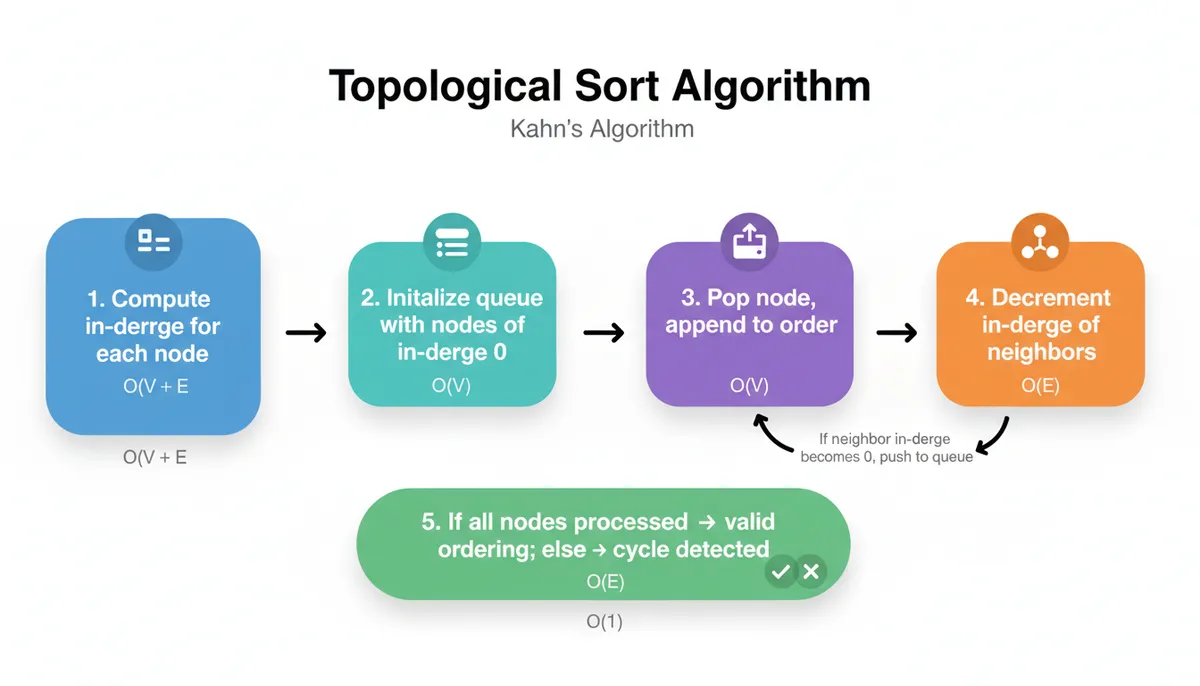
6.2 Topological Sort (Kahn’s Algorithm)
Used for:
- Course schedule / dependency resolution
- Detecting cycles in directed graphs
High-level steps:
- Compute in-degree of each node.
- Initialize queue with nodes of in-degree 0.
- Repeatedly pop from queue, decrement neighbors’ in-degree, enqueue new zeros.
For more on graph traversal and topological sort patterns, see Master Graph Traversal Patterns (DFS & BFS): 11 templates for Coding Interviews.
7. Heaps & Priority Queues
Heaps show up in scheduling, streaming, and “k-th something” questions.
Common uses:
- Find k-th smallest/largest element
- Merge k sorted lists
- Maintain top-k elements in a stream
- Dijkstra’s algorithm (shortest path in weighted graph)
7.1 k-th Largest Element
Using a min-heap of size k:
PYTHON
- Time: O(n log k)
- Space: O(k)
7.2 Merge k Sorted Lists
Use a min-heap keyed by node value.
- Push the head of each list into heap.
- Pop smallest, append to result, push its next node.
For detailed heap patterns, see Master Heap (Priority Queue) Patterns: 4 templates for Coding Interviews.
8. Dynamic Programming (DP)
Dynamic programming is one of the most feared and most important DSA topics. Interviewers use it to check whether you can:
- Recognize overlapping subproblems
- Define states and transitions
- Optimize time/space
High-frequency DP families:
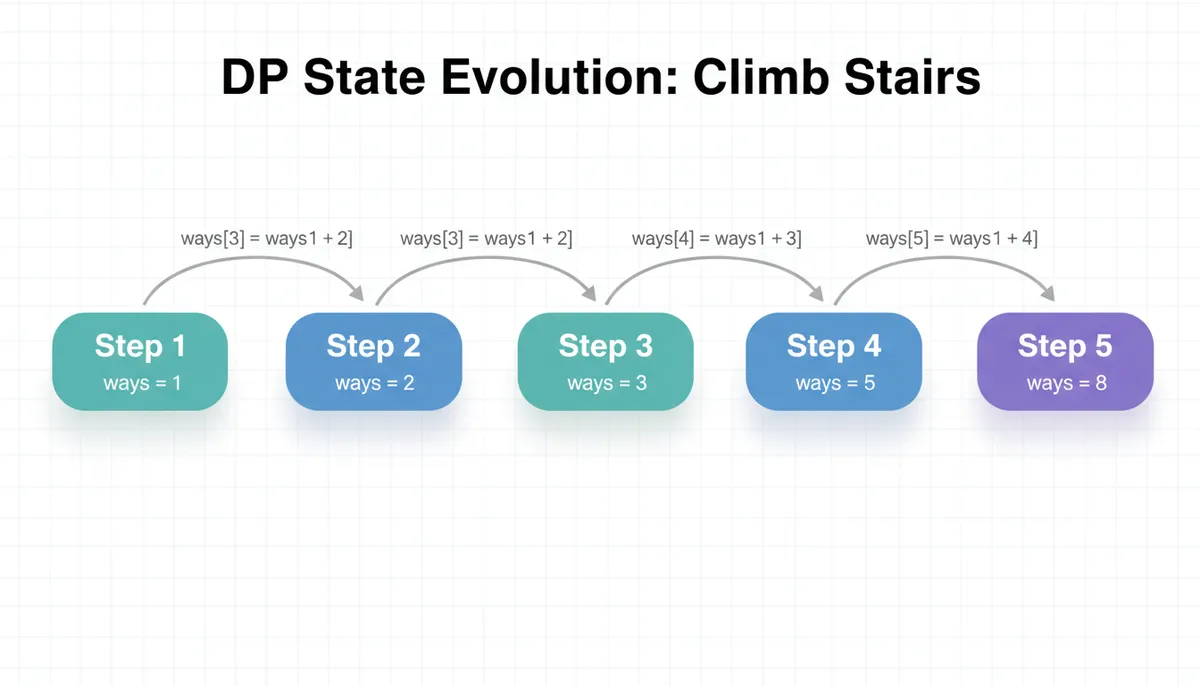
- 1D DP on sequences (climbing stairs, house robber)
- 2D DP on grids (unique paths, min path sum)
- Knapsack-like problems
- String DP (edit distance, longest common subsequence)
8.1 DP Checklist
When you suspect DP:
- Ask: “Can I define the problem in terms of smaller subproblems?”
- Identify dimensions of state (index, remaining capacity, previous choice, etc.).
- Choose bottom-up or top-down with memoization.
- Optimize space if possible.
Example: Climbing Stairs (Fibonacci DP)
PYTHON
- Time: O(n)
- Space: O(1)
For a structured approach, check out Master Dynamic Programming (DP) Patterns: 12 templates for Coding Interviews.
9. Greedy Algorithms
Greedy algorithms make locally optimal choices hoping for a global optimum. They’re common in scheduling, intervals, and resource allocation.
High-frequency greedy questions:
- Interval scheduling (maximum number of non-overlapping intervals)
- Merge intervals
- Minimum number of platforms / rooms (meeting rooms)
- Activity selection
- Simple string/array optimizations (min operations)
Patterns:
- Sort by some key (end time, start time, ratio).
- Iterate and maintain current best choice.
Example: Non-overlapping intervals (erase minimum)
PYTHON
- Time: O(n log n)
- Space: O(1) extra
For more on greedy strategies, see Master Greedy Patterns: 6 templates for Coding Interviews.
10. Common Interview Patterns Across Topics
Most frequently asked DSA questions can be grouped into patterns that cut across data structures:
- Two Pointers / Sliding Window (arrays, strings, linked lists)
- Prefix Sums / Difference Arrays
- Binary Search on Answer
- Backtracking (subsets, permutations, combinations)
- Union-Find (Disjoint Set Union)
You don’t need to memorize 500 problems. You need to internalize ~30–40 patterns and learn to recognize them.
If you want a structured view of these patterns, a pattern-based sheet (like Thita’s The 90 DSA Patterns That Cover 99% of Coding Interviews) can be a useful reference while you practice.
11. Ranking the Most Important DSA Topics by Frequency
Here’s a rough ranking of coding interview topics by how often they appear in standard software engineering interviews (junior to mid-level):
- Arrays & Strings (two pointers, sliding window, prefix sums)
- Hash Maps & Sets
- Linked Lists
- Binary Search
- Binary Trees & BSTs
- Heaps / Priority Queues
- Graphs (BFS/DFS)
- Dynamic Programming (1D, 2D)
- Greedy & Intervals
- Backtracking (subsets, permutations)
- Tries, Advanced Graph Algorithms, Segment Trees, etc. (more common in competitive programming / specialized roles)
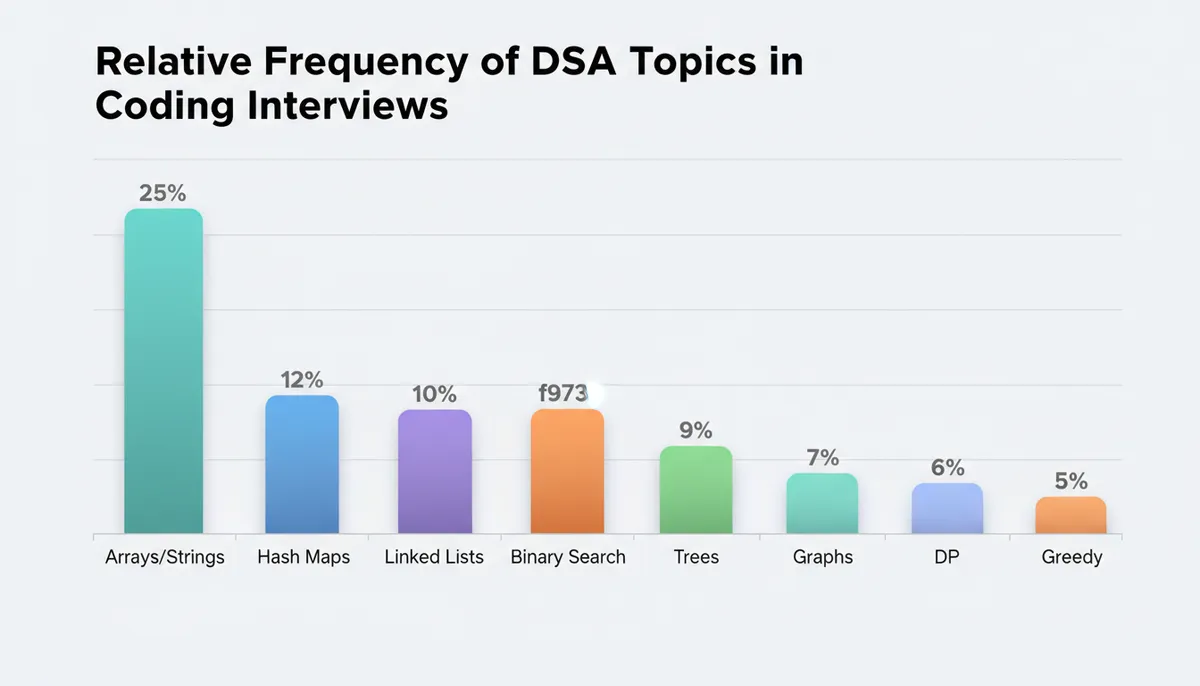
These percentages are approximate and vary by company, but they reflect what you’ll see if you sample many real interview question sets.
12. Common Mistakes and Pitfalls
12.1 Studying Too Broad, Not Deep
- Solving 300 random problems without pattern recognition is low-yield.
- Better: 80–120 problems, deliberately chosen to cover the main patterns, revisited until you can explain them from scratch.
12.2 Ignoring Complexity and Trade-Offs
Interviewers care about:
- Time and space complexity
- Why you chose a hash map vs. sorting vs. two pointers
- How your solution scales
Always:
- State brute-force approach first.
- Then explain the optimization and its complexity.
12.3 Not Practicing Under Constraints
- Solving with unlimited time is different from a 30–45 minute interview.
- You need to practice thinking out loud, clarifying requirements, and iterating on design.
A lightweight way to do this is to simulate real interviews (e.g., with a friend or an AI mock interviewer such as Thita’s AI Interview Practice: Free Mock Interview Simulator with Real-Time Feedback for Technical Interviews) and treat them as real sessions, including constraints and feedback.
12.4 Weak Handling of Edge Cases
Common edge cases:
- Empty arrays / strings / lists
- Single element
- All duplicates / all same value
- Negative numbers and zero
- Very large inputs (n up to 10^5 or 10^6)
Train yourself to:
- Ask clarifying questions about constraints.
- Verbally enumerate edge cases before coding.
- Add simple tests after coding.
13. Best Practices for Mastering Important DSA Topics
13.1 Follow a Pattern-First Study Plan
Organize your practice around patterns, not problem sources:
- Arrays & Strings with Two Pointers and Sliding Window
- Hash Maps & Sets
- Linked Lists
- Binary Search
- Trees
- Graphs
- Heaps
- DP & Greedy
For each pattern:
- Learn a canonical problem.
- Implement from scratch without looking.
- Explain the reasoning and complexity.
- Solve 3–5 variations.
13.2 Use Deliberate Practice
For each question:
- Classify: What category and pattern is this?
- Brute Force: State the naive solution and its complexity.
- Optimize: Identify the bottleneck and pattern that fixes it.
- Code: Clean, readable code with clear variable names.
- Review: After seeing the solution, re-implement a day later from memory.
13.3 Maintain a Personal “Pattern Notebook”
- Keep short notes with:
- Problem name
- Category and pattern
- Key idea (1–3 lines)
- Time/space complexity
- Revisit this notebook before interviews.
14. Key Takeaways
- A small set of important DSA topics covers the majority of coding interview topics you’ll see in practice.
- The highest-frequency categories are: arrays/strings, hash maps, linked lists, binary search, trees, and heaps, followed by graphs, DP, and greedy.
- Within each category, focus on patterns (two pointers, sliding window, prefix sums, DFS/BFS, binary search on answer, classic DP forms) rather than isolated problems.
- Avoid common pitfalls: don’t study too broadly, don’t ignore complexity, and always practice with edge cases and time constraints in mind.
- A structured, pattern-based approach plus deliberate practice is far more effective than grinding hundreds of random dsa interview questions.
If you internalize the patterns above and get comfortable applying them under time pressure, you’ll be well-prepared for the most frequently asked DSA questions in modern coding interviews.