
Interview
7-Day, 30-Day, and 90-Day Coding Interview Preparation Plans Compared
Most engineers don’t fail coding interviews because they’re bad at algorithms—they fail because they picked the wrong study plan for their timeline.
Most engineers don’t fail coding interviews because they’re bad at algorithms—they fail because they picked the wrong study plan for their timeline.
If you have 7 days, your coding interview study plan should look nothing like a 90 day coding interview plan. The problem is that many candidates use the same scattered approach regardless of time: random LeetCode, occasional system design videos, last-minute mock interviews.
This guide compares 7-day, 30-day, and 90-day interview prep plans side by side. We’ll break down what’s realistic at each horizon, what to prioritize, and how to structure your days so you’re not guessing.
How to Choose Between 7-Day, 30-Day, and 90-Day Plans
Before diving into details, you need to answer three questions:
-
How much time do you really have per day?
1–2 hours vs 4–5 hours changes everything. -
What’s your starting point?
- Strong at DSA, weak at system design?
- Haven’t coded in 6 months?
- Already doing LeetCode daily?
-
What’s your interview timeline?
- Final round in 7 days
- Phone screen in 3 weeks
- Targeting interviews in 3 months
As a rule of thumb:
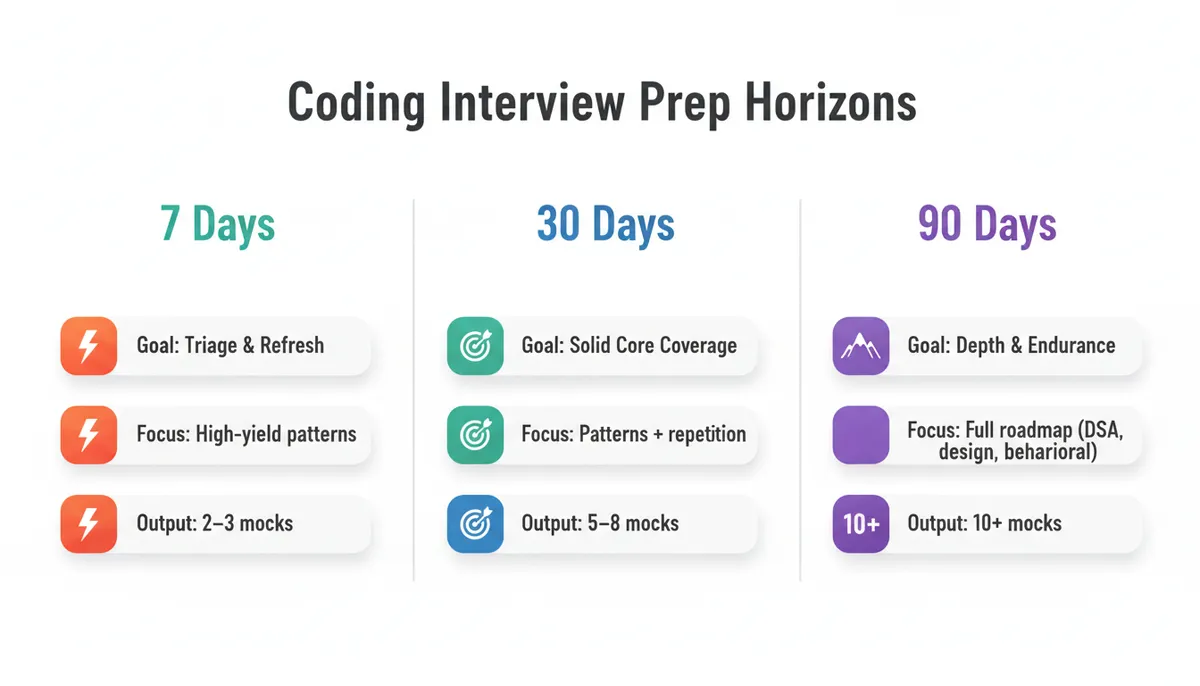
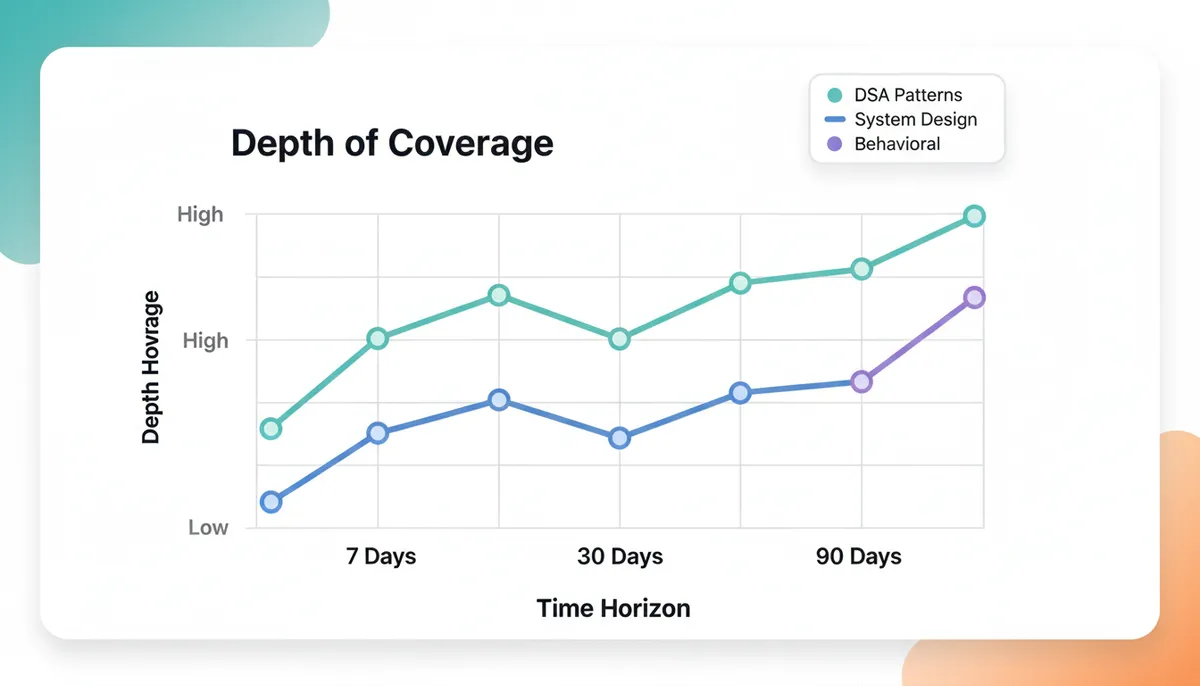
- 7-Day Plan: Triage mode. You already know most topics; you’re optimizing recall, patterns, and confidence.
- 30-Day Plan (30 day interview prep): Focused ramp-up. Enough time to cover core patterns, do targeted practice, and run a few mock interviews.
- 90-Day Plan (90 day coding interview plan): Full technical interview roadmap. You can build depth, breadth, and endurance across DSA, system design, and behavioral.
The rest of this article shows what each plan should realistically include and how to execute.
Core Principles for Any Coding Interview Study Plan
Regardless of whether you have 7, 30, or 90 days, good plans share the same backbone.
1. Pattern-Based Learning Over Problem Memorization
Top candidates don’t remember 500 problems; they recognize patterns:
- Sliding window
- Two pointers
- Fast & slow pointers
- Binary search on answer
- Topological sort
- DFS/BFS on trees/graphs
- Dynamic programming (knapsack, subsequences, intervals, DP on trees)
- Greedy strategies
- Prefix sums / difference arrays
A platform like Thita’s DSA patterns sheet (94 patterns across 15 categories) is designed around this idea: you learn a pattern, then apply it to many problems.
2. Tight Feedback Loops
You learn fastest when you:
- Attempt a problem under time pressure.
- Code a full solution.
- Compare to an optimal pattern-based solution.
- Reflect: “What pattern did I miss? What did I misread? Where did I get stuck?”
Mock interviews (with peers, mentors, or tools like AI Interview Practice: Free Mock Interview Simulator with Real-Time Feedback for Technical Interviews) tighten this loop by adding pressure and verbal reasoning.
3. Balanced Coverage
A complete technical interview roadmap should cover:
- Data structures & algorithms
- System design (for mid-level+ roles)
- Behavioral & past project deep dives
- Language & tooling fluency (e.g., Java collections, Python built-ins, debugging)
The shorter your timeline, the more aggressively you must prioritize.
The 7-Day Coding Interview Study Plan: Emergency Mode
A 7-day plan is not where you learn DSA from scratch. It’s damage control and optimization.
This plan assumes:
- You’ve seen core patterns before.
- You have at least 3–4 hours/day.
- You have interviews already scheduled.
Goals for a 7-Day Plan
- Refresh key DSA patterns and recall.
- Practice solving under time constraints.
- Rehearse your explanation style and communication.
- Prepare your top 5–7 behavioral stories.
Day-by-Day Breakdown (7 Days)
Day 1–2: High-Yield DSA Patterns
Focus on patterns that appear most frequently:
- Arrays & strings
- Two pointers
- Sliding window
- Prefix sums
- Hashing
- Hash map / set usage
- Frequency counting
- Trees & graphs
- DFS/BFS templates
- Basic dynamic programming
- 1D DP (e.g., climbing stairs, house robber)
- 2D DP (e.g., grid paths, edit distance if you have time)
Practice structure per problem (max 40–45 minutes):
- 5–7 minutes: Clarify problem, restate, define examples.
- 10–15 minutes: Derive approach, identify pattern.
- 15–20 minutes: Code with clean structure and edge cases.
- 5 minutes: Dry run on examples, analyze complexity.
Day 3–4: Timed Sets + Weak Areas
- Do 2–3 timed sets per day:
- 2 easy + 2 medium in 60–75 minutes.
- After each set, categorize:
- Missed pattern?
- Implementation bug?
- Misread constraints?
Target your weak spots:
- If you’re struggling with trees → focus on DFS/BFS, recursion.
- If DP is your gap → pick 3–4 canonical DP problems and focus on state & transitions.
Day 5: System Design (If Relevant)
For mid/senior roles:
- Review 2–3 canonical designs:
- URL shortener
- News feed / timeline
- Rate limiter
- Focus on:
- High-level components (API layer, service layer, DB, cache, message queue)
- Tradeoffs: SQL vs NoSQL, consistency vs availability
- Bottlenecks and scaling strategies
For junior roles or if system design is not evaluated, spend this day on:
- Graphs & DP
- Additional mock coding interviews
Day 6: Behavioral & Project Deep Dives
- Prepare STAR stories for:
- Conflict
- Failure
- Ambiguity
- Leadership/ownership
- Impact
- For each major project on your resume:
- Architecture diagram
- Key tradeoffs
- Performance/scaling considerations
- Your specific contributions
Day 7: Full Simulation Day
- Morning: 1–2 mock coding interviews.
- Afternoon: 1 system design (if applicable).
- Evening: Light review of notes and patterns, sleep early.
The 30-Day Coding Interview Study Plan: Focused Ramp-Up
A 30 day interview prep timeline is where most candidates land. It’s enough time to rebuild fundamentals and do iterative practice, but not enough to waste on unstructured grinding.
Assumptions:
- You can commit 2–4 hours/day.
- You have basic familiarity with at least one programming language.
- You might be rusty on algorithms or system design.
Goals for a 30-Day Plan
- Cover all core DSA patterns at least once.
- Build muscle memory via repetition.
- Run multiple mock interviews.
- Prepare structured behavioral answers and project narratives.
Weekly Structure (4 Weeks)
Week 1: Foundations & Patterns
Focus on:
- Arrays & strings
- Hash maps/sets
- Two pointers
- Sliding window
- Basic recursion & backtracking
Daily routine (2–4 hours):
- 30–45 min: Pattern study
- Read/recall the pattern.
- Understand 1–2 canonical examples.
- 90–120 min: Problem practice
- 3–5 problems around today’s pattern.
- 30–45 min: Review + notes
- Summarize “pattern recognition triggers”:
- “Fixed/variable length subarray with condition → sliding window”
- “Pair/sum with sorted array → two pointers”
- Summarize “pattern recognition triggers”:
Week 2: Trees, Graphs, and More Patterns
Focus on:
- Binary trees & BSTs
- DFS & BFS
- Graph representation (adjacency list/matrix)
- Basic topological sort
- Intro to dynamic programming
Daily routine:
- 1 day: Tree traversals (preorder, inorder, postorder, level-order).
- 1 day: Tree problems (LCA, diameter, path sum).
- 1 day: Graph traversal (BFS for shortest path, DFS for connectivity).
- 2 days: Intro DP problems:
- Climbing stairs
- Coin change
- Longest increasing subsequence (if time)
Week 3: Dynamic Programming & Mixed Sets
Focus on:
- 1D DP (knapsack-like, linear DP)
- 2D DP (grid-based, subsequences)
- Mixed sets that combine patterns.
Daily routine:
- 2–3 days: DP deep dive
- Identify state:
dp[i]ordp[i][j] - Transition logic
- Base cases
- Space optimization (if relevant)
- Identify state:
- 2–3 days: Mixed problem sets
- 1 array/string
- 1 tree/graph
- 1 DP/greedy
This builds context switching similar to real interviews.
Week 4: System Design, Behavioral, and Mocks
- 2–3 days: System design (if applicable)
- Learn a repeatable structure:
- Clarify requirements.
- Define APIs and data model.
- Draw high-level architecture.
- Handle scaling: load, storage, caching, partitioning.
- Walk through 2–3 example systems.
- Learn a repeatable structure:
- 2 days: Behavioral & resume
- STAR stories.
- Project deep dives.
- 2–3 days: Mock interviews
- 3–5 coding mocks.
- 1–2 system design mocks.
The 90-Day Coding Interview Study Plan: Full Roadmap
A 90 day coding interview plan is ideal if you’re:
- Changing jobs proactively.
- Switching into software engineering.
- Rebuilding after a long break.
You have time to build depth, not just breadth.
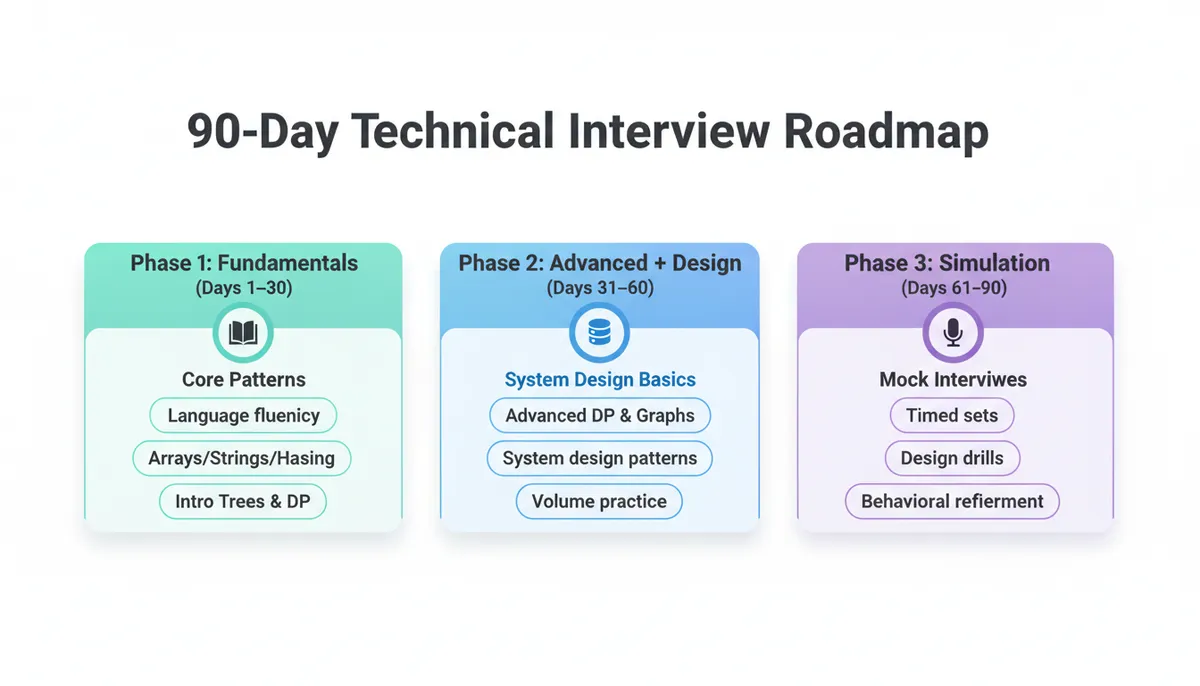
High-Level Phases (90 Days)
- Phase 1 (Days 1–30): Fundamentals & core patterns.
- Phase 2 (Days 31–60): Advanced patterns, system design basics, more volume.
- Phase 3 (Days 61–90): Interview simulation, refinement, and endurance.
Phase 1 (Days 1–30): Fundamentals
Similar to the 30-day plan, but with more breathing room.
Focus on:
- Language fluency (collections, idioms, debugging).
- Arrays, strings, hash maps/sets.
- Two pointers, sliding window.
- Basic recursion/backtracking.
- Trees and graphs.
- Intro DP.
You can afford to:
- Implement data structures manually (linked list, stack, queue, simple tree).
- Re-solve problems after a few days to reinforce memory.
Phase 2 (Days 31–60): Advanced Topics & System Design
Add:
- More complex DP:
- Subsequence problems (LCS, LIS).
- Partitioning, palindromes.
- Graph algorithms:
- Topological sort (Kahn’s algorithm).
- Dijkstra (if relevant).
- Advanced patterns:
- Binary search on answer.
- Sweep line, intervals.
- Trie (if relevant to your target roles).
System design (especially for mid/senior):
- Learn common building blocks:
- Load balancers
- Caches (Redis)
- Message queues (Kafka)
- Databases (SQL vs NoSQL)
- Design 4–6 systems:
- URL shortener
- Chat application
- News feed
- File storage (like Dropbox)
- Rate limiter
Phase 3 (Days 61–90): Simulation & Refinement
Now you shift from “learning” to “performing”.
- Coding:
- 3–4 timed sessions per week:
- 2 mediums in 45–60 minutes.
- Occasionally 1 hard.
- Re-solve previously missed problems.
- 3–4 timed sessions per week:
- System design:
- 1–2 designs per week, time-boxed to 45–60 minutes.
- Behavioral:
- Practice aloud.
- Record yourself and review clarity and structure.
- Mocks:
- 1–2 mock interviews per week, ramping to 2–3/week in the last 2–3 weeks.
Example: Pattern-Based Problem Approach (with Code)
To make this concrete, here’s how a pattern-based mindset looks on a common interview problem.
Problem:
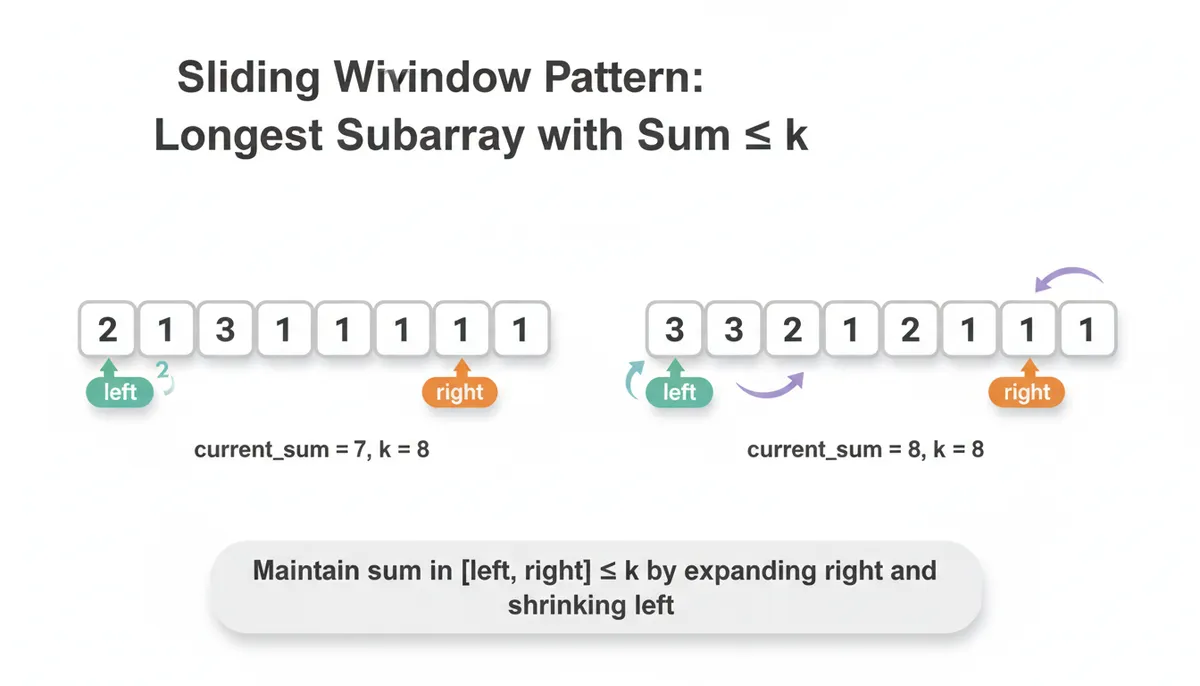
Given an array of integers nums and an integer k, return the length of the longest subarray with sum ≤ k.
Step 1: Recognize the Pattern
- We’re dealing with:
- A subarray (contiguous)
- A constraint on sum
- This often maps to a sliding window pattern (if all numbers are non-negative).
Assume all numbers are non-negative (you should clarify this in an interview).
Step 2: Sliding Window Solution (Python)
PYTHON
Key interview behaviors to show:
- You identified the sliding window pattern.
- You explained why it works (non-negative numbers → window only grows/shrinks one way).
- You handled edge cases (empty array, k < 0, etc.).
- You stated time and space complexity.
Common Mistakes Across All Timelines
Regardless of whether you choose a 7-day, 30-day, or 90-day plan, certain mistakes are extremely common.
1. Random Problem Grinding
Symptoms:
- Solving whatever comes up in a feed.
- No tracking of patterns or topics.
- Can’t articulate why a solution works.
Fix:
- Group problems by pattern.
- Maintain a simple log:
- Problem
- Pattern
- Mistake type (logic, implementation, misread)
- Notes for next time
2. Ignoring Explanation & Communication
Many candidates can code but struggle to:
- Explain their approach clearly.
- Justify tradeoffs.
- Think out loud.
Fix:
- Practice verbalizing:
- Restate the problem.
- Enumerate brute-force and optimized approaches.
- Walk through examples out loud.
- Use mock interviews or tools like Mock Interviews: How to Use Them Effectively for Faster Improvement to simulate explaining to another person.
3. Over-Indexing on Hard Problems
Spending 2 hours stuck on a single hard problem is often lower ROI than solving 3–4 mediums.
Fix:
- For short timelines (7–30 days): prioritize easy + medium problems across patterns.
- For 90 days: introduce hard problems only after you’re consistent on mediums.
4. Neglecting Behavioral and System Design
Even for coding-heavy roles, behavioral and system design can be decisive.
Fix:
- Allocate explicit days (especially in 30- and 90-day plans).
- Prepare structured stories and at least a few standard designs.
Best Practices for Each Timeline
7-Day Plan Best Practices
- Be brutally selective. Focus only on patterns and topics you’re most likely to see.
- Do small, frequent mocks. Even 30-minute sessions help.
- Optimize sleep and energy. Cognitive performance matters more than squeezing in one extra problem at 1 a.m.
30-Day Plan Best Practices
- Weekly retrospectives.
- What patterns are still weak?
- Which mistakes are recurring?
- Mix repetition with new material.
- Re-solve previously failed problems after a few days.
- Simulate at least one full “interview week”.
- 3–4 mocks in a week to test endurance.
90-Day Plan Best Practices
- Phase your learning. Don’t try to do everything at once.
- Build depth projects.
- Implement a small system that you can discuss in design/behavioral rounds.
- Track progress quantitatively.
- Problems solved by pattern.
- Mock interview scores or feedback themes.
- Time to solve typical medium problems.
How to Decide: 7, 30, or 90 Days?
If you’re still unsure which plan to follow, use this quick guide:
-
Choose 7-Day Plan if:
- Interviews are already scheduled within a week.
- You’ve done DSA before and just need a refresher.
- You can commit 3–5 hours/day briefly.
-
Choose 30-Day Plan if:
- Interviews are 3–6 weeks away.
- You know basics but feel rusty or inconsistent.
- You can commit 2–4 hours/day.
-
Choose 90-Day Plan if:
- You’re proactively job searching or switching fields.
- You want a complete technical interview roadmap including DSA, design, and behavioral.
- You can commit 1–3 hours/day for a longer period.
Key Takeaways
- A good coding interview study plan is shaped by your time horizon, not by what others are doing.
- 7-Day Plan: Triage and refresh high-yield patterns, plus a few mocks.
- 30-Day Plan: Systematic coverage of core patterns, mixed problem sets, system design intro, and several mocks.
- 90-Day Plan: Full roadmap—deep DSA, system design fundamentals, behavioral mastery, and consistent simulations.
- Pattern-based learning, tight feedback loops, and deliberate practice matter more than raw problem count.
- Don’t neglect system design and behavioral; they’re integral to the overall evaluation.
With a realistic plan aligned to your timeline, your preparation becomes a controlled process instead of a last-minute scramble.