
Interview
Mock Interviews: How to Use Them Effectively for Faster Improvement
Most engineers know they “should” do mock interviews, but few use them in a way that actually accelerates improvement. Many treat mock interviews like one-of...
Most engineers know they “should” do mock interviews, but few use them in a way that actually accelerates improvement. Many treat mock interviews like one-off practice exams: show up, struggle through a problem, get a vague “you did fine” at the end, and move on. Then they’re surprised when real technical interviews still feel chaotic.
Used correctly, mock interviews are not just practice—they’re a tight feedback loop for your technical interview prep. They help you debug your thinking, your communication, and your decision-making under pressure.
This post walks through how to use mock interviews systematically so each session compounds your skills, rather than just burning an hour on LeetCode with an audience.
Why Mock Interviews Work (When Done Right)
Mock interviews are powerful because they compress the full interview experience into a repeatable, analyzable unit. Each session gives you:
- A realistic time constraint
- A problem (or set of problems) at interview-level difficulty
- A human or AI interviewer simulating expectations
- Immediate and delayed feedback
That’s essentially a closed-loop control system: you perform, observe the outcome, adjust, and repeat. The quality of that loop—its frequency, precision, and specificity—determines how fast you improve.
Contrast this with solo grinding:
- You pick problems you’re comfortable with
- You can “cheat” by looking at hints early
- You rarely practice explaining tradeoffs out loud
- You rarely get feedback on your communication or structure
Mock interviews force you to practice the whole stack: problem solving + communication + time management + stress management.
Types of Mock Interviews (and When to Use Each)
Not all mock interviews are the same. You’ll improve faster if you match the format to your current goal.
1. Algorithm / DSA Mock Interviews
Focus: Data structures, algorithms, and coding under time pressure.
Typical format:
- 45–60 minutes
- 1–2 coding problems (e.g., medium + follow-up)
- Expectation: think aloud, propose approach, code, test, optimize
Best for:
- Practicing patterns (sliding window, two pointers, graphs, DP, etc.)
- Building fluency in coding on a whiteboard or shared editor
- Debugging your problem-solving process
If you’re using a pattern-based resource (like a DSA patterns sheet), align your mock problems with patterns you’re currently focusing on.
2. System Design Mock Interviews
Focus: Designing scalable systems and communicating architecture clearly.
Typical format:
- 45–60 minutes
- One open-ended design problem (e.g., “Design Twitter feed”, “Design URL shortener”)
- Expectation: clarify requirements, propose high-level design, reason about tradeoffs, handle deep dives
Best for:
- Mid-level and senior roles
- Practicing structured thinking under ambiguity
- Improving your ability to verbalize tradeoffs
3. Behavioral / Leadership Mock Interviews
Focus: Past experience, teamwork, conflict resolution, leadership.
Typical format:
- 30–45 minutes
- Question-driven: “Tell me about a time when…”
- Expectation: concise, structured stories (e.g., STAR: Situation, Task, Action, Result)
Best for:
- Any level, but especially senior roles
- Refining your stories and delivery
- Reducing rambling and improving clarity
4. End-to-End Mock Interview Rounds
Focus: Simulating a real interview loop.
Typical format:
- 2–4 sessions back-to-back (coding, design, behavioral)
- Same constraints as real onsite / virtual onsite
Best for:
- Final 2–3 weeks before real onsites
- Testing your stamina and context switching
- Calibrating your expectations for the real process
How Often Should You Do Mock Interviews?
Think of mock interviews as high-intensity training. Too few, and you don’t adapt. Too many, and you burn out without proper reflection.
A practical guideline:
- Early prep (2–3 months out)
- 1 mock per week (mostly DSA)
- Focus: identifying glaring weaknesses
- Mid prep (1–2 months out)
- 2 mocks per week (mix of DSA + design/behavioral as needed)
- Focus: tightening structure and patterns
- Final stretch (2–3 weeks before onsites)
- 3–4 mocks per week (including at least one end-to-end loop)
- Focus: realism, stamina, and polishing
The key is not just frequency, but what you do between mocks.
The Three Phases of an Effective Mock Interview
Treat each mock interview as a three-phase process:
- Pre-interview setup: Define what you’re practicing
- During the interview: Execute with intention
- Post-interview analysis: Turn feedback into a plan
Phase 1: Pre-Interview – Set a Clear Objective
Going into a mock interview with “I just want practice” is too vague. You’ll get generic feedback and generic improvement.
Instead, define a primary objective and at most one secondary objective.
Examples of good objectives:
- Primary: “Practice systematically exploring brute force → optimized solution”
Secondary: “Improve clarity of communication while coding” - Primary: “Practice graph problems (BFS/DFS) under time pressure”
Secondary: “Focus on verbalizing edge cases before coding” - Primary: “Practice driving a system design conversation”
Secondary: “Use a clear step-by-step structure (requirements → API → data model → architecture)”
Communicate this to your interviewer (human or AI) upfront. It shapes the feedback you get.
Checklist: Pre-Mock Setup
Before each mock interview, answer:
- What is my primary objective for this session?
- What problem types or topics do I want to cover?
- What constraints do I want simulated?
- Time limit strictness
- Hint frequency (none, minimal, normal)
- Level of interruption / probing questions
If you’re using an AI mock interviewer (e.g., something like Thita’s /ai-interview style sessions), configure these parameters intentionally rather than accepting defaults.
Phase 2: During the Mock – Practice the Full Loop
Your goal during the mock is not to “get the problem right at all costs.” It’s to practice the behaviors that predict success in real interviews.
1. Start with Clarifying Questions
For coding interviews:
- Restate the problem in your own words
- Ask about:
- Input constraints (size, ranges)
- Edge cases (empty input, duplicates, negative values)
- Performance expectations (time/space constraints if not stated)
For system design:
- Clarify:
- Functional requirements (what exactly must the system do?)
- Non-functional requirements (scale, latency, availability, consistency)
- Scope (what is out of scope?)
This builds a habit of requirements gathering instead of jumping into coding.
2. Think Aloud with Structure
You want your interviewer to see your reasoning, not just your final answer. A simple mental template for DSA problems:
- Restate the problem in your own words
- Naive approach: describe the brute-force solution
- Constraints check: why brute force may not scale
- Pattern search: relate to known patterns (e.g., sliding window, binary search, DP)
- Choose an approach and explain why
- Outline your algorithm step-by-step before coding
- Code while narrating key decisions
- Test with examples and edge cases
- Optimize or discuss tradeoffs if time allows
You can even say this structure out loud as you go. Interviewers appreciate explicit structure.
3. Code for Readability Under Constraints
In a mock, practice:
- Using clear variable names
- Writing helper functions when they simplify logic
- Keeping functions short and focused
- Commenting only where it clarifies non-obvious decisions
Example (Python):
PYTHON
During the mock, explicitly state the complexity and why this approach is appropriate for the constraints.
4. Test Systematically
Don’t just say “looks good.” Walk through:
- A simple base case
- A slightly more complex normal case
- Edge cases (empty, single element, max sizes, duplicates, etc.)
Narrate your dry run:
- “For input [2, 7, 11, 15], target 9…”
- “At i = 0, num = 2, complement = 7, map is empty…”
- “At i = 1, num = 7, complement = 2, 2 is in map → return [0,1].”
This gives your interviewer confidence in your attention to detail.
5. Manage Time Explicitly
Use time checkpoints:
- At ~10 minutes: confirm understanding and initial approach
- At ~20 minutes: have a concrete plan and start coding
- At ~30 minutes: be coding or debugging
- Last 5–10 minutes: testing, edge cases, complexity discussion
If you’re stuck, say so and request a small hint. Practice how you recover from being stuck—this happens in real interviews too.
Phase 3: After the Mock – Turn Feedback into a Learning Plan
The post-interview analysis is where most of the value lies. Many candidates skip this entirely.
Aim to spend at least as much time analyzing the mock as you spent doing it.
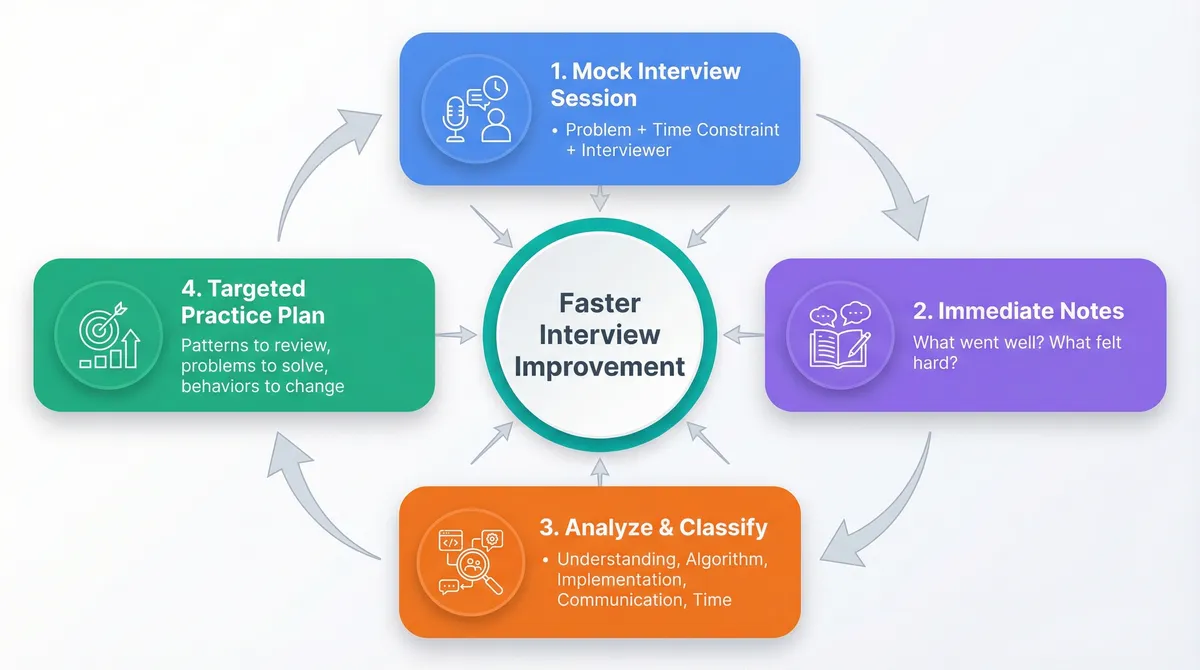
1. Capture Immediate Notes
Right after the session, write down:
- Problems you solved (with brief descriptions)
- Where you got stuck and why
- Feedback from the interviewer (verbatim if possible)
- Your own self-assessment:
- What went well?
- What felt weak?
Don’t trust your memory—details fade quickly.
2. Classify Your Mistakes
Group your issues into categories:
- Understanding: misread problem, missed constraints, unclear requirements
- Algorithmic: didn’t know pattern, incorrect approach choice
- Implementation: off-by-one errors, null checks, syntax issues
- Communication: didn’t explain thought process, rambled, too quiet
- Time management: spent too long on one idea, didn’t cut losses
This helps you see patterns across multiple mocks.
3. Build a Feedback Loop
For each category, define specific corrective actions.
Example:
- Issue: “Struggled with graph problems (BFS/DFS).”
- Action:
- Review BFS/DFS templates like those in Master Graph Traversal Patterns (DFS & BFS): 11 templates for Coding Interviews
- Solve 5 graph problems over the next week (2 BFS, 2 DFS, 1 shortest path)
- Next mock: request a graph-focused problem
- Action:
- Issue: “Didn’t state brute force before jumping to optimized.”
- Action:
- Create a checklist to glance at before each problem
- Practice explicitly stating brute force in 3 solo problems
- Action:
- Issue: “Ran out of time due to over-explaining.”
- Action:
- Practice 25-minute timed problems with strict narration limits
- Focus on concise summaries instead of full re-explanations
- Action:
This is the feedback loop in action: perform → analyze → adjust → perform.
Using AI Mock Interviews Effectively
AI mock interviewers can dramatically increase how often you practice, but only if you treat them as more than auto-graded LeetCode.
1. Configure for Realism
When using an AI interviewer (like a system similar to Thita’s /ai-interview):
- Set realistic time limits (e.g., 45 minutes, not 2 hours)
- Disable or limit auto-hints unless you truly get stuck
- Enable conversational mode where the AI:
- Asks clarifying questions
- Probes your assumptions
- Challenges your complexity analysis
2. Demand Specific Feedback
Generic feedback like “You should communicate more clearly” is not actionable. Look for or explicitly ask the AI for:
- Concrete examples:
- “At 12:34, you changed your approach without explaining why.”
- “You didn’t consider negative numbers as input.”
- Categorized feedback:
- “Algorithm choice: good; Implementation: multiple off-by-one errors; Communication: needs more structure.”
- Improvement suggestions:
- “Next time, start by stating a brute-force approach, then optimize.”
If the platform supports it, ask for rubric-based scoring (e.g., 1–5 on problem solving, coding, communication, testing) so you can track trends over time.
3. Use Transcripts as Learning Data
One advantage of AI mock interviews is that you often get full transcripts. Use them like logs in a distributed system:
- Scan for:
- Long pauses (places you got stuck)
- Repeated phrases (“I’m not sure…”, “Maybe…”) near dead ends
- Times when the AI had to nudge you back on track
- Annotate:
- Add comments like “Here I should have asked about constraints” or “I jumped into coding too early.”
Over multiple sessions, this becomes a dataset of your thinking patterns, not just your answers.
Common Mistakes People Make with Mock Interviews
Many candidates do mock interviews but see limited improvement because of avoidable mistakes.
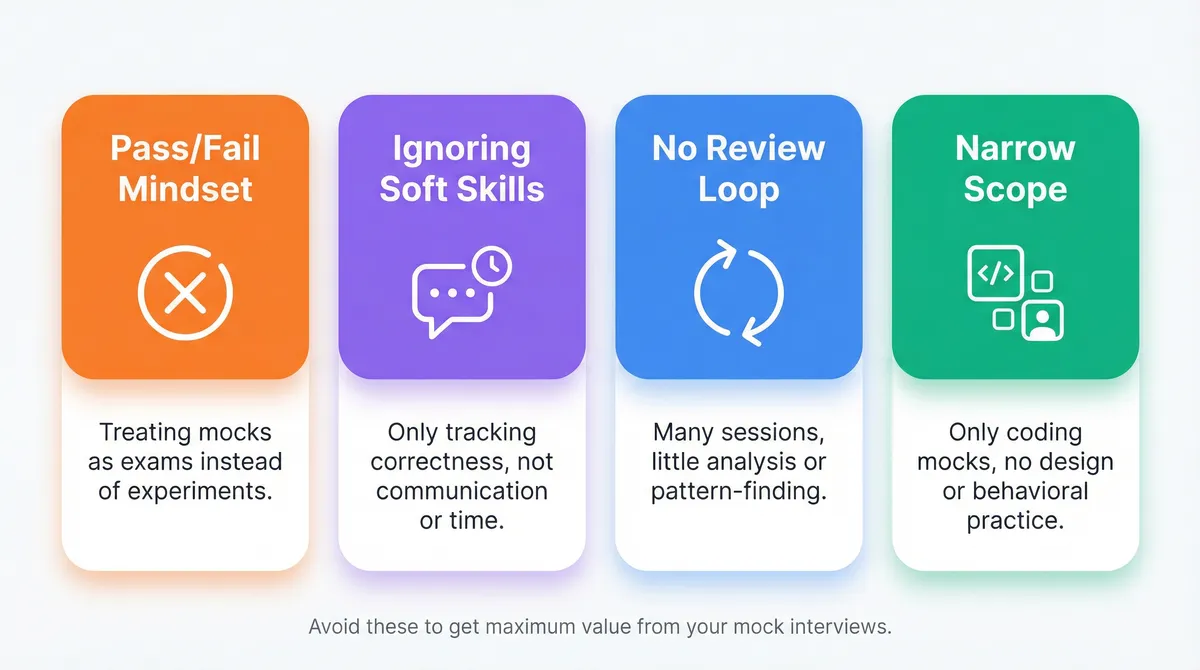
Mistake 1: Treating Mocks as Pass/Fail
Mindset: “I need to ace this mock to feel confident.”
Why it’s harmful:
- You avoid challenging problems because you don’t want to “fail”
- You don’t take risks or explore alternative approaches
- You feel discouraged when a mock goes poorly
Better framing: Mocks are experiments, not exams. The only failure is not learning from them.
Mistake 2: Ignoring Non-Technical Skills
Focusing only on “Did I solve the problem?” misses:
- Communication clarity
- Handling of ambiguity
- Collaboration style (how you respond to hints or corrections)
- Time management
Interviewers (and good AI systems) evaluate all of these. Make them explicit goals in some sessions.
Mistake 3: Doing Too Many Mocks, Not Enough Review
Back-to-back mocks without reflection lead to:
- Repeating the same mistakes
- Burnout
- False sense of progress (“I did 20 mocks!”) without measurable improvement
You should be able to answer:
- “What are my top 3 recurring weaknesses?”
- “What did I change in the last week to address them?”
If you can’t, you’re likely under-investing in analysis.
Mistake 4: Practicing Only at One Difficulty Level
Sticking only to “medium” problems or only to your comfort zone pattern (e.g., arrays, not graphs) leads to brittle preparation.
Better approach:
- Rotate:
- Easy: to practice speed and flawless execution
- Medium: to simulate typical interview questions
- Hard: to practice staying calm and structured under difficulty
- Intentionally request problem types that you find uncomfortable.
Mistake 5: Not Practicing Behavioral and Design Mocks
Many candidates delay system design and behavioral prep until the last week. This is risky:
- These interviews reward storytelling, structure, and frameworks that take time to develop
- You can’t “cram” leadership experiences you never reflected on
- System design especially benefits from multiple iterations and feedback
Integrate at least occasional design/behavioral mocks early, then increase frequency as interviews approach.
Best Practices: A Playbook for High-Impact Mock Interviews
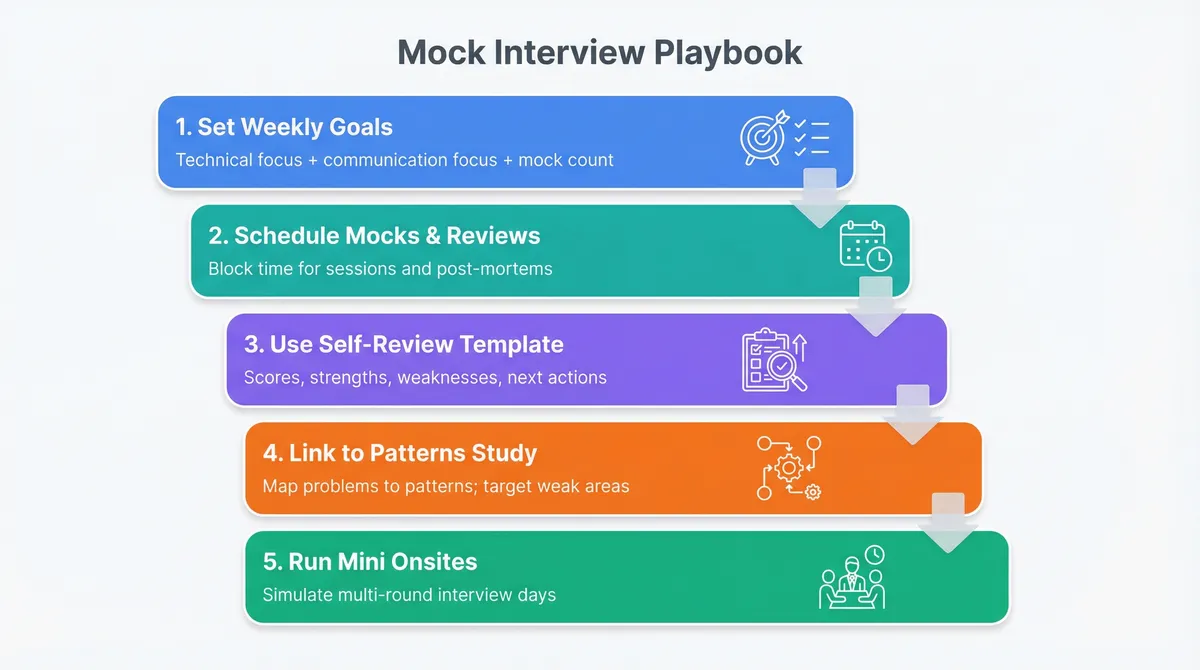
To make this concrete, here’s a step-by-step playbook you can adapt.
Step 1: Define Weekly Goals
At the start of each week, write:
- 1–2 technical focus areas (e.g., “graphs + DP”, “system design scalability”)
- 1 communication focus (e.g., “concise problem restatement”)
- Target number and type of mocks (e.g., “2 DSA, 1 design”)
Step 2: Schedule Mocks and Recovery Time
On your calendar:
- Block 1 hour for each mock
- Block an additional 45–60 minutes afterwards for:
- Notes
- Re-solving the problem solo
- Implementing a small practice plan
Treat these blocks as non-negotiable.
Step 3: Use a Consistent Self-Review Template
After each mock, fill out a short template. For example:
- Session metadata:
- Date, type (DSA/design/behavioral), difficulty, company level (e.g., FAANG mid-level)
- Outcome:
- Problem solved? (Y/N)
- Time taken to get to working solution
- Scores (1–5):
- Problem solving:
- Coding correctness:
- Communication:
- Testing:
- Time management:
- What went well (2–3 bullets):
- What to improve (2–3 bullets):
- Concrete actions before next mock:
Over time, this becomes a log of your trajectory.
Step 4: Connect Mock Results to Pattern-Based Study
For DSA:
- Map each problem to a pattern (e.g., sliding window, binary search, backtracking)
- If you struggle with a pattern:
- Revisit conceptual explanations
- Solve 3–5 additional problems in that pattern
- Next mock: request a problem from that pattern to test improvement
This closes the loop between theory (patterns) and practice (mocks).
Step 5: Periodically Run a “Mini Onsite”
Every 2–3 weeks during intense prep:
- Schedule 2–3 mocks in a single day:
- 1–2 coding
- 1 design or behavioral
- Simulate:
- Limited breaks
- Switching context quickly
- Staying focused across multiple sessions
Afterward, review not just individual performance, but:
- Energy levels across sessions
- Whether your later sessions degrade in quality
- How your communication holds up when tired
This is realistic training for real onsite loops.
Key Takeaways
- Mock interviews are most powerful as feedback loops, not as scoreboards. The value comes from analysis and targeted follow-up, not just doing more sessions.
- Before each mock, set specific objectives (e.g., pattern focus, communication behavior) and communicate them to your interviewer or AI system.
- During the mock, practice the full interview behavior: clarify requirements, think aloud, structure your approach, code cleanly, and test systematically.
- After the mock, classify your mistakes (understanding, algorithm, implementation, communication, time) and turn them into concrete practice tasks.
- Use AI mock interviews to increase frequency and capture detailed transcripts, but demand specific, example-driven feedback.
- Avoid common pitfalls: pass/fail mindset, ignoring soft skills, over-practicing without review, and focusing only on coding while neglecting design and behavioral rounds.
- Build a weekly playbook that integrates mock interviews with pattern-based study, self-review, and occasional mini-onsites.
If you approach mock interviews as engineered feedback systems rather than ad-hoc practice, each session becomes a controlled experiment in getting better. Over weeks, that discipline compounds into the kind of calm, structured performance that real interviewers are looking for.