
Interview
Airbnb Interview Questions and Process: The Complete Guide (2026)
Explore Airbnb interview questions, rounds, code review and Core Values preparation, plus a 30-day plan for coding, design and behavioural interviews.
Airbnb interview questions commonly test more than your ability to find a correct algorithm. Reported candidate accounts describe a recruiter screen, a technical coding screen, then an onsite loop of four to five interviews. Coding quality matters throughout: Airbnb reportedly expects runnable code rather than pseudocode, includes a code review round, and gives Core Values interviews real hiring weight. Prepare algorithms, communication, code quality and credible project stories together. For focused coding practice, Airbnb's interview kit contains eight mapped DSA questions.
Reported processes vary by team, level and hiring need. Treat this guide as a preparation map rather than a fixed company policy, and confirm your exact format with the recruiter.
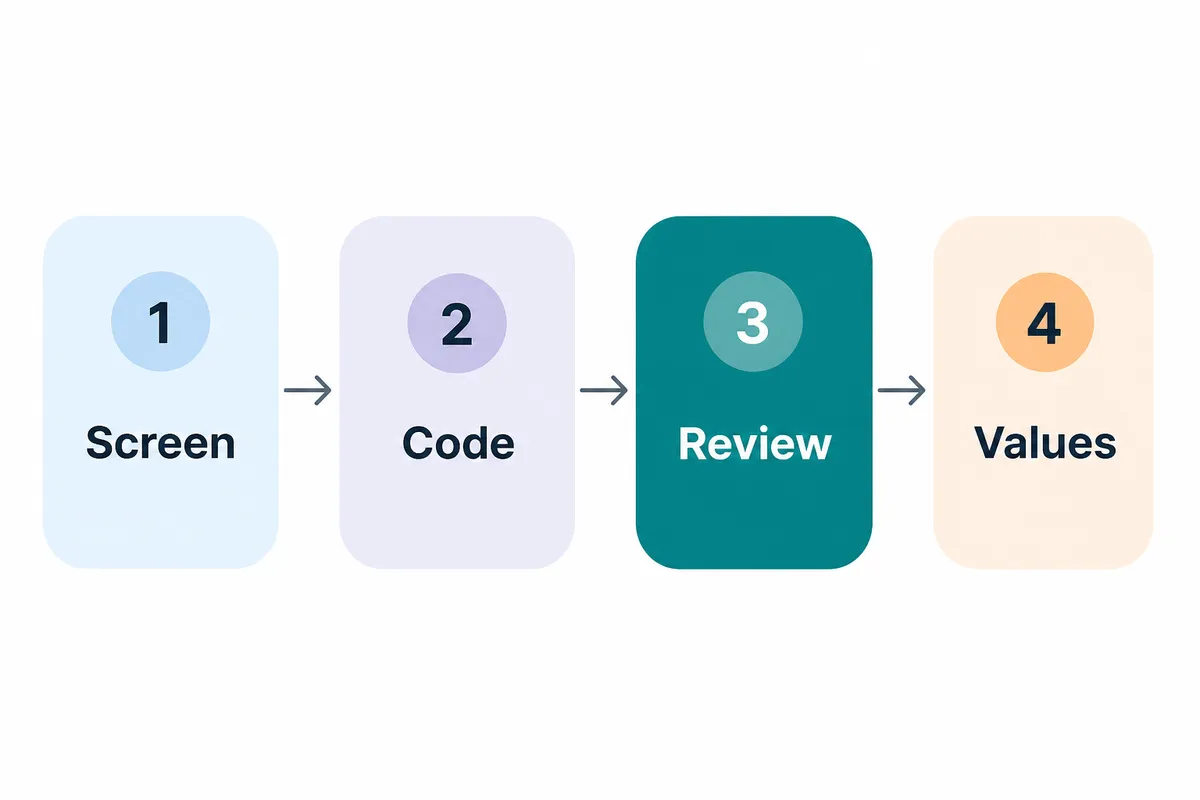
The process at a glance
| Stage | Commonly reported format | What it screens for | Preparation priority |
|---|---|---|---|
| Recruiter screen | Around 30 minutes | Motivation, role fit, communication | Career narrative and interest in Airbnb |
| Technical screen | Around 60 minutes; CoderPad, HackerRank or CodeSignal reported | Coding fundamentals, reasoning, correctness | DSA patterns and thinking aloud |
| Onsite coding | Part of a four-to-five-round onsite | Problem solving, runnable implementation | Timed live coding and edge cases |
| Code review | Dedicated onsite round reported | Reading code, identifying issues, improving quality | Clear review comments and trade-offs |
| Core Values | Onsite interview reported | Collaboration, judgement and values alignment | Specific project stories and reflection |
The exact composition of the onsite varies. What remains consistent across reported accounts is that Airbnb's loop is not a pure puzzle-solving exercise. A clean answer that cannot run, weak explanation of a past decision, or shallow review judgement can undermine otherwise strong coding performance.
Round 1 — recruiter screen
The recruiter conversation is commonly reported as a short opening screen, but it is still worth preparing properly. It establishes why you are considering the role, whether your experience broadly fits the team’s need, and whether you can explain your work without disappearing into technical detail.
Prepare a concise account of your recent work: the system, your personal responsibility, the hardest decision, the outcome and what you learned. Avoid a generic “I want to work at a fast-growing company” answer. A stronger answer connects your interests to the kind of product and engineering problems you want to solve.
You should also use this conversation to ask practical questions. Confirm the interview sequence, whether there is a code review component, the expected programming environment and whether the loop changes for your level. Candidate reports are useful orientation; the recruiter’s description is the relevant one for your process.
Round 2 — technical coding screen
Reported accounts describe a technical screen of roughly 60 minutes, with CoderPad, HackerRank and CodeSignal all mentioned. The platform matters less than the habits it exposes: clarify before coding, choose an approach deliberately, explain complexity, test edge cases and make the final solution work.
Hard dynamic programming is repeatedly flagged in Airbnb interview discussions. That does not mean every candidate receives a dynamic programming problem. It means you should not leave DP until the final days of preparation if your foundations are weak. Learn to recognise state, transitions, base cases and overlapping subproblems rather than memorising a catalogue of solutions. The guide to dynamic programming patterns is a useful way to structure that work.
The free DSA Patterns Sheet helps organise preparation around recurring approaches: hashing, sliding windows, binary search, trees, graphs and dynamic programming. The aim is recognition under pressure. When you can name the pattern and justify it before typing, your implementation becomes calmer and more reliable.
💡 Pro Tip: Before writing code, say three things aloud: your interpretation of the problem, the intended approach and its time and space complexity. This takes less than a minute and makes your reasoning visible.
Round 3 — onsite coding
The onsite is commonly reported as four to five interviews. Coding remains a central part of it, but the bar is not simply “arrive at the optimal answer”. Candidate accounts specifically emphasise that code should run with only minor syntax fixes. Pseudocode is reportedly not accepted as a substitute for an executable solution.
That requirement changes how you should practise. You need to be fluent with your chosen language’s basic operations, common data structures, error-prone boundary conditions and testing habits. A correct high-level plan can still fail if you cannot turn it into functioning code during the session.
Practise in a realistic editor rather than only reading solutions. Use in-browser code practice to rehearse implementation, then explain your choices out loud as you work. For live-round communication, read what interviewers actually look for in live coding interviews.
A useful sequence is:
- Restate the problem and ask about unclear inputs or constraints.
- Offer a simple approach first if it helps establish correctness.
- Explain the improved approach before implementing it.
- Write small, testable pieces of code.
- Walk through ordinary, boundary and awkward cases before finishing.
This is not performative narration. It lets the interviewer assess your judgement, and it gives them opportunities to redirect you before you spend too long pursuing an unsuitable route.
Round 4 — the code review round
The code review round is one of the most distinctive reported elements of Airbnb’s loop. It tests a different engineering muscle from solving a fresh problem: reading an existing implementation, forming a view of its risks and improvements, and communicating that view constructively.
Do not approach review as a hunt for stylistic preferences. Start with behaviour. What is the code intended to do? Which assumptions does it make? Where might it fail on unusual inputs? Then move outward: readability, duplication, naming, test coverage, performance, maintainability and the consequences of changing the code later.
A good review comment has a reason behind it. Instead of saying “this should be refactored”, explain the observable concern: a repeated branch could drift over time; a name hides an important unit; an edge case has no test; or a data structure creates avoidable work at scale. The interviewer is assessing prioritisation as much as observation. Not every issue deserves the same urgency.
This is also where communication style matters. Frame feedback around the code and its impact, not the imagined competence of the author. Be clear, specific and practical: identify the concern, explain why it matters, then suggest an improvement proportionate to the risk.
Round 5 — Core Values interviews
Reported accounts describe Core Values rounds as genuine hiring inputs, not a formality after technical interviews. The safest preparation is not memorising polished value statements. It is building accurate stories from your own work that show how you make decisions with other people.
Prepare several examples covering different situations:
- A disagreement where you changed someone’s mind or changed your own.
- A difficult trade-off between speed, quality and risk.
- A project where your ownership was clear.
- A mistake, what you did next and what changed afterwards.
- A situation where you helped a colleague or team succeed.
For each story, separate your contribution from the group’s. “We” is appropriate when describing a team outcome, but be ready to explain what you noticed, proposed, implemented or decided. Interviewers often probe beyond the polished opening answer because specific ownership is more credible than a rehearsed summary.
An AI mock interview can help you practise behavioural answers aloud. Focus on being concrete and reflective, not flawless. Good judgement often shows up in what you would do differently now.
Is the Airbnb interview hard?
Yes — mostly because it requires breadth and consistency rather than one exceptional performance.
The reported process begins with a recruiter conversation and a technical screen, followed by an onsite of four to five interviews. That makes the full sequence commonly reported as six to seven stages. The hard part is that success in one area does not erase a weak signal in another: coding, code review and Core Values all contribute to the overall decision.
Technically, expect a meaningful coding bar, with hard dynamic programming frequently flagged in candidate reports. Practically, Airbnb’s reported insistence on runnable code raises the standard beyond explaining an approach on a whiteboard. You need to implement reliably, test your work and recover if something goes wrong.
How long does the process take? The research available for this guide does not establish a reliable company-wide timeline. Timing can vary substantially by team, level and scheduling. Ask your recruiter for the expected sequence and target dates.
Is it harder for senior candidates? Usually the scope broadens with level. More experienced candidates should expect deeper discussion of technical decisions, system trade-offs, influence and project ownership. Do not assume one reported loop applies unchanged to every role.
A 30-day preparation plan
Days 1–7 — rebuild pattern recognition
Start with core DSA patterns. Work through arrays, hash maps, two pointers, sliding windows, trees, graphs and dynamic programming. Solve fewer problems with full explanation rather than racing through a long list.
Use Airbnb's interview kit as a company-focused practice set, then fill gaps with the free patterns sheet. If graphs are less familiar, revise DFS and BFS graph traversal patterns.
Days 8–14 — make code runnable
Move from untimed learning to implementation discipline. Pick a language you can write quickly and confidently. For every practice problem, test empty inputs, single elements, duplicate values, large values and any condition that changes control flow.
Spend time reading code as well as writing it. Take a previous solution and ask: where is the naming unclear? Which function has too many responsibilities? What test would reveal a hidden bug? This builds the review instinct that puzzle practice alone does not develop.
Days 15–21 — practise the review and design mindset
Run mock code reviews. Read a small function, identify the highest-impact concerns, then explain them in priority order. Keep your feedback grounded in behaviour, maintainability and risk.
For design vocabulary, the free Low Level Design Sheet and free System Design Sheet are useful references. The distinction between class-level and architecture-level thinking is covered in low-level design versus high-level design.
Days 22–30 — rehearse the full loop
Alternate timed coding, review practice and behavioural preparation. Run at least two complete mock sessions: one coding session where every solution must run, and one behavioural session focused on project depth and judgement.
In the final days, revisit mistakes rather than cramming unfamiliar topics. Prepare questions for interviewers, confirm logistics and protect your sleep. The best final-week improvement is usually sharper execution, not another dozen new problems.
What is specific about Airbnb’s interview process?
Airbnb’s reported code review round changes what “technical preparation” should mean. Many engineering candidates prepare only to generate a solution from a blank editor. Reviewing an existing solution is a separate skill: you need to understand intent, identify meaningful risks, weigh trade-offs and give feedback that another engineer could act on.
Combined with the reported requirement for runnable code, this creates a practical standard. You are not only demonstrating that you know an algorithm. You are demonstrating how you work with code that already exists: whether you notice unsafe assumptions, whether you care about maintainability and whether you can explain improvements without losing sight of the product need.
That is why a balanced preparation plan beats a coding-only grind. Practise solving, implementing, testing, reviewing and explaining. Each activity reinforces the others.
Frequently asked questions
How many interview rounds does Airbnb have?
Reported accounts describe a recruiter screen, a technical screen and an onsite loop of four to five interviews. The exact sequence varies by team and level.
Does Airbnb have a code review interview?
Candidate reports describe a code review round as part of the onsite. Prepare to read existing code, identify meaningful issues and communicate improvements clearly.
Does Airbnb accept pseudocode in coding interviews?
Reported accounts say Airbnb expects code that runs with only minor syntax fixes rather than pseudocode. Confirm the exact expectations for your interview with your recruiter.
Are Airbnb interview questions hard?
The process is challenging because it combines coding, code quality, review judgement and Core Values evaluation. Hard dynamic programming is repeatedly flagged in reported candidate discussions.
What coding topics should I prepare?
Build fluency in common DSA patterns, including hashing, trees, graphs and dynamic programming. Prioritise recognising the right approach, explaining complexity and implementing a tested solution.
Are Core Values interviews important at Airbnb?
Yes. Reported accounts describe Core Values rounds as carrying real hiring weight. Prepare detailed examples of ownership, collaboration, trade-offs, mistakes and learning.
How should I prepare for the code review round?
Practise reading unfamiliar code. Start with correctness and edge cases, then discuss maintainability, tests, clarity and performance. Prioritise the most important issues instead of listing every possible preference.
How long does the Airbnb interview process take?
A reliable company-wide timeline was not established in the available reports. Ask your recruiter about the expected schedule, as timing can vary by team and level.
What is the best way to practise Airbnb coding interviews?
Use timed practice, write runnable code and explain your reasoning aloud. Review your own older solutions for clarity and edge cases, then practise behavioural stories separately.
Where to start
Start with the coding fundamentals, but do not stop there. Airbnb’s reported process rewards candidates who can produce working code, review code thoughtfully and explain how they work with other people.
Open Airbnb's interview kit to practise the eight mapped DSA questions in the set. Then use the free sheets to broaden your preparation and an AI mock interview to rehearse coding explanations and Core Values stories before the real loop.
Topics
Related on Thita
Your next step
Practise with AI mock interviews
A spoken interview that asks follow-up questions, runs your code and ends with a written report.