
Interview
AlgoExpert Runs Your Code. It Doesn't Interview You.
AlgoExpert is strong for coding practice, but mock interviews score more: explanation, follow-ups and recovery under pressure. Learn what to add well.
AlgoExpert is good at what it was built to do: helping you work through coding problems, write a solution, and run that solution against test cases. Its explanations, curated questions and code execution make it a useful part of a serious preparation plan.
But solving a problem alone is not the same as being interviewed.
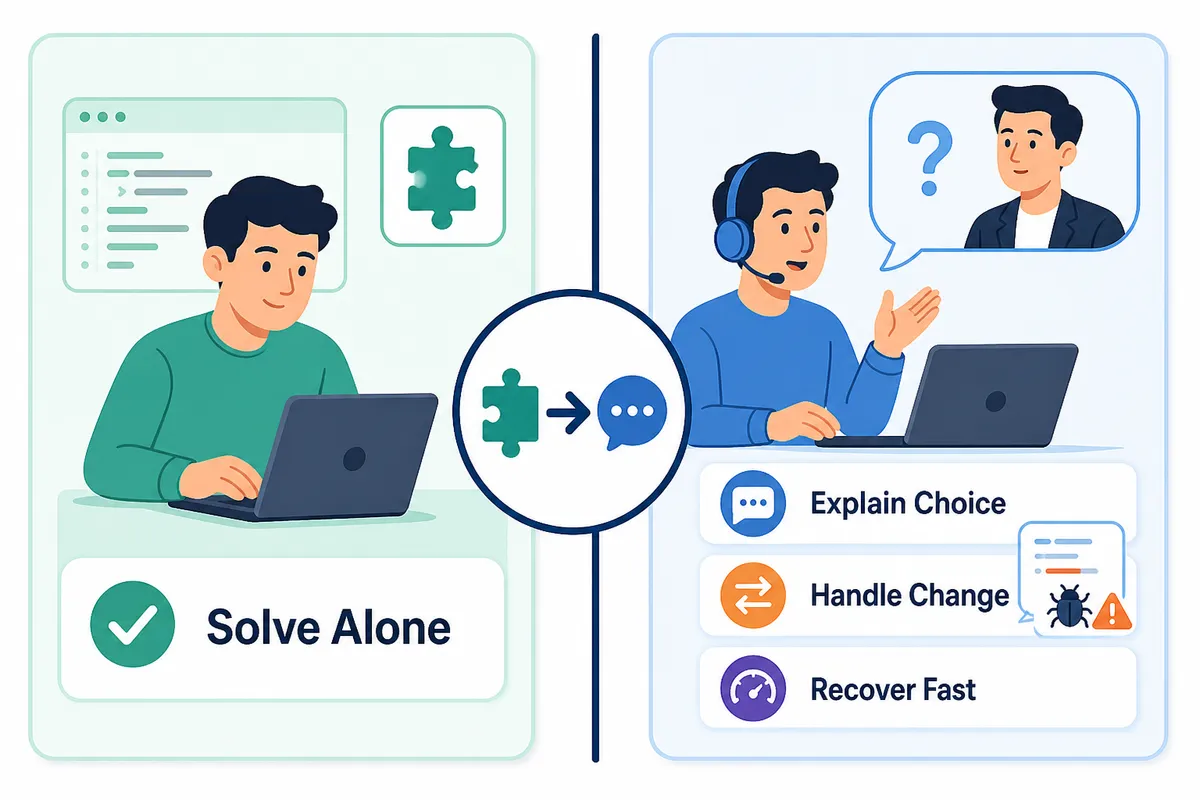
In a real interview, someone is listening while you choose an approach. They ask why you chose it. They change a constraint halfway through. They point out a failing case and wait to see whether you recover. They may ask you to improve the complexity, explain a trade-off, or defend a design decision you made ten minutes earlier.
That is why candidates looking for an AlgoExpert alternative for mock interviews need something additive, not necessarily something replacing it. Alongside problem practice, use live voice AI interview practice to rehearse the part where your reasoning, communication and recovery are being scored in real time.
The missing half is not more questions. It is an interviewer.
An AlgoExpert review: what it does well
It is only fair to start with the strengths.
Its content is structured around common coding interview topics and patterns. That structure matters, especially when you are moving from random problem-solving towards deliberate preparation. Rather than opening a question bank and guessing what to do next, you can work through arrays, strings, trees, graphs, recursion, dynamic programming and related concepts with a clearer route.
The platform also gives you a place to write and run code. That is important. You should not prepare only by reading solutions or mentally tracing them. Working code exposes incorrect assumptions, off-by-one errors, poor edge-case handling and complexity mistakes that look harmless on paper.
For candidates who need to rebuild DSA foundations or cover a predictable set of interview patterns, this is useful work. The question is not whether AlgoExpert helps. It does.
The question is: what does it not simulate?
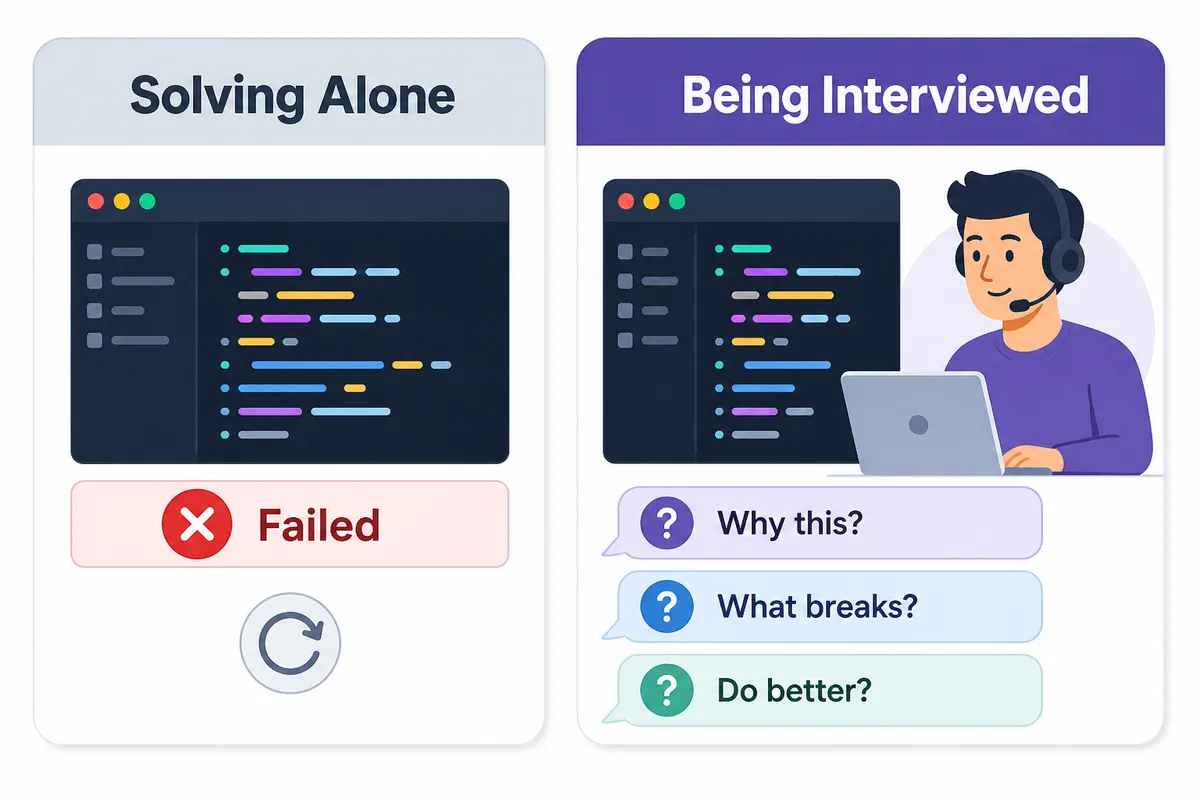
It does not put another party in the session who can react to your answer. There is no interviewer asking, “Why a hash map rather than sorting?” There is no interruption when you jump into code too quickly. There is no follow-up after your first solution passes. There is no conversational pressure when the test case fails.
That distinction is easy to overlook because solo practice feels productive. You solve a hard problem, your code passes, and you reasonably feel more prepared. Yet real interviews assess a broader set of behaviours than whether you can eventually arrive at working code.
A good preparation stack has room for both:
- Solo coding practice for pattern recognition, syntax, implementation speed and repetition.
- Mock interview practice for communication, prioritisation, judgement, follow-ups and recovery.
If you only do the first, you may become strong at solving in silence and still underperform when somebody starts asking questions.
For a structured question bank before your interview sessions, the free DSA patterns sheet covers 98 patterns and 405 problems to browse.
AlgoExpert vs mock interview: the difference is not cosmetic
The phrase “mock interview” is often used loosely. A timer, a coding prompt and a test runner can feel interview-like. They are useful, but they are not a full simulation of the interaction that makes a live technical round difficult.
Consider the same problem in two settings.
Setting one: you solve alone
You read the prompt. You recognise a sliding-window pattern. You write the implementation. A few tests fail, so you edit the loop condition. Eventually the tests pass.
This builds valuable technical ability. You should absolutely do it.
But you made every decision privately. You may have switched approaches without explaining why. You may have looked at the solution after getting stuck. You may have spent twenty minutes on an idea that an interviewer would have challenged in minute three. You may have fixed a bug silently without ever articulating what caused it.
Setting two: you are interviewed
You read the prompt aloud and clarify the input constraints. You propose a brute-force approach first, then explain why it will not fit the expected scale. You state the invariant of your sliding window before implementing it.
Halfway through, the interviewer asks what happens with duplicate values. Your first answer is incomplete. You test it, notice the mistake, explain the issue, and revise the logic. Once it works, they ask whether the same result is possible with less memory.
The final code might be identical in both settings. The performance is not.
In the second setting, the interviewer has evidence of how you think:
- How you frame an ambiguous problem.
- Whether you communicate a plan before coding.
- Whether you recognise trade-offs.
- How you respond to challenge.
- Whether you test deliberately.
- How you react when wrong.
Those are scored behaviours. They influence hiring decisions even when your final submission passes every visible test.
This is the practical answer to the long-tail question, AlgoExpert vs mock interview: AlgoExpert helps you practise the solution. A mock interview helps you practise being evaluated while producing one.
⚠️ Important: Passing the problem after forty minutes of quiet trial and error is not equivalent to passing it after clearly explaining your decisions, responding to constraints and correcting one mistake under pressure.
Why thinking aloud changes your result
Many strong candidates underestimate thinking aloud because they view it as presentation rather than engineering.
It is neither decoration nor forced chatter. Good verbal reasoning gives an interviewer a view of your process. It lets them distinguish between a candidate who understands an approach and one who has memorised a familiar template.
Imagine you say only: “I’ll use BFS.”
An interviewer has almost nothing to assess. Why BFS? What does each queue entry contain? How will you avoid revisiting nodes? What is the time complexity? What condition ends the traversal?
Now compare that with:
“I’ll model each cell as a node and use BFS because we need the shortest number of moves in an unweighted grid. I’ll mark a cell visited when I add it to the queue, not when I remove it, so duplicate entries do not build up.”
That explanation takes seconds. It gives the interviewer confidence that your implementation will follow from a real model rather than a remembered answer.
Thinking aloud also reveals problems earlier. When you state an invariant, you often notice that it does not hold. When you explain a complexity claim, you may realise you are sorting inside a loop. When you describe an edge case, you may identify a missing base condition before the code runner does.
If this feels unnatural, it is trainable. Start with a simple cadence:
- Clarify the input and success condition.
- State the simplest viable approach.
- Explain why you are improving it, if needed.
- Name the data structures you will use.
- Narrate only meaningful decisions while coding.
- Test the risky cases out loud.
- Summarise complexity and trade-offs.
For examples and practical drills, read how to think out loud in coding interviews.
💡 Pro Tip: Do not narrate every keystroke. Narrate decisions. “I am adding this guard because an empty input would otherwise access index zero” is useful. “Now I am typing a for loop” is not.
Follow-ups are where a solved problem becomes an interview
A coding platform can tell you whether a submitted answer works. An interviewer can ask whether the answer is the best one for a changing situation.
That difference matters because many technical rounds are deliberately designed in layers.
You may start with a straightforward version:
- Find duplicates in an array.
- Return the shortest path in a grid.
- Design a cache.
- Parse a stream of events.
Then the interviewer adds constraints:
- The input no longer fits in memory.
- Values arrive continuously.
- The graph is too large to traverse repeatedly.
- Users need consistency across regions.
- The API must support concurrent writes.
- The initial requirement has changed.
These are not tricks. They test whether you can adapt rather than merely complete a familiar exercise.
A useful mock interviewer should respond to the answer you actually gave. If your first approach uses sorting, it might ask about preserving original order. If you use a hash map, it might ask about memory limits. If you select a particular database in a system design round, it might ask what happens when writes spike.
That is the type of practice available in adaptive AI interview sessions. You speak through the problem while using a real code editor that compiles and runs code. The AI can follow your choices, ask follow-ups and assess how you adjust.
You can practise in six languages: Python, C++, Java, JavaScript, Go and C#. The goal is not just to get a correct result. It is to experience the sequence that happens in a real round: explain, implement, run, inspect, defend and improve.
Recovery is often the real score
Every candidate gets stuck sometimes. Every experienced engineer writes a bug sometimes. Every good interviewer knows this.
What separates a strong performance from a weak one is rarely perfection. It is recovery.
When your code fails, an interviewer is watching for several signals:
- Do you panic or become defensive?
- Do you read the failure carefully?
- Can you form a specific hypothesis?
- Do you test the hypothesis rather than making random edits?
- Can you explain the corrected logic?
- Do you reassess complexity after the fix?
The worst response is silent patching. You change three lines, run again, change three more, and hope something turns green. Even if it works, the interviewer cannot see a reliable debugging process.
A better response sounds like this:
“The failing case suggests I am not processing the final window. My loop stops at
n - k, but it needs to include that index. I’ll change the bound, rerun this edge case, then check the empty input separately.”
That is not polished theatre. It is practical engineering judgement.
You can practise recovery deliberately. Once per session, write a quick test case intended to challenge your own logic. Or take a solution you wrote last week and introduce a small bug before starting the mock. Then explain how you would discover and resolve it.
For a fuller framework, see how to recover when you get stuck in an interview.
Is AlgoExpert enough for interviews?
For some early-stage goals, it may be enough to make meaningful progress.
If you are starting from weak DSA fundamentals, learning standard patterns, or preparing for an online assessment where the format is mostly independent problem-solving, a focused period of AlgoExpert-style preparation can be highly effective. You need repetitions. You need to become fluent in writing and testing solutions. You need to stop treating common patterns as unfamiliar.
But is AlgoExpert enough for interviews? Not if the interview includes live coding, follow-up questions, system design, behavioural discussion or a conversation about your experience.
Most candidates eventually need to prepare for more than a problem judge. They need to make decisions visible.
That means practising:
- Clarifying vague requirements.
- Giving a brute-force baseline without getting trapped in it.
- Explaining complexity accurately.
- Handling interviewer prompts without losing your train of thought.
- Debugging in public.
- Recovering after a wrong turn.
- Discussing projects, trade-offs and past work.
- Switching between coding, system design and behavioural rounds.
For example, a senior candidate might solve a graph question comfortably but struggle when asked to design a service around it. A career switcher might write good Python but freeze when explaining a project gap. A product candidate may not need a code editor at all, but still needs adaptive questioning based on their background.
Thita supports DSA, system design, low-level design and machine coding, behavioural, product management, data science, AI and ML, CS fundamentals, and resume-based interviews generated from your own CV. Resume-based sessions work for non-technical roles too.
The right approach is not “replace every solo problem with a mock”. It is to use the right practice mode for the skill you are trying to build.
A better preparation split
If your interview is a few weeks away, try dividing your time intentionally rather than doing only whichever task feels most comfortable.
Earlier in preparation
Spend more time on fundamentals:
- Learn recurring DSA patterns.
- Solve independently.
- Review errors after each problem.
- Build fluency in your chosen language.
- Use short mock sessions to begin speaking clearly.
Closer to the interview
Increase simulation:
- Do timed, voice-based coding sessions.
- Ask for follow-ups after each first solution.
- Practise a recovery when tests fail.
- Rotate between likely round types.
- Review not just code quality, but communication quality.
A company-specific process may require a different split. If you expect more system design, use a design canvas. If you expect a machine coding round, build and explain a complete small feature. If the first screen is likely behavioural, practise your project stories before you are asked them under pressure.
Our guide to how interviewers judge problem-solving in live coding rounds can help you review your sessions through the same lens.
✅ Do use AlgoExpert or similar platforms to build your problem-solving base.
✅ Do add mock interviews once you can solve common questions without constant hints.
❌ Don't wait until the night before the real interview to speak through a solution for the first time.
❌ Don't mistake a passing submission for proof that you can handle a live round.
Frequently asked questions
Is AlgoExpert good for coding interview preparation?
Yes. AlgoExpert is useful for learning common interview patterns, solving structured coding questions and running your solutions. It is particularly valuable when you need a focused way to build DSA fluency.
What is the main AlgoExpert limitation for mock interviews?
AlgoExpert runs your code, but it does not act as an interviewer who listens to your explanation, asks adaptive follow-ups or evaluates your recovery after a mistake.
Why do interviewers care about thinking aloud?
Thinking aloud reveals how you frame the problem, choose data structures, assess trade-offs and notice errors. It gives the interviewer evidence of your reasoning, not only your final answer.
Can I practise coding interviews without finding a partner?
Yes. Thita’s live voice AI interviewer lets you start a session without scheduling a peer. You can code, run tests, speak through your decisions and receive follow-up questions on demand.
Which languages can I practise in?
You can practise in six languages: Python, C++, Java, JavaScript, Go and C#. Use the language most relevant to your upcoming interview, while keeping enough fluency to explain your choices clearly.
Do mock interviews help if I already solve LeetCode or AlgoExpert questions?
They help with the gap between solving and interviewing: communication, time pressure, clarification, follow-ups and recovery. These skills are often what determine whether strong solo problem-solvers perform well live.
Can I practise interviews beyond coding?
Yes. Thita includes system design on a canvas whose submitted architecture the AI evaluates, low-level design, machine coding, behavioural, product management, data science, AI and ML, CS fundamentals, and CV-based interview sessions.
Add the interviewer to your preparation
AlgoExpert can help you become better at solving coding problems. Keep that strength in your preparation plan.
Then add the condition that changes the experience: somebody asking what you mean, why your approach works, what happens at scale, and what you will do now that the test failed.
Start a live voice AI mock interview and practise the part that code execution alone cannot measure: how you perform when the solution has to be explained, challenged and recovered in real time.
If you are hiring rather than interviewing, visit interviews.thita.ai.
Topics
Related on Thita
Your next step
Try Thita before you decide
The Starter plan is free: pattern sheets, code execution in six languages and an AI mock interview. Pro adds more AI code feedback and mock interviews, company kits and the 90-day roadmaps.