
Interview
How to Think Out Loud in Coding Interviews (With Real Examples)
Most candidates know they should “think out loud” in a coding interview. Very few know *how* to do it in a way that actually helps them.
Most candidates know they should “think out loud” in a coding interview. Very few know how to do it in a way that actually helps them.
Done well, thinking out loud turns the interview into a collaborative problem-solving session. Done poorly, it becomes a stream of unstructured narration that hides your real skills.
This guide breaks down how to think out loud in coding interviews with concrete frameworks, scripts, and real examples—so your communication becomes a strength, not an afterthought.
Why Thinking Out Loud Matters More Than You Think
When interviewers say “please explain your thought process,” they’re trying to evaluate:
- How you approach problems, not just whether you get the right answer
- How you debug, simplify, and prioritize
- Whether you can communicate clearly with other engineers
In most companies, your “coding interview communication” is a first-class signal, not a soft bonus. Many strong coders fail because they stay silent and only reveal their thinking at the end—when it’s too late to course-correct.
Thinking out loud helps you:
- Get early feedback when you’re going down the wrong path
- Demonstrate knowledge of patterns and tradeoffs
- Show how you’d work in a real team, under time pressure
- Turn partial progress into a positive signal even if you don’t fully finish
The rest of this post gives you a repeatable structure for explaining your thought process in interviews, with annotated examples.
A Simple Framework for Thinking Out Loud in Coding Interviews
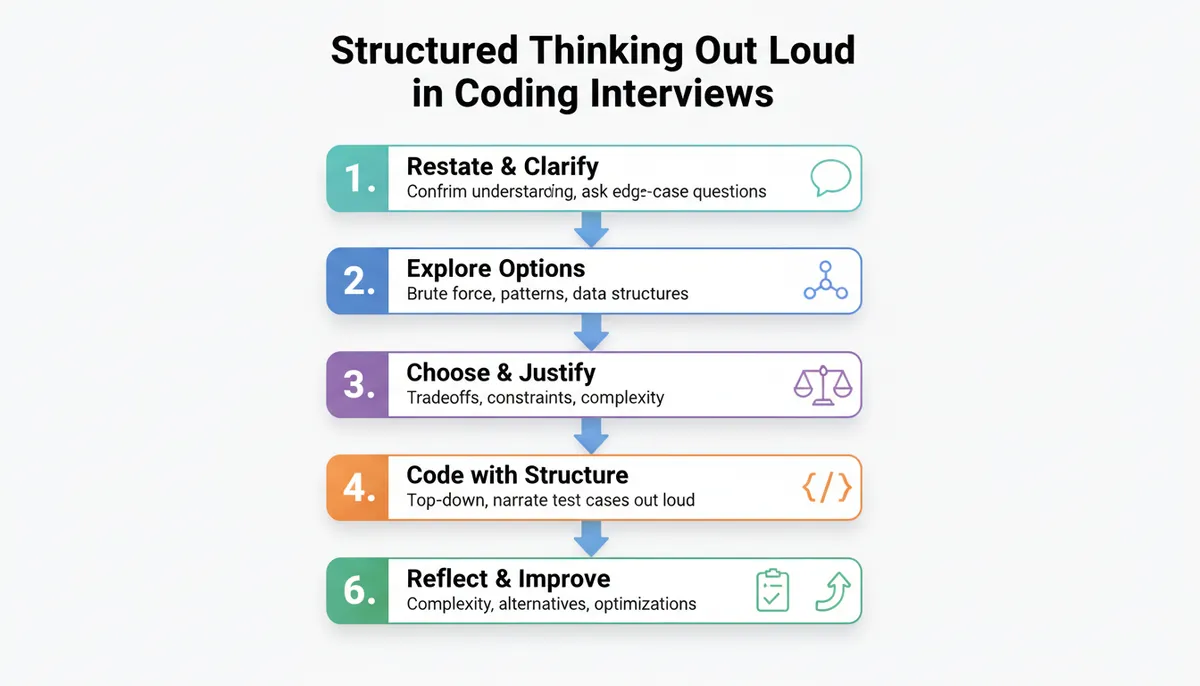
Instead of narrating every keystroke, structure your explanation into clear phases:
- Restate and clarify the problem
- Explore and constrain the solution space
- Choose an approach and justify it
- Code with structured narration
- Test with explicit cases
- Reflect on complexity and improvements
You don’t need to memorize a script. But you do want consistent scaffolding so your thoughts are easy to follow.
Let’s walk through each phase with concrete language you can use.
1. Restate the Problem and Clarify Out Loud
Goal: Show you understand the problem and uncover hidden constraints.
What to say
Instead of silent reading followed by “okay,” do this:
- Restate in your own words
“Let me restate to make sure I understand. We’re given an array of integers and a target sum, and we need to return indices of two numbers that add up to the target. We can assume exactly one solution, and we can’t reuse the same element, correct?”
- Clarify constraints and edge cases
Ask 2–4 targeted questions, not a random checklist:
- Input size? (impacts complexity)
- Value ranges? (impacts overflow / data structure choice)
- Sorted or unsorted? (impacts patterns like two pointers)
- Multiple solutions or one?
- Can we modify input?
Example:
“What are the constraints on
n? Up to 10^5?
Are numbers positive, negative, or both?
Do you care about returning any valid pair or a specific one?”
This is already strong “explaining thought process” behavior: you’re surfacing assumptions instead of hiding them.
2. Explore Approaches Explicitly (Don’t Jump Straight to Code)
Goal: Show that you can reason about alternatives and tradeoffs before coding.
Use a small “option list” out loud
For most DSA problems, you can quickly enumerate 2–3 options:
“I see a few approaches:
- Brute force: check all pairs with nested loops → O(n²) time, O(1) space.
- Use a hash map to store seen numbers and their indices → O(n) time, O(n) space.
- If the array were sorted, we could use a two-pointer approach → O(n) time, O(1) space, but we’d need to sort first, which is O(n log n), and that would change indices.”
You don’t need to derive everything from first principles. If you’ve studied DSA patterns (e.g., from a complete guide to DSA patterns for beginners), this is where you show you recognize a pattern:
“This looks like a classic ‘hash map for complement lookup’ pattern for two-sum type problems.”
Explicitly labeling patterns helps interviewers see your mental model.
3. Choose an Approach and Justify It
Goal: Make your decision traceable and defensible.
Once you’ve outlined options:
“Given that
ncan be up to 10^5 and we want better than O(n²), the hash map approach is a good fit. It gives us O(n) time and O(n) extra space, which should be acceptable for this input size. I’ll proceed with that.”
If there are tradeoffs (e.g., memory vs time), narrate them:
“We could sort and use two pointers with O(1) extra space, but that would lose original indices or require additional bookkeeping. Since the problem cares about indices in the original array, the hash map approach is cleaner.”
You’ve now demonstrated:
- Awareness of complexity
- Awareness of problem requirements
- Ability to justify design decisions
4. How to Code While Thinking Out Loud (Without Over-Narrating)
Goal: Narrate structure and decisions, not every character you type.
Before coding: outline the plan in 3–5 sentences
“I’ll iterate through the array once. For each number
nums[i], I’ll compute its complementtarget - nums[i]and check if that complement is already in a hash map. If it is, I’ll return the stored index andi. Otherwise, I’ll insertnums[i]and its index into the map and continue. If we finish the loop without finding a pair, I’ll return some indication that no solution exists, though the prompt says there’s always one.”
Now code. While coding, narrate key decisions, not syntax:
PYTHON
What to say while coding
Short, structural comments:
“I’ll use a dictionary from value to index.”
“For each number, I compute the complement and check if we’ve already seen it.”
“If yes, we return immediately; otherwise, we record this value.”
Avoid noisy narration:
- Bad: “Now I’ll type
for i in range(len(nums))… now I’ll open a curly brace…” - Good: “I’m using a single pass with early return once we find a valid pair.”
5. Test Out Loud: Walk Through Examples Systematically
Goal: Show you can simulate and verify your code logically.
Start with a simple example
“Let’s test with
nums = [2, 7, 11, 15]andtarget = 9.”
Walk through step-by-step:
“
i = 0,num = 2, complement is7. Map is empty, so we store2:0.
i = 1,num = 7, complement is2.2is in the map at index 0, so we return(0, 1). That matches expectation.”
Then cover edge cases
Depending on the problem, think out loud about:
- Duplicates
- Negative numbers
- Empty or single-element arrays
- Very large values
- Boundary indices
For two-sum:
“If the array is
[3, 3]and target is6, then:
i = 0, num = 3, complement = 3, map empty → store3:0i = 1, num = 3, complement = 3, found in map at 0 → return(0,1).
That’s correct and shows we handle duplicates properly.”
Explicit walk-throughs like this are excellent “explaining thought process” signals.
6. Reflect on Complexity and Possible Improvements
Goal: Wrap up with a concise, high-signal summary.
Complexity
“Time complexity is O(n) because we do a single pass and each hash map operation is expected O(1). Space complexity is O(n) in the worst case if no pair is found until the end, since we store each element once.”
Improvements or alternatives
“If memory were a concern and we didn’t care about original indices, we could sort a copy of the array and use a two-pointer approach with O(1) extra space and O(n log n) time. But given the problem’s requirement to return original indices, the hash map solution is more natural.”
This final reflection is often where senior-level candidates distinguish themselves.
Real Example: Thinking Out Loud on a Sliding Window Problem
Let’s walk through a slightly more complex example to see the full pattern.
Problem:
“Given a string s and an integer k, return the length of the longest substring that contains at most k distinct characters.”
1. Restate and clarify
“We’re given a string
sand an integerk. We need the length of the longest contiguous substring that has at mostkdistinct characters.
Clarifications:
- Can
kbe zero? If so, I assume the answer is zero for non-empty strings.- What are the constraints on the length of
s? Up to 10^5?- Are characters ASCII or Unicode? For now I’ll assume ASCII and treat them as simple chars.”
2. Explore approaches
“Brute force would be to check all substrings and count distinct characters, which is O(n²) substrings and O(n) to count distinct characters per substring in the worst case → O(n³), too slow for 10^5.
This looks like a classic sliding window problem: we want the longest window with a constraint on the number of distinct characters. We can maintain a window
[left, right]and a frequency map of characters in the window. As we expandright, if we exceedkdistinct characters, we shrinkleftuntil we’re back to at mostkdistinct characters.”
You’ve named the pattern (“sliding window”) and described the invariant, which is a key concept in many master sliding window pattern guides for coding interviews.
{{IMAGE: sliding-window-k-distinct | Sliding Window for At Most K Distinct Characters | Create a horizontal visualization. Top: title "Sliding Window: At Most K Distinct" in black. Below, a string represented as 10 connected boxes labeled with characters: [a, a, b, c, c, b, b, a, c, a]. Each box has light gray border and white fill. Below the boxes, a colored bar indicates the current window: a semi-transparent blue (#3b82f6) rounded rectangle spanning from index 1 to 6 (covering "a, b, c, c, b, b"). On the left end, an upward green arrow (#10b981) labeled "left" pointing to index 1. On the right end, an upward orange arrow (#f97316) labeled "right" pointing to index 6. Under the window, show a small white box with border listing "Distinct chars: {a, b, c} = 3" in black text and "k = 3" in gray. On the far right, a callout bubble in purple (#8b5cf6) with text "Maintain window with ≤ k distinct chars" in white. Clean flat design, white background.}}
3. Choose and justify
“I’ll use the sliding window approach. It gives us O(n) time since each character enters and leaves the window at most once, and O(min(n, alphabet_size)) space for the frequency map. This is appropriate for strings up to 10^5.”
4. Outline then code
Outline out loud:
“I’ll maintain:
- Two pointers
leftandrightfor the window.- A dictionary
freqmapping char → count in the current window.- An integer
distinctfor how many chars have non-zero count.- A variable
max_lenfor the best window length so far.I’ll expand
rightone step at a time, updatefreqanddistinct. Whiledistinct > k, I’ll shrink from the left, updatingfreqanddistinct. After each step, I’ll updatemax_lenwith the current window size.”
Code:
PYTHON
5. Test out loud
“Test
s = "eceba",k = 2(classic example).
- Start:
left = 0,right = 0, window ="e", distinct = 1 → max_len = 1right = 1, add"c", distinct = 2 → window"ec", max_len = 2right = 2, add"e", distinct still 2 → window"ece", length 3 → max_len = 3right = 3, add"b", distinct = 3 > k. Now shrink:
left = 0, remove"e", freq(e) decreases but still > 0? Initially we had 2 e’s, so now 1 → distinct stays 3,left = 1left = 1, remove"c", freq(c) becomes 0 → distinct = 2,left = 2. Now window is"eb", length 2, max_len stays 3.right = 4, add"a", distinct = 3 again. Shrink:
left = 2, remove"e", freq(e) becomes 0 → distinct = 2,left = 3. Window is"ba", length 2.Final
max_lenis 3, which matches the expected result ("ece").”
You’ve demonstrated correctness and understanding of edge conditions in the sliding window.
6. Reflect
“Time complexity is O(n) because each index moves left-to-right once. Space is O(k)
or O(min(n, alphabet_size)) for the frequency map. If we needed to return the substring itself, we could track the best window’sstartandend` indices.”
Common Mistakes When Thinking Out Loud (and How to Fix Them)
1. Narrating syntax instead of reasoning
- Problem: “Now I’ll type a for loop, now I’ll declare a variable…”
- Fix: Focus on why and what, not how:
- “I’ll iterate once over the array.”
- “I’ll store counts in a hash map so I can check frequency in O(1).”
2. Staying completely silent while thinking
- Problem: Long pauses with no context; interviewer can’t tell if you’re stuck or exploring.
- Fix: Use “thinking bookmarks”:
- “I’m considering whether a greedy approach will work here.”
- “I’m trying to see if sorting breaks any constraints.”
- “Give me 20–30 seconds to think about edge cases.”
3. Dumping all ideas with no structure
- Problem: “We could use DFS, or maybe BFS, or dynamic programming, or a map, or sort…”
- Fix: Enumerate labeled options and quickly compare:
- “I see three options: brute force, sorting + two pointers, and hash map. Brute force is O(n²), too slow for n=10^5. Sorting is O(n log n) but breaks index requirements. Hash map gives O(n) and preserves indices, so I’ll choose that.”
4. Over-apologizing or labeling ideas as “dumb”
- Problem: “This is probably a stupid idea, but…”
- Fix: Neutral, technical language:
- “This is a naive approach; I’ll use it as a baseline and then optimize.”
- “First, I’ll outline the brute-force solution to clarify the constraints.”
5. Ignoring hints or interviewer reactions
- Problem: Plowing ahead even when interviewer is nudging you.
- Fix: Treat hints as collaboration:
- “You’re right, that might be overkill. Let me reconsider a simpler data structure.”
- “Good point about memory usage; I’ll switch to an in-place approach.”
6. Not verbalizing tradeoffs
- Problem: Coding a solution without mentioning complexity or alternatives.
- Fix: Add a 30-second “tradeoff summary”:
- “This solution is O(n log n) time due to sorting and O(1) extra space. If we needed O(n) time, we could use a hash map at the cost of O(n) space.”
Best Practices and Actionable Tips for Coding Interview Communication
Use a consistent mental template
For every problem, run this checklist:
- Restate and clarify
- List 2–3 approaches + complexity
- Choose and justify
- Outline the algorithm in words
- Code with structural narration
- Test with normal + edge cases
- Summarize complexity and alternatives
With practice, this becomes automatic and keeps your thinking organized.
Tie your thinking to known patterns
Interviewers like to see pattern recognition plus understanding:
- “This looks like a sliding window with a frequency map.”
- “This is a tree DFS with backtracking.”
- “This is a graph shortest-path problem; Dijkstra’s fits because we have non-negative weights.”
If you’re using a platform with pattern-based learning, like Thita’s 94 DSA patterns, this is where that vocabulary pays off.
Calibrate your verbosity
- If the interviewer is quiet and taking notes: keep a steady stream of high-level reasoning.
- If they’re highly interactive: pause often and ask, “Does this direction make sense?” or “Would you like me to optimize further or move to code?”
Practice with constraints similar to interviews
You can simulate this with:
- Timed mock interviews (with a friend or an AI mock interview simulator)
- Recording yourself solving problems and listening for:
- Did I restate the problem clearly?
- Did I enumerate alternatives?
- Did I test thoroughly out loud?
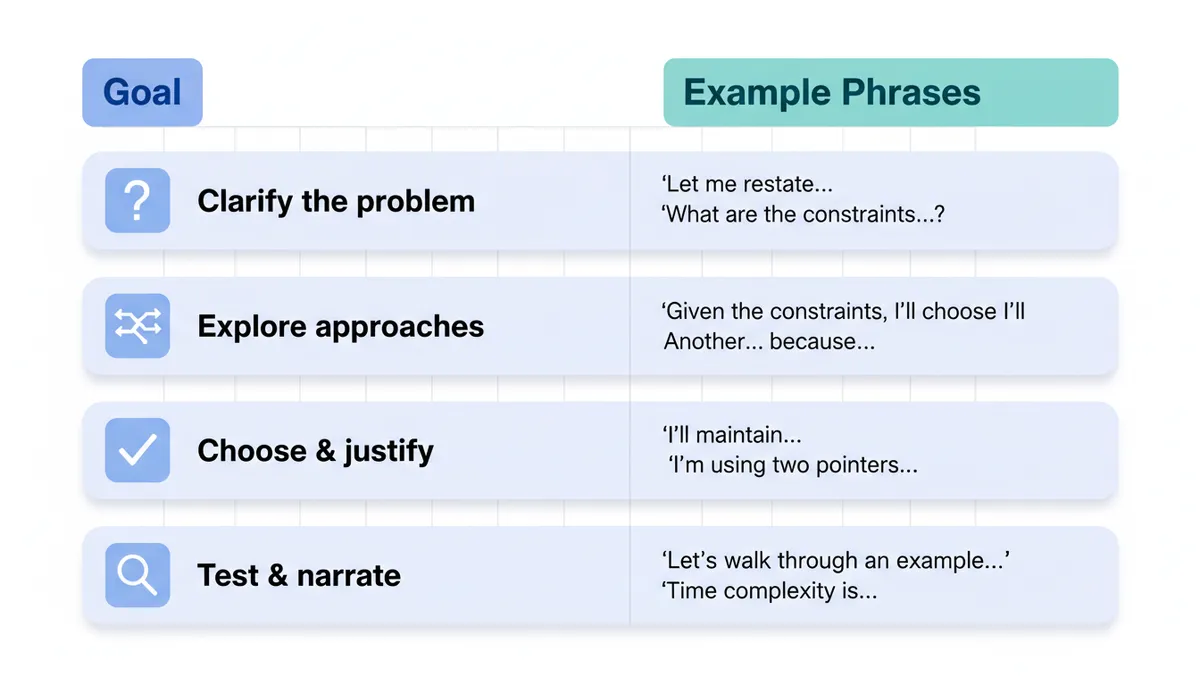
Quick Reference: Phrases That Help You Think Out Loud Effectively
You don’t need to memorize sentences, but having a few ready helps.
Clarifying
- “Let me restate the problem to confirm my understanding…”
- “What are the constraints on input size and values?”
- “Do we care about optimizing for time, space, or both?”
Exploring approaches
- “The naive approach would be…”
- “Another option is…, which would give us O(n log n) time.”
- “This reminds me of the [pattern] approach…”
Choosing
- “Given the constraints, I’ll go with X because…”
- “Between these two, I prefer Y since it preserves [property] and runs in O(n).”
While coding
- “I’ll maintain a map from value to its latest index.”
- “I’ll use two pointers to represent the current window.”
- “I’m writing a helper function to keep the main logic cleaner.”
Testing
- “Let’s walk through a simple example…”
- “Now I’ll test an edge case where…”
- “Here’s how the window evolves step by step…”
Reflecting
- “Time complexity is O(n²) due to the nested loops; space is O(1).”
- “If we wanted to reduce space, we could instead…”
- “A more advanced optimization would be…, but it might be overkill unless we have stricter constraints.”
Key Takeaways
- Thinking out loud in interviews is a skill, not a personality trait. You can learn and practice it.
- Use a structured flow: restate → explore → choose → outline → code → test → reflect.
- Focus your narration on reasoning, tradeoffs, and invariants, not keystrokes.
- Tie your solutions to known patterns (sliding window, hash map, two pointers, DFS/BFS, etc.) and say that explicitly.
- Even if you don’t finish, strong “explaining thought process” and clear communication can still create a positive signal.
If you build the habit of solving practice problems while narrating this way, your real interviews will feel much closer to just another structured problem-solving session—exactly what interviewers want to see.