
Interview
Does Your AI Mock Interview Actually Run Your Code?
Most AI mock interviews talk about your code without running it. How to tell the difference — and practise with real execution in 6 languages.
There is a question worth asking before you trust any AI mock interview with your preparation time: when you finish writing your solution, does anything actually execute it?
It sounds like a strange thing to have to ask. In a real coding interview, your code gets run — against the example case, against edge cases, against whatever the interviewer throws at you when they say "what happens if the array is empty?" That moment, when the output comes back wrong and you have to debug under pressure, is the interview. It is the part that separates people who can code from people who can describe code.
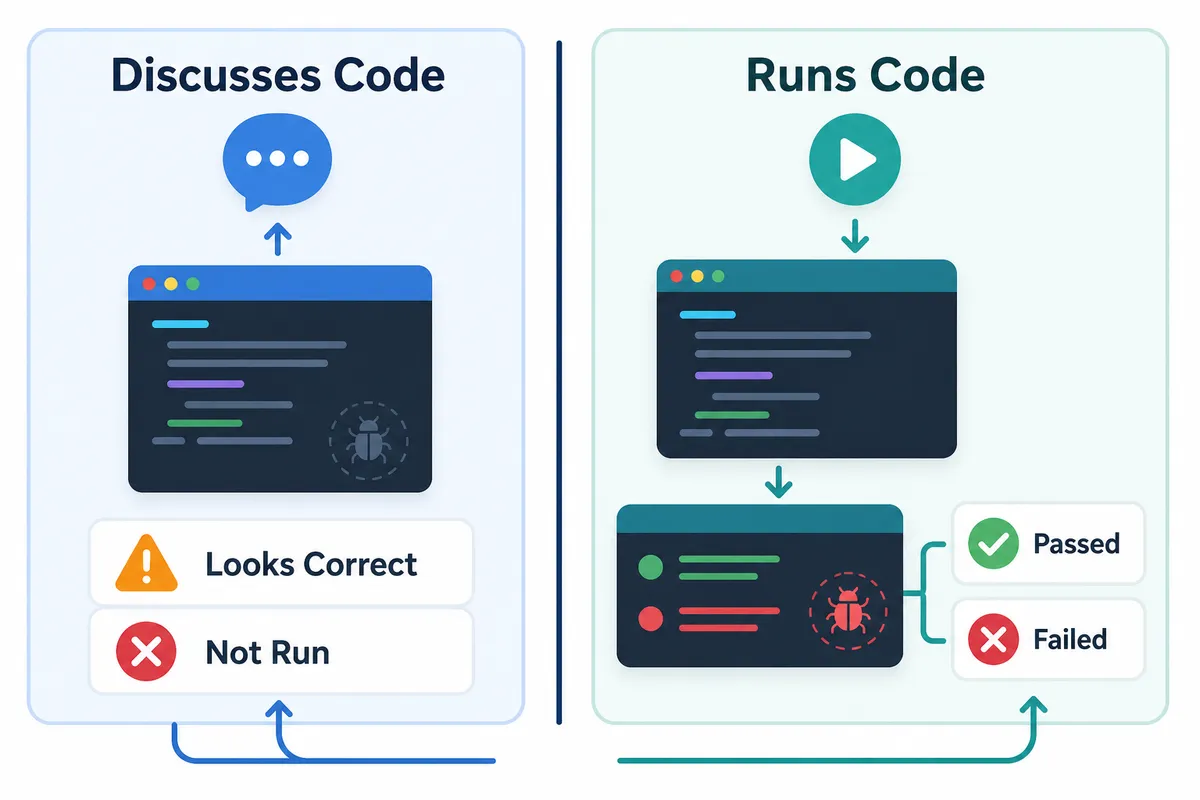
A surprising number of AI interview tools skip it entirely. They read what you wrote, they generate a plausible-sounding critique, and they move on. The conversation feels like an interview. Nothing was ever compiled.
Why this matters more than it sounds
An AI that only discusses your code will confidently tell you your solution looks correct when it has an off-by-one error. It has no way to know. It is pattern-matching against what correct code usually looks like, not against what your code actually does.
That produces a specific and expensive failure mode: you practise for weeks, feel ready, and then discover in the real interview that you have never once had to debug your own mistake under time pressure. The muscle you needed was never trained.
Real execution changes the whole shape of a practice session:
- You find out you were wrong while you can still fix it
- You get used to reading a failing test case and forming a hypothesis quickly
- You practise the recovery, not just the writing — and recovery is most of what senior interviewers are actually scoring
- Your complexity claims get checked against reality, not against your own optimism
💡 Pro Tip: In a real interview, the interviewer rarely tells you your code is wrong. They run it, show you the output, and watch what you do next. If your practice never includes that moment, you are rehearsing the easy half.
If you want to skip straight to the thing being described here, a Thita AI mock interview runs your code in a real editor from the first session — no setup, no partner needed.
How to tell whether a tool actually executes code
You can usually find out in about ninety seconds. Open any AI mock interview tool and try these:
1. Write code that is deliberately, obviously broken. Off-by-one in a loop bound. Return the wrong variable. If the tool praises your approach and says it looks correct, it never ran anything.
2. Add an infinite loop.
A real execution sandbox will time out and tell you so. A tool that only reads code will
happily discuss the elegance of your while True.
3. Ask for the output of a specific input.
"What does this return for [3, 1, 2]?" A tool with execution gives you the actual value.
A tool without it produces a confident guess — and confident guesses about program output
are exactly what language models are worst at.
4. Look for test cases, not vibes. Does the feedback reference a specific failing input, or does it speak in generalities about readability and time complexity? Specific failing inputs come from running things.
⚠️ Important: Marketing copy is not evidence here. "AI-powered code review" and "intelligent feedback on your solution" are both entirely compatible with never compiling a line. Test it yourself with the broken-code trick above.
The landscape is genuinely mixed
It is worth being fair about this, because the category is not uniformly hollow — it is split, and the split does not follow price or brand recognition.
Some well-known tools are simply not built for coding rounds at all, and are upfront about it. Yoodli coaches how you speak — pacing, filler words, delivery — and does not claim to grade an algorithm. It is not pretending otherwise, and it is useful for what it is. (Google's Interview Warmup filled a similar niche for behavioural practice until Google retired it in April 2026; its old address now redirects to a generic interview-tips page.)
Others give you real execution but no interviewer. AlgoExpert runs your code against test cases perfectly well; there is simply nobody asking you follow-up questions while you do it. LeetCode's mock interview mode gives you the judge and a timer, but no voice, no adaptive questioning, and no follow-ups when your approach goes sideways.
And some give you the interviewer and the editor but need another human to show up. Pramp pairs you with a peer for a live session with a shared editor — genuinely valuable, and completely dependent on your partner turning up and being competent enough to push you.
Meanwhile several serious platforms do combine an AI interviewer with real execution. HackerRank has run one of the industry's judges for years and has added AI voice interviewing on top of it. CodeSignal's AI Interviewer has code execution as an explicit, switchable capability. Hello Interview does genuinely thoughtful AI evaluation of system design work. If you are choosing between tools, these are real options, not straw men.
The point is not that everyone else is faking. It is that you cannot tell from the homepage, the tools differ enormously in what they actually do, and the difference maps directly onto whether your practice transfers to a real interview.
| What you want to practise | What the tool must actually do |
|---|---|
| Writing a correct solution | Compile and run it against real test cases |
| Debugging under pressure | Show you a specific failing input, not general advice |
| Explaining while you code | Hold a live voice conversation, not a text box |
| Handling follow-ups | Adapt its next question to what you just did |
| Designing a system | Evaluate the architecture you submitted, not just read it |
What we built, and how you can check it
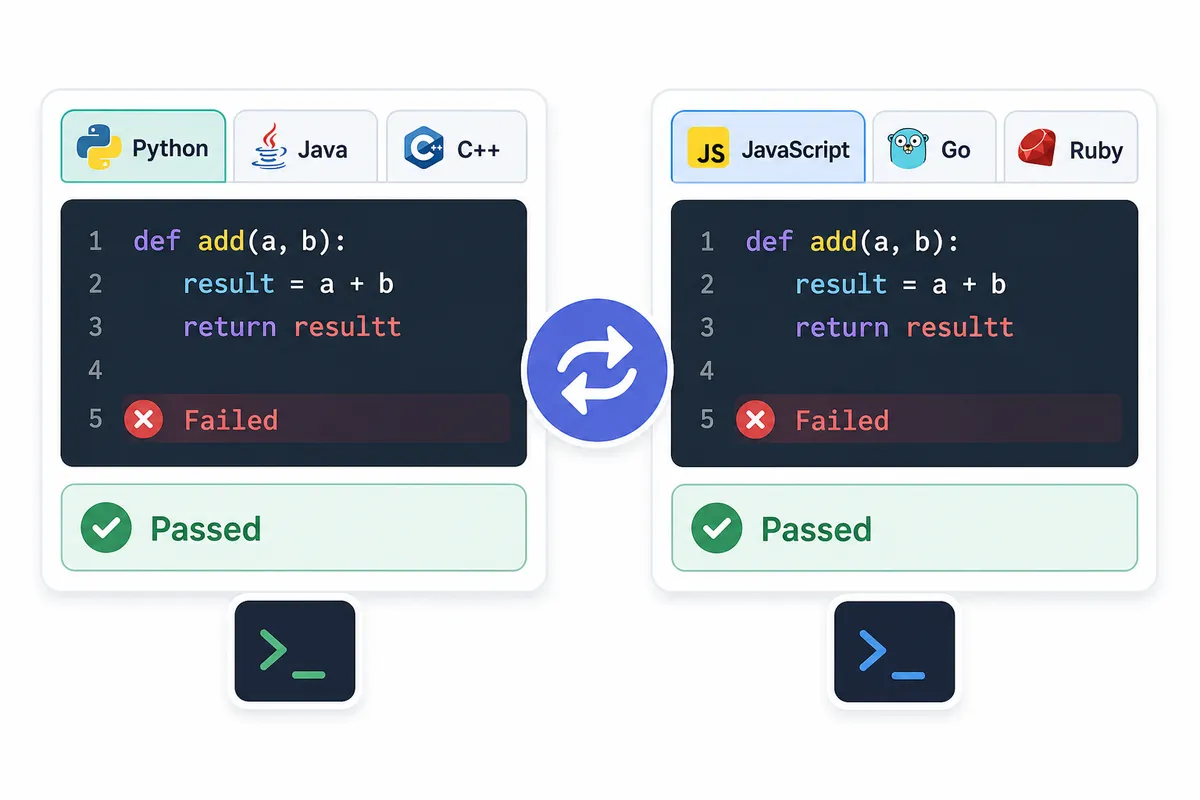
We run live voice interviews with a real code editor, and the code genuinely executes — in Python, C++, Java, JavaScript, Go and C#. You write, you run, you see actual output and actual test results, and the AI interviewer responds to what your code did, not to what it looks like it might do.
24,000+ engineers have practised on the platform, and the reason we lead with execution rather than conversation quality is simple: conversation quality is easy to fake and hard to verify. Execution either happens or it doesn't, and you can check ours in the ninety-second test above. Please do — write something broken on purpose and watch what comes back.
The same principle runs through the rest of it. System design sessions use a real canvas, and the AI evaluates the architecture you actually submitted. Low-level design and machine coding rounds run the same way. Behavioural, product management, data science and ML each have their own track.
You can start an AI mock interview with real code execution without setting anything up, and without waiting for a partner to accept a slot.
What good practice actually looks like
Once execution is real, the way you practise should change. A few things worth doing deliberately:
✅ Do run your code before you announce it works. In a real interview, saying "this should handle all the cases" and then watching it fail is far worse than testing first and narrating what you found.
✅ Do write one deliberately bad solution per session. Practise the recovery — spotting the failure, forming a hypothesis, fixing it while talking. That is the skill under test.
✅ Do switch languages occasionally if your target role allows it. A round answered in Java and the same round in Python exercise different reflexes.
❌ Don't treat a passing test suite as the end of the round. Interviewers almost always follow up: "can you do better than O(n²)?", "what breaks at scale?" Practise having a second answer ready.
❌ Don't practise only the rounds you are already good at. If your DSA is solid and your system design is shaky, an hour on the canvas is worth three on another array problem.
❌ Don't silently rewrite your solution when a test fails. Say what you think went wrong before you change anything. Interviewers are listening for a hypothesis, and a candidate who narrates "the loop is running one element short, so the bound is wrong" reads completely differently from one who quietly edits until the tests go green.
One more thing worth practising deliberately: the moment where you realise your whole approach is wrong. It happens in real interviews, and the recovery is a specific skill — saying so plainly, explaining what you would do instead, and estimating whether there is time. Candidates who have rehearsed that once handle it far better than candidates meeting it for the first time in front of a stranger who is deciding whether to hire them.
Frequently asked questions
Does an AI mock interview actually compile and run my code? It depends entirely on the tool, and you cannot tell from the marketing. Some execute code in a real sandbox; others only read it and generate commentary. Test it by writing deliberately broken code — if the tool praises it, nothing was executed. On Thita, code runs for real in six languages.
Which languages can I practise a coding interview in? Thita's editor supports Python, C++, Java, JavaScript, Go and C#. You can switch languages between sessions to match the role you are targeting.
Is an AI mock interview as good as a real one? It is better for volume and worse for unpredictability. You can do five AI sessions in the time it takes to schedule one human mock, and get consistent feedback on each. Serious candidates usually do both — AI practice for reps, human mocks for the genuinely unscripted experience.
How is this different from just solving problems on LeetCode? Solving problems trains the writing. An interview trains the writing plus explaining yourself out loud, handling follow-ups, and recovering when something fails in front of someone. Those are different skills, and only the second one is what actually gets scored.
Can I practise system design as well as coding? Yes. System design sessions use a design canvas, and the AI evaluates the architecture you submit rather than just reading a description of it. Low-level design and machine coding rounds are available too.
Do I need to schedule a session or find a partner? No. That is the main practical advantage over peer-matching platforms — sessions start when you want them, at whatever hour you actually have free.
What if I am not a software engineer? There are tracks for product management, data science and machine learning, and a resume-based interview that generates questions from your own background — which works for non-technical roles too.
Start with a session that actually runs your code
The fastest way to know whether a practice tool is worth your time is to give it something broken and see whether it notices. If it does, you are practising. If it doesn't, you are rehearsing a conversation.
Start a free AI mock interview and try the broken-code test yourself. If you would rather warm up on the problems first, the DSA patterns sheet and in-browser code practice are free to browse, and the company-wise kits map the round mix at specific companies.
Write something wrong on purpose. See what comes back. That is the whole test.
Topics
Related on Thita
Your next step
Practise with AI mock interviews
A spoken interview that asks follow-up questions, runs your code and ends with a written report.