
Interview
Goldman Sachs 2027 Summer Analyst Program (Engineering): Complete Interview Prep Guide
Prep for the Goldman Sachs 2027 Summer Analyst engineering track: OA, HireVue, and superday. Get the timeline, questions, and a 3-week plan. Start free today.
The Goldman Sachs 2027 Summer Analyst engineering track is one of the most competitive tech internships in finance — and it has a different prep profile than the firm's general finance roles. If you're an engineering or computer science student aiming for the Engineering Division, this guide walks you through everything that actually matters: the application timeline, the online assessment, the HireVue video interview, the superday, how to frame your resume and projects, and a focused 3-week plan to get ready.
Most online advice about Goldman Sachs is written for banking and finance candidates. This one isn't. It's built specifically for the Goldman Sachs summer analyst engineering path — coding-heavy assessments, system design, and the behavioral signals Goldman engineers screen for.
Want to start now? Run your resume through the Thita.ai Resume Analyzer to tighten your project framing, then book an AI mock interview to rehearse the HireVue round before it counts.
⚠️ Important: Recruiting timelines change every cycle, and the Engineering Division often runs a slightly later, rolling schedule than other divisions. Always confirm exact dates and openings on the official Goldman Sachs 2027 Summer Analyst page before you rely on anything here.
Engineering vs General Summer Analyst: What's Actually Different
Goldman Sachs runs one Summer Analyst program, but the experience and the screening differ a lot depending on the division. The Engineering Division is technical to the core — you'll write code, review code, and reason about systems. A general (finance) Summer Analyst spends far less time in an IDE and far more on markets, modeling, and client work.
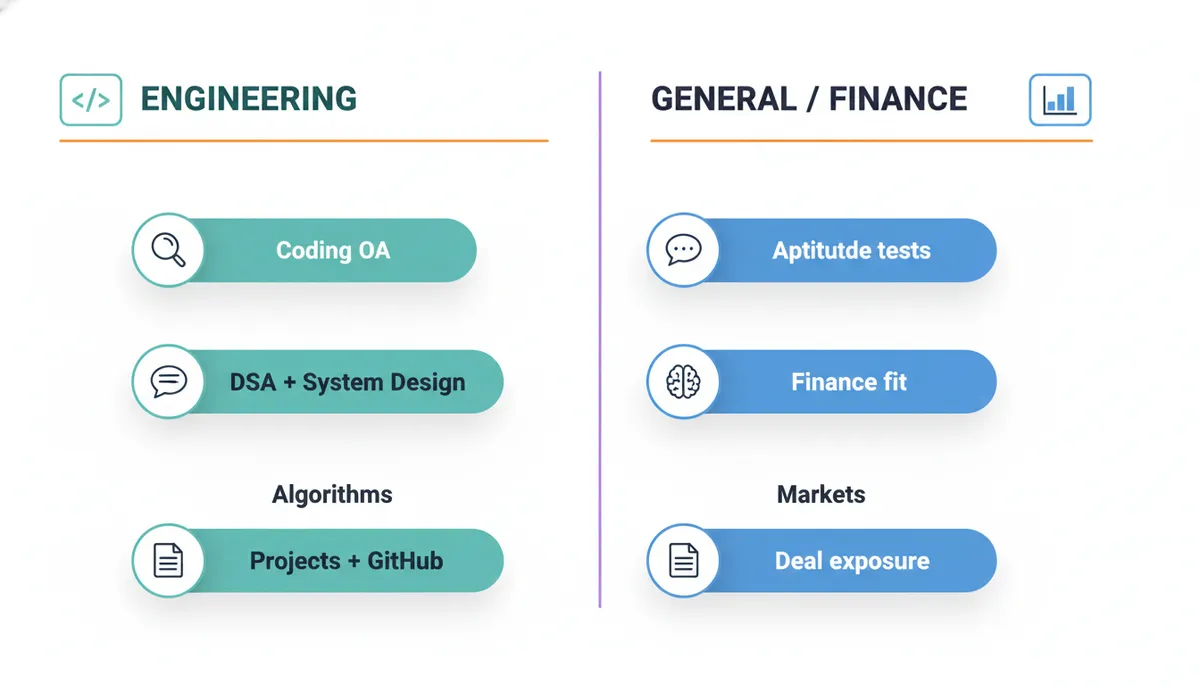
Understanding this difference changes how you prepare. Here's the breakdown:
| Dimension | Engineering Summer Analyst | General (Finance) Summer Analyst |
|---|---|---|
| Core focus | Software, data, infrastructure, quant tooling | Banking, markets, asset management, finance |
| Online assessment | Coding-heavy (HackerRank-style OA) | Aptitude / numerical + situational tests |
| Technical interview | DSA + system design + code review | Finance fit, brain teasers, valuation basics |
| Key skills screened | Algorithms, problem-solving, CS fundamentals | Markets knowledge, modeling, commercial sense |
| Resume signal | Projects, internships, GitHub, languages | Deal exposure, leadership, finance coursework |
| Program length | ~9–10 weeks | ~9–10 weeks |
| Eligibility | Penultimate-year undergrads (typically) | Penultimate-year undergrads (typically) |
💡 Pro Tip: If you're a CS or engineering student, apply directly to the Engineering opening, not a generic Summer Analyst posting. The screening, the interviewers, and the questions are tuned for engineers — applying to the right track is half the battle.
Application Timeline: Apply Early (Open Now — Verify)
Goldman Sachs recruits on an early, rolling basis. The firm posted its first 2027 Summer Analyst applications in early 2026, and roles open and fill on a rolling schedule — which means waiting until a "deadline" is a mistake. Spots can close before any posted cutoff.
Here's the evergreen reality of Goldman engineering recruiting:
- Applications open early and roll. As soon as the 2027 Engineering posting is live, apply. Reviews and assessments often go out within days.
- Engineering runs slightly later than some divisions — but don't bank on it staying open.
- The OA usually follows fast — often within a week of applying.
✅ Do: Submit your application the week the Engineering role goes live. Rolling recruiting rewards early, complete applications — not polished-but-late ones.
❌ Don't: Assume there's a single firm deadline. Confirm the current status on the official Goldman Sachs careers site and apply the moment your target location and division are open.
The Likely Interview Flow: OA → HireVue → Behavioral / Superday
For the Goldman Sachs summer analyst engineering track, expect a three-stage funnel. The exact format varies by region and year, but the structure below is well-documented across recent cycles.
| Stage | Format | Roughly | What It Tests |
|---|---|---|---|
| 1. Online Assessment | HackerRank-style coding OA | ~90–135 min | DSA, problem-solving, CS fundamentals |
| 2. HireVue Interview | One-way recorded video | ~30 min | Behavioral + some technical, communication |
| 3. Superday | Live interviews (2–5 rounds) | Half day | Coding, system design, code review, fit |
Stage 1: The Online Assessment (OA)
The engineering OA is coding-heavy. Recent candidates report a mix of multiple-choice CS questions and 2–3 hands-on coding problems on HackerRank, with a tight time limit (commonly 90–135 minutes, sometimes proctored).
Topics that show up repeatedly:
- Arrays & strings — two pointers, sliding window, hashing
- Hash maps & sets — frequency counting, grouping, dedup
- Recursion & backtracking — subsets, permutations, search
- Dynamic programming — 1D/2D DP, memoization
- Graphs & trees — BFS/DFS, shortest paths, traversal
- Sorting & searching — binary search variants, custom comparators
The fastest way to cover all of these is pattern-based practice rather than grinding random problems. Work through the Thita.ai DSA Patterns Sheet and the DSA Learning Path so you recognize the underlying pattern instantly under time pressure.
💡 Pro Tip: Goldman's coding problems lean practical. Expect data-processing and real-world-flavored prompts, not just abstract puzzles. Practice writing clean, well-named code — your superday may include a review of the code you wrote in the OA.
Stage 2: The HireVue Video Interview
The Goldman Sachs HireVue round is a one-way, recorded video interview — there's no live human on the other end. You get a question on screen, a short prep window (often ~30 seconds), and a few minutes to record your answer. The whole thing usually takes around 30 minutes.
What it evaluates:
- Content — did you actually answer the question?
- Structure — clear framework (STAR) vs rambling
- Specific examples — concrete situations, not vague claims
- Communication — clarity, pacing, and confidence
⚠️ Important: For Engineering, HireVue questions are mostly behavioral but may include a light technical or motivational prompt ("describe a project you built out of pure interest"). Treat it as a serious round — many strong coders get filtered here because they under-prepare.
The closest simulation to the real thing is recorded, timed practice with feedback. Use the Thita.ai AI Mock Interview to rehearse under HireVue-style constraints, or read our HireVue interview preparation guide for question-by-question strategy.
Stage 3: Behavioral & Superday
If you pass HireVue, you're invited to a superday — a half-day of live interviews (typically 2–5 rounds) with analysts, associates, and often a VP from the Engineering Division. For engineers, expect:
- Live coding / DSA — solve and explain a problem in real time
- System design — e.g., "design a feed," "design a URL shortener," scaled to your level
- Code review — walking through and improving code, sometimes the code from your OA
- Behavioral — teamwork, conflict, learning fast, why Goldman, why engineering
Resume & Project Framing for Goldman Sachs Engineering
Your resume is the first technical screen. For the Goldman Sachs engineering interview prep process, recruiters and engineers scan for evidence you can build and ship real software.
✅ Do: Lead each project bullet with impact and the technical decision you made — "Built X using Y to achieve Z," with a number where possible (latency cut, users served, data processed).
❌ Don't: List a wall of technologies with no context. "Familiar with Python, Java, C++, React, SQL, AWS" tells an engineer nothing about what you can actually do.
A strong engineering resume bullet looks like this:
"Built a real-time analytics dashboard (React + FastAPI + PostgreSQL) processing 10K events/min; added indexing and caching that cut p95 query latency from 1.2s to 180ms."
That single line shows stack fluency, ownership, a measurable result, and a performance-engineering instinct — exactly the signals Goldman engineers look for. Run your draft through the Resume Analyzer to catch weak verbs, missing metrics, and skills that aren't backed by a project.
💡 Pro Tip: Keep one GitHub project genuinely clean and documented. If an interviewer opens it, a clear README, sensible commits, and readable code do more for you than ten half-finished repos.
Common Questions: Coding + Behavioral
Coding / Technical
- Find the longest substring without repeating characters (sliding window).
- Detect a cycle in a linked list or directed graph.
- Implement an LRU cache (hash map + doubly linked list).
- Return the top-K frequent elements (heap or bucket sort).
- Number of islands / connected components (BFS/DFS on a grid).
- System design: design a rate limiter, a URL shortener, or a news feed — scoped to an intern level.
Behavioral
- "Tell me about a technical project you're proud of — what was hard about it?"
- "Describe a time you disagreed with a teammate. How did you resolve it?"
- "Tell me about a time you had to learn a new technology quickly."
- "Why Goldman Sachs Engineering specifically?"
- "Tell me about a time you failed or a bug that cost you. What did you learn?"
Answer every behavioral question with STAR — Situation, Task, Action, Result — and make the Action about 60% of your answer. Quantify the result whenever you can. Rehearse these out loud with the AI Mock Interview so your delivery is tight before the HireVue and superday.
Your 3-Week Prep Plan
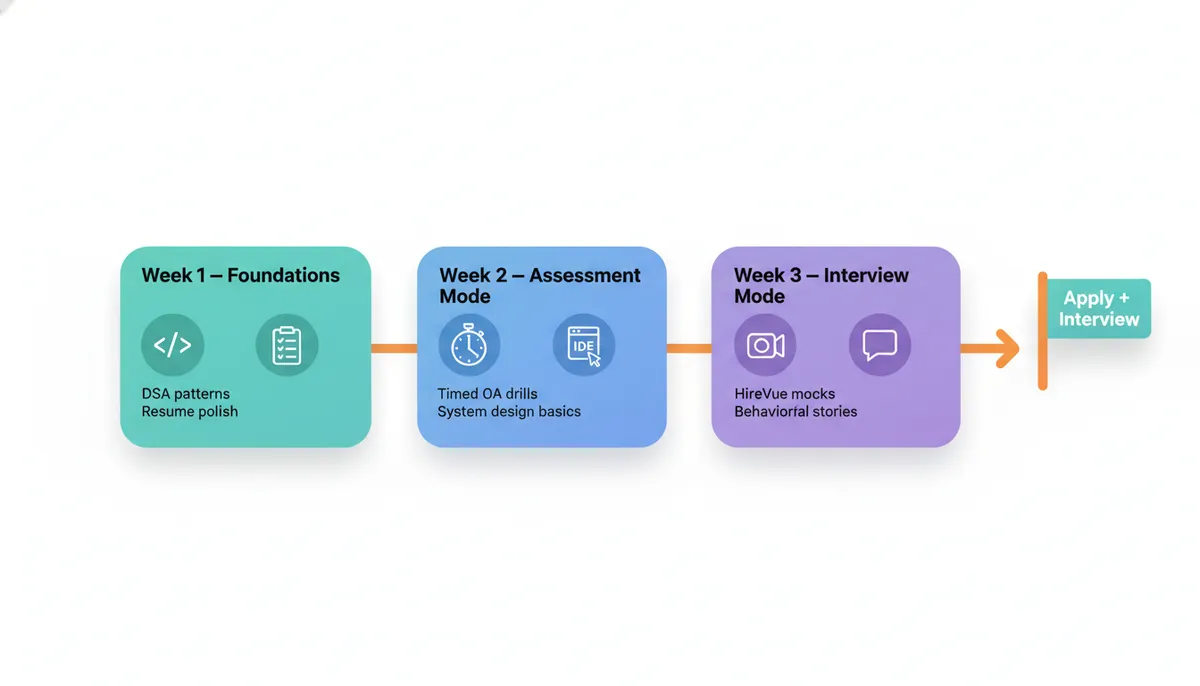
Three focused weeks is enough to move the needle meaningfully if you're disciplined. Here's the plan:
-
Week 1 — Foundations. Lock in CS fundamentals and your resume.
- Work through the DSA Patterns Sheet: arrays, strings, hash maps, recursion.
- Solve 2–3 medium problems daily; aim for 20–25 minutes each.
- Polish your resume with the Resume Analyzer; rewrite every project bullet with a metric.
-
Week 2 — Assessment mode. Train for the OA and technical superday.
- Add DP, graphs, and trees from the DSA Learning Path.
- Do 2–3 timed mock OAs (2–3 problems in ~90 minutes) to build speed.
- Learn the basics of system design (one diagram a day: cache, queue, load balancer, database).
-
Week 3 — Interview mode. Get reps under interview conditions.
- Record daily HireVue-style mock interviews; review your pacing and filler words.
- Write and rehearse 5–6 STAR stories (teamwork, technical challenge, failure, learning, "why Goldman").
- Do 2–3 live-coding mocks where you explain your thinking out loud.
- Submit your application early and confirm the current timeline on the official page.
Frequently Asked Questions
When does the Goldman Sachs 2027 Summer Analyst engineering application open?
Goldman recruits early and on a rolling basis, with 2027 Summer Analyst applications first appearing in early 2026. The Engineering Division often stays open slightly later than other divisions. Because dates shift each cycle, confirm the current status on the official 2027 Summer Analyst page and apply as soon as your location and division are live.
Is the engineering OA different from the general aptitude test?
Yes. The engineering online assessment is coding-heavy — typically a HackerRank-style test with multiple-choice CS questions plus 2–3 hands-on coding problems. General (finance) Summer Analyst candidates usually take numerical/aptitude and situational tests instead.
Do I need to be a Computer Science major?
Not strictly, but the Engineering track is genuinely technical. You should be comfortable with data structures, algorithms, and at least one language (Python, Java, or C++ are common). Engineering, math, and other STEM majors with strong coding ability are welcome.
What is the Goldman Sachs HireVue interview like?
It's a one-way recorded video interview (around 30 minutes) with short prep time per question. For engineers it's mostly behavioral, sometimes with a light technical or motivational prompt. There's no live interviewer, so structure and clarity matter — practice with AI mock interviews.
How hard is the superday for engineering?
The engineering superday usually includes live coding, a scoped system design question, and sometimes a review of the code you wrote in the OA — plus behavioral rounds. Expect 2–5 back-to-back interviews. Solid DSA fundamentals and the ability to explain your reasoning clearly are what carry you through.
How competitive is the Goldman Sachs engineering Summer Analyst program?
Very. Goldman receives a large volume of applications for a limited number of seats, so acceptance is low single digits in many cycles. Applying early and preparing for all three stages — not just the coding round — meaningfully improves your odds.
How long is the program and who is it for?
The Summer Analyst Program is typically a 9–10 week summer internship aimed at undergraduates in their penultimate (usually third) year of study. Strong performance can lead to a full-time return offer.
What's the single best thing I can do to prepare?
Practice under realistic conditions. Run timed OA drills, rehearse recorded HireVue-style answers, and do live-coding mocks where you talk through your approach. Pair the DSA Learning Path with AI mock interviews and a Resume Analyzer pass.
Final Thoughts
The Goldman Sachs 2027 Summer Analyst engineering track rewards candidates who prepare for the whole funnel — the coding OA, the HireVue video, and the superday — not just the part they're most comfortable with. The strongest applicants pair real DSA fluency with crisp, structured communication and a resume that proves they can ship.
Start today:
- Tighten your projects with the Resume Analyzer.
- Rehearse the behavioral and HireVue rounds with AI Mock Interviews.
- Build coding speed with the DSA Patterns Sheet and DSA Learning Path.
Then apply early — and always verify the live timeline on the official Goldman Sachs careers page. The work you put in now compounds well beyond this one internship.