
Interview
How Interviewers Evaluate Junior vs Senior Software Engineers
Most engineers eventually ask the same question: *what actually changes between a junior and senior engineer in an interview?* The job descriptions sound sim...
Most engineers eventually ask the same question: what actually changes between a junior and senior engineer in an interview? The job descriptions sound similar—write code, review PRs, ship features—but interview expectations are very different.
Understanding how interviewers evaluate junior vs senior software engineers is one of the most effective ways to prepare. It clarifies what to emphasize, what to de‑emphasize, and how to tell your story in a way that matches the level you’re targeting.
This guide breaks down how experienced interviewers think about levels, what “senior” really means in practice, and how that shows up in coding, system design, behavioral, and cross-functional interviews.
How Companies Define Junior vs Senior Engineer
Before diving into interview expectations, it helps to clarify what “junior” and “senior” usually mean in modern software engineering careers.
Skill vs Scope vs Autonomy
Most companies implicitly evaluate three dimensions:
- Skill – Your technical ability: coding, debugging, testing, design, architecture.
- Scope – The size and complexity of problems you can own end-to-end.
- Autonomy – How independently you can operate, and how much guidance you need.
Roughly:
-
Junior engineer
- Skill: Solid fundamentals, still building depth.
- Scope: Well-defined tasks or small features.
- Autonomy: Needs direction on what and how; can execute with help.
-
Mid-level engineer
- Skill: Strong coding and debugging; some design experience.
- Scope: Features or small services; can break down work.
- Autonomy: Needs direction on what; can figure out how.
-
Senior engineer
- Skill: Deep expertise in at least one area; strong across the stack they work in.
- Scope: End-to-end ownership of projects and components; can handle ambiguity.
- Autonomy: Can define what and how; mentors others; influences direction.
Interviews are designed to probe these dimensions differently depending on level.
High-Level Differences in Interview Expectations
What Interviewers Look for in Junior vs Senior Engineer Candidates
At a high level, interviewers adjust expectations across four axes:
- Correctness vs tradeoffs
- Execution vs ownership
- Guidance vs leadership
- Local optimization vs system thinking
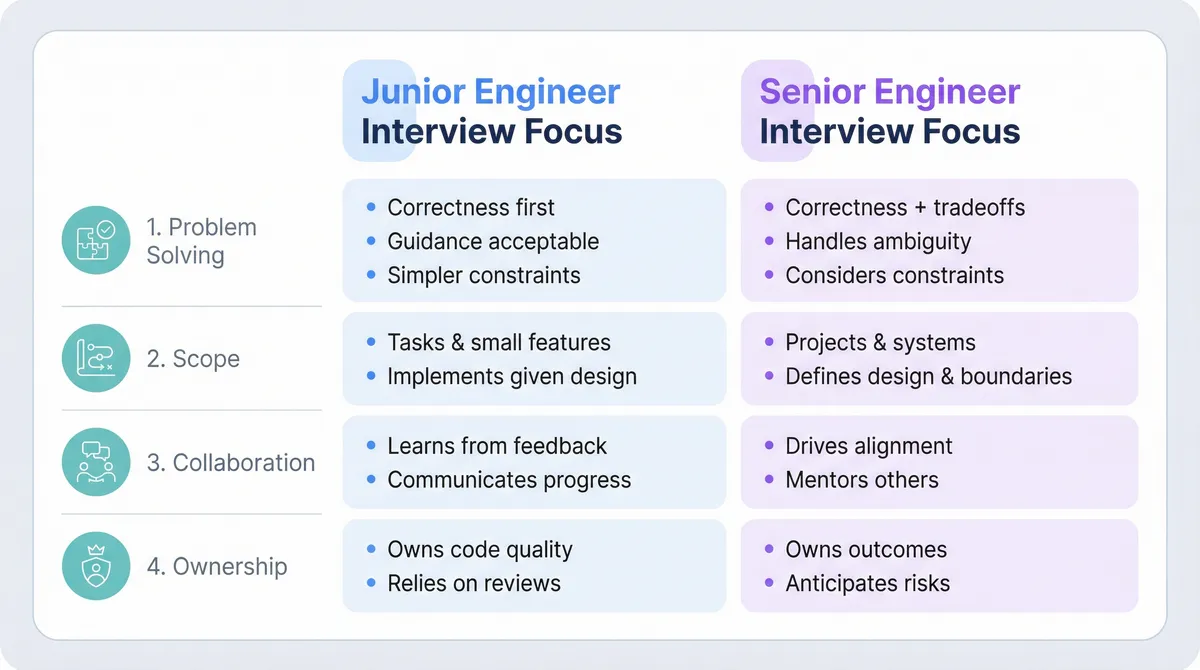
For junior engineers, interviewers mainly ask:
- Can you write correct, readable code?
- Do you understand core data structures and algorithms?
- Can you learn quickly from feedback?
- Will you be reliable and collaborative on a team?
For senior engineers, interviewers additionally ask:
- Can you design and evolve systems that will last?
- Do you make good tradeoffs under real constraints?
- Can you lead projects and align stakeholders?
- Do you raise the bar for the team (mentoring, standards, practices)?
The same interview question can have very different evaluation criteria depending on the level.
Coding Interviews: Junior vs Senior Expectations
Coding interviews are often the clearest place where expectations diverge.
What Interviewers Expect from Junior Engineers in Coding Rounds
For junior candidates, coding interviews emphasize fundamentals and potential.
Interviewers look for:
-
Problem understanding
- Restating the problem in your own words.
- Asking clarifying questions: input size, constraints, edge cases.
- Identifying examples that test your understanding.
-
Basic algorithmic reasoning
- Recognizing when to use arrays, hash maps, stacks, queues, trees, graphs.
- Understanding time/space complexity at a high level (e.g., O(n), O(n²)).
- Being able to improve a naive solution when prompted.
-
Clean, correct implementation
- Writing syntactically correct code in a familiar language.
- Handling edge cases: empty inputs, duplicates, off-by-one errors.
- Explaining your code as you write it.
-
Coachability
- Responding well to hints and guidance.
- Being open to feedback and correcting course quickly.
A junior candidate can pass even if they:
- Don’t always find the optimal solution.
- Need hints for optimizations.
- Are a bit slower, as long as they eventually get to a working solution.
Example: Two-Sum Problem (Junior-Level Approach)
Given an array of integers
numsand an integertarget, return indices of the two numbers such that they add up totarget.
A junior-level solution might be:
PYTHON
A strong junior candidate:
- Can explain why this is O(n²).
- Can discuss how this might be slow for large inputs.
- Can, with a hint, move to a hash map solution.
What Interviewers Expect from Senior Engineers in Coding Rounds
For senior engineers, the bar is higher and broader:
-
Fast problem decomposition
- Quickly clarifying constraints and corner cases.
- Identifying the “shape” of the problem (e.g., sliding window, tree traversal, graph shortest path).
- Outlining an approach before coding.
-
Optimal or near-optimal algorithms
- Reaching time/space-efficient solutions with minimal prompting.
- Recognizing when a brute force solution is unacceptable given constraints.
- Using appropriate data structures fluently.
-
Production-minded coding
- Writing code that is readable, modular, and testable.
- Considering error handling and input validation.
- Discussing tradeoffs (e.g., time vs memory, precomputation vs on-demand).
-
Communication and leadership
- Narrating thought process clearly and concisely.
- Proactively identifying edge cases and testing them.
- Guiding the interviewer through tradeoffs and alternatives.
Example: Two-Sum Problem (Senior-Level Approach)
A senior-level solution often goes beyond correctness and optimality:
PYTHON
What distinguishes a senior candidate here is not the algorithm alone (many juniors know this pattern), but:
- Explaining why O(n²) is not acceptable for large
n(e.g.,nup to 10⁵). - Discussing memory tradeoffs of the hash map.
- Considering variations:
- What if the array is sorted?
- What if there can be multiple solutions?
- What if we need all unique pairs, not just one?
Coding Interview Pitfalls by Level
Common junior pitfalls:
- Jumping into coding without confirming understanding.
- Not handling edge cases (empty arrays, single element, duplicates).
- Struggling to reason about complexity.
- Going silent under pressure instead of thinking aloud.
Common senior pitfalls:
- Over-optimizing prematurely without clarifying constraints.
- Ignoring code quality (naming, structure) in favor of speed.
- Failing to explore tradeoffs or alternatives.
- Not demonstrating leadership in the conversation (e.g., not driving structure).
System Design: The Biggest Gap Between Junior and Senior
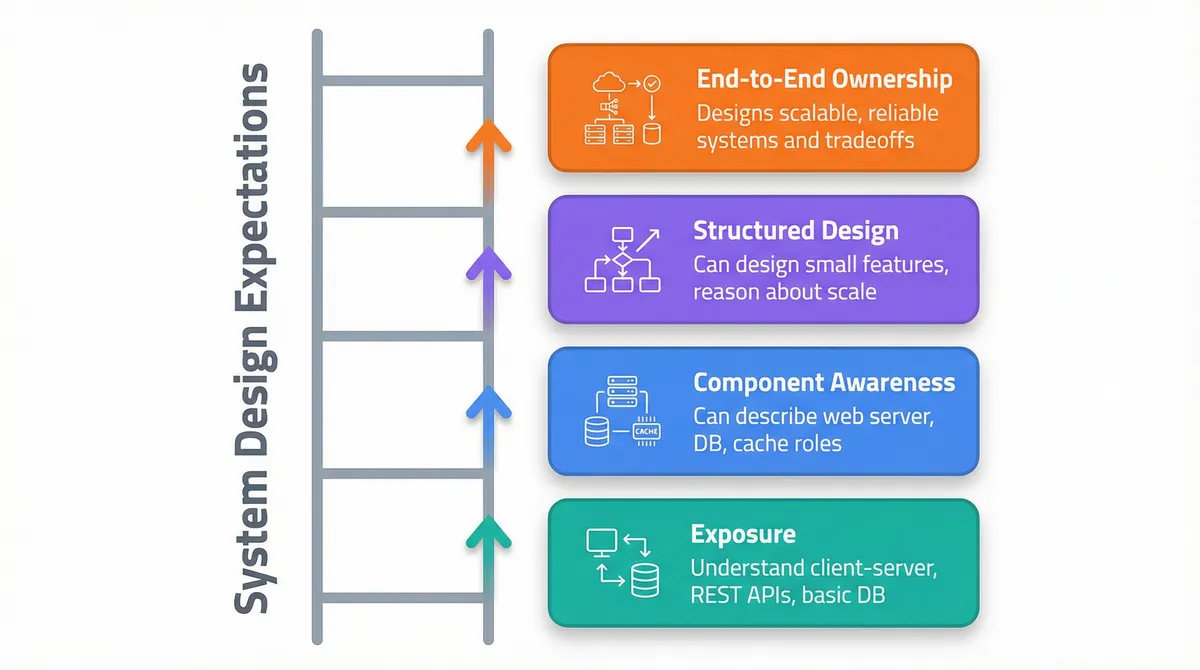
System design interviews are the clearest differentiator between junior vs senior engineer expectations.
Junior Engineers: Limited or No System Design Expectations
Many companies:
- Don’t give formal system design interviews to junior candidates, or
- Ask very scoped design questions (e.g., design a URL shortener focusing on data modeling).
If design is evaluated at the junior level, expectations are:
- Basic understanding of client-server architecture.
- Awareness of common components: databases, caches, REST APIs, message queues.
- Ability to reason about simple data models and API endpoints.
Interviewers mainly look for exposure and curiosity, not mastery.
Senior Engineers: End-to-End System Design Ownership
For senior candidates, system design is a core signal:
- Can you design a system that scales and evolves?
- Do you understand real-world constraints (latency, throughput, consistency, cost)?
- Can you drive a structured design conversation?
How Interviewers Evaluate Senior System Design
They typically look for:
-
Requirements clarification
- Functional requirements: what should the system do?
- Non-functional requirements: scale, latency, availability, consistency, cost.
- Prioritization: what matters most for this problem?
-
High-level architecture
- Clear separation of components (API layer, service layer, data storage, caching, messaging).
- Reasonable technology choices with justification.
- Data flow from client to storage and back.
-
Data modeling and storage
- Choosing between relational vs NoSQL, or hybrid.
- Designing schemas and access patterns.
- Considering indexes, sharding, partitioning.
-
Scalability and reliability
- Load balancing, replication, failover strategies.
- Caching strategies and invalidation.
- Idempotency, retries, and backoff.
-
Tradeoffs and evolution
- Being explicit about tradeoffs: consistency vs availability, latency vs cost.
- Discussing how the system can evolve as requirements grow.
- Knowing when to keep it simple vs add complexity.
Behavioral and “Soft Skills”: How Expectations Scale with Level
Technical strength is necessary but not sufficient, especially for senior roles. Interviewers also carefully evaluate behavioral signals.
Junior Engineer Behavioral Expectations
For junior candidates, interviewers focus on:
-
Learning mindset
- How you’ve learned new technologies or concepts.
- How you respond to feedback and mistakes.
- Curiosity about how systems work.
-
Collaboration basics
- Ability to work in a team, take direction, and communicate progress.
- Handling disagreements respectfully.
- Ownership of your tasks and commitments.
-
Resilience and growth
- How you handle setbacks (bugs, failed projects, rejections).
- Examples of perseverance and improvement.
Typical questions:
- “Tell me about a time you received critical feedback. What did you do?”
- “Describe a challenging bug you fixed. How did you approach it?”
Interviewers don’t expect you to have led large initiatives; they want evidence of trajectory.
Senior Engineer Behavioral Expectations
For senior engineers, expectations are broader and deeper:
-
Leadership without authority
- Driving technical decisions across teams.
- Influencing direction without formal power.
- Resolving disagreements constructively.
-
Project ownership
- Owning outcomes, not just code.
- Anticipating risks and unblocking others.
- Communicating effectively with engineers, PMs, and stakeholders.
-
Raising the bar
- Mentoring and coaching junior engineers.
- Improving processes, tooling, and standards.
- Introducing better practices (testing, observability, reliability).
Typical questions:
- “Tell me about a project where you had to align multiple stakeholders.”
- “Describe a time you made a significant technical tradeoff. How did you decide?”
- “How have you helped less experienced engineers grow?”
A common mistake for senior candidates is answering these with purely individual-contributor stories (“I wrote X code”) instead of ownership and impact stories (“I drove X outcome”).
Cross-Functional and Product Thinking: Where Senior Engineers Stand Out
Another key difference in hiring criteria is how candidates think about the product and business context.
Junior: Solid Engineering, Limited Product Context
Junior engineers are usually evaluated on:
- Implementing features according to spec.
- Asking clarifying questions about behavior.
- Being aware of user impact when testing.
It’s a plus (but not a requirement) if a junior candidate:
- Talks about user experience.
- Mentions tradeoffs between engineering complexity and user value.
Senior: Product-Aware Engineering
Senior engineers are expected to:
-
Understand the “why” behind the “what”
- Asking: “What problem are we solving?” and “Who is the user?”
- Challenging requirements when they don’t make sense.
-
Balance product and engineering tradeoffs
- Proposing phased approaches (MVP vs v2).
- Considering time-to-market vs technical debt.
- Suggesting experiments or metrics to validate impact.
-
Communicate with non-engineers
- Explaining technical constraints in non-technical terms.
- Negotiating scope and timelines.
- Helping prioritize work based on impact.
In interviews, this often appears in:
- Product-oriented design questions.
- Scenario questions about conflicting priorities.
- Discussion of past projects and decision-making.
Concrete Comparison Table: Junior vs Senior Interview Expectations
| Dimension | Junior Engineer Interview Expectations | Senior Engineer Interview Expectations |
|---|---|---|
| Problem Solving | Correctness, basic efficiency, guided improvements | Optimal/near-optimal, independent, clear tradeoff reasoning |
| Data Structures & Algos | Recognize and apply core structures (arrays, hash maps, trees) | Fluent use across a wide range; patterns for common problems |
| Code Quality | Reasonable naming, basic structure, some tests if time allows | Production-minded: modular, testable, robust, clear error handling |
| System Design | Exposure to basic concepts; simple diagrams if asked | End-to-end system design; scalability, reliability, data modeling, tradeoffs |
| Collaboration | Works well in a team, takes direction, communicates progress | Drives alignment, mentors others, resolves conflicts |
| Product Thinking | Some awareness of user impact | Deep product awareness; balances business and engineering constraints |
| Autonomy | Needs guidance on tasks and approach | Defines projects, scope, and technical direction |
| Impact | Contributes to team goals | Owns key outcomes; improves team or org capabilities |
Common Mistakes When Targeting the Wrong Level
A subtle but frequent failure mode is interviewing at one level while presenting yourself as another.
Junior Candidates Trying to Look “Senior”
Common issues:
- Overusing buzzwords (microservices, CQRS, event sourcing) without depth.
- Claiming ownership of systems where you mostly implemented tickets.
- Talking about architecture you didn’t design.
Interviewers quickly detect shallow understanding. It’s better to:
- Be honest about your contributions.
- Show depth in the parts you did own.
- Emphasize learning and growth.
Senior Candidates Presenting as “Strong Juniors”
Common issues:
- Focusing only on individual coding contributions.
- Describing tasks instead of projects (no scope or ownership).
- Not mentioning tradeoffs, stakeholders, or long-term impact.
If you’re a senior candidate, ensure your stories show:
- Ambiguity you navigated.
- Decisions you drove.
- People you influenced.
- Systems you designed or significantly evolved.
How to Prepare Differently as a Junior vs Senior Candidate
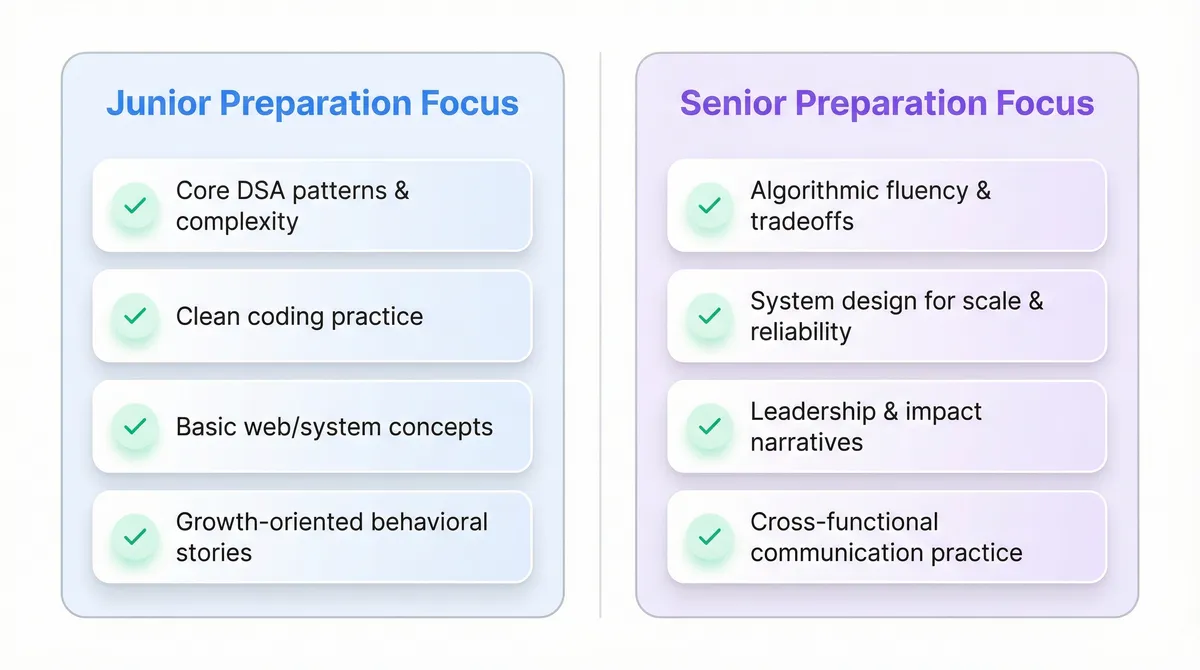
Preparation Strategy for Junior Engineers
Focus on building strong fundamentals and demonstrating potential.
-
Strengthen core DSA patterns
- Arrays, strings, hash maps, linked lists.
- Trees (BST operations, traversals), graphs (BFS/DFS).
- Common patterns: two pointers, sliding window, binary search, recursion/backtracking.
- A structured resource like a Beginner to Advanced DSA Roadmap for Software Engineers in 2026 can help you cover breadth efficiently.
-
Practice coding with feedback
- Solve problems in a timed environment.
- Focus on clarity: variable names, function decomposition.
- After solving, refactor and analyze complexity.
-
Prepare simple system understanding
- Know how a web request flows (browser → DNS → load balancer → app → DB).
- Understand basics of REST, HTTP, and databases.
-
Develop strong behavioral stories
- Projects where you learned something hard.
- Times you debugged tricky issues.
- Situations where you took initiative.
Preparation Strategy for Senior Engineers
For senior roles, preparation must reflect the broader hiring criteria.
-
Sharpen algorithmic fluency
- You’re still expected to perform strongly in coding rounds.
- Focus on patterns, not just individual problems: graph traversal, DP, greedy, interval problems, etc.
- Practice articulating tradeoffs and alternative approaches.
-
Deepen system design skills
- Study common large-scale systems: news feed, search, messaging, file storage.
- Practice whiteboarding designs with clear structure:
- Clarify requirements.
- Propose high-level architecture.
- Dive into data modeling.
- Discuss scale, reliability, and tradeoffs.
- Use post-mortems of real systems (public incident reports, engineering blogs) to learn.
- For a comprehensive approach, follow the Ultimate System Design Roadmap: 120 Topics to Master Every Interview to cover essential concepts and patterns.
-
Refine leadership and impact stories
- Prepare detailed examples that show:
- Project ownership from idea to production.
- Technical decisions and tradeoffs you led.
- Mentoring and team improvements.
- Use the STAR framework (Situation, Task, Action, Result) but emphasize decisions and impact.
- Prepare detailed examples that show:
-
Practice communication under interview constraints
- Simulate design and behavioral interviews with peers or tools like an AI interview partner.
- Focus on structuring your thoughts and guiding the conversation.
Best Practices During the Interview: Behaviors That Signal Level
Regardless of seniority, certain behaviors consistently correlate with strong performance. Interviewers implicitly calibrate these behaviors by level.
Behaviors That Help Junior Candidates
-
Think aloud, but not chaotically
- Narrate key steps: understanding → approach → implementation → testing.
- Don’t narrate every keystroke; focus on reasoning.
-
Ask clarifying questions
- “What are the expected input sizes?”
- “How should we handle invalid inputs?”
-
Be explicit about tradeoffs even if simple
- “I’ll start with a simple O(n²) solution; if we need better performance, we can use a hash map to get O(n).”
-
Show you can learn
- When corrected, summarize the lesson: “So the issue was X; next time I’ll watch for Y.”
Behaviors That Help Senior Candidates
-
Structure the conversation
- For coding: “Let me restate, then propose a high-level approach, then we can dive into code.”
- For design: “First I’ll clarify requirements, then outline components, then discuss data and scale.”
-
Make tradeoffs explicit
- “Option A uses more memory but is simpler; option B is more complex but saves 50% memory. Given we’re latency-bound, I’d choose A.”
-
Connect to real-world constraints
- “In practice, we’d need to consider schema migrations and backward compatibility here.”
-
Demonstrate leadership, not just expertise
- Use “we” when describing team efforts, but be clear about your role.
- Mention mentoring, documentation, and process improvements naturally.
Key Takeaways: How Interviewers Distinguish Junior vs Senior
-
Same questions, different expectations
The difference between junior vs senior engineer interviews is often not the problems but the evaluation criteria: depth, tradeoffs, scope, and autonomy. -
Junior interviews emphasize fundamentals and potential
- Correctness, basic efficiency, and clean code.
- Core data structures and algorithms.
- Coachability, collaboration, and a growth mindset.
-
Senior interviews emphasize ownership and impact
- Optimal or near-optimal solutions with clear tradeoffs.
- End-to-end system design under real constraints.
- Leadership, mentoring, and cross-functional collaboration.
-
Misalignment between your level and your stories is costly
- Overstating your role or depth is quickly detected.
- Understating your impact can get you leveled lower than you deserve.
-
Preparation should match your target level
- Juniors: focus on fundamentals, clean coding, and learning stories.
- Seniors: combine algorithmic fluency with strong system design and leadership narratives.
Understanding how interviewers evaluate junior vs senior software engineers lets you prepare with intent, not guesswork. Align your preparation, examples, and communication style to the level you’re targeting, and you’ll make it much easier for interviewers to see you at that level.