
Interview
How to Break Out of a Coding Interview Preparation Plateau
If you’ve been grinding LeetCode for months and your progress graph has gone flat, you’re not alone. Almost everyone preparing for coding interviews hits a *...
If you’ve been grinding LeetCode for months and your progress graph has gone flat, you’re not alone. Almost everyone preparing for coding interviews hits a coding interview plateau at some point: you’re solving problems, but not improving; you’re putting in hours, but your mock interviews look the same.
This post breaks down why that happens and how to systematically get unstuck. We’ll treat interview prep like engineering work: diagnose, instrument, iterate.
Why Coding Interview Plateaus Happen
Most “interview prep stuck” stories follow a similar pattern:
- You’ve solved 100–300+ problems.
- Easy/mediums feel fine, but new mediums/hards still feel impossible.
- You keep forgetting patterns you “already learned.”
- Mock interviews feel stressful and inconsistent.
- You’re not sure what to do differently, so you just… do more problems.
To break a LeetCode plateau, you need to stop optimizing for problem count and start optimizing for skill acquisition. That means:
- Identifying which skills are actually limiting you.
- Switching from passive repetition to deliberate practice.
- Tracking the right signals (not just “AC” vs “WA”).
Let’s start by diagnosing what’s really blocking you.
Step 1: Diagnose Your Plateau Like a Bug
When a production service misbehaves, you don’t just restart it and hope. You collect logs, metrics, traces. Treat your prep the same way.
1.1 Identify Your Failure Modes
Go through your last 20–30 problems or 3–5 mock interviews and classify how you failed. Common patterns:
- Pattern recognition gap
- “I’ve seen something like this before, but I can’t recall the approach.”
- You stare at the problem for 30 minutes with no direction.
- Implementation gap
- You know the right idea (e.g., “use two heaps”), but:
- Off-by-one errors
- Wrong edge cases
- Timeouts from minor inefficiencies
- You know the right idea (e.g., “use two heaps”), but:
- Complexity analysis gap
- You can code something, but:
- You can’t argue time/space complexity confidently.
- You pick an approach that’s too slow for constraints.
- You can code something, but:
- Communication gap
- In mock interviews:
- Silence while thinking
- Incomplete explanation of trade-offs
- Jumping straight into code
- In mock interviews:
- Stress/pressure gap
- You can solve offline, but:
- Freeze in interviews
- Forget basic patterns under pressure
- You can solve offline, but:
Write these down. You’re building a small “postmortem” for your prep.
1.2 Build a Simple Prep Dashboard
You don’t need a full analytics stack—just a structured log. For each problem or mock:
- Problem ID / topic
- Did you solve it without help? (Y/N)
- Time to first working solution
- Main failure mode (if any)
- Pattern used (e.g., sliding window, binary search on answer, DSU)
- What you’d do differently next time
Over 30–50 entries, patterns will emerge:
- “I’m consistently slow on tree DP.”
- “I rarely think of binary search on answer.”
- “I overcomplicate problems that have a greedy solution.”
This is your roadmap out of the plateau.
Step 2: Switch From “More Problems” to Deliberate Practice
Grinding random problems is like randomly pushing buttons in a debugger. Sometimes it works, but it’s not systematic.
Deliberate practice is targeted, feedback-driven, and slightly uncomfortable by design.
2.1 Narrow Your Focus: One Skill at a Time
Pick one limiting skill from your diagnosis:
- Pattern recognition (e.g., graph traversal variants)
- Implementation robustness (e.g., pointers, indices, edge cases)
- Complexity intuition
- Problem decomposition
- Verbal explanation
For 1–2 weeks, design your practice around that skill.
Example: If your main issue is pattern recognition, your plan might be:
- Choose a single pattern (e.g., “sliding window”).
- Solve 10–15 problems in that pattern only.
- For each problem, explicitly:
- Identify why this is sliding window and not something else.
- Classify the variant (fixed window vs dynamic vs “at most K”).
- Write a 2–3 sentence summary of the pattern at the end.
2.2 Slow Down to Speed Up
When stuck in a coding interview plateau, the instinct is to go faster—more problems, less thinking. That cements shallow understanding.
For targeted practice sessions:
- Spend 5–10 minutes only reading and rephrasing the problem.
- Before coding, write:
- Input constraints
- Edge cases
- Brute force idea
- Desired complexity
- Force yourself to outline the algorithm in comments before implementation.
Example comment outline:
PYTHON
You’re practicing thinking like an interviewer expects, not just getting to “Accepted.”
Step 3: Use Patterns to Escape the LeetCode Plateau
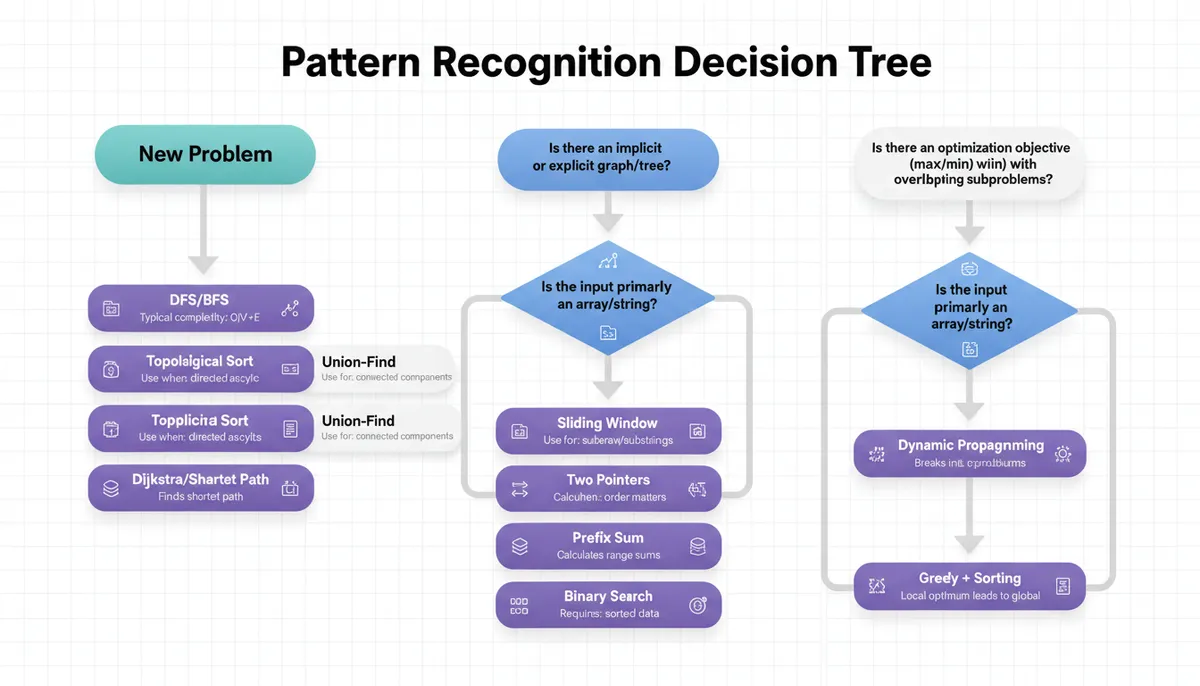
Patterns are the mental compression you need. Instead of memorizing 500 problems, you internalize ~50–100 reusable templates.
3.1 Build a Pattern-First Mental Model
When reading a new problem, your first question should be:
“What kind of problem is this?”
Common pattern families:
- Arrays & strings
- Sliding window, two pointers, prefix sums, binary search
- Trees & graphs
- DFS/BFS, topological sort, shortest path, union-find
- Dynamic programming
- 1D/2D DP, knapsack, subsequences, interval DP, tree DP
- Greedy
- Sorting + greedy choice, heap-based greedy
- Search
- Binary search on answer, backtracking
Train yourself to quickly map problems into these buckets.
3.2 Example: Recognizing Sliding Window vs Two Pointers
Consider the problem:
Given an array of integers and an integer
k, find the length of the longest subarray with sum ≤ k.
Think in patterns:
- We’re dealing with a contiguous subarray → likely sliding window or prefix sum.
- We want “longest” while maintaining a constraint (
sum ≤ k) → dynamic window size.
So we reach for sliding window:
PYTHON
- Time: O(n)
- Space: O(1)
The key isn’t the code—it’s the pattern recognition:
- Contiguous → sliding window
- Constraint on sum → shrink while violating
Do this explicitly for every problem. Over time, you’ll internalize the mapping and break through the interview prep stuck feeling.
3.3 Pattern Sheets and Grouped Practice
Instead of solving random problems:
- Pick a pattern family (e.g., “binary search on answer”).
- Solve 8–12 problems that all use that pattern.
- After each, write:
- “Why binary search on answer works here”
- “What the monotonic property is”
This is exactly what pattern-based resources (like a DSA patterns sheet) are designed to support: you’re training generalizable skills, not memorizing isolated puzzles.
Step 4: Close the Feedback Loop With Mock Interviews
You can’t debug what you don’t observe. If you’re only doing offline LeetCode, you’re missing critical signals.
4.1 Simulate the Real Constraints
At least once a week:
- Do a timed session:
- 1–2 problems
- 45–60 minutes
- No copy-paste from old solutions
- No pausing the clock
- Ideally, do a live mock:
- With a friend
- Or with an AI interviewer that forces you to talk through your thinking (e.g., AI Mock Interviews vs Real Interviews: Do They Actually Help?)
Treat this like production traffic. You’ll notice different failure modes:
- Rushing into code without clarifying requirements
- Poor time management (30 minutes on the first idea that’s clearly too slow)
- Freezing when stuck instead of exploring alternatives
4.2 Instrument Your Mock Interviews
After each mock, write a short “postmortem”:
- What went well?
- What specifically broke?
- Pattern recognition?
- Complexity estimation?
- Communication?
- Where did time go?
- 15 min understanding vs 30 min coding vs 10 min debugging?
Over several mocks, you’ll see recurring themes. Aim each week’s practice at those themes.
Step 5: Fix the Core Technical Gaps
Sometimes the plateau isn’t about interviews at all—it’s about fundamentals.
5.1 Data Structures You Must Be Fluent In
If any of these feel shaky, that’s a likely bottleneck:
- Arrays / lists, strings
- Hash maps / hash sets
- Stacks, queues, deques
- Heaps / priority queues
- Binary search (on array and on answer)
- Basic trees (binary tree, BST)
- Graph representation (adjacency list, adjacency matrix)
- Union-Find (Disjoint Set Union)
For each structure, you should be able to:
- Implement core operations from scratch (even if interviews often allow library usage).
- State time/space complexity.
- Recognize when it’s the right tool.
Example: If you routinely implement “get max in a sliding window” with O(n²) nested loops, you likely haven’t internalized the monotonic deque pattern.
5.2 Complexity Intuition
A common plateau symptom: “not improving coding interviews” because you keep picking O(n²) solutions for n up to 10⁵.
Habit to build:
- Always read constraints.
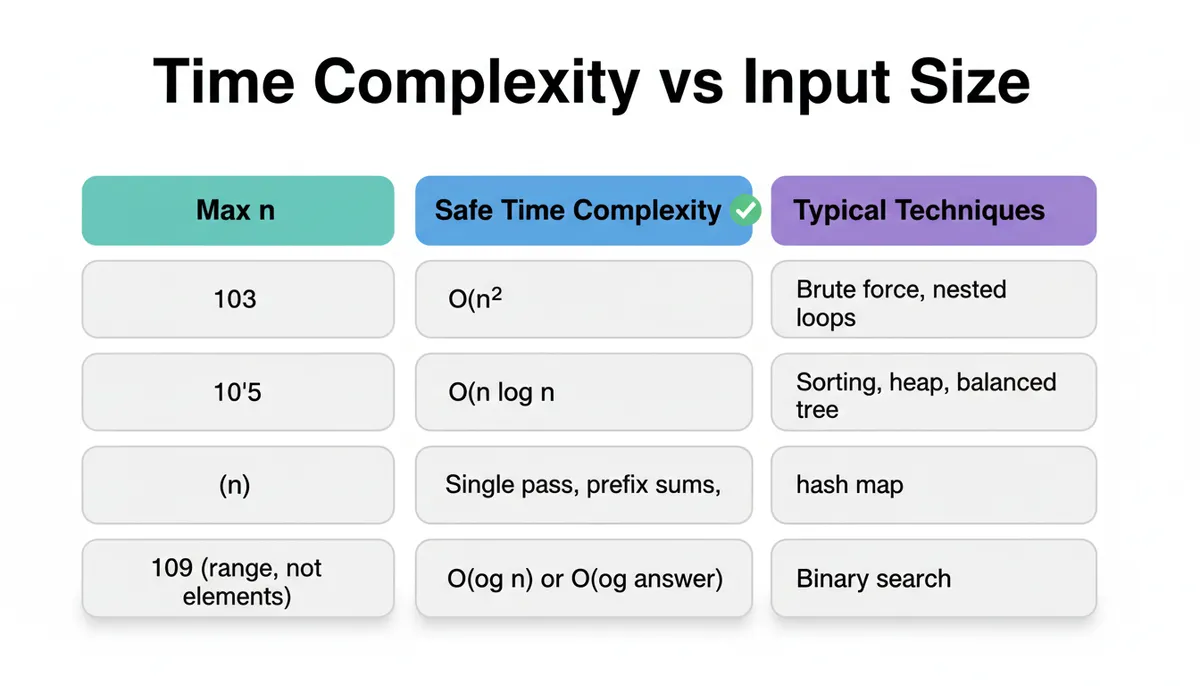
- Map constraints to target complexity:
- n ≤ 10³ → O(n²) is often fine
- n ≤ 10⁵ → aim for O(n log n) or better
- n ≤ 10⁶ → O(n) or O(n log log n)
Create a quick reference table and keep it visible during practice.
Step 6: Change How You Review Problems
Most people do this:
- Struggle for 30 minutes.
- Look at editorial.
- Copy solution.
- Move on.
That guarantees a LeetCode plateau. The learning happens in the review, not the first attempt.
6.1 The 4-Pass Review Method
For each non-trivial problem, after you’ve seen a solution:
- Conceptual pass
- Without looking at code, explain:
- What pattern is used?
- Why does it work at a high level?
- What’s the key invariant or monotonic property?
- Without looking at code, explain:
- Code reconstruction pass
- Close all references.
- Re-implement the solution from memory.
- Aim for correctness, not brevity.
- Variation pass
- Ask: “How would I change this if…”
- The array was a linked list?
- We needed count instead of max?
- We needed index instead of value?
- Sketch how the algorithm would adapt.
- Ask: “How would I change this if…”
- Summary pass
- Write a 2–3 line summary in your notes:
- “Pattern: sliding window”
- “Trick: shrink window while constraint violated”
- “Watch out for: off-by-one when updating answer”
- Write a 2–3 line summary in your notes:
This takes more time per problem but dramatically increases retention.
6.2 Track by Patterns, Not by Problem IDs
Instead of a flat list of “problems solved,” maintain notes grouped by pattern:
- Sliding Window
- LC 3 – Longest Substring Without Repeating Characters
- LC 76 – Minimum Window Substring
- LC XYZ – …
- Common template, pitfalls, variants
- Binary Search on Answer
- LC 875 – Koko Eating Bananas
- LC 410 – Split Array Largest Sum
- Monotonic condition, search space definition
When you feel “interview prep stuck,” revisit a pattern section and re-solve 2–3 problems from it. This reinforces long-term memory.
Step 7: Address Non-Technical Bottlenecks
Not all plateaus are algorithmic.
7.1 Time Management in Interviews
A simple structure for 45-minute coding questions:
- 0–5 min: Clarify problem, restate in your own words, ask about constraints and edge cases.
- 5–15 min: Discuss approaches, start with brute force, then optimize.
- 15–35 min: Implement chosen solution while narrating your thought process.
- 35–45 min: Test with examples, analyze complexity, discuss trade-offs.
If you find yourself coding for 35+ minutes, you’re under-investing in upfront thinking.
7.2 Communication and “Thinking Out Loud”
Interviewers can’t see your internal state. Silent thinking looks like being stuck.
Practice this in every problem, even alone:
- When reading:
- “This looks like a graph problem because…”
- “Constraints are up to 10⁵, so O(n²) is too slow…”
- When choosing between approaches:
- “Option A is simpler but O(n²); option B uses a heap for O(n log n). Given constraints, I’ll pick B.”
- When coding:
- “I’ll use a dict to map value to index so I can check in O(1)…”
If you don’t have a human partner, using an AI coach (see Best AI Interview Prep Tools of 2026: Compare Top Platforms & Features) to “force” you to verbalize can be surprisingly effective.
7.3 Psychological Burnout
Sometimes the plateau is just fatigue:
- You’re grinding hours after a full-time job.
- You feel guilty when not practicing.
- Every problem feels like a chore.
Counterintuitively, reducing volume can increase progress:
- 60–90 minutes of deep, focused, deliberate practice beats 4 hours of distracted grinding.
- Take 1–2 rest days per week from coding interview prep.
- Mix in different activities:
- System design
- Reading high-quality solutions and editorials
- Reviewing notes instead of solving new problems
Common Mistakes That Keep You Stuck
These patterns show up in almost every coding interview plateau:
Mistake 1: Chasing Problem Count
“I solved 500 LeetCode problems” is a vanity metric if:
- You can’t explain why solutions work.
- You forget patterns after a week.
- You can’t perform under time pressure.
Fix: Track skills (patterns mastered, mock performance) rather than raw counts.
Mistake 2: Avoiding Weak Areas
You’re great at arrays and strings, so you keep solving… more arrays and strings.
Fix: Intentionally schedule “weak topic days” (graphs, DP, etc.). Start with easier problems in that topic to build confidence, then ramp up.
Mistake 3: Over-Reliance on Editorials
Reading editorials too early short-circuits your problem-solving muscles.
Fix: Enforce a rule:
- 20–30 minutes of genuine effort before peeking.
- When you peek, read just enough to get unstuck, then close it and continue independently.
Mistake 4: Ignoring Implementation Quality
Some candidates think “as long as it works, style doesn’t matter.” In interviews, messy code:
- Makes bugs harder to find.
- Makes it harder to explain what you’re doing.
- Signals lack of engineering discipline.
Fix: Practice clean code in interview constraints:
- Clear variable names
- Logical function decomposition
- Inline comments for non-obvious parts
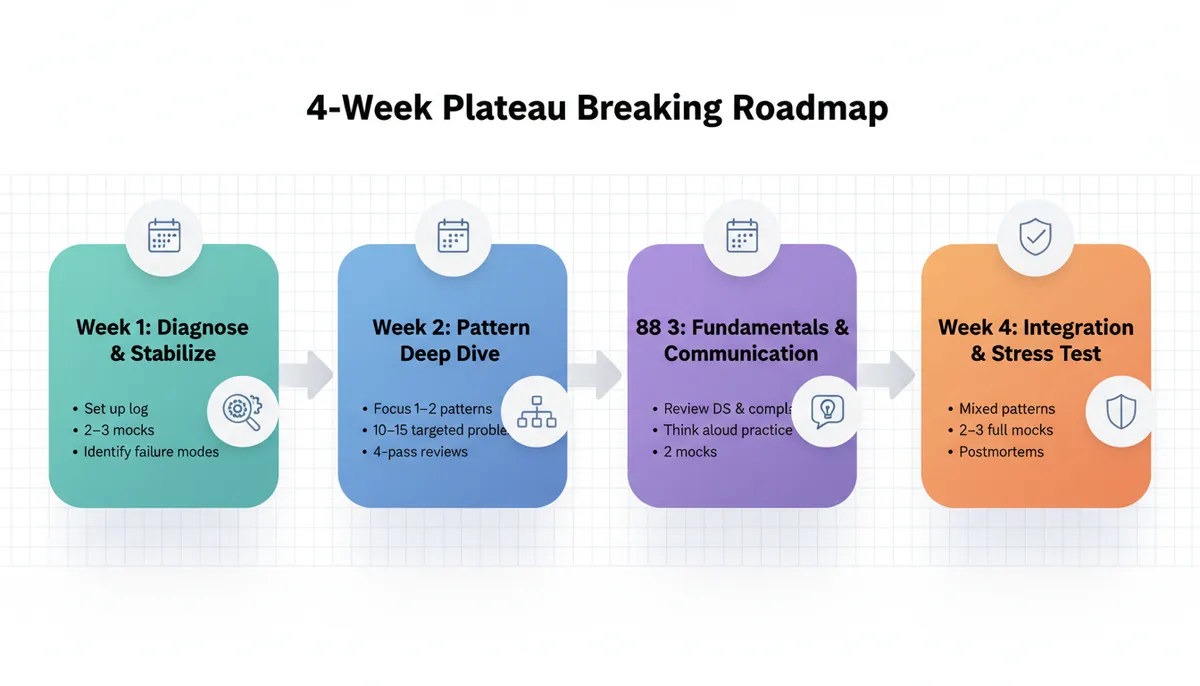
Putting It All Together: A 4-Week Plateau-Breaking Plan
Here’s a concrete, structured plan to get moving again.
Week 1: Diagnose and Stabilize
- Set up your prep log / dashboard.
- Do 2–3 timed sessions or mock interviews.
- Identify your top 2 limiting factors.
- Reduce problem volume slightly; increase time spent per problem on review.
Week 2: Pattern-Focused Deep Dive
- Pick 1–2 core patterns you’re weak on (e.g., graphs, DP).
- Solve 10–15 problems only in those patterns.
- Use the 4-pass review method for each.
- Do 1 mock focused on those patterns.
Week 3: Fundamentals and Communication
- Spend 2–3 sessions reviewing:
- Data structure fundamentals
- Complexity intuition
- Practice “thinking out loud” on every problem.
- Do 2 mocks, explicitly focusing on:
- Clarifying questions
- Approach discussion before coding
Week 4: Integration and Stress Testing
- Mix problem sets across patterns, but still log failure modes.
- Do 2–3 mocks simulating real interviews.
- After each, write a brief postmortem and adjust the next session accordingly.
Key Takeaways
If your coding interview prep is stuck, don’t just push harder on the same lever. Treat it like any engineering problem:
- Instrument your process: track failure modes, not just problem counts.
- Optimize for patterns, not individual problems.
- Practice deliberately: focus on one skill at a time with structured review.
- Simulate reality through timed sessions and mock interviews.
- Reinforce fundamentals in data structures, algorithms, and complexity.
- Address communication and stress, not just code.
Breaking out of a LeetCode plateau isn’t about raw hours; it’s about feedback loops and intentional practice. With a few weeks of structured work, you can turn that flat line back into an upward slope.