
Interview
How to Explain Your Thought Process Clearly in Coding Interviews
Most candidates know they should “think out loud” in coding interviews. Very few know how to do it well.

Most candidates know they should “think out loud” in coding interviews. Very few know how to do it well.
Interviewers don’t just evaluate whether you reach the correct answer—they evaluate how you get there. Clear interview communication and explicit problem solving are often the difference between “strong hire” and “not sure.”
This guide breaks down how to explain your thought process clearly in coding interviews: what to say, when to say it, and how to make your reasoning easy to follow without rambling or going silent.
Why Explaining Your Thought Process Matters
In a real engineering team, you rarely solve problems alone in silence. You discuss trade-offs, document designs, and review code. Coding interviews simulate this: the interviewer wants to see how you think, not just whether you can type out a solution.
Explaining your thought process well helps you:
- Show structured problem-solving, not guesswork
- Demonstrate knowledge of algorithms, data structures, and complexity
- Invite hints and course corrections early, before you go too far down a wrong path
- Turn partial progress into a positive signal, even if you don’t fully finish
Strong interview communication is a skill you can practice deliberately—just like mock interviews or DSA patterns.
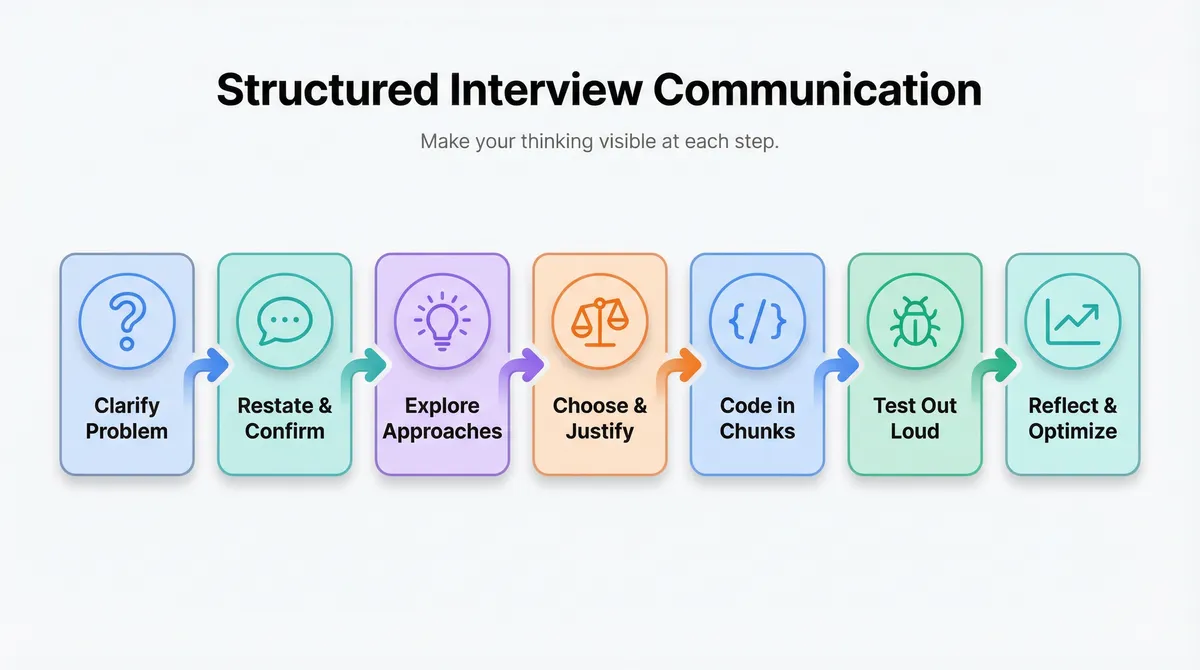
A Simple Framework for Thinking Out Loud
You don’t need to narrate every keystroke. You do need a structure that makes your reasoning visible.
A reliable framework:
- Clarify the problem
- Restate and summarize
- Explore approaches
- Choose a direction and justify it
- Code in small, explained chunks
- Test out loud
- Reflect on complexity and trade-offs
Use this as your “mental checklist” in every coding interview.
Step 1: Clarify the Problem Before You Solve Anything
The first 1–3 minutes should be mostly you asking questions and paraphrasing, not coding.
What to clarify
Out loud, you might say:
-
Input format and constraints
- “Can the array be empty?”
- “What’s the maximum length of the input string?”
- “Are the values guaranteed to be integers? Can they be negative?”
-
Edge cases and special behavior
- “What should we return if there is no valid answer?”
- “How should duplicates be handled?”
-
Environment assumptions
- “Can I assume this fits in memory?”
- “Is the input already sorted, or can it be arbitrary?”
This doesn’t just help you—it shows the interviewer you’re thinking like an engineer who cares about correctness and robustness.
Example: Clarifying a common problem
Prompt: “Given an array of integers and a target sum, return indices of the two numbers that add up to the target.”
You might respond:
“Let me check a few details:
- Can the array contain negative numbers?
- Are there guaranteed to be exactly two numbers that add up to the target, or could there be zero or multiple pairs?
- Should I return any one valid pair, or all such pairs?
- Do you care about the order of indices in the result?”
You’re already demonstrating structured thinking before you touch the keyboard.
Step 2: Restate the Problem in Your Own Words
Once you’ve clarified, restate the problem briefly. This is a high-signal form of interview communication.
For the two-sum example:
“So, I’m given an array
numsof lengthnand an integertarget. I need to find one pair of indices(i, j)such thatnums[i] + nums[j] == target. If there are multiple pairs, returning any is fine. If no pair exists, I should return[-1, -1]. Does that match your expectations?”
This step:
- Confirms alignment
- Shows you’ve internalized the problem
- Gives the interviewer a chance to fix misunderstandings early
Step 3: Explore Approaches Out Loud (Without Over-Talking)
Thinking out loud doesn’t mean narrating every thought. It means making key decisions and trade-offs explicit.
How to structure your exploration
Use a simple pattern:
- Name the approach
- Explain the idea at a high level
- State time and space complexity
- Mention pros/cons
For two-sum:
“I see at least two approaches:
- Brute force: Check every pair
(i, j)and see if their sum istarget.
- Time:
O(n²)because of the nested loop.- Space:
O(1).- Hash map: Iterate once, and for each element
x, check iftarget - xhas been seen before in a hash map from value to index.
- Time:
O(n)average case.- Space:
O(n)for the map.Given typical constraints, the hash map approach seems better. Unless you’d like me to start with brute force for clarity, I’d go with the hash map.”
You’ve shown:
- Awareness of multiple solutions
- Understanding of complexity
- Ability to justify a choice
Step 4: Choose a Direction and Justify It
Interviewers want to see that you can make decisions under constraints.
Once you’ve explored options, explicitly choose:
“I’ll implement the hash map approach because it gives us linear time, which should scale well even for large arrays. The extra
O(n)space is acceptable given the performance benefit.”
If there are trade-offs (e.g., memory limits, streaming data, immutable inputs), talk through them briefly:
“If memory were very constrained, I’d consider a sort-and-two-pointer approach: sort a copy of the array, then use two pointers from both ends. That would be
O(n log n)time andO(n)space for the copy, but we’d avoid the hash map. For now, I’ll stick with the hash map as it’s simpler and optimal in time.”
This is “thinking like a senior engineer” in a compressed format.
Step 5: Code While Narrating at the Right Level
Once you start coding, you don’t need to verbalize every character. Instead, narrate:
- The structure you’re creating
- The invariants you’re maintaining
- The purpose of each logical block
Example implementation (Python)
PYTHON
How you might narrate as you code:
“I’ll define a function
two_sumthat takes the array and target and returns a pair of indices.I’ll maintain a dictionary
seenmapping each value to its index as I iterate. For each valuexat indexi, I’ll computecomplement = target - x. Ifcomplementis already inseen, I can immediately return the pair(seen[complement], i). Otherwise, I’ll storexinseenwith its index.If I finish the loop without finding a pair, I’ll return
(-1, -1)to indicate no solution.”
You’ve explained:
- Data structure choice (
dict) - Loop invariant
- Early-exit condition
- Fallback behavior
That’s the right granularity for thinking out loud in coding interviews.
Step 6: Test Out Loud With Examples and Edge Cases
Testing is a great place to demonstrate systematic problem solving. Don’t test silently—walk through it.
Use at least three categories:
- Typical case
- Edge cases
- Corner or stress cases (if time)
For two-sum:
“Let me test a few cases:
- Typical:
nums = [2, 7, 11, 15],target = 9.
- Start with
2at index 0: complement is7, not inseen. Store2 -> 0.- Next
7at index 1: complement is2, which is inseenat index 0. Return(0, 1). That matches expectation.- No solution:
nums = [1, 2, 3],target = 100.
- We’ll iterate through all elements, never find a complement, and return
(-1, -1). That matches our contract.- Negative numbers:
nums = [-3, 4, 5, 90],target = 1.
-3→ complement4not yet seen.4→ complement-3seen at index 0 → return(0, 1). Works with negatives.That gives me confidence the logic is correct for basic scenarios.”
This is extremely valuable signal to the interviewer.
Step 7: Reflect on Complexity and Alternatives
End by summarizing:
“Time complexity is
O(n)because we do a single pass through the array and each hash map operation is averageO(1). Space complexity isO(n)for the hash map in the worst case.If we couldn’t use extra space or needed sorted output, I’d consider sorting the array with indices and then using a two-pointer technique, which would be
O(n log n)time andO(n)space for storing original indices.”
This shows you understand the algorithm beyond just getting it to work.
How to Communicate in More Complex Problems
Not all problems are as simple as two-sum. For tree, graph, or DP problems, structured communication becomes even more important.
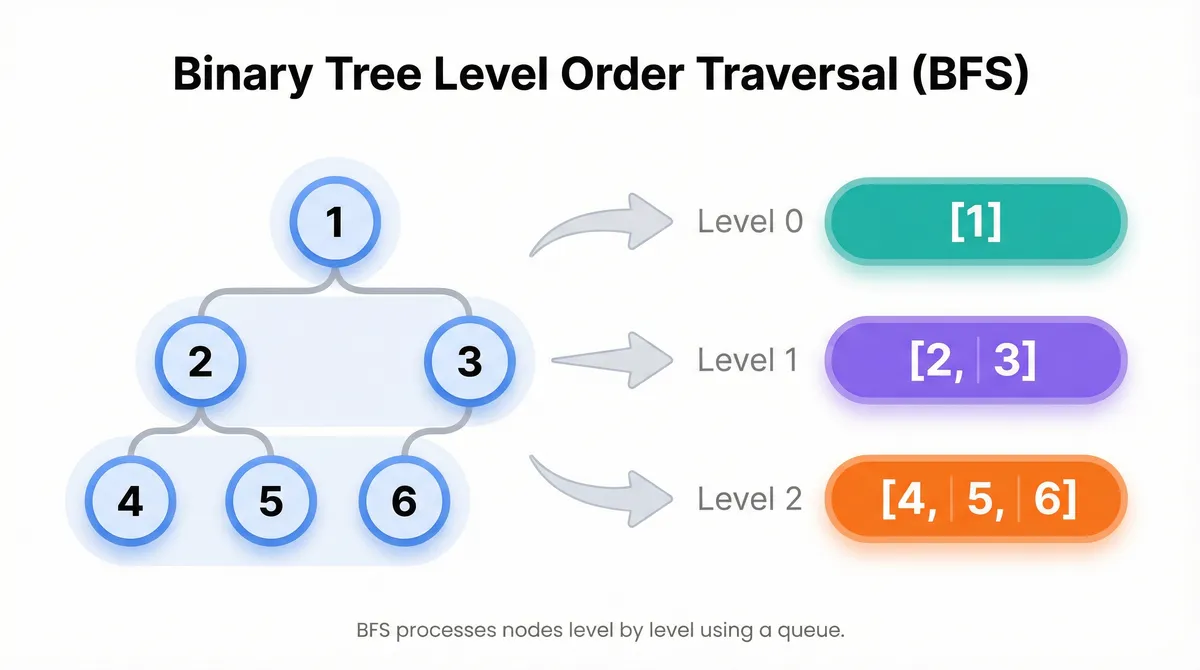
Example: Binary Tree Level Order Traversal
Prompt: “Given the root of a binary tree, return its level order traversal (values by level from left to right).”
How you might think out loud:
-
Clarify
- “Can the tree be empty? If so, should I return an empty list?”
- “Is the tree necessarily balanced?”
-
Restate
- “So I need to return a list of lists, where each inner list contains the node values at that depth, from left to right.”
-
Explore approaches
- “The most natural approach is BFS using a queue. We process nodes level by level, tracking the number of nodes per level.
- Alternatively, we could do DFS and track depth, appending to the appropriate list, but BFS aligns directly with the notion of levels.”
-
Choose and justify
- “I’ll use BFS with a queue. Time and space will both be
O(n)wherenis the number of nodes.”
- “I’ll use BFS with a queue. Time and space will both be
-
Code with narration
PYTHON
Narration:
“If the root is
None, I’ll return an empty list. Otherwise, I’ll use a queue initialized with the root. While the queue is not empty, I’ll recordlevel_sizeas the number of nodes in the current level. Then I’ll pop exactlylevel_sizenodes, collect their values, and push their non-null children. After processing one level, I appendlevel_valuestoresult. That ensures each sublist corresponds to one tree level.”
-
Test out loud
- Walk through a small tree of 3–5 nodes.
- Mention how empty trees and skewed trees behave.
-
Reflect
- “Time is
O(n)because each node is enqueued and dequeued once. Space isO(n)for the queue and result.”
- “Time is
Common Communication Mistakes in Coding Interviews
Many candidates know they should be thinking out loud, but fall into predictable traps.
1. Silent for too long
- Problem: You read the prompt, then go quiet for 5–10 minutes.
- Why it hurts: The interviewer has no visibility into your progress; they don’t know if you’re stuck, lost, or just thinking deeply.
- Fix: After a short pause (10–20 seconds), start verbalizing:
- “I’m considering a brute-force approach first to establish correctness.”
- “I’m thinking whether sorting helps here or if a hash map would be better.”
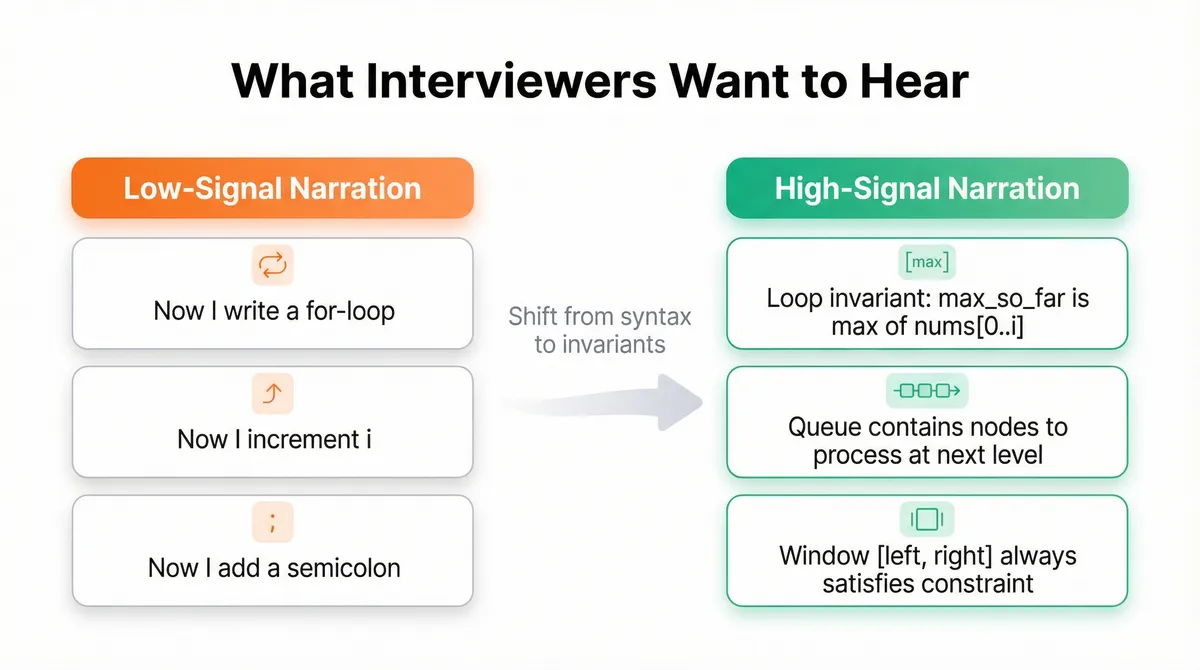
2. Narrating every keystroke
- Problem: “Now I’m typing
for, now I’m typingi, now I’m adding a brace…” - Why it hurts: It adds noise without signal and can feel like filler.
- Fix: Focus on logical units, not characters:
- “I’ll write a loop over the array and maintain a running maximum.”
- “I’m adding a helper function to compute the height of the tree.”
3. Jumping into code with no plan
- Problem: You start coding before confirming the problem or exploring approaches.
- Why it hurts: You might solve the wrong problem or choose a suboptimal approach.
- Fix: Force yourself to say:
- “Before I code, let me outline the approach and check if it aligns with what you expect.”
4. Over-explaining trivialities, under-explaining trade-offs
- Problem: You spend time explaining basic syntax but skip why you chose an algorithm.
- Fix: Prioritize:
- Why this data structure?
- Why this complexity?
- What are the trade-offs?
5. Not asking for hints when stuck
- Problem: You spin for 10 minutes in silence or low-value exploration.
- Fix: After a few minutes of being stuck:
- “I see two directions: A and B. I’ve tried A and hit this issue. Would you prefer I continue or explore B?”
- This keeps communication open and shows self-awareness.
Best Practices for Clear Interview Communication
Here are concrete, repeatable behaviors you can practice.
Use a consistent problem-solving script
For every question, run this script:
- Clarify constraints and edge cases
- Restate problem
- Brainstorm 2–3 approaches
- Compare time/space trade-offs
- Choose and justify
- Code in small, logical chunks
- Test with normal and edge cases
- Summarize complexity and potential improvements
Over time, this becomes muscle memory.
Name patterns and techniques explicitly
Interviewers like to see that you recognize patterns:
- “This looks like a sliding window problem.”
- “This is similar to a classic BFS on a grid.”
- “We can use a two-pointer technique after sorting.”
- “This feels like a dynamic programming problem with overlapping subproblems.”
If you’re practicing pattern-based learning, referencing resources like the DSA patterns guide can help you build this vocabulary.
Keep a running commentary of invariants
Instead of narrating code, narrate invariants:
- “At this point in the loop,
max_so_faralways stores the maximum value seen up to indexi.” - “The queue always contains the nodes of the next level to process.”
- “The
lowandhighpointers always bound the current search range.”
This shows deeper understanding than just “the code works.”
Use the interviewer as a collaborator, not a judge
Treat the session like a design discussion:
- “I’m leaning toward a hash map here. Do you see any constraints that might make that problematic?”
- “I’m thinking about a recursive approach; if recursion depth is a concern, we could translate to iterative later.”
This shows you can communicate like a teammate.
Be explicit about trade-offs and assumptions
Even if the interviewer doesn’t ask, you can say:
- “I’m assuming the input size can be up to around 10^5, so an
O(n²)solution would be too slow.” - “This approach uses extra space, but it keeps the time complexity linear.”
This kind of thinking is what senior engineers do in design reviews.
Practicing Thinking Out Loud (Deliberate Practice)
Clear communication under time pressure is a skill. You can train it.
1. Record yourself
- Take a random LeetCode-style problem.
- Solve it while talking out loud as if in an interview.
- Record your screen and audio.
- Rewatch and ask:
- Did I clarify the problem?
- Did I explain my approach before coding?
- Did I test methodically?
- Was I silent for long stretches?
2. Use mock interviews with feedback
Practice with peers or tools that give feedback on your communication style, not just correctness. For example, an AI interviewer (like Thita’s AI interview practice simulator) can simulate a real session and surface where your explanations are unclear or incomplete.
3. Build a “communication checklist”
Before each interview, quickly remind yourself:
- “Clarify → Restate → Explore → Choose → Code → Test → Reflect”
Use it until it’s automatic.
Putting It All Together: A Mini Script You Can Reuse
Here’s a compact template you can adapt to almost any coding interview:
-
Initial response (first 1–2 minutes)
- “Let me restate the problem to make sure I understand.”
- [Restate in your own words]
- “A few clarifying questions: …”
-
Planning (next 2–4 minutes)
- “I see a few possible approaches.”
- [Briefly describe brute force]
- [Describe 1–2 better approaches]
- “The trade-offs are: …”
- “I’ll go with [approach] because [reason].”
-
Coding (10–20 minutes)
- “I’ll start by setting up the function signature and any data structures I need.”
- [Code in logical chunks, occasionally summarizing]
- “The invariant here is that …”
-
Testing (3–5 minutes)
- “Let’s test this with a typical case.”
- “Now an edge case: empty input / single element / etc.”
- “One more with negative numbers / large values / duplicates.”
-
Wrap-up (1–2 minutes)
- “Time complexity is …; space complexity is …”
- “If we had more time or different constraints, I’d consider …”
Practice speaking this way until it feels natural.
Key Takeaways
- Interview communication is not optional; it’s a core part of coding interviews.
- Thinking out loud doesn’t mean narrating syntax—it means making your reasoning visible.
- Use a consistent framework: clarify → restate → explore → choose → code → test → reflect.
- Focus your narration on:
- Problem understanding
- Approach selection and trade-offs
- Invariants and data structures
- Testing and complexity
- Avoid extremes: don’t be completely silent, and don’t over-narrate trivialities.
- Treat the interviewer as a collaborator and use their feedback to steer your approach.
Like any other skill, explaining your thought process clearly improves with deliberate practice. Combine regular problem solving with explicit practice in speaking your reasoning, and your coding interviews will feel much closer to the engineering discussions you already have on the job.