
Interview
How to Practice Coding Interview Questions Effectively (Not Just Solve More Problems)
Most people approach coding interview prep the same way: open LeetCode, sort by “Top 100,” and start grinding. Weeks later, they’ve “solved” 200 problems—but...
Most people approach coding interview prep the same way: open LeetCode, sort by “Top 100,” and start grinding. Weeks later, they’ve “solved” 200 problems—but still freeze when a new question shows up in an interview.
The problem isn’t effort. It’s how you practice.
This guide will walk through how to practice coding interviews effectively—not just solve more problems. We’ll focus on building reusable patterns, feedback loops, and interview-ready skills rather than raw problem counts. Along the way, we’ll connect this to pattern-based learning (like Thita’s 94 DSA patterns) and mock interviews, but the emphasis is on concrete techniques you can apply immediately.
Why Solving More Problems Isn’t Enough
If you’re reading about “how to practice coding interviews,” you probably already know that just doing more questions isn’t working as well as you’d like. Let’s make that concrete.
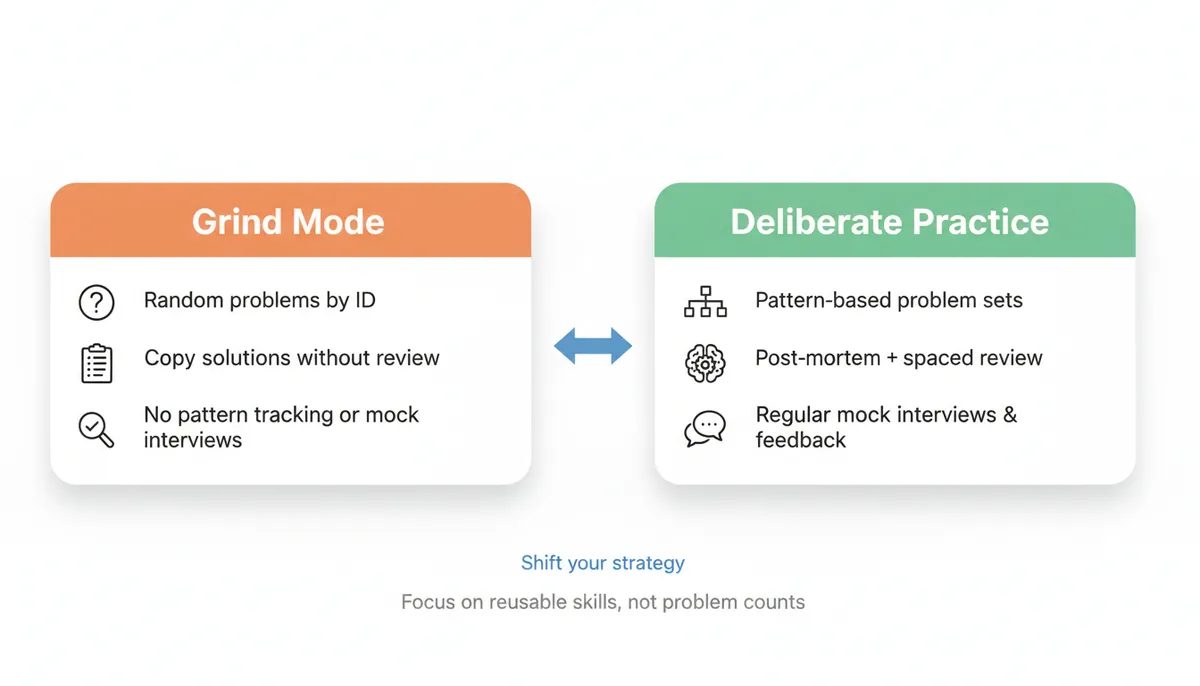
What “grind mode” looks like
Typical LeetCode grind:
- Pick random medium problem.
- Struggle for 40–60 minutes.
- Look at solution.
- Copy code.
- Mark as “solved.”
- Repeat.
This feels productive, but it often leads to:
- Shallow understanding: You remember the exact solution, not the underlying idea.
- Poor recall under pressure: You can’t reconstruct the approach in a live interview.
- No pattern recognition: Every new problem feels “brand new.”
- No improvement loop: You don’t know why you’re slow or stuck.
Effective technical interview preparation is less like “doing homework” and more like training for a sport: you need drills, feedback, pattern recognition, and deliberate practice.
A Better Model: Deliberate Practice for Coding Interviews
Deliberate practice has three key components:
- Clear, specific goals (e.g., “recognize sliding window problems quickly”).
- Focused practice on weaknesses, not just what feels comfortable.
- Tight feedback loops (self-review, mock interviews, pattern checklists).
Applied to coding interviews, this means your coding interview practice strategy should be structured around skills, not just problem counts.
Those skills include:
- Problem understanding and clarification
- Pattern recognition (e.g., two pointers, BFS, DP)
- Systematic problem solving (brute force → optimize)
- Coding cleanly under time pressure
- Communicating your thinking out loud
- Testing and debugging quickly
We’ll build a strategy around these.
Step 1: Define Your Coding Interview Practice Strategy
Before opening any problem set, answer:
1. What is your current level?
Roughly classify yourself:
- Beginner: Struggle with easy problems, syntax mistakes, basic data structures rusty.
- Intermediate: Comfortable with easy, some mediums, slow on new patterns.
- Advanced: Can solve most mediums, some hards, main issues are speed and communication.
Your strategy should match your level.
2. What is your time horizon?
- 3–6+ months: You can systematically build fundamentals, patterns, and mock interview experience.
- 4–8 weeks: You need focused practice on high-yield patterns and interview simulation.
- < 4 weeks: You’re in triage mode—prioritize pattern review and mock interviews over breadth.
3. What is your goal?
Be specific:
- “Pass Big Tech-style algorithm rounds.”
- “Clear mid-level startup interviews with standard DSA questions.”
- “Move from LC easy/medium to consistent medium performance.”
Your goals dictate the depth and breadth of your pattern coverage.
Step 2: Practice by Patterns, Not by Problem IDs
One of the most effective LeetCode practice tips is to stop seeing each problem as unique and start seeing it as an instance of a known pattern.
Patterns are recurring structures in problems, such as:
- Sliding window
- Two pointers
- Fast & slow pointers
- Binary search on answer
- BFS/DFS on trees and graphs
- Topological sort
- Backtracking
- Dynamic programming (knapsack, LIS, interval DP, etc.)
Platforms like Thita organize these into structured DSA pattern sheets, but you can also build your own.
Why pattern-based learning works
- Faster recognition: You map a new problem to a known pattern.
- Reusable templates: You don’t reinvent traversal, window maintenance, or state transitions every time.
- Better transfer: You can adapt to variants you’ve never seen before.
How to practice a pattern effectively
For each pattern, follow a mini-curriculum:
-
Understand the core idea
Example: Sliding window
- Used when: contiguous subarray/substring, with constraints like length, sum, or distinct elements.
- Core operations: expand right, maybe shrink left, maintain a window invariant (e.g., “no more than K distinct chars”).
-
Study a canonical example
For sliding window, something like “Longest Substring Without Repeating Characters” is ideal.
-
Solve 3–5 variants in one session
- Start with guided hints.
- Move to no hints.
- Focus on what stays the same (pattern) and what changes (problem-specific condition).
-
Write a pattern summary
One-page or half-page summary:
- When to use it.
- Typical template (pseudo-code).
- Common pitfalls.
- 2–3 problems where you’ve seen it.
-
Revisit after a few days
Delayed recall is critical; don’t assume “I did it once” means you’ve learned it.
Step 3: A Structured Workflow for Each Problem
Instead of “open problem → struggle → give up,” use a consistent, time-boxed workflow. This is where technical interview preparation becomes systematic.
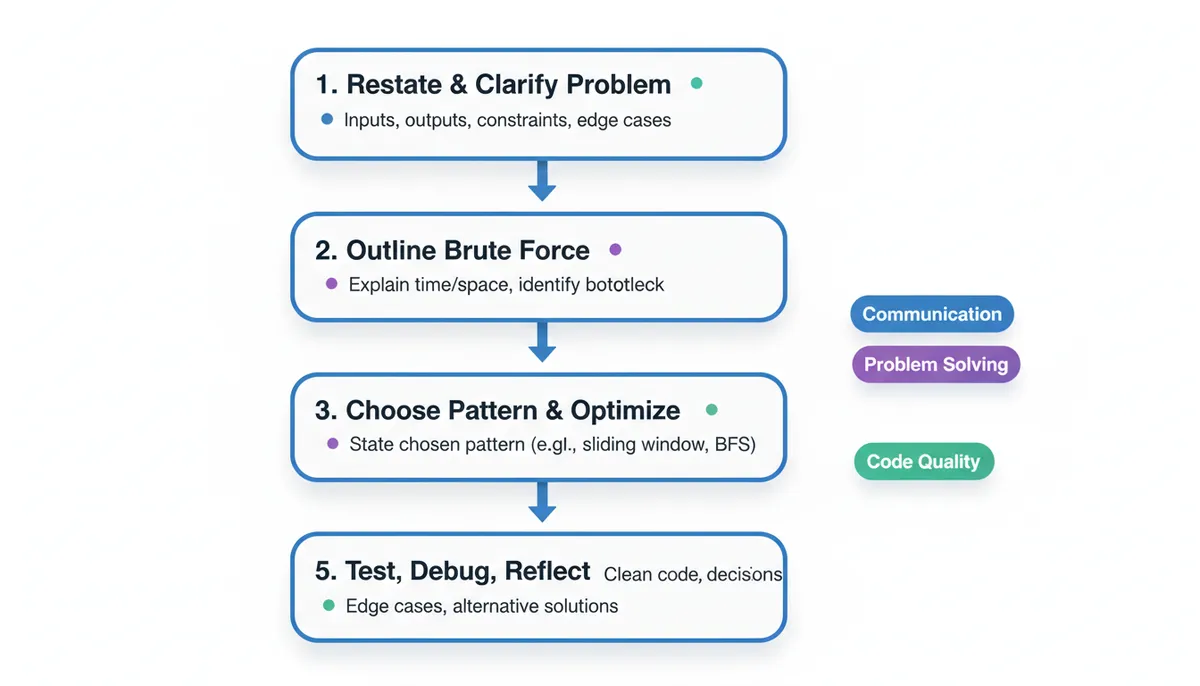
0–5 minutes: Problem understanding and constraints
- Restate the problem in your own words.
- Clarify input/output types and edge cases.
- Identify constraints:
nsize, value ranges, time/space limits.
Ask yourself:
- “What’s the naive brute force?”
- “What’s the bottleneck if I try that?”
5–10 minutes: Pattern recognition and brute force
- Identify candidate patterns:
- Array + contiguous segment → sliding window
- Sorted array → binary search or two pointers
- Graph relationships → BFS/DFS/topological sort
- Sketch a brute-force solution:
- Even if it’s O(n²) or O(2ⁿ), write it down.
- This is your baseline to optimize.
10–25 minutes: Optimize using patterns
- Transform brute force:
- Can you remove a loop with a hash map?
- Can you avoid recomputation with DP?
- Can you maintain a rolling state (prefix sums, sliding window)?
- Think in invariants:
- “What must be true about my window / DP state / visited set at all times?”
If you’re still completely stuck after ~25 minutes:
- Allow yourself targeted hints:
- First hint: pattern category (“Try sliding window”).
- Second hint: key invariant or observation.
- Third hint: partial pseudo-code.
The goal is guided learning, not blind copying.
25–40 minutes: Code and test
- Write code as if in an interview:
- Clear variable names.
- Handle edge cases explicitly.
- Add brief comments for non-obvious logic.
- Test systematically:
- Trivial cases (empty, single element).
- Small normal cases.
- Edge cases (max/min values, duplicates, all equal, already sorted, etc.).
40–50 minutes: Post-mortem and pattern extraction
This is where most people stop—but it’s where most of the learning happens.
For each problem, answer:
- What pattern did this use?
- What was the key insight?
- Where did I get stuck? Why?
- How would I explain this to someone else?
Write 3–5 bullet points in a notebook or doc. This becomes your personal pattern library.
Example: Practicing Sliding Window the Right Way
Let’s walk through a concrete example with code.
Problem: Longest Substring Without Repeating Characters
Given a string
s, find the length of the longest substring without repeating characters.
Step 1: Brute force thinking
- Check all substrings
s[i:j]and test if all characters are unique. - Time: O(n³) (O(n²) substrings × O(n) to check uniqueness).
- Too slow for large
n.
Step 2: Recognize pattern
- Substring → contiguous segment.
- Constraint: “no repeats” → property of current window.
- We want the longest such window.
This screams sliding window.
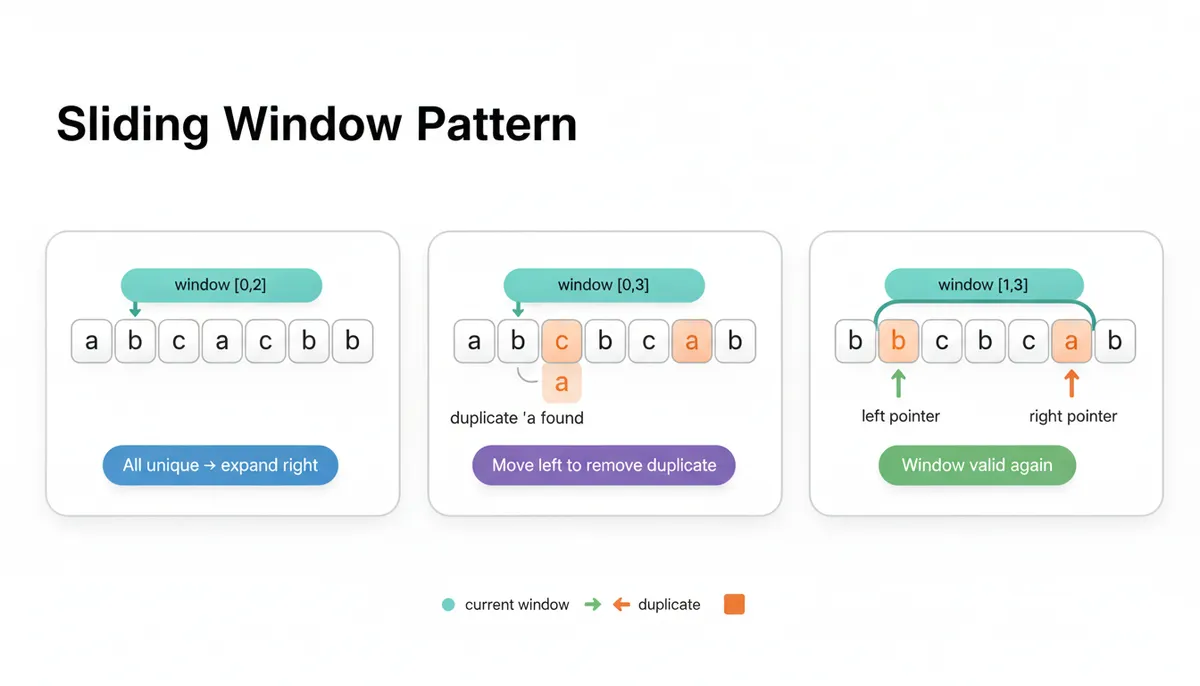
Step 3: Design sliding window
Idea:
- Maintain a window
[left, right]where all characters are unique. - Expand
rightone step at a time. - If we see a duplicate, move
leftuntil the window is valid again.
PYTHON
- Time complexity: O(n) — each character visited once.
- Space complexity: O(min(n, alphabet_size)).
Step 4: Extract the pattern
Pattern summary for this problem:
- When to use: Longest/shortest substring with constraint on characters.
- Template:
- Use two indices
leftandright. - Use a map to track counts or last positions.
- Expand
righteach step. - While constraint violated, move
left.
- Use two indices
- Key invariant: Window
[left, right]always satisfies “no duplicates.”
Now, when you see “Longest Substring with At Most K Distinct Characters,” you can adapt the same pattern instead of starting from scratch.
Step 4: Use Spaced Repetition and Review, Not Just New Problems
A major mistake in coding interview practice is never revisiting solved problems. Human memory is leaky; if you don’t review, you will forget.
Build a lightweight review system
For each problem you solve:
- Tag it by pattern (e.g., “sliding-window”, “binary-search”).
- Rate difficulty: 1 (trivial) to 5 (very hard).
- Mark whether you:
- Solved it without hints
- Needed a hint
- Needed to see the full solution
Then schedule reviews:
- Problems you couldn’t solve → review within 1–2 days.
- Problems you solved with hints → review within 3–5 days.
- Hard problems (4–5) → revisit weekly until they feel natural.
You don’t need to redo all code. For many problems, just re-deriving the approach and pseudo-code from memory is enough to reinforce the pattern.
Step 5: Practice the Interview, Not Just the Code
Many strong coders fail interviews not because they can’t solve problems, but because they don’t communicate well under constraints.
Your coding interview practice strategy must explicitly train:
- Thinking aloud
- Clarifying ambiguous requirements
- Explaining trade-offs
- Handling hints gracefully
How to simulate real interviews
-
Time-boxed, spoken walkthroughs
- Pick a problem.
- Set a 30–45 minute timer.
- Talk through your thinking as if an interviewer is present:
- Restate the problem.
- Ask clarifying questions.
- Propose brute force, then optimize.
- Record yourself (audio or screen) and review.
-
Use AI or peers as mock interviewers
- Platforms like Thita’s AI interview simulator can simulate interviewers who ask follow-up questions and give feedback.
- Alternatively, pair up with a friend and alternate roles.
- Focus feedback on:
- Structure of explanation
- Clarity and conciseness
- Handling of edge cases
- Code quality under time pressure
-
Practice post-solution discussion
Many interviews include “follow-up” questions:
- Can you optimize space?
- How would this change if the input were streamed?
- What if the array were on disk?
After solving a problem, spend 5 minutes exploring “what if” variations. This trains adaptability.
Step 6: Balance Breadth and Depth Across Patterns
Another common failure mode: going too deep into one pattern while ignoring others.
Recommended coverage plan (for 4–8 weeks)
Focus on high-yield patterns first:
-
Arrays & Strings
- Two pointers
- Sliding window
- Prefix sums
-
Hashing
- Frequency maps
- Set-based deduplication
-
Trees & Graphs
- DFS/BFS
- Level order traversal
- Basic graph representation (adjacency list)
-
Binary Search
- On sorted arrays
- On answer (searching over range of possible values)
-
Heap / Priority Queue
- Top-K problems
- Merge K sorted lists
-
Backtracking
- Subsets, permutations, combinations
-
Dynamic Programming (core)
- 1D DP (climbing stairs, house robber)
- 2D DP (grid paths, edit distance)
- Knapsack-style
For each category:
- Spend 2–3 focused sessions learning the pattern.
- Solve 5–10 representative problems.
- Write a pattern summary.
- Revisit 2–3 key problems in review sessions.
If you have more time (3–6 months), expand to:
- Advanced graph algorithms (Dijkstra, topological sort)
- More complex DP (interval DP, bitmask DP)
- Segment trees / Fenwick trees (if relevant to target companies)
Pattern collections like Thita’s Beginner to Advanced DSA Roadmap for Software Engineers in 2026 can serve as a roadmap for this kind of coverage.
Common Mistakes in Coding Interview Practice (and Fixes)
Mistake 1: Measuring success by “problems solved”
Problem: You optimize for quantity, not retention or adaptability.
Fix: Track:
- Patterns you’ve mastered.
- Problems you can re-derive after a week.
- Performance in mock interviews.
Mistake 2: Never writing from scratch
Copy-pasting or heavily referencing the solution while coding creates an illusion of understanding.
Fix:
- After reading a solution, close it.
- Re-implement from memory.
- If you get stuck, only peek at small snippets, not the full solution.
Mistake 3: Ignoring time and space complexity
Problem: You “solve” a problem but can’t explain why it’s efficient.
Fix:
- Always annotate your final solution:
- Time complexity: O(n), O(n log n), etc.
- Space complexity: auxiliary vs input.
- Practice explaining why:
- “We visit each node once in this BFS, and each edge twice (undirected), so O(V + E).”
Mistake 4: Avoiding hard problems entirely
Problem: You stay in your comfort zone, which caps your growth.
Fix:
- Intentionally include some “stretch” problems:
- Even if you can’t solve them fully, learn the pattern.
- Add them to your review list.
Mistake 5: No feedback loop
Problem: You repeat the same mistakes without noticing.
Fix:
- After each week, review:
- Which patterns still feel weak?
- Which mistakes are recurring (off-by-one, missing edge cases, timeouts)?
- Adjust next week’s plan accordingly.
Putting It All Together: A Sample Weekly Plan
Here’s how you might operationalize this coding interview practice strategy over one week (assuming ~10–12 hours total).
Day 1–2: Learn & Drill a Pattern (e.g., Sliding Window)
- 30 min: Read about the pattern, study 1–2 canonical examples.
- 90 min: Solve 3–4 sliding window problems:
- Follow the structured workflow (understand → brute force → optimize → code → post-mortem).
- 30 min: Write or update your pattern summary.
Day 3: Review & Mock Interview
- 60 min: Review 2–3 problems from previous week:
- Try to re-derive approaches without looking.
- 60 min: Do a mock interview:
- With a peer or via an AI-driven mock like the AI interview practice simulator.
- Focus on communication and time management.
Day 4–5: New Pattern (e.g., Binary Search on Answer)
- 30 min: Learn the pattern, identify triggers (“minimize max”, “maximize minimum”, monotonic property).
- 90 min: Solve 3–4 related problems.
- 30 min: Pattern summary + compare with normal binary search.
Day 6: Mixed Practice
- 90 min: Mixed set of 3–4 problems from different patterns:
- Goal: pattern recognition and switching context.
- 30 min: Weekly retrospective:
- What improved?
- Which patterns still feel shaky?
- Adjust next week’s focus.
Day 7: Rest or Light Review
- Skim pattern summaries.
- Revisit one tricky problem.
- Avoid full problem grinding; let concepts consolidate.
Key Takeaways: How to Practice Coding Interviews Effectively
- Don’t optimize for problem count; optimize for pattern mastery and recall under pressure.
- Build a pattern-based mental model:
- Map each problem to a known pattern.
- Maintain your own pattern summaries.
- Use a structured workflow for each problem:
- Understand → brute force → pattern → optimize → code → test → reflect.
- Incorporate spaced repetition:
- Revisit hard and partially-solved problems.
- Practice the interview itself:
- Think aloud.
- Clarify requirements.
- Use mock interviews and feedback loops.
- Balance breadth and depth:
- Cover core patterns thoroughly.
- Add stretch problems to grow.
If you adopt this deliberate, pattern-centric approach to technical interview preparation, you’ll find that new problems stop feeling “random” and start looking familiar. That’s when you know your practice is working.