
Interview
Paytm Interview Questions and Process: The Complete Guide (2026)
A full breakdown of Paytm's SDE interview process — the assessment with its React component, the LLD round, difficulty, timelines and a 30-day prep plan.
Paytm's interview loop has a distinctive feature that surprises candidates: frontend fluency turns up early and often, including in the online assessment. Reported accounts describe an assessment that mixes algorithmic problems with multiple-choice questions and a React-based machine coding component — and a first technical round that pairs data structures with frontend fundamentals.
The design round then arrives as the second technical stage, framed explicitly around scalable, modular design and discussed alongside your own projects rather than as an isolated puzzle.
This guide covers each stage and how to prepare. To practise the design round, Paytm's interview kit holds three low-level design problems attributed to the company, each with a worked editorial and AI-evaluated practice.
The process at a glance
| # | Round | Format | What it screens |
|---|---|---|---|
| 1 | Online assessment | Coding problems, multiple choice, and a React machine-coding question | Breadth: algorithms, fundamentals, practical build |
| 2 | Technical round 1 | Data structures plus frontend fundamentals | Problem solving and applied knowledge |
| 3 | Technical round 2 | Project discussion plus low-level design | Design judgement, scalable and modular thinking |
| 4 | Managerial / HR | Fit, ownership, expectations | Communication, level alignment |
The exact composition is role-dependent — a frontend-leaning role will weight the JavaScript content more heavily than a backend one. Confirm the sequence with your recruiter.
Round 1 — the mixed assessment
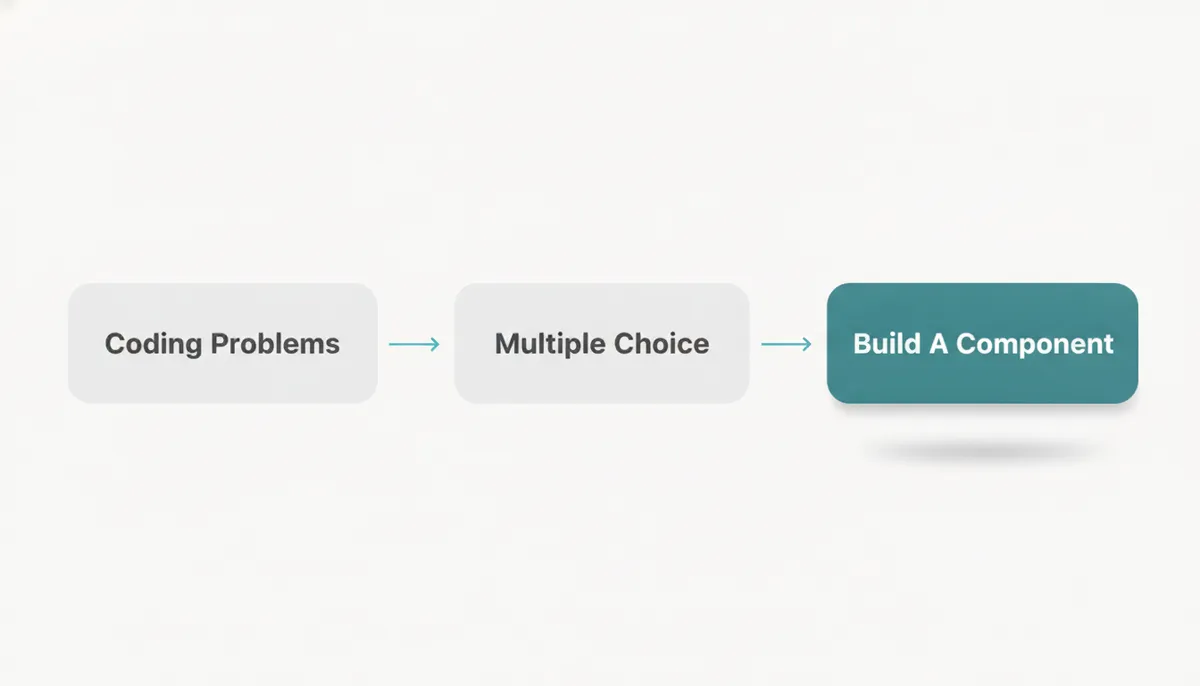
Three things in one sitting, which is unusual:
Algorithmic problems. Standard interview material — arrays and strings, hash maps, common patterns. Medium difficulty rather than competitive-programming level.
Multiple-choice questions. Computer science fundamentals: complexity, data structure properties, and often language-specific behaviour. These reward breadth and are the cheapest marks in the round to secure, because they are revision rather than problem solving.
A React-based machine coding question. A small component or interaction to build. This is the part candidates do not anticipate, particularly those interviewing for backend-leaning roles.
Preparation implication: do not skip the fundamentals revision. Candidates optimise almost entirely for the coding problems, then lose easy marks on the multiple-choice section and stall on the React component. The DSA Patterns Sheet is free to browse for the algorithmic half, and the free computer science sheets covering operating systems and DBMS are efficient ways to shore up the fundamentals.
💡 Pro Tip: Even if you are interviewing for a backend role, be able to build a small React component with state and an event handler without looking up syntax. It appears in the assessment often enough to matter.
Round 2 — data structures and frontend fundamentals
A live technical round that pairs algorithmic problem solving with applied frontend knowledge. Reported topics include asynchronous JavaScript — promises, the event loop, the difference between concurrent and sequential execution — alongside conventional data structures work.
For the algorithmic half, the usual expectations hold: clarify before coding, state your approach and complexity before typing, narrate trade-offs, find your own edge cases. What interviewers look for in live coding rounds covers the mechanics.
For the frontend half, the questions tend to probe understanding rather than recall — not "what does this method do" but "why does this code log in that order". Being able to reason about the event loop out loud is the specific skill.
Round 3 — project discussion and low-level design
The design round, and the one that carries the most weight. It arrives paired with a discussion of your own projects, which is a deliberate combination: the interviewer is checking whether the design judgement you demonstrate abstractly shows up in the work you have actually done.
The framing reported most often is scalable and modular design. In practice that means:
- A real domain model. Entities with behaviour, not data bags manipulated from elsewhere.
- Modularity that means something. Boundaries drawn where responsibilities genuinely differ, so a change lands in one place rather than five.
- Extension points where requirements clearly branch. Interfaces where behaviour varies — not everywhere, which reads as pattern application without judgement.
- Awareness of what scales. Given Paytm's domain, transaction volume, idempotent operations and exact monetary representation are natural concerns. Money as integer minor units rather than a floating-point number is a small decision that signals domain familiarity.
Because your projects are discussed alongside the design exercise, be ready to describe the architecture of something you built and defend its structure — including the parts you would now do differently. Claiming a design was perfect reads worse than naming its weaknesses.
The free Low Level Design Sheet builds the vocabulary, and design patterns for interviews covers the idioms this round assumes.
⚠️ Important: Prepare the architecture of your own projects as carefully as you prepare design problems. This round tests both, and the two answers should be consistent with each other.
Round 4 — managerial and HR
Fit, ownership and expectations. Two or three projects you can discuss in specifics: what you decided, what broke, what you would change. Be able to say why this company and this problem space.
Is the Paytm interview hard?
Moderate, with the difficulty coming from breadth rather than depth.
No individual round is exceptionally hard. The algorithmic content is medium; the design round is a fair conversation rather than a gauntlet. What makes the loop selective is how many different things it touches — algorithms, computer science fundamentals, frontend behaviour, design judgement, and the architecture of your own work — often within the same round.
Candidates who struggle are usually those who prepared narrowly. The React component in the assessment is the most common single surprise.
How many rounds? Typically three technical or semi-technical stages plus a managerial round, varying by role and level.
How long does it take? Commonly two to four weeks end to end.
A 30-day preparation plan
Week 1 — algorithms and fundamentals together. Core patterns for recognition speed, plus deliberate revision of complexity, data structure properties, operating systems and databases for the multiple-choice section. Short daily code practice sessions.
Week 2 — JavaScript and a small build. Asynchronous JavaScript properly: promises, the event loop, execution order. Then build two or three small React components with state, events and an error state, without looking up syntax.
Week 3 — design. Class-level design vocabulary, then two problems implemented end to end. The three low-level design problems evidenced at Paytm are the most directly relevant set, and reading the editorials against your own attempts is where most of the learning happens.
Week 4 — your own projects, and rehearsal. Write out the architecture of two projects you have built: what the components were, why the boundaries fell where they did, what you would change. Then one algorithmic mock, one design mock, one behavioural. An AI mock interview covers the design and behavioural formats.
Frontend and backend loops diverge
Paytm's loop is role-dependent to an unusual degree, and the divergence matters because the same preparation does not serve both paths equally.
Frontend-leaning roles weight the JavaScript content heavily. Expect the React component in the assessment to be substantive rather than token, deeper questioning on asynchronous behaviour and the event loop, and a design round oriented toward component architecture, state management and how you keep a growing interface maintainable. Browser fundamentals — rendering, events, storage — become fair game.
Backend-leaning roles keep the React component but treat it as a floor rather than a focus. The design round shifts toward service structure, data modelling, and the scalable-and-modular framing described above, with transaction volume and exact monetary handling as natural concerns.
Full-stack roles get both, which in practice means neither half is examined as deeply but the breadth expectation is real.
Two practical consequences:
- Ask which track you are in. This is a normal question for a recruiter and the answer materially changes how you spend your remaining preparation time. Do not infer it from the job title alone.
- Do not skip the other half entirely. The reason the React component appears across roles is that Paytm ships product surfaces where the boundary is blurry. A backend candidate who cannot build a small component looks narrow; a frontend candidate who cannot reason about a data model looks the same.
The genuine risk here is not difficulty, it is misallocation — preparing thoroughly for one shape of round and meeting the other.
Frequently asked questions
How many rounds does Paytm have? Typically an online assessment, two technical rounds, and a managerial or HR round. Composition varies by role.
What is in the online assessment? Reported accounts describe a mix: algorithmic coding problems, multiple-choice fundamentals questions, and a React-based machine coding question.
Do I need React for a backend role? Reported accounts include a React component in the assessment across roles, so basic fluency is worth having regardless. Confirm with your recruiter for your specific role.
What does the low-level design round focus on? Scalable and modular design, discussed alongside your own projects. Expect to defend the structure of something you actually built.
Is the coding difficulty high? Medium in the main — standard interview patterns rather than competitive-programming difficulty.
Are computer science fundamentals tested? Yes, via the multiple-choice section of the assessment. It is the cheapest part of the loop to prepare for and the most commonly neglected.
Does Paytm ask system design questions? Class-level design is the focus in reported accounts. Architecture-level depth scales with seniority; confirm for your level.
How long does the process take? Commonly two to four weeks, varying by team and role.
How do I know whether I am in a frontend or backend loop? Ask your recruiter directly — it is a normal question and the answer materially changes how you should spend your remaining preparation time. Job titles alone are not a reliable guide.
Is the React component in the assessment substantial or token? It varies by track. For frontend-leaning roles expect it to be substantive; for backend roles it is closer to a floor check, but it is still present and still marked.
Where to start
Paytm's loop is broad, so narrow preparation is the main risk. Cover the algorithmic patterns, but do not neglect the fundamentals revision or arrive unable to build a small React component — those are the two places candidates lose marks they could have had cheaply.
Open Paytm's interview kit for the three low-level design problems evidenced at Paytm, each with an editorial and AI-evaluated practice. Use the free DSA Patterns Sheet and Low Level Design Sheet for the technical rounds, and an AI mock interview to rehearse.
Interview processes change. Confirm round structure and timings with your recruiter, and check Paytm's careers site for current openings.
Topics
Related on Thita
Your next step
Practise with AI mock interviews
A spoken interview that asks follow-up questions, runs your code and ends with a written report.