
Interview
Self-Taught vs CS Degree: Who Performs Better in Tech Interviews?
Most candidates eventually ask the same question: in a head‑to‑head tech interview, who has the edge—someone self‑taught, or someone with a CS degree?
Most candidates eventually ask the same question: in a head‑to‑head tech interview, who has the edge—someone self‑taught, or someone with a CS degree?
This isn’t just a philosophical debate. It affects how you prepare, what you focus on, and how you explain your background to interviewers. When you look closely at actual interview performance—phone screens, live coding, systems design—the answer is more nuanced than “degrees are better” or “skills are all that matter.”
This post breaks down self taught vs CS degree performance in tech interviews: where each background tends to shine, where they struggle, and how to close the gaps. We’ll focus on software engineering roles and practical, interview‑oriented skills.
How Tech Interviews Actually Evaluate You
Before comparing backgrounds, it’s important to be precise about what “performs better” means. Most software engineering interview loops evaluate:
-
Problem solving under constraints
- Decomposing a vague problem
- Choosing appropriate data structures and algorithms
- Handling edge cases
-
CS fundamentals
- Time and space complexity
- Common data structures (arrays, hashes, trees, graphs, heaps)
- Algorithms (sorting, searching, traversal, dynamic programming, greedy, etc.)
-
Code quality
- Clear, readable code
- Correctness and testability
- Handling corner cases and error conditions
-
System design (mid‑level and above)
- Breaking down large problems into components
- Understanding tradeoffs (latency vs throughput, consistency vs availability)
- Familiarity with real‑world systems (caches, queues, databases, microservices)
-
Communication and collaboration
- Explaining your thinking as you go
- Asking clarifying questions
- Responding to hints and feedback
These dimensions are largely background‑agnostic. Interviewers rarely care how you learned something; they care whether you can demonstrate it reliably under time pressure.
Self-Taught vs CS Degree: What the Data and Experience Suggest
There isn’t a single definitive dataset that cleanly answers “self taught vs cs degree: who performs better in tech interviews?” Most companies don’t publish performance breakdowns by education.
But we do have:
- Public hiring data showing non‑traditional backgrounds are common at top companies
- Experience from interviewers across large and small companies
- Patterns from hundreds of mock interviews and candidate prep journeys
Combined, these suggest:
-
CS degree candidates tend to:
- Start with stronger coverage of core CS theory (algorithms, operating systems, networking)
- Be more comfortable with formal notation (Big‑O, proofs, invariants)
- Be more familiar with whiteboard‑style problem solving
-
Self‑taught candidates tend to:
- Have stronger practical engineering experience (shipping apps, debugging, using frameworks)
- Be more adept at learning new technologies quickly
- Sometimes lack systematic exposure to algorithmic patterns and complexity analysis
In practice:
- At entry level, CS degree candidates often have a slight edge in algorithmic problem solving—because that’s what they’ve practiced in coursework.
- At mid‑level and above, performance depends far more on experience, preparation, and deliberate practice than on formal education.
The key takeaway: background influences your default strengths and weaknesses, but dedicated interview preparation can completely change the outcome.
CS Degree Path: Strengths and Interview Advantages
1. Structured Coverage of Core CS Topics
Most CS curricula cover:
- Data structures: arrays, linked lists, stacks, queues, hash tables, trees, graphs
- Algorithms: sorting, searching, dynamic programming, greedy algorithms, graph algorithms
- Systems: operating systems, computer networks, databases, compilers
This maps directly to common interview patterns:
- Tree traversal → binary tree / BST interview questions
- Graph algorithms → shortest path, cycle detection, topological sort
- OS and networking → concurrency questions, system design tradeoffs
Because of this, many CS grads:
- Recognize patterns faster (“this is a variant of BFS with state compression”)
- Can justify choices with complexity (“this reduces time from O(n²) to O(n log n)”)
- Are comfortable with abstract problem solving without a concrete UI or API
2. Familiarity with Algorithmic Thinking
Typical CS courses use problem sets and exams that resemble interview questions:
- “Given a graph, detect if there is a cycle”
- “Design a data structure that supports insert, delete, and random access in O(1)”
- “Optimize this naive algorithm”
This repeated exposure builds:
- Comfort with whiteboard‑style reasoning
- Ability to prove correctness or argue about edge cases
- Intuition for time/space tradeoffs
3. Signaling and Screening
Some companies still use a CS degree as a screening filter, especially for new grads. Even where they don’t, a degree can:
- Reduce skepticism about your fundamentals
- Simplify internal calibration (“this candidate has similar training to our previous hires”)
This doesn’t mean self‑taught candidates can’t pass; it just means CS grads sometimes start with less friction at the resume stage.
Self-Taught Path: Strengths and Interview Advantages
1. Strong Practical Engineering Skills
Self‑taught developers often start by:
- Building real applications (web apps, mobile apps, scripts)
- Learning frameworks and tools (React, Node.js, Django, etc.)
- Deploying to production (cloud services, CI/CD, monitoring)
This can translate into interview advantages:
- Concrete examples in behavioral rounds (“Tell me about a time you debugged a complex issue”)
- Better intuition for system bottlenecks and failure modes
- Comfort with reading and writing real‑world code, not just toy problems
2. Adaptability and Learning Velocity
Teaching yourself to code requires:
- Self‑direction and persistence
- Ability to learn from docs, source code, and community resources
- Comfort with ambiguity and incomplete instructions
These are exactly the skills needed to:
- Ramp up on a new codebase
- Learn a new tech stack under deadline pressure
- Tackle unfamiliar interview questions by pattern‑matching and incremental refinement
3. Diverse Perspectives
Non‑traditional backgrounds often bring:
- Domain expertise in another field (finance, healthcare, education, etc.)
- Different approaches to problem framing and user empathy
- Strong communication skills from previous careers
In system design and behavioral interviews, this can be a significant asset.
Where CS Degree Candidates Commonly Struggle
Even with the advantages above, CS grads are not automatically better at tech interviews. Common pitfalls include:
1. Over‑Theoretical Answers
Example:
- Question: “Design a URL shortener.”
- Pitfall: Spending 15 minutes discussing hash families and collision resistance, but not:
- How to store mappings
- How to handle read/write throughput
- How to avoid hot keys
Interviewers want practical designs with clear tradeoffs, not just theory.
2. Weakness in Real-World Systems
Many CS programs:
- Emphasize algorithms and theory
- Underemphasize large‑scale system design and operational concerns
Result:
- Candidates can implement Dijkstra’s algorithm, but struggle to:
- Design a resilient service
- Talk about monitoring, alerting, and incident response
- Reason about database indexing and caching strategies
3. Underestimating the Need for Interview-Specific Practice
A common mistake:
- “I took algorithms and data structures; I’ll be fine.”
Interview performance requires:
- Practicing under time pressure
- Verbalizing your thought process
- Handling interactive hints and course corrections
Without targeted practice, even strong CS students can underperform.
Where Self-Taught Candidates Commonly Struggle
Self‑taught engineers can absolutely excel in interviews, but there are predictable gaps.
1. Incomplete CS Fundamentals
Typical symptoms:
- Can code features, but:
- Struggle to choose between a list vs hash map vs tree
- Don’t know standard graph algorithms (BFS, DFS, Dijkstra)
- Are unfamiliar with complexity analysis beyond “this is slow”
Example:
PYTHON
A stronger approach:
PYTHON
Without exposure to pattern‑based problem solving (like binary search, two pointers, sliding window, etc.), self‑taught candidates often reinvent suboptimal solutions.
2. Pattern Blindness in Algorithmic Questions
Interviewers often reuse canonical patterns:
- Sliding window for subarray problems
- Two pointers for sorted arrays or linked lists
- Fast/slow pointers for cycle detection
- Backtracking for combinatorial search
- Dynamic programming for optimal substructure problems
Self‑taught candidates who learned mainly through building apps may not have:
- Seen these patterns explicitly
- Practiced enough variants to recognize them quickly
This leads to:
- Long periods of silence
- Brute‑force attempts that don’t scale
- Running out of time before converging on the right idea
3. Underestimating System Design Expectations
At mid‑level and above, many self‑taught engineers:
- Know how to build a single service or app
- Have less experience with:
- Horizontal scaling
- Distributed transactions
- Event‑driven architectures
- Caching layers and consistency models
System design interviews then feel vague and intimidating, instead of being a structured conversation about tradeoffs.
Side-by-Side Comparison: Interview Strengths and Gaps
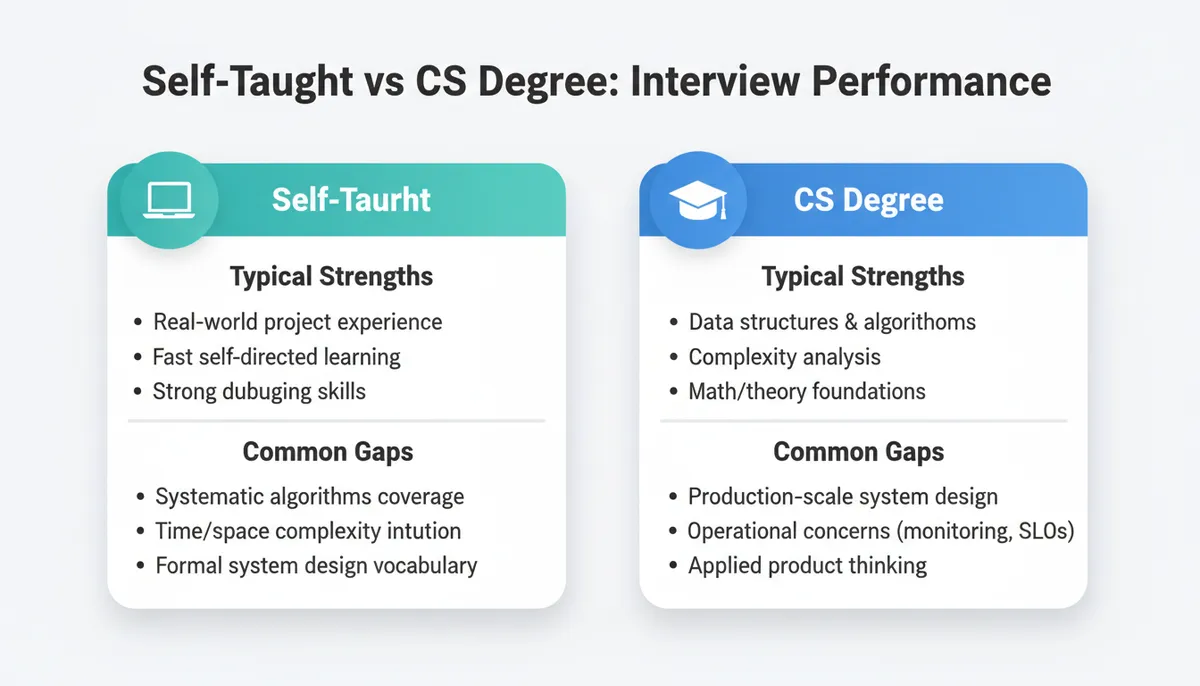
This comparison isn’t deterministic; individuals vary widely. But it shows how background shapes default strengths—and where focused preparation matters most.
How Interview Format Affects Self-Taught vs CS Degree Performance
Different interview types emphasize different skills. Here’s how they tend to play out.
1. Online Coding Screens
Format:
- 1–2 problems on platforms like HackerRank, LeetCode
- 45–90 minutes
- Automated evaluation based on correctness and performance
Favored background:
- Slight edge to CS degree candidates who:
- Have practiced similar problems in coursework
- Are familiar with algorithmic patterns and constraints
How self‑taught candidates can match or exceed:
- Practice pattern‑based problem sets (e.g., curated DSA patterns rather than random questions like those on LeetCode)
- Learn to quickly:
- Parse problem statements
- Identify the underlying pattern (e.g., sliding window)
- Implement and test iteratively
2. Live Coding / Whiteboard Interviews
Format:
- 45–60 minutes with an engineer
- One or two problems
- Heavy emphasis on communication and thought process
Favored background:
- Neutral, but:
- CS grads may recognize patterns faster
- Self‑taught devs often communicate more concretely, using real‑world analogies
Success factors:
- Explaining your approach clearly
- Iterating based on feedback
- Handling edge cases and testing your code
3. System Design Interviews
Format:
- 45–60 minutes, usually for mid‑level and above
- Design a system (e.g., chat service, news feed, rate limiter)
- Focus on tradeoffs, scalability, and reliability
Favored background:
- Slight edge to engineers with production experience, which many self‑taught devs have
- CS degree alone is not sufficient; practical exposure matters more
Key skills:
- Breaking down requirements
- Identifying core components (API gateway, services, databases, caches, queues)
- Reasoning about capacity, bottlenecks, and failure modes
4. Behavioral Interviews
Format:
- 30–45 minutes
- Questions about past experiences, conflict, ownership, learning
Favored background:
- Neutral; depends entirely on experience and storytelling
- Self‑taught candidates can leverage diverse backgrounds
- CS grads can draw from internships, research, and projects
Performance here is mostly about reflection and communication, not education.
Common Interview Mistakes by Both Groups
Regardless of background, many candidates make the same avoidable mistakes.
Mistake 1: Jumping into Code Without Clarifying the Problem
Symptoms:
- Misreading input format
- Ignoring constraints (n up to 10⁵ vs 10⁹ matters)
- Missing edge cases
Better approach:
- Restate the problem in your own words.
- Ask clarifying questions (input size, character set, ordering requirements).
- Confirm examples and add your own edge cases.
Mistake 2: Not Talking Through Your Thought Process
Silence is hard to evaluate. Interviewers need to know:
- What options you considered
- Why you chose a particular approach
- How you’re checking correctness
Practice:
- Narrate like a running commentary:
- “I see two approaches: brute force in O(n²) and a hash‑based approach in O(n). Given n can be 10⁵, I’ll try the hash‑based one.”
- “Let me think through edge cases: empty input, duplicates, negative numbers…”
Mistake 3: Over-Optimizing Too Early
Some candidates:
- Spend too long chasing the “perfect” solution
- Never get a working version
Better pattern:
- Start with a simple, correct solution (even if O(n²)).
- Explain its complexity and limitations.
- Then optimize to O(n log n) or O(n) as needed.
Interviewers care more about structured problem solving than about magically jumping to the optimal answer.
Best Practices for Self-Taught Candidates
If you’re self‑taught, you don’t need a degree to compete. You do need structured preparation to fill in gaps and align your skills with interview expectations.
1. Systematically Learn Core CS Fundamentals
Focus on:
-
Data structures:
- Arrays, strings
- Hash maps/sets
- Linked lists
- Stacks, queues, heaps
- Trees (binary, BST, tries)
- Graphs (adjacency list/matrix)
-
Algorithms:
- Sorting and searching
- BFS/DFS and shortest path
- Sliding window, two pointers
- Binary search (on values and answers)
- Backtracking
- Dynamic programming basics
You don’t need a full 4‑year curriculum. You do need depth in the areas interviews test repeatedly.
Pattern‑based resources (like a DSA patterns sheet that groups problems by pattern instead of topic) are especially effective because they train you to recognize and reuse solutions. See our guide on What Are DSA Patterns? A Complete Guide for Beginners for a comprehensive introduction.
2. Practice Under Interview-Like Conditions
-
Use mock interviews (with peers, mentors, or AI‑based tools) to:
- Practice thinking aloud
- Handle time pressure
- Get feedback on both code and communication
-
Simulate:
- 45‑minute sessions
- One medium or hard problem
- No copy‑paste from old solutions
This is where tools like an AI Mock Interview Simulator can be useful: they force you into the interview tempo and feedback loop.
3. Translate Project Experience into Interview Stories
For behavioral and system design interviews:
- Prepare 6–8 stories using the STAR format (Situation, Task, Action, Result)
- Cover:
- A time you debugged a hard production issue
- A time you improved performance or reliability
- A time you learned a new technology quickly
- A time you handled disagreement or feedback
Your non‑traditional background is an asset if you can articulate it clearly.
4. Learn to Speak the Language of Complexity
Even if you can solve problems intuitively, learn to:
- Use Big‑O notation accurately
- Explain tradeoffs (“I’m using extra O(n) space to get O(n) time”)
- Reason about scalability (“this approach will time out if n is 10⁵”)
This doesn’t require advanced math—just practice applying the concepts to your own code.
Best Practices for CS Degree Candidates
If you have a CS degree, your main opportunity is to bridge theory and practice.
1. Connect Algorithms to Real-World Use Cases
For each major algorithm or data structure you know, ask:
- Where is this used in real systems?
- What are the practical tradeoffs?
Examples:
-
Hash maps:
- Used in caching, symbol tables, routing tables
- Tradeoffs: memory usage, collision handling, worst‑case O(n)
-
BFS/DFS:
- Used in shortest path (social graphs, routing)
- Used in crawling and reachability analysis
This makes it easier to discuss your solutions in a way that resonates with interviewers who care about production systems.
2. Build and Deploy Real Projects
Even small projects help:
- Build a web service with authentication and persistence
- Deploy it to a cloud provider
- Add logging, metrics, and basic monitoring
Then, in interviews, you can:
- Reference real incidents you handled
- Talk about tradeoffs you made (SQL vs NoSQL, caching, etc.)
- Show that you can move beyond textbook examples
3. Practice System Design Explicitly
Don’t assume algorithms knowledge covers this. Learn:
-
Common components:
- API gateways, load balancers
- Application servers
- Databases, caches, queues
- Object storage, CDNs
-
Core design patterns:
- Read‑heavy vs write‑heavy systems
- Event‑driven vs request/response
- Sharding and replication
Practice designing systems on a whiteboard or doc, focusing on:
- Requirements gathering
- Component breakdown
- Data flow
- Bottlenecks and failure handling
4. Calibrate to Interview Constraints
Academic exercises often:
- Allow long problem‑solving times
- Emphasize proofs and completeness
Interviews emphasize:
- Progress within 45 minutes
- Clear communication
- Good enough solutions with explicit tradeoffs
Practice with real‑time constraints and interactive feedback to recalibrate.
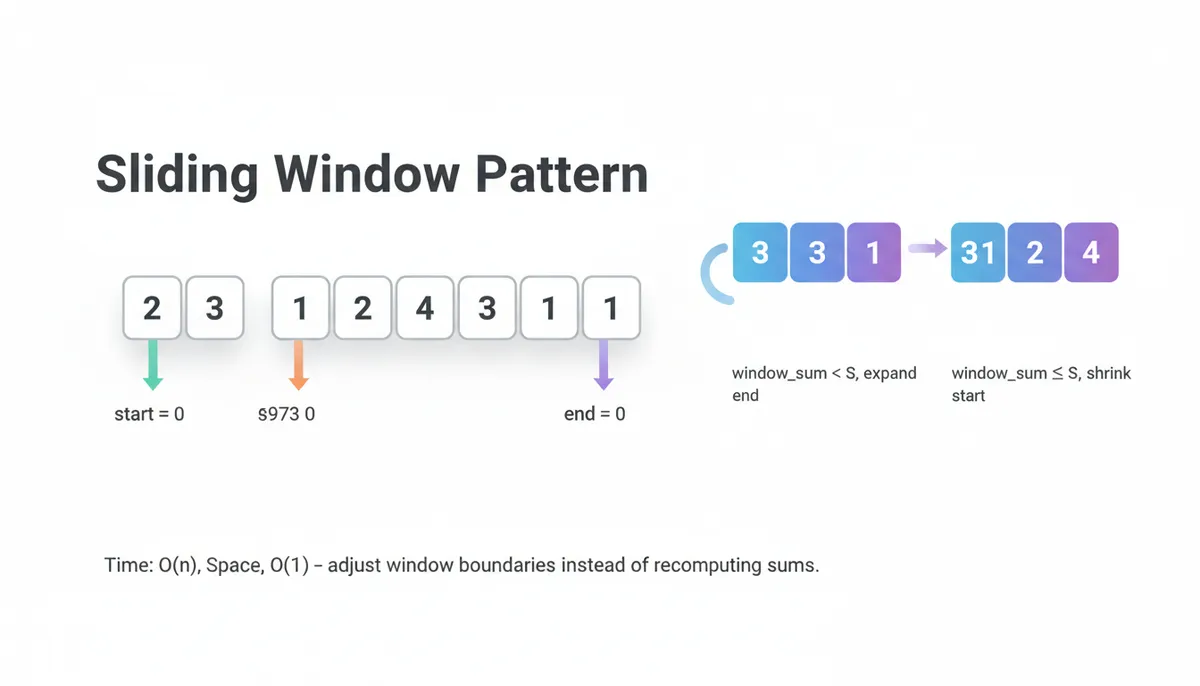
A Simple Pattern Example: Sliding Window
To illustrate how pattern‑based learning helps both self‑taught and CS degree candidates, consider a classic interview question:
Given an array of positive integers and a target sum
S, find the length of the smallest contiguous subarray whose sum is ≥S. If none exists, return 0.
Naive Approach (Brute Force)
Check all subarrays:
PYTHON
Optimized Approach (Sliding Window)
Use a dynamic window [start, end]:
PYTHON
Once you’ve seen the sliding window pattern a few times, you recognize:
- Contiguous subarray + sum constraint → sliding window
- Two pointers (start, end) adjusting based on cumulative sum
This kind of pattern recognition is what separates struggling candidates from those who appear “naturally good” at interviews—regardless of degree status.
How to Decide Your Path Forward (Regardless of Background)
Whether you’re self‑taught or have a CS degree, the right question isn’t “who is better?” but:
Given my starting point, what’s the most effective way to prepare for tech interviews?
A practical plan:
-
Assess your current strengths and gaps
- Can you comfortably solve medium‑level algorithm problems?
- How do you perform in mock interviews?
- Are you more comfortable with coding, system design, or behavioral questions?
-
Adopt a pattern-based learning approach
- Group problems by pattern (two pointers, sliding window, BFS/DFS, etc.)
- For each pattern:
- Learn the core idea
- Implement 3–5 variations
- Reflect on when it applies and when it doesn’t
Structured resources like a Beginner to Advanced DSA Roadmap for Software Engineers in 2026 can accelerate this.
-
Integrate realistic mock interviews
- Alternate between:
- Solo practice (coding platforms)
- Mock interviews (with peers, mentors, or AI)
- Focus on:
- Explaining your thought process
- Handling hints and corrections
- Managing time and complexity
- Alternate between:
-
Iterate with feedback
- After each session, ask:
- Where did I get stuck?
- Was it knowledge (didn’t know the pattern) or execution (couldn’t implement in time)?
- How can I adjust my practice plan?
- After each session, ask:
-
Leverage your unique background
- Self‑taught:
- Highlight your projects and learning journey
- Connect your previous experience to product thinking and user empathy
- CS degree:
- Highlight research, internships, and complex course projects
- Connect theory to practical decisions in your designs
- Self‑taught:
Key Takeaways
-
There is no inherent winner in “self taught vs cs degree” for tech interviews. Performance is driven more by preparation, pattern familiarity, and communication than by educational background.
-
CS degree candidates often start stronger in algorithms and complexity, but may lack real‑world system design and production experience.
-
Self‑taught candidates often start stronger in practical engineering and adaptability, but may lack systematic coverage of CS fundamentals and algorithmic patterns.
-
Interview formats matter. Online coding screens slightly favor those with algorithm practice; system design interviews favor those with real‑world engineering experience.
-
Pattern-based learning is a powerful equalizer. Recognizing and mastering core patterns (sliding window, two pointers, BFS/DFS, DP, etc.) dramatically improves coding interview performance for both groups.
-
Deliberate, interview-specific practice—including mock interviews, feedback, and time‑boxed problem solving—is the single most important factor in improving outcomes.
Your background shapes your starting point, not your ceiling. With a focused plan, either path can lead to strong interview performance and a successful software engineering career.