
Interview
Should You Memorize Solutions for Coding Interviews?
Most candidates secretly wonder the same thing: “If I just grind enough LeetCode and memorize solutions, will I be safe in coding interviews?”

Most candidates secretly wonder the same thing: “If I just grind enough LeetCode and memorize solutions, will I be safe in coding interviews?”
On the surface, memorizing LeetCode solutions looks like an efficient coding interview strategy. You see similar problems, you recall the pattern, you write the code. But interview loops at top companies are designed to break that illusion. They test whether you can reason, adapt, and debug—not whether you’ve seen a particular problem before.
This post dives deep into memorizing LeetCode solutions as an interview preparation method: when it helps, when it fails, and what to do instead if you want to build durable, adaptable problem-solving skills.
We’ll focus on practical, technical guidance you can apply immediately.
Why Memorizing LeetCode Solutions Feels So Tempting
There are real reasons candidates gravitate toward LeetCode memorization:
- The problem bank is finite and public.
- Solutions are often short and neatly packaged.
- You can get the dopamine hit of a “green check” quickly.
- It feels like progress: more problems solved → more confidence.
In the early days of preparation, this can even help. You’re exposed to standard patterns, you see idiomatic implementations, and you get used to coding under constraints.
But there’s a critical distinction:
Memorizing LeetCode solutions is not the same as understanding the algorithmic patterns behind them.
Interviewers are testing the latter.
What Interviewers Actually Evaluate
Before deciding whether LeetCode memorization is a good strategy, it’s useful to understand the evaluation criteria on the other side of the table.
Core dimensions interviewers care about
Most companies (from FAANG to fast-growing startups) informally evaluate:
-
Problem understanding
- Can you restate the problem clearly?
- Do you identify edge cases and constraints?
- Do you ask clarifying questions?
-
Solution design
- Can you generate multiple approaches?
- Can you reason about time/space complexity?
- Do you choose an approach that fits the constraints?
-
Algorithmic reasoning
- Do you recognize applicable patterns (e.g., sliding window, BFS/DFS, DP)?
- Can you adapt known techniques to a slightly new setting?
- Can you derive the solution logically, not just recall it?
-
Coding ability
- Is your code correct, readable, and idiomatic?
- Do you handle edge cases?
- Do you name variables and functions meaningfully?
-
Debugging and iteration
- Can you find and fix bugs from tests?
- Do you trace through examples?
- Do you refine your solution under feedback?
-
Communication
- Do you explain your thought process?
- Can someone else follow your reasoning?
Memorizing LeetCode solutions primarily helps with #4 (coding) and only partially with #3 (if you internalize the pattern). It does very little for #1, #2, #5, and #6.
That’s why a pure memorization strategy breaks down under even slight variations in the problem.
The Problem With Pure LeetCode Memorization
Let’s look at where memorizing solutions fails in practice.
1. Small variations break your recall
Suppose you memorized the classic “Two Sum” solution with a hash map:
PYTHON
Now the interviewer asks:
“Given an array of integers and a target, return the number of unique pairs that sum to target. Each pair should be counted once regardless of order.”
This is not the same as the standard LeetCode problem. If you rely on rote memorization, you might:
- Try to force-fit the original solution.
- Miss the requirement about uniqueness.
- Struggle with duplicates and ordering.
If, instead, you understand the pattern (“hash map to complement pairs; handle duplicates via sets or sorting”), you can systematically adapt.
2. Interviews often test unseen combinations
Companies intentionally mix and match patterns:
- BFS + bitmasking
- Sliding window + prefix sums
- Binary search + greedy feasibility check
- Graph traversal + dynamic programming
If your mental model is “I know problem #123 and its solution,” you’ll be stuck when you see a hybrid you haven’t memorized.
If your mental model is “I recognize these two underlying techniques and how to compose them,” you’re fine.
3. Memorization doesn’t scale with seniority
For junior roles, many questions are close to canonical LeetCode problems. For mid-level and senior roles, you’ll see:
- System design
- Unusual constraints
- Domain-specific data models (e.g., intervals with business rules)
Memorizing LeetCode solutions helps very little here. The skill that scales is structured problem solving, not recall.
4. Rote learning hides weak conceptual understanding
If you solve a problem by recognizing it from memory, you might not notice:
- You don’t actually understand why the time complexity is O(n log n).
- You can’t explain why a greedy choice is safe.
- You can’t reason about corner cases you haven’t seen.
Interviewers often probe with “why” questions precisely to differentiate memorization from understanding.
When Memorizing LeetCode Solutions Can Be Useful
Memorization is not inherently bad. It’s about how and when you use it.
1. As a result of deep understanding
If you’ve truly understood a pattern, implemented it multiple times, and explained it to others, you will naturally “memorize” it.
Examples:
- Two-pointer template for sorted arrays
- Binary search on answer space
- BFS/DFS traversal skeleton
- Classic DP recurrences (knapsack, LIS, LCS)
This is productive memorization: you remember the essence and can re-derive details under pressure.
2. For implementation templates and idioms
Some things are worth memorizing almost verbatim:
- BFS queue pattern
- DFS recursion pattern
- Typical sliding window skeleton
- Common library functions in your language of choice
Example: BFS on a grid:
PYTHON
Memorizing this structure saves cognitive load so you can focus on the problem-specific logic.
3. For last-minute review
Before interviews, it’s reasonable to:
- Skim through notes of solved problems.
- Revisit tricky edge cases.
- Recall standard patterns.
This is similar to reviewing flashcards before an exam. It’s reinforcement, not the primary learning method.
A Better Coding Interview Strategy: Pattern-Based Learning
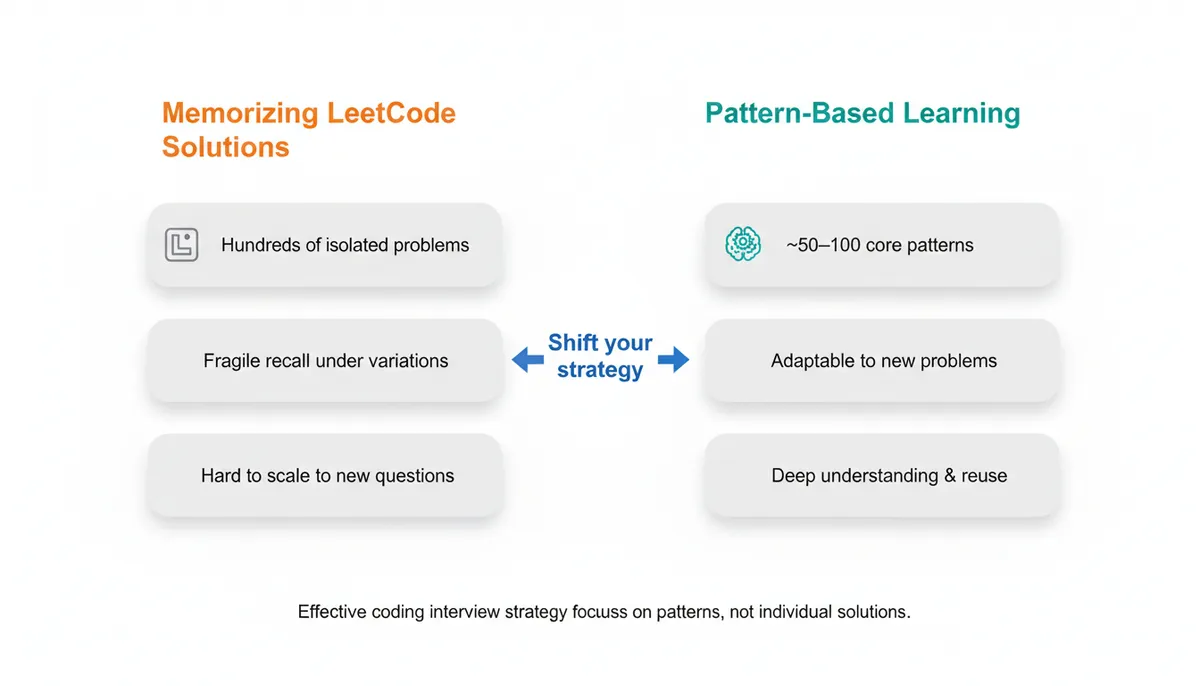
Instead of memorizing hundreds of individual LeetCode solutions, focus on mastering a smaller set of patterns that generalize.
What is pattern-based learning?
Pattern-based learning groups problems by the underlying technique, not by their surface story.
Examples of patterns:
- Two Pointers / Sliding Window
- Binary Search (on index, on answer)
- Prefix Sum / Difference Array
- Fast & Slow Pointers (cycle detection)
- Backtracking / DFS with state
- Topological Sort / Kahn’s Algorithm
- Union-Find (Disjoint Set Union)
- Dynamic Programming on sequences / grids / trees
Instead of asking, “How do I solve LeetCode #123?” you ask:
“Which pattern applies here, and how do I adapt it?”
This is the core idea behind structured pattern sheets (like a 94-pattern catalog) and AI coaches that nudge you toward patterns instead of handing you full solutions. For a comprehensive guide, see What Are DSA Patterns? A Complete Guide for Beginners.
Example: From Memorizing a Solution to Understanding a Pattern
Let’s walk through a concrete transformation from memorization to pattern mastery.
Problem: Longest Substring Without Repeating Characters
Classic LeetCode-style statement:
Given a string
s, find the length of the longest substring without repeating characters.
Memorized solution (sliding window)
You might have seen this exact code:
PYTHON
You can memorize this. But that doesn’t help much when the problem changes slightly.
Extracting the pattern
Let’s articulate the sliding window pattern behind it:
- Maintain a window
[left, right]over the string. - Maintain some state about the window (e.g., set of characters in it).
- Expand
rightstep by step. - While the window violates a constraint, move
leftforward to restore validity. - Track the best window satisfying the constraint.
This pattern applies to many problems:
- Longest substring with at most
kdistinct characters. - Minimum window substring containing all characters of
t. - Longest subarray with sum ≤
k.
Once you understand the pattern, the specific implementation is easy to re-derive. For more on sliding window techniques, check out Master Sliding Window: 4 templates for Coding Interviews.
Visual: Memorization vs Pattern-Based Strategy
Common Pitfalls With LeetCode Memorization
If you’re already grinding problems, watch for these warning signs.
Pitfall 1: Solving the same problem multiple times without insight
Symptom:
- You’ve “solved” a problem 3–4 times.
- Each time you have to look at the solution again.
- You can’t explain why it works.
Fix:
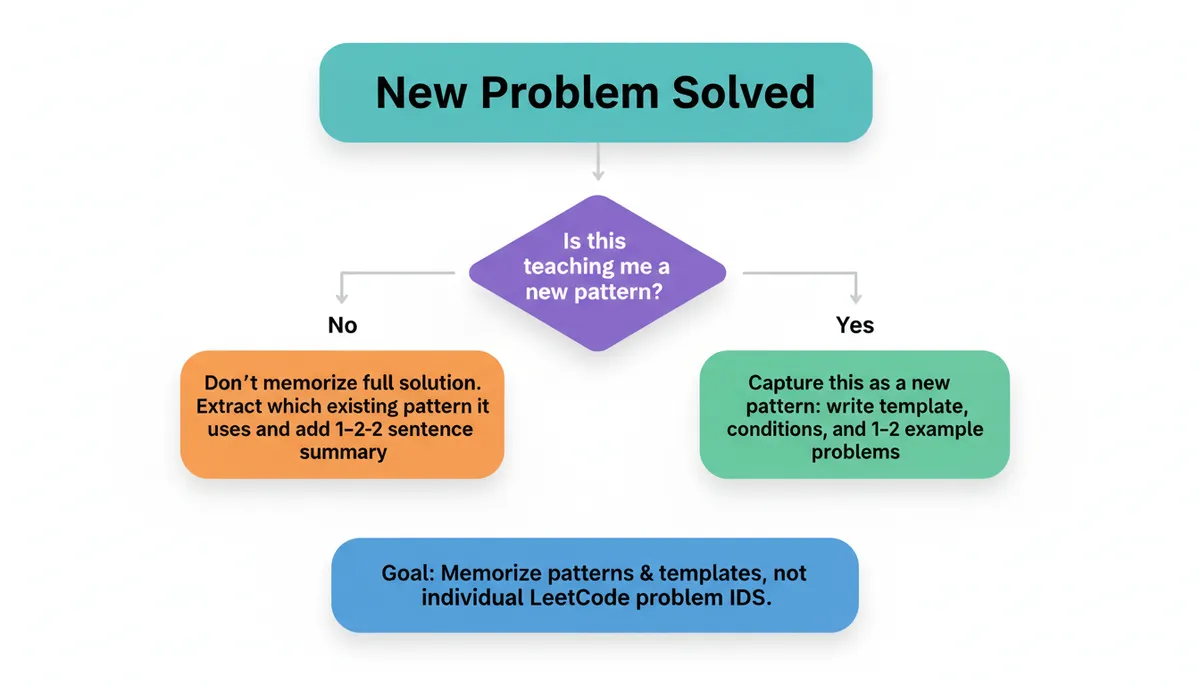
- After solving, write a 2–3 sentence summary:
- What pattern did I use?
- What’s the core idea in plain language?
- How would I recognize this pattern again?
Pitfall 2: Skipping the dry run
Symptom:
- You jump from idea → code → submit.
- When it fails, you tweak code randomly.
- You rarely trace through examples by hand.
Fix:
- For every non-trivial problem, dry run on:
- A small normal case.
- At least one edge case (empty, single element, all same values).
- Explain the dry run out loud as if to an interviewer.
Pitfall 3: Ignoring time and space complexity
Symptom:
- You know the code but not the complexity.
- When asked “why O(n log n)?”, you answer vaguely: “Because sort.”
Fix:
- For each solution you study:
- Write down time and space complexity.
- Justify it step by step (e.g., “Sorting dominates: O(n log n); scanning is O(n)”).
Pitfall 4: Treating editorial solutions as final answers
Symptom:
- You immediately open the editorial when stuck.
- You copy the code and move on.
- You don’t attempt to re-derive the solution yourself.
Fix:
- When reading a solution:
- Close it and re-implement from memory.
- Try to explain the idea to an imaginary peer.
- Modify the problem slightly and see if you can still solve it.
How to Transition From Memorization to Understanding
Here’s a concrete, step-by-step process.
Step 1: Group problems by pattern, not by ID
Instead of a flat list of “LeetCode 1–300,” maintain a pattern-based index:
- Sliding Window
- Binary Search
- Graph Traversal
- Interval Problems
- Tree Traversals
- DP on Arrays / Strings / Trees
- Greedy
For each solved problem, tag it with one or more patterns. Tools like structured DSA pattern sheets can accelerate this.
Step 2: Build your own “pattern templates”
For each pattern, create a mini template in your own words:
Example: Binary Search on Answer Space
- Use when:
- Answer is numeric and monotonic (if
xworks, all >xor all <xwork). - You can write a
can(answer)function that checks feasibility in O(f(n)).
- Answer is numeric and monotonic (if
- Template:
PYTHON
Memorize the template, not a specific problem. For more on binary search patterns, see Master Binary Search Patterns: 5 templates for Coding Interviews.
Step 3: Practice deriving from patterns, not copying
When you encounter a new problem:
- Restate the problem and constraints.
- Ask: “Which 1–2 patterns might apply here?”
- Try to fit the problem into a known template.
- Only then, start coding.
If you can’t identify a pattern, solve it anyway—but afterward, decide how you would categorize it.
Step 4: Use active recall and spaced repetition
Instead of passively rereading solutions:
- After solving a problem, revisit it a few days later:
- Try to solve it from scratch.
- If you’re stuck, recall the pattern first, then details.
- Maintain a small set of “review problems” that were initially hard for you.
Example: Adapting a Known Pattern to a New Problem
Consider the classic “Minimum Window Substring” problem. You may know the sliding window solution.
Now suppose the interviewer gives you:
Given a string
sand an integerk, return the length of the shortest substring with at leastkdistinct characters.
This isn’t a standard LeetCode problem, but the pattern is similar.
Reasoning with patterns (not memorized solution)
- We want a shortest substring satisfying a constraint → sliding window candidate.
- Window must have ≥ k distinct characters.
- Maintain:
left,rightpointers.- A frequency map of chars in window.
- A count of distinct characters.
Pseudo-code sketch:
PYTHON
You didn’t need to memorize this exact problem. You only needed:
- The sliding window pattern.
- The idea of a frequency map and a “valid window” condition.
What About Time Pressure? Doesn’t Memorization Help You Move Faster?
Time constraints are real. It’s natural to think memorizing LeetCode solutions will help you move faster.
In practice:
- Templates make you faster.
- Patterns make you more robust.
- Rote memorization of whole solutions makes you brittle.
Interviews reward candidates who can:
- Quickly identify the right pattern.
- Communicate trade-offs clearly.
- Implement a correct solution with minimal backtracking.
Memorization alone rarely gets you there; it often leads to:
- Forcing the wrong pattern.
- Over-optimizing prematurely.
- Struggling to adapt under follow-up questions.
If you want to simulate time pressure realistically, using an AI mock interview or timed practice environment is far more effective than cramming solutions.
Practical Study Plan: Balancing Practice and Understanding
Here’s a concrete, pattern-centered plan that still uses LeetCode effectively.
Phase 1: Foundation (2–3 weeks)
Goal: Learn the most common patterns and their templates.
- Pick ~10–15 core patterns (arrays, two pointers, binary search, hash maps, basic DP, BFS/DFS, trees).
- For each pattern:
- Study 2–3 canonical problems.
- Write your own template and explanation.
- Implement from scratch until you can do it without looking.
Phase 2: Breadth and variation (3–6 weeks)
Goal: See how patterns combine and vary.
- Solve problems grouped by pattern.
- For each problem:
- Identify the pattern(s) used.
- Write a 1–2 sentence summary of the key idea.
- Tag it in your own pattern index.
Phase 3: Simulation and refinement (2–4 weeks)
Goal: Operate under interview-like constraints.
- Do timed sessions (45–60 minutes) with:
- 1 medium + 1 easy, or
- 1 hard.
- After each session:
- Reflect: Did I pick the right pattern quickly?
- Note any patterns you misapplied or didn’t recognize.
- Add those to your review list.
Ongoing: Review, don’t re-memorize
- Regularly revisit:
- Your pattern templates.
- A curated list of “representative problems” per pattern.
- Focus on:
- Re-deriving the solution from the pattern.
- Explaining the reasoning, not just the code.
Visual: Decision Flow – Should I Memorize This?
Key Takeaways: Should You Memorize Solutions for Coding Interviews?
- Pure LeetCode memorization is a weak strategy. It fails on small variations, unseen combinations, and senior-level interviews.
- Interviewers test reasoning, not recall. They care about how you approach, design, and debug solutions under constraints.
- Some memorization is useful—but at the pattern/template level. BFS skeletons, sliding window templates, and binary search frameworks are worth internalizing.
- Pattern-based learning scales. A manageable set of patterns can cover a wide variety of problems far more effectively than hundreds of isolated solutions.
- Use LeetCode as a pattern lab, not a question bank to memorize. Tag problems by pattern, summarize ideas, and practice deriving solutions from templates.
- Simulate interviews to test understanding, not memory. Timed practice and mock interviews reveal whether you can apply patterns under pressure.
If you shift your focus from memorizing LeetCode solutions to mastering patterns and reasoning, you’re not just preparing for interviews—you’re building the core skill set you’ll use every day as an engineer.