
Interview
Udaan Interview Questions and Process: The Complete Guide (2026)
Udaan's interview loop is design-heavy and skips LeetCode-style screens entirely. Every round, what each expects, and a 30-day plan built for that shape.

Udaan's interview loop is the most unusual in Indian product hiring, and the difference is worth understanding before you prepare: reported accounts consistently describe a process that does not use LeetCode-style algorithmic screens at all. Instead there are four rounds, and they are design-heavy from the first one.
For candidates whose preparation is built almost entirely around algorithmic problems, this is a genuine reorientation. The skills Udaan examines — building working software under a clock, modelling a system at class level, reasoning about architecture, and producing something a user could actually use — overlap far less with competitive problem solving than most candidates expect.
To practise the design rounds, Udaan's interview kit holds six low-level design problems attributed to the company, each with a worked editorial and AI-evaluated practice.
The process at a glance
| # | Round | Format | What it screens |
|---|---|---|---|
| 1 | Machine coding | ~90 min, build a working system | Design under time pressure, code quality |
| 2 | System design | Class-level and architecture-level discussion | Modelling, scale, trade-offs |
| 3 | Design / product round | Produce a working interface; code quality not the focus | Product judgement, user thinking |
| 4 | HR | Fit and motivation | Communication, alignment |
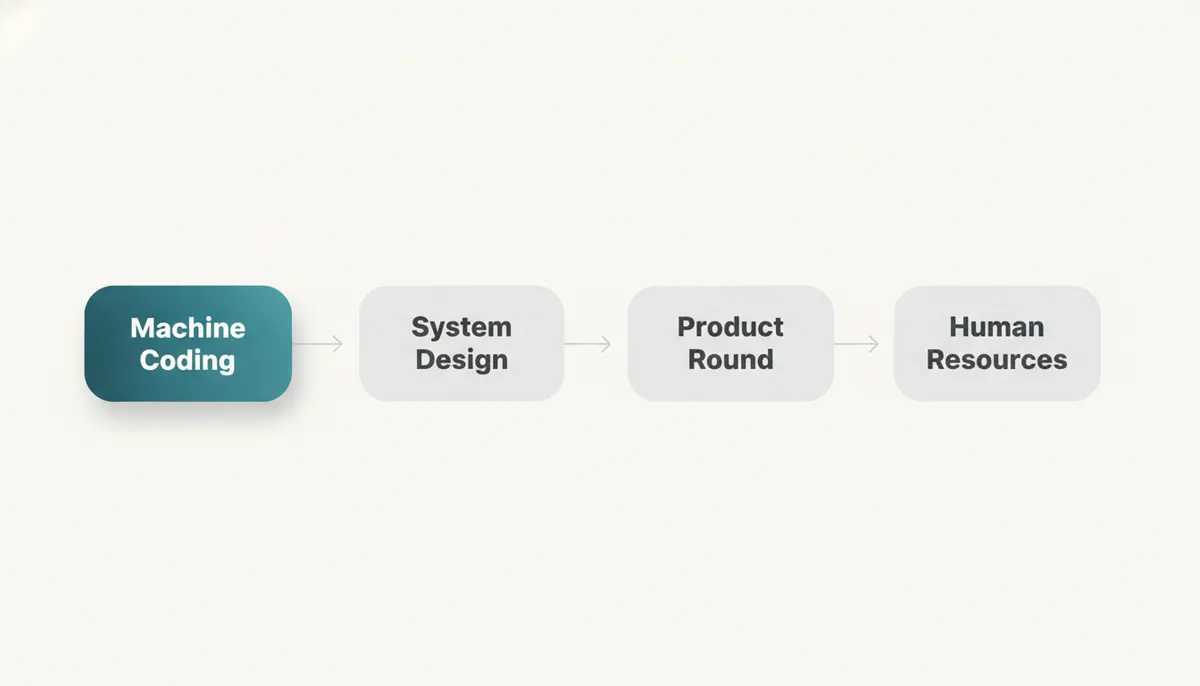
Round counts and order vary by role, level and team. Confirm the sequence with your recruiter — and in particular confirm whether an algorithmic round applies to the role you are interviewing for, since the absence of one is unusual enough to be worth checking rather than assuming.
Round 1 — machine coding
Around ninety minutes, one deliberately under-specified problem, and running code expected at the end. In-memory state, your choice of language, no database or web framework, and a driver demonstrating the flows end to end.
Because this is the first round rather than the third, it carries the filtering load that an online assessment carries elsewhere. There is no gentler warm-up stage before it.
What gets marked, roughly in order:
- It works. A running system covering the core flow beats an elegant half-finished abstraction.
- A real domain model. Classes representing the things in the problem, with behaviour — not one procedural block.
- One responsibility per class.
- Clean extension. "How would you add X?" should be answerable with a new implementation rather than a rewrite.
- Readability, as a proxy for your production code.
Get the smallest working version of the core flow running early, then improve its structure. Arriving at ninety minutes with a beautiful hierarchy that does not execute is the most common failure.
💡 Pro Tip: Spend the first five minutes clarifying scope and stating assumptions. The incompleteness of the problem statement is deliberate — it checks whether you ask or quietly build the wrong thing.
Round 2 — system design, both levels
Udaan's design round spans both the class level and the architecture level, which is broader than the equivalent round at most companies. Expect to move between "how would you model these entities and their relationships" and "how does this behave at scale, and what happens when this dependency is slow".
Udaan operates business-to-business commerce across a wide, distributed supplier and retailer network, so natural territory includes catalogue and inventory modelling, order and fulfilment state, pricing that varies by buyer and geography, and systems where the write path matters as much as the read path.
Two things distinguish strong answers. First, naming trade-offs rather than reciting an architecture — what you are giving up, and why that is right here. Second, moving fluently between levels: being able to say what a class boundary implies for a service boundary.
The free Low Level Design Sheet and System Design Sheet cover both halves, and low-level design vs high-level design explains what each level of the discussion is actually asking for. For rehearsal, an AI mock interview supports both LLD and HLD modes with evaluation of the design you submit.
Round 3 — the design and product round
This is the round with no real equivalent elsewhere, and the one candidates are least prepared for. Reported accounts describe producing a working interface — commonly with a frontend framework — where the code itself is explicitly not the thing being judged. The output is.
What that means in practice: the round is assessing product judgement. Does the thing you built solve the problem a user actually has? Did you make sensible decisions about what to show, what to hide, and what to do when data is missing or an action fails? Does it handle the empty state, the error state, the loading state — the parts that separate a demo from a product?
How to prepare for it:
- Be fluent in one frontend framework, enough to build a small working interface without fighting the tooling. Which one matters less than fluency.
- Practise the unglamorous states. Empty, loading, error. Candidates build the happy path and stop; the states around it are where judgement shows.
- Narrate your product reasoning. Say why you chose to surface one thing and not another. In a round where code is not the criterion, your stated reasoning carries the evaluation.
✅ Do: Ship something small that works completely, including its failure states. ❌ Don't: Optimise code quality in a round that has explicitly told you it is not measuring that.
Round 4 — HR
Fit, motivation and communication. Be able to say why this company and this problem space, and have two or three projects you can discuss with real specifics — what you owned, what went wrong, what you would change.
Is the Udaan interview hard?
Hard in an unfamiliar way rather than a brutal one.
There is no algorithmic gauntlet, which makes the loop considerably more approachable for engineers whose strength is building rather than puzzle-solving. But there is nowhere to hide either: every round asks you to produce or reason about real software, and the first round is a ninety-minute build with no warm-up before it.
Candidates who find this loop hard are usually those whose preparation was entirely algorithmic. Candidates who have shipped real systems and can model a domain cleanly often find it a fairer test of their actual job than a standard loop.
How many rounds? Typically four, varying by role and level.
How long does it take? Commonly two to four weeks end to end.
A 30-day preparation plan
Week 1 — design vocabulary. Object-oriented design patterns and class-design idioms. Implement two design problems end to end with no clock, focusing entirely on structure, then read the editorials and compare against your own decisions. Design patterns for interviews covers the ground.
Week 2 — machine coding under the clock. A 90-minute timer, one problem per session, running code by the end, no exceptions. The six low-level design problems evidenced at Udaan are the most directly relevant set to work through.
Week 3 — architecture. Move up a level: data modelling, caching, queues, consistency, failure behaviour. Do two system design mocks and force yourself to name trade-offs aloud rather than draw boxes.
Week 4 — the product round and rehearsal. Build two small working interfaces from scratch, each complete with empty, loading and error states. Then rehearse: one machine coding mock, one design mock, and your project stories said out loud.
💡 Pro Tip: Practise machine coding unassisted. The round is timed and without an AI assistant, and practice that ignores that builds confidence which will not survive it.
Who this loop suits, and who it catches out
Because Udaan's process is shaped so differently from a standard loop, it rewards and punishes different candidates — which is worth thinking about before you invest weeks preparing for it.
It suits engineers who ship. If you have built and maintained real systems, made design decisions you had to live with, and can produce working software under a deadline, this loop lets you demonstrate that directly rather than asking you to prove it via proxy puzzles. Several candidates describe it as the fairest interview they have sat, for exactly that reason.
It suits people who think about users. The product round has no equivalent elsewhere, and it rewards a habit — asking what someone is actually trying to do — that no amount of algorithmic practice builds.
It catches out candidates whose preparation is purely algorithmic. This is the important one. If your last three months have been problem sets, essentially none of that effort is directly examined here. There is no round where recognising a sliding window earns you anything.
It catches out candidates who cannot finish. Every round produces an artefact: running code, a design, an interface. Fluency in talking about software is not enough; you have to make something inside the time.
The practical read: if you are choosing where to spend limited preparation time across several companies, Udaan's loop is unusually transferable to the design rounds at Swiggy, Flipkart and Razorpay, and unusually poor value if your other targets are algorithm-heavy loops. Prepare for it deliberately rather than incidentally.
Frequently asked questions
Does Udaan ask LeetCode-style questions? Reported accounts consistently say no — the loop is described as design-heavy without a conventional algorithmic screen. Confirm with your recruiter for your specific role, since this is unusual enough to be worth checking.
How many rounds does Udaan have? Typically four: machine coding, system design, a design and product round, and HR.
How long is the machine coding round? Around ninety minutes in reported accounts. Confirm with your recruiter.
What is the design and product round? A round where you produce a working interface and the output rather than the code is judged. It assesses product judgement — what you chose to build and how it handles the awkward states.
Do I need frontend skills? Enough fluency in one framework to build a small working interface comfortably. Depth matters less than not fighting the tooling.
Is system design required at junior levels? Design features throughout the loop, at class level from the first round. Architecture depth scales with the level you are interviewing at.
What language should I use for machine coding? Whichever you are fastest in. Fluency beats the choice.
How long does the process take? Commonly two to four weeks, varying by role and team.
Where to start
Udaan's loop rewards engineers who build. If your preparation so far has been algorithmic, the highest-leverage change you can make is to start producing working systems under a clock — because that is what round one is, with no gentler stage before it.
Open Udaan's interview kit for the six low-level design problems evidenced at Udaan, each with an editorial and AI-evaluated practice. Browse the free Low Level Design Sheet and System Design Sheet for the design rounds, and rehearse with an AI mock interview.
Interview processes change. Confirm round structure and timings with your recruiter, and check Udaan's careers site for current openings.
Topics
Related on Thita
Your next step
Practise with AI mock interviews
A spoken interview that asks follow-up questions, runs your code and ends with a written report.