
Interview
Why Most Candidates Fail Technical Interviews (Even After Months of Preparation)
Most candidates who fail technical interviews aren’t underprepared—they’re misprepared.
Most candidates who fail technical interviews aren’t underprepared—they’re misprepared.
They’ve solved hundreds of LeetCode problems, memorized common questions, and watched hours of YouTube tutorials. Yet when they sit down in front of a shared editor and a blank function signature, everything falls apart.
Understanding why candidates fail interviews, even after months of preparation, is the first step to fixing it. This post breaks down the most common failure modes in technical interviews, how they show up in real sessions, and what you can do to avoid them.
We’ll focus on coding interviews, but most principles apply to system design and behavioral rounds as well.
1. The Core Problem: Optimizing for the Wrong Goal
Many candidates treat technical interview prep as a memorization contest:
- “If I solve 300+ problems, I’ll be safe.”
- “If I memorize all the patterns, I’ll recognize the question.”
- “If I watch enough interview walkthroughs, I’ll be ready.”
This leads to a dangerous outcome: you get good at solving familiar problems in comfortable conditions, but interviews are specifically designed to be unfamiliar and uncomfortable.
The core reason most candidates fail technical interviews:
They train for pattern recall instead of real-time problem solving under constraints.
Let’s break down what that means in practice.
2. Why Candidates Fail Interviews: The Real Failure Modes
Below are the most common, practical reasons candidates fail, based on patterns you see repeatedly in real interviews.
2.1 They Can Code, But Can’t Communicate
Many rejections happen before the code is even run.
Common behaviors:
- Starting to type immediately without clarifying the problem.
- Going silent for 10–15 minutes while “thinking.”
- Not explaining trade-offs or why they chose a specific approach.
- Giving a final solution with no walkthrough or test cases.
Interviewers are evaluating how you think, not just the final answer. Silence is indistinguishable from being stuck.
A typical failure sequence:
- Candidate reads the prompt.
- Says “Okay” and starts coding.
- Hits an edge case, rewrites parts of the solution.
- Runs out of time; code is incomplete or buggy.
- Interviewer has no insight into the thought process.
Contrast with a strong candidate:
- Restates the problem in their own words.
- Asks clarifying questions.
- Proposes a high-level plan verbally.
- Codes while narrating key steps.
- Tests with edge cases and explains why.
The difference isn’t knowledge—it’s communication discipline.
2.2 Overfitting to LeetCode: Pattern Knowledge Without Pattern Recognition
There’s a big difference between:
- Pattern knowledge: “I know the sliding window template.”
- Pattern recognition: “This problem can be reduced to a sliding window over a frequency map.”
Many candidates can implement a known pattern if you name it, but fail to recognize it in a new, slightly twisted problem.
Example scenario:
Problem: “Given a string, find the length of the longest substring with at most K distinct characters.”
A candidate who’s solved a similar LeetCode problem might do well. But change it slightly:
“Now, instead of length, return the actual substring. And K is large (up to 10^5).”
A pattern-memorizer might:
- Try brute force or nested loops.
- Panic when the previous template doesn’t apply perfectly.
- Fail to adapt the sliding window idea to track both indices and substrings.
A pattern-thinker will:
- Recognize: “We’re still tracking a window with a constraint (≤ K distinct chars). Only the output changed.”
- Reuse the same core logic with minor adjustments.
This is the essence of pattern-based learning done right: you learn to see the structure of problems, not the surface wording. For a comprehensive guide on mastering such coding patterns, consider exploring The 90 DSA Patterns That Cover 99% of Coding Interviews.
2.3 Weak Problem Decomposition: Jumping Straight to Code
Another major reason for technical interview failure: candidates skip the “thinking” phase.
Symptoms:
- Trying to write the full function in one pass.
- Handling data structure choices “on the fly.”
- Discovering time complexity issues midway through coding.
- Realizing at the end that they misinterpreted the problem.
Interviewers notice when you haven’t decomposed the problem. Good decomposition typically includes:
- Clarify constraints and input size.
- Identify the core operation (search, count, transform, optimize).
- Map to a known space (arrays, trees, graphs, DP, etc.).
- Choose an approach and articulate complexity.
- Only then start coding.
Candidates who skip steps 1–4 often end up backtracking or rewriting large chunks of code under time pressure.
2.4 Shallow Understanding of Data Structures and Algorithms
Many candidates “sort of” know:
- How a hash map works.
- What a heap is.
- That BFS/DFS exist.
But in interviews, shallow understanding breaks quickly.
Example: You’re asked to find the shortest path in a grid with obstacles.
- A memorizer might say: “This looks like DFS.”
- A candidate who understands graphs will say: “We want the shortest path in an unweighted graph → BFS.”
Or:
“Use a priority queue here.”
If you can’t explain:
- Why a priority queue is needed.
- What its time complexity is.
- How it’s implemented (binary heap, typical operations).
…then you’re likely to get stuck when the interviewer asks follow-ups or variations. To build depth in these core concepts, reviewing Master Heap (Priority Queue) Patterns: 4 templates for Coding Interviews can be very helpful.
2.5 Not Practicing the Execution Environment
A significant, underrated reason for failure: environment mismatch.
Candidates practice in:
- Their favorite IDE with autocomplete, linting, and debugger.
- No time pressure.
- Ability to run tests frequently.
Interviews usually involve:
- A barebones shared editor (no autocomplete, no linting).
- 30–45 minutes.
- No compiler until the end (or limited runs).
This mismatch leads to:
- Syntax errors you’re not used to catching manually.
- Slower typing and more context switching.
- Panic when you can’t “just run it and see.”
You should practice in an environment that is worse than the real thing, so the interview feels familiar, not hostile. For tips on how to use AI tools effectively without becoming dependent, see How to Use AI Tools Like ChatGPT for Interview Preparation (Without Becoming Dependent).
2.6 Ignoring Edge Cases and Testing
Many interview failures happen after a candidate has written 80–90% of a correct solution but:
- Doesn’t test with edge cases (empty input, single element, duplicates, maximum constraints).
- Doesn’t dry-run the code.
- Doesn’t verify off-by-one behavior.
Interviewers are not just evaluating if your idea is correct—they’re evaluating if you can produce reliable code under time pressure.
A common pattern:
- Candidate codes a reasonable solution.
- Interviewer asks: “Let’s test it with some cases.”
- Candidate tests only the sample input from the prompt.
- Obvious edge case breaks.
- Candidate scrambles to patch it, introduces new bugs.
Strong candidates:
- Design tests before or during coding.
- Start with simple and edge inputs.
- Verbally walk through the code with those inputs.
2.7 Poor Time Management and Lack of Strategy
Another frequent cause of technical interview failure: no plan for the 45–60 minute session.
Common mistakes:
- Spending 15–20 minutes just understanding the problem.
- Over-optimizing early (e.g., jumping to advanced data structures too soon).
- Getting stuck on minor syntax details.
- Not asking for hints when clearly stuck for >5 minutes.
An effective time strategy might look like:
- 0–5 min: Clarify problem, constraints, examples.
- 5–10 min: Discuss brute force, then optimized approach.
- 10–30 min: Implement chosen solution.
- 30–40 min: Test and debug.
- 40–45 min: Discuss improvements, complexity, edge cases.
Without an internal clock and a rough plan, it’s easy to run out of time with an incomplete solution.
2.8 Underestimating Behavioral and “Soft” Failure Modes
Many candidates focus solely on coding interview mistakes and ignore behavioral aspects that still influence the decision:
- Being overly defensive when challenged.
- Blaming previous teams or employers.
- Not accepting hints gracefully.
- Appearing disinterested or uncollaborative.
Technical interviews are often collaborative problem-solving sessions. Interviewers ask:
- “Would I want to work with this person?”
- “Can they take feedback?”
- “Do they stay calm under uncertainty?”
A candidate who codes slightly worse but collaborates well can outperform a stronger coder with poor communication or attitude.
3. The Hidden Gap: Practice vs. Actual Interview Conditions
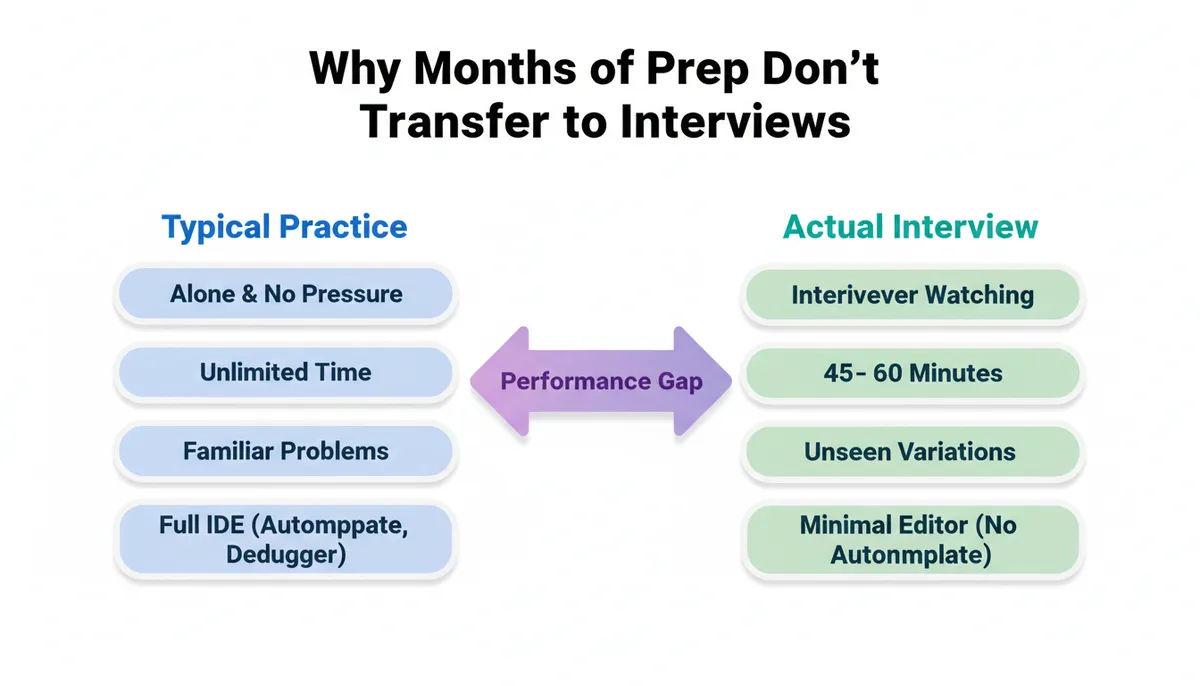
Many months of preparation fail because the practice distribution is completely different from the interview distribution.
You practice:
- Alone.
- With unlimited time.
- On previously seen problems.
- With full tooling support.
You’re evaluated:
- With another engineer watching you.
- Under a ticking clock.
- On unseen variations.
- In a constrained environment.
Bridging this gap is essential.
4. Common Coding Interview Mistakes in Detail (With Examples)
Let’s go deeper into some specific coding interview mistakes that frequently cause failure.
4.1 Not Starting With a Brute-Force Baseline
Many candidates feel they must immediately jump to an optimal solution. When they can’t, they freeze.
Instead, strong candidates:
- Start with the simplest correct solution (often O(n²) or worse).
- Use it as a baseline to reason about optimizations.
Example problem:
“Given an array of integers, return indices of two numbers such that they add up to a specific target.”
A failing candidate might:
- Sit silently, trying to recall the O(n) hash map solution.
- Waste valuable minutes under pressure.
A strong candidate will say:
“Brute force: try all pairs with nested loops, O(n²) time, O(1) space. But we can do better using a hash map to track seen numbers…”
This shows clear thinking even before the optimal solution is reached.
Hash Map Approach (Two Sum) – Example
PYTHON
- Time complexity: O(n)
- Space complexity: O(n)
The key interview skill isn’t memorizing this code—it’s being able to derive it from the brute force idea.
4.2 Treating Hints as a Sign of Failure
Some candidates think:
“If I need hints, I’ve already failed.”
So they resist hints or ignore them, which leads to:
- Staying stuck longer.
- Appearing inflexible or uncoachable.
Interviewers often want to give hints. It lets them see how you:
- Incorporate new information.
- Adjust your approach.
- Collaborate.
A better mindset:
“Hints are part of the signal. Using them well is a positive, not a negative.”
4.3 Overcomplicating Solutions
Another frequent coding interview mistake: overengineering.
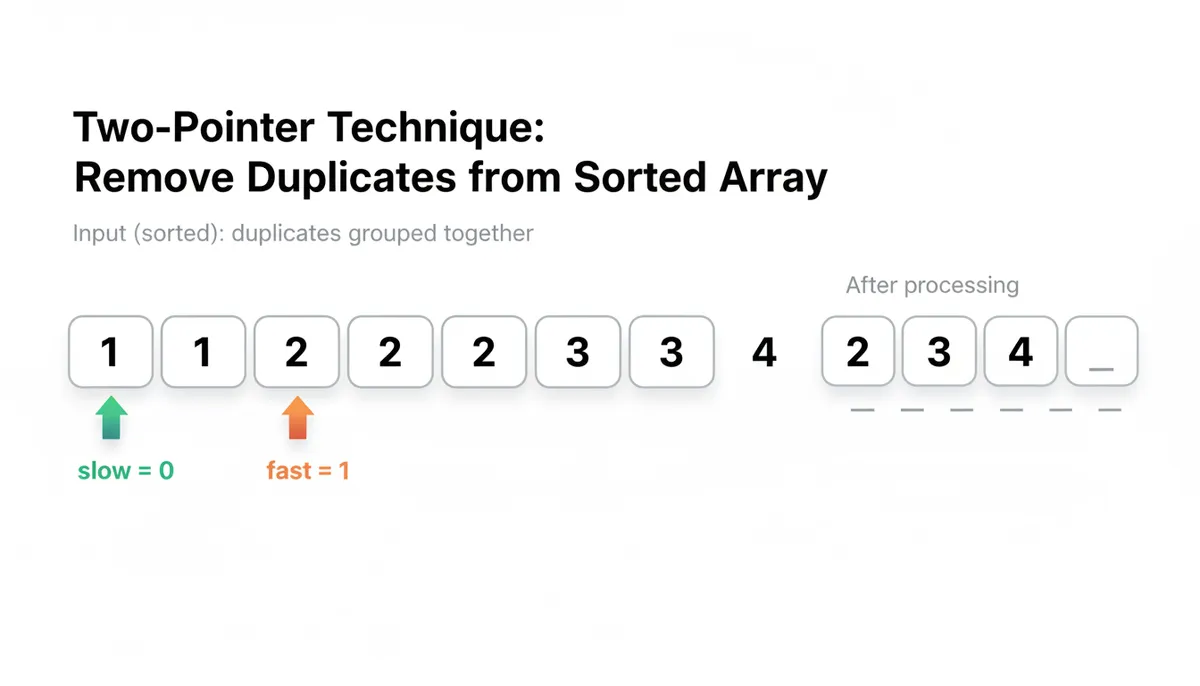
Example: Given a sorted array, remove duplicates in-place and return the new length.
A common overcomplication:
- Using extra data structures (sets, maps).
- Trying to track multiple indices unnecessarily.
A simpler, two-pointer solution:
PYTHON
- Time: O(n)
- Space: O(1)
Interviewers prefer a simple, correct O(n) solution over a complex, fragile “clever” one.
4.4 Not Explicitly Stating Complexity
Even with a correct solution, some candidates fail to articulate:
- Time complexity.
- Space complexity.
- Why it’s acceptable given constraints.
Interviewers use this to assess your ability to reason about scalability.
Example of a good wrap-up:
“This solution runs in O(n log n) time due to the sort, and O(1) extra space since we sort in place. Given n ≤ 10^5, this should be fine in practice.”
5. Best Practices to Avoid Technical Interview Failure
Now that we’ve covered common failure modes, here are concrete practices to improve.
5.1 Practice the Full Interview Loop, Not Just Solving Problems
Don’t just solve problems; simulate the entire interview flow:
- Read problem.
- Restate in your own words.
- Ask clarifying questions.
- Propose brute force.
- Propose optimization (if needed).
- Outline approach verbally.
- Code while narrating.
- Test with multiple cases.
- Analyze complexity.
- Discuss trade-offs or extensions.
You can do this alone, but practicing with another person or an AI interviewer (e.g., a mock session via AI Interview Practice: Free Mock Interview Simulator with Real-Time Feedback for Technical Interviews) is much closer to real conditions.
5.2 Train Pattern Recognition, Not Just Pattern Recall
Instead of just grinding random problems:
- Group problems by underlying pattern (e.g., sliding window, two pointers, binary search on answer, BFS on graphs).
- For each pattern:
- Understand when it applies.
- Write down the generic template.
- Solve multiple variations and identify what changed.
A consolidated sheet of patterns (like a The 90 DSA Patterns That Cover 99% of Coding Interviews) can be a useful backbone, but only if you use it to generalize, not memorize.
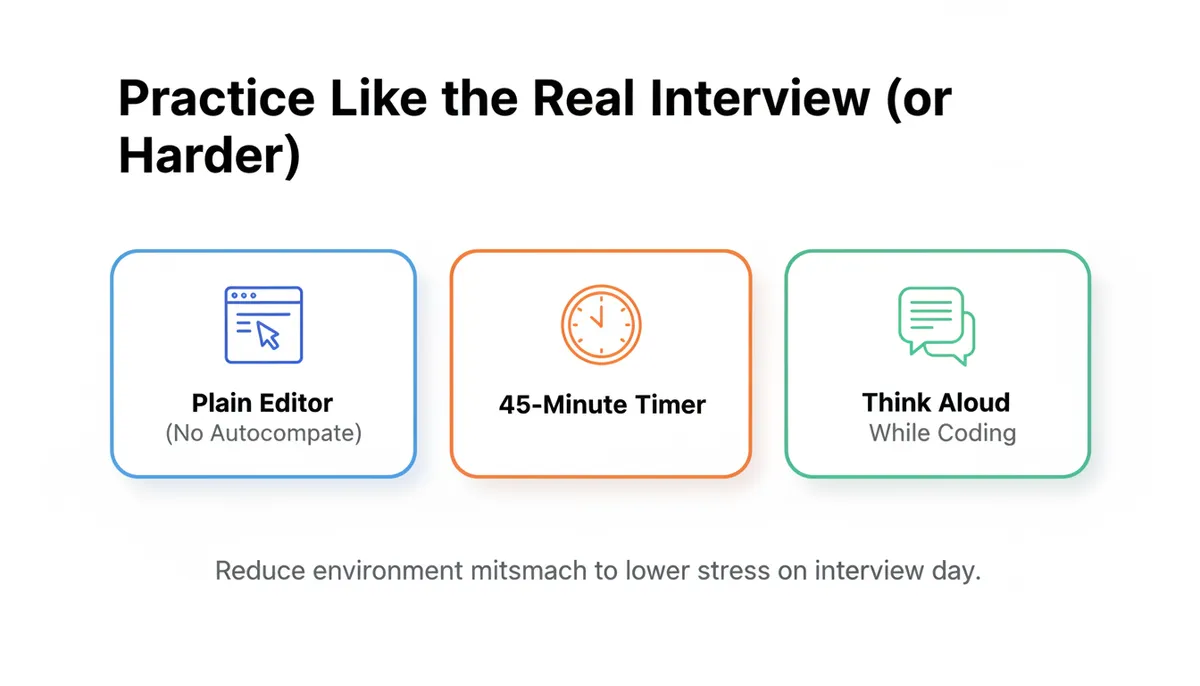
5.3 Practice in a “Worse” Environment Than the Interview
To reduce environment shock:
- Use a plain text editor (no autocomplete, no linting).
- Set a 30–45 minute timer per problem.
- Verbally explain your thought process as you code.
- Limit how often you run the code.
This makes the real interview feel like a milder version of your practice, not a harsher one.
5.4 Build Depth in Core Data Structures and Algorithms
Instead of skimming many topics, go deep on the fundamentals:
- Arrays, strings, hash maps, sets.
- Linked lists, stacks, queues.
- Trees (especially binary trees, BSTs).
- Graphs (BFS, DFS, shortest path basics).
- Heaps / priority queues.
- Basic dynamic programming (1D, 2D, subsequences).
For each:
- Implement from scratch at least once.
- Know typical operations and their complexities.
- Be able to explain when you’d choose it and why.
Depth in fundamentals beats shallow exposure to advanced topics.
5.5 Systematically Improve Communication
Communication is a skill you can train:
- Record yourself solving a problem out loud.
- Watch the recording and note:
- Long silences.
- Unclear explanations.
- Jargon without definitions.
- Practice replacing “uh, I don’t know” with:
- “Here’s my current thinking…”
- “I see two possible approaches; let me compare them.”
A simple heuristic: if someone only heard your audio (no code), could they roughly follow your approach?
5.6 Use Hints Strategically
If you’re stuck:
- Summarize your current approach.
- Identify what’s blocking you.
- Ask for a targeted hint:
- “I’m considering BFS vs. DFS here but not sure which fits better. Any guidance?”
- “I feel this might be a DP problem, but I’m struggling to define the state. Is that the right direction?”
This shows self-awareness and collaborative thinking.
5.7 Develop a Time Management Mental Model
Before each interview, remind yourself:
- “I’ll spend at most 10 minutes without a clear approach before I ask for a hint.”
- “I’ll leave at least 10 minutes for testing and edge cases.”
- “If I realize my approach is too slow (e.g., O(n²) for n = 10^5), I’ll explicitly say so and pivot.”
Interviewers appreciate candidates who can course-correct and manage time visibly.
6. Putting It All Together: A Sample Interview Flow
Here’s what a strong 45-minute coding interview might look like:
-
0–5 min: Problem Understanding
- Restate problem.
- Ask clarifying questions.
- Confirm input/output formats and constraints.
-
5–10 min: Approach Discussion
- Propose brute force.
- Identify complexity issues.
- Propose optimized approach.
- Verify with interviewer.
-
10–30 min: Implementation
- Outline function structure.
- Implement step by step, narrating key decisions.
- Keep code clean and readable.
-
30–40 min: Testing & Debugging
- Test with:
- Simple case.
- Edge cases (empty, single element, max size).
- Corner cases (duplicates, negative numbers, etc.).
- Fix bugs methodically, explaining thought process.
- Test with:
-
40–45 min: Wrap-Up
- State time and space complexity.
- Mention possible optimizations or trade-offs.
- Ask if they’d like to explore variations.
This structure directly addresses many of the failure modes we covered.
7. Key Takeaways
Why do most candidates fail technical interviews, even after months of preparation?
- They optimize for problem count, not interview realism.
- They memorize solutions instead of training pattern recognition and problem decomposition.
- They underinvest in communication, testing, and time management.
- They practice in comfortable environments that don’t match actual interview conditions.
To improve your odds:
- Simulate full interviews, not just coding sessions.
- Organize your learning around patterns and fundamentals.
- Practice in a constrained environment and think aloud.
- Treat hints, questions, and discussion as part of the evaluation, not detours.
Interview performance is a skill. With deliberate, structured practice that mirrors real conditions, you can close the gap between “months of prep” and consistent, reliable performance when it counts.